For years, building production generative AI meant defaulting to OpenAI's API endpoints like gpt-4o and gpt-4o-mini. However, in 2026, relying solely on a single proprietary API provider has become a critical engineering liability. Crushing enterprise token costs, opaque rate limit throttling, unpredictable latency jitter, and strict data sovereignty mandates have pushed engineering teams to adopt high-performance, cost-effective alternatives across the modern Large Language Models (LLMs) landscape.
Whether you need a 95% cost reduction for high-volume background data processing, sub-100ms time-to-first-token (TTFT) for conversational voice agents, open-weights deployment for on-premise compliance, or superior multi-file refactoring inside modern AI coding assistants, the 2026 AI developer landscape has matured rapidly.
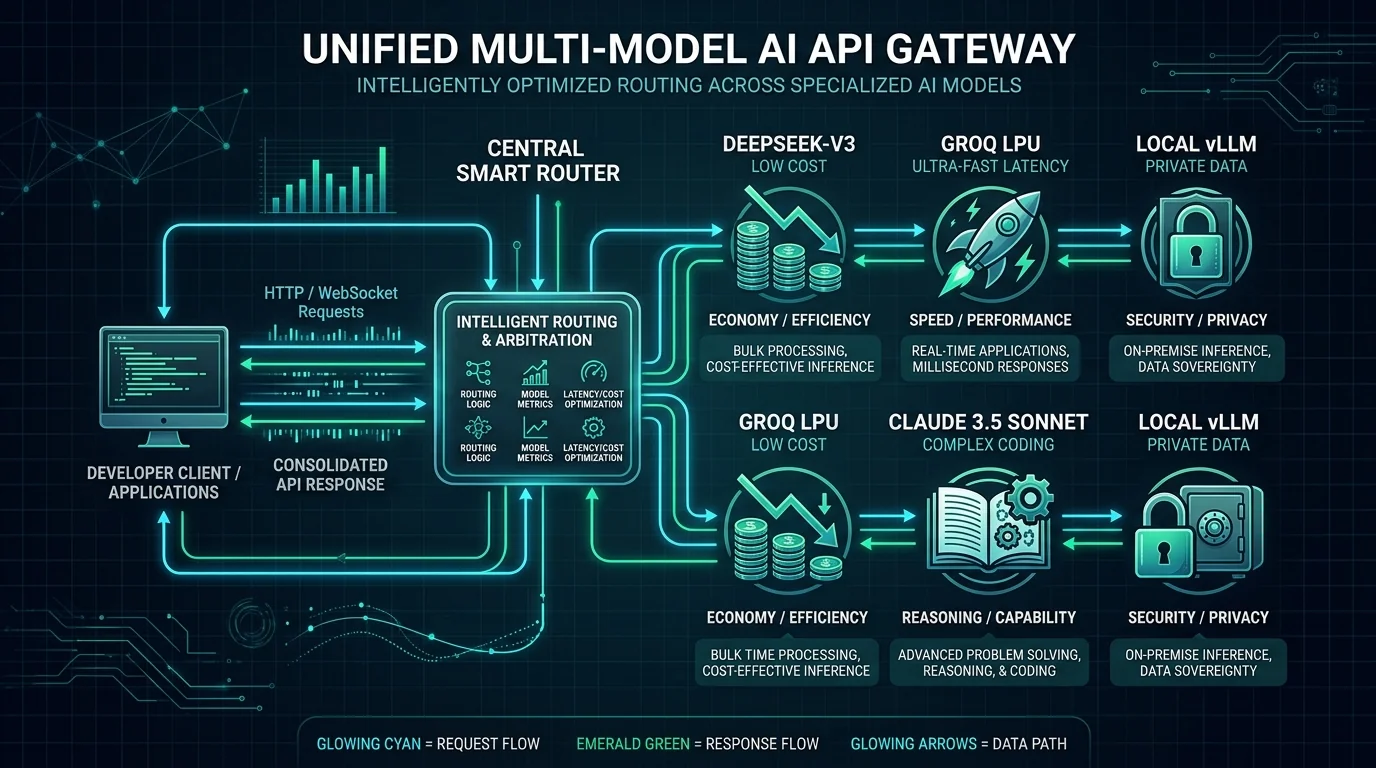
In 2026, building on the OpenAI API alone is an unnecessary margin drain and architectural single point of failure. The optimal multi-model strategy pairs specialized inference engines with low-cost reasoning backends:
In this technical guide, we break down the Top 8 OpenAI API alternatives for software engineers, comparing per-token economics, inference latency benchmarks, context limits, and drop-in integration patterns to supercharge your AI productivity workflows.
Why Developers Are Diversifying Away from the OpenAI API in 2026

Before analyzing individual alternatives, it is crucial to understand the architectural forces driving this multi-model shift:
- The Economic Chasm (10x to 20x Price Differences): Proprietary frontier models like ChatGPT
gpt-4ocost $2.50 per 1M input tokens and $10.00 per 1M output tokens. Meanwhile, state-of-the-art open-weights models like DeepSeek-V3 deliver comparable or superior benchmark performance at $0.14 input and $0.28 output per 1M tokens. For startups scaling AI automation pipelines, this represents tens of thousands of dollars in monthly infrastructure savings. - Latency Jitter vs. Specialized Inference Hardware: General-purpose GPU clouds frequently suffer from queuing latency during peak traffic hours. Dedicated inference engine providers like Groq, powered by custom LPUs, stream responses at 500–800 tokens per second, transforming user experience in real-time developer tooling and voice assistants.
- Data Privacy & Air-Gapped Deployments: Regulated enterprises in finance, healthcare, and defense cannot send proprietary codebases or PII to third-party endpoints. Self-hosted runtimes allow teams to run flagship open models on their own private infrastructure with zero telemetry leakage.
- Vendor Lock-in and Outage Resilience: Relying on a single API endpoint creates a single point of failure. Implementing a multi-model routing layer with automatic failover—similar to patterns explored in our Ultimate Guide to AI Productivity Tools—ensures 99.99% uptime for mission-critical production services.
OpenAI API Alternatives: 2026 Benchmark & Pricing Comparison Matrix
The table below summarizes the key technical specifications, per-token pricing (USD per 1 Million Tokens), throughput speed, and ideal use cases across all 8 providers compared to baseline OpenAI API tiers:
| Provider / Model | Model Architecture | Input Cost (per 1M) | Output Cost (per 1M) | Inference Speed (TPS) | Context Window | Best Engineering Use Case |
|---|---|---|---|---|---|---|
| OpenAI (GPT-4o) [Baseline] | Proprietary Dense/MoE | $2.50 | $10.00 | ~60–90 tps | 128k Tokens | General Multimodal & Ecosystem Native |
| 1. DeepSeek (V3 / R1) | Open-Weights MoE (671B / 37B active) | $0.14 94% Cheaper | $0.28 97% Cheaper | ~75–120 tps | 64k–128k Tokens | High-Volume ETL, Deep Reasoning & Complex Math/Code |
| 2. Anthropic (Claude 3.5 / 3.7 Sonnet) | Proprietary Transformer | $3.00 ($0.30 cached) | $15.00 | ~80–110 tps | 200k Tokens | Complex Codebases, Agentic Tool Use & Computer Control |
| 3. Mistral AI (Large 2 / Codestral) | Open-Weights & Managed API | $2.00 / $0.30 | $6.00 / $0.90 | ~90–140 tps | 128k / 256k Tokens | European GDPR Sovereignty & Dedicated Code Completion |
| 4. Groq (LPU Inference Engine) | Custom Tensor Streaming Processor (LPU) | $0.59 (Llama 3.3 70B) | $0.79 | 550–800 tps Fastest | 128k Tokens | Real-Time Conversational Voice AI & Sub-Second Autocomplete |
| 5. OpenRouter (Unified API Gateway) | Multi-Provider Smart Router | Provider Pass-through | Provider Pass-through | Dynamic (Fastest Provider) | Up to 2M Tokens | Zero-Lockin Multi-Model Fallback & Dynamic Cost Optimization |
| 6. Together AI / Replicate | Optimized Serverless GPU Cloud | $0.88 (Llama 3.3 70B) | $0.88 | ~150–220 tps | 128k Tokens | Fine-Tuned LoRA Serving & Speculative Decoding |
| 7. Ollama + vLLM (Self-Hosted) | Self-Managed GPU Hardware | $0.00 / Token (Hardware Only) | $0.00 / Token | Hardware Dependent | Configurable | Air-Gapped Privacy, Zero-Leakage PII & Offline Edge Nodes |
| 8. Google Gemini (2.0 Flash / Pro) | Native Multimodal Sparse Architecture | $0.10 / $1.25 | $0.40 / $5.00 | ~130–180 tps | 2,000,000 Tokens | Massive Document Search, Video Understanding & Live Grounding |
Deep-Dive: The Top 8 OpenAI API Alternatives
1. DeepSeek-V3 & DeepSeek-R1 API
The Disruption: DeepSeek has fundamentally rewritten the economics of frontier AI. Utilizing an innovative Multi-Head Latent Attention (MLA) and Mixture-of-Experts (MoE) architecture with 671 billion total parameters (activating only 37 billion per token), DeepSeek-V3 matches gpt-4o across SWE-bench and coding benchmarks at a fraction of the hardware cost.
Key Developer Strengths:
- Unprecedented Economics: At $0.14 per 1M input tokens and $0.28 per 1M output tokens, you can run roughly 18 full requests on DeepSeek for the cost of a single query on OpenAI's standard endpoints.
- Drop-in OpenAI SDK Compatibility: DeepSeek’s cloud API exposes an identical endpoint format (
/chat/completions). You simply replace thebase_urlin your existing client without rewriting application schemas. - R1 Reasoning Capabilities: DeepSeek-R1 provides native chain-of-thought mathematical reasoning, rivaling OpenAI’s
o1series for automated unit test generation, complex algorithm synthesis, and structured code verification.
When to use: High-throughput batch processing, content synthesis pipelines, code analysis in AI code generation tools, and cost-constrained production services.
2. Anthropic Claude 3.5 Sonnet & Claude 3.7 Sonnet API
The Developer Gold Standard: Anthropic’s Claude models remain the undisputed leader for serious software engineering tasks. While slightly more expensive on raw output than GPT-4o, Claude’s architectural discipline in adhering to complex system prompts and executing tool calls without hallucination makes it the primary engine behind next-gen developer environments like Cursor, Claude Code, and CodeRabbit.
Key Developer Strengths:
- Prompt Caching (90% Cost & 80% Latency Reduction): Anthropic allows you to cache recurring system prompts, codebase indexes, and documentation chunks. Cached input tokens drop from $3.00 down to $0.30 per 1M tokens.
- Superior Multi-File Refactoring: Claude excels at large architectural refactors, generating precise git patches without drifting off-spec. Discover how top dev teams configure this in our review of Top AI Workflow Automation Tools.
- Computer Use & Precise Structured Outputs: Native tool-calling schemas reliably return strict JSON matching your TypeScript interfaces.
When to use: Autonomous coding agents, complex IDE extensions, multi-step workflow automation, and mission-critical logic validation alongside tools like GitHub Copilot and Augment Code.
3. Mistral AI (Mistral Large 2 & Codestral API)
The European Open Frontier: Mistral AI has positioned itself as the enterprise standard for data sovereignty and transparent model governance. Through "La Plateforme" or self-hosted deployment on cloud VPCs like Google Cloud Vertex AI, Mistral provides high-tier reasoning with full EU AI Act compliance.
Key Developer Strengths:
- Codestral (Fill-in-the-Middle Specialization): Codestral is trained specifically for code generation with native Fill-in-the-Middle (FIM) support, making it exceptional for low-latency IDE tab autocompletion in Codeium and custom editor plugins.
- Flexible Licensing & Weights: Access model weights to run privately within your own Kubernetes clusters while utilizing managed APIs for cloud bursts.
- Multi-Language Fluency: Superior performance across multilingual European contexts and multilingual programming languages.
When to use: EU-based enterprise deployments, automated code linting pipelines, and hybrid cloud architectures looking for a sovereign alternative to OpenAI Codex.
4. Groq LPU Inference Engine

Unmatched Speed (500–800 Tokens/sec): Groq did not build another LLM; they engineered custom silicon—the Language Processing Unit (LPU)—specifically designed for sequential token generation. Hosting open-weights models like Llama 3.3 70B, Mixtral 8x7B, and DeepSeek-R1-Distill, Groq achieves speeds that render traditional GPU clusters obsolete for latency-critical tasks.
Key Developer Strengths:
- Instantaneous TTFT: Time-to-first-token is frequently under 150 milliseconds.
- High-Speed Streaming: Streams full responses at over 500 tokens per second, enabling conversational voice agents where user pauses feel completely natural.
- OpenAI Compatible REST API: Integrates directly with existing LangChain, LlamaIndex, or n8n workflow automations (see our detailed Zapier vs Make vs n8n Pricing Breakdown).
When to use: Real-time voice agents, interactive terminal CLI tools, live meeting transcription summarization, and interactive debugging assistants.
5. OpenRouter (Unified Multi-Model Gateway)
The Zero-Lockin Architecture: OpenRouter serves as an intelligent routing proxy across 200+ commercial and open-weights models. Instead of managing separate accounts and API keys with OpenAI, Anthropic, DeepSeek, and Mistral, developers integrate a single OpenAI-compatible client.
Key Developer Strengths:
- Automatic Failover & Fallback: If OpenAI returns a
429 Rate Limitor500 Internal Server Error, OpenRouter instantly re-routes the prompt to Claude 3.5 Sonnet or DeepSeek without client interruption. - Dynamic Provider Price Arbitrage: OpenRouter automatically directs requests to the cheapest available host offering the target model.
- Unified Usage & Cost Dashboard: Track developer token spend and rate limits across multiple teams from a single interface.
When to use: Production SaaS platforms requiring 99.99% uptime, multi-tenant AI backends, and rapid prototyping across our full catalog of AI Tools & Directories.
6. Together AI & Replicate
Enterprise Serverless Open-Source Inference: Together AI and Replicate specialize in highly optimized GPU virtualization for open-source AI. Using proprietary memory optimization (FlashAttention-3, speculative decoding, and custom CUDA kernels), they serve models like Llama 3.3 70B and Qwen 2.5 Coder at speeds 3x faster than vanilla Hugging Face deployments.
Key Developer Strengths:
- Custom LoRA Adapter Serving: Hot-swap fine-tuned domain LoRA adapters on top of shared base models without dedicated GPU provisioning costs.
- Speculative Decoding: Accelerates large model generation by using smaller draft models to verify tokens in parallel.
- Dedicated Private Endpoints: Seamlessly transition from pay-per-token serverless to reserved GPU instances as your traffic scales.
When to use: Fine-tuned enterprise applications, domain-specific legal/medical tooling, and high-concurrency API backends.
7. Self-Hosted Ollama & vLLM Clusters
Absolute Data Sovereignty & Zero-Token Cost: For teams operating private data centers or secure cloud VPCs, self-hosting open-weights models using vLLM (for production API clusters) or Ollama (for local developer environments) eliminates third-party dependencies entirely.
Key Developer Strengths:
- Zero Per-Token Charges: Run millions of batch inferences with zero marginal cost beyond baseline compute and electricity.
- Air-Gapped Security: Sensitive customer records, health data, and proprietary intellectual property never leave your private VPC.
- Continuous High-Throughput (PagedAttention): vLLM optimizes GPU VRAM allocation, achieving massive request concurrency on NVIDIA A100/H100 and AMD MI300X clusters.
When to use: On-premise enterprise deployments, HIPAA/SOC-2 compliance environments, and offline edge computing solutions.
8. Google Gemini 2.0 Flash & Pro API
Massive 2M Context Window & Multimodal Native: Google’s Gemini 2.0 API series offers unmatched context handling. Capable of processing up to 2 million tokens in a single prompt (equivalent to ~1.5 million words or 2 hours of raw video), Gemini Flash 2.0 combines extreme speed with industry-low pricing ($0.10 input per 1M tokens), powering innovative research tools like Google NotebookLM (read our complete NotebookLM Review & Features Breakdown).
Key Developer Strengths:
- Massive Context Retrieval: Query entire GitHub repositories, multi-hour video recordings, or entire compliance libraries without complex RAG chunking pipelines.
- Native Google Search Grounding: Integrate real-time web verification directly into API responses with a single toggle.
- Audio & Video Ingestion: Ingest raw video and audio streams natively without separate transcription pre-processing steps.
When to use: Deep codebase analysis, long-form document RAG, multimodal video applications, and high-speed web-grounded research assistants.
Implementation: Writing a Drop-in Multi-Model Python Abstraction
Because most major providers adopt OpenAI's standard REST schema, you can build a resilient, multi-provider abstraction layer in Python using only the official openai SDK:
import os
from typing import Optional, Dict, Any
from openai import OpenAI

class MultiModelAIClient:
    """
    Drop-in unified client supporting OpenAI, DeepSeek, Groq, and OpenRouter
    with zero breaking changes to existing codebase logic.
    """
    def __init__(self):
        # Configure Provider Endpoints
        self.providers = {
            "openai": {
                "base_url": "https://api.openai.com/v1",
                "api_key": os.getenv("OPENAI_API_KEY"),
                "default_model": "gpt-4o"
            },
            "deepseek": {
                "base_url": "https://api.deepseek.com/v1",
                "api_key": os.getenv("DEEPSEEK_API_KEY"),
                "default_model": "deepseek-chat"
            },
            "groq": {
                "base_url": "https://api.groq.com/openai/v1",
                "api_key": os.getenv("GROQ_API_KEY"),
                "default_model": "llama-3.3-70b-versatile"
            },
            "openrouter": {
                "base_url": "https://openrouter.ai/api/v1",
                "api_key": os.getenv("OPENROUTER_API_KEY"),
                "default_model": "anthropic/claude-3.5-sonnet"
            }
        }

    def get_client(self, provider: str = "deepseek") -> tuple[OpenAI, str]:
        config = self.providers.get(provider, self.providers["deepseek"])
        client = OpenAI(
            base_url=config["base_url"],
            api_key=config["api_key"]
        )
        return client, config["default_model"]

    def generate_completion(
        self,
        prompt: str,
        system_prompt: str = "You are an expert software engineer.",
        provider: str = "deepseek",
        model: Optional[str] = None
    ) -> str:
        client, default_model = self.get_client(provider)
        target_model = model or default_model

        try:
            response = client.chat.completions.create(
                model=target_model,
                messages=[
                    {"role": "system", "content": system_prompt},
                    {"role": "user", "content": prompt}
                ],
                temperature=0.2
            )
            return response.choices[0].message.content
        except Exception as e:
            # Fallback to OpenRouter if primary provider fails
            if provider != "openrouter":
                print(f"[Warning] {provider} failed: {e}. Falling back to OpenRouter...")
                return self.generate_completion(prompt, system_prompt, provider="openrouter")
            raise e

# Usage Example:
if __name__ == "__main__":
    ai = MultiModelAIClient()

    # 1. Cost-optimized high-volume coding task (DeepSeek)
    print("--- DeepSeek-V3 Output ---")
    code_review = ai.generate_completion(
        "Refactor this SQL query for indexing performance: SELECT * FROM orders WHERE status='paid';",
        provider="deepseek"
    )
    print(code_review)

    # 2. Ultra-low latency conversational query (Groq)
    print("\n--- Groq LPU Output ---")
    fast_response = ai.generate_completion(
        "Explain Redis caching strategies in 3 bullet points.",
        provider="groq"
    )
    print(fast_response)
Architectural Decision Matrix: Which Provider Should You Choose?
To help you select the optimal backend for your specific architectural tier:
- If your #1 priority is lowering AWS/API bills: Migrate bulk processing and internal workflows to DeepSeek-V3 or Gemini 2.0 Flash for an immediate 90%+ cost reduction.
- If your #1 priority is sub-second latency (voice, live autocomplete): Deploy on Groq LPU with Llama 3.3 70B.
- If your #1 priority is complex codebase refactoring and autonomous agents: Standardize on Anthropic Claude 3.5 Sonnet using prompt caching in editors like Cursor.
- If your #1 priority is zero downtime and automatic model failover: Implement an API proxy via OpenRouter or automate tasks through tools like Make and Zapier (explore our No-Code AI Automation Blueprint).
- If your #1 priority is strict data compliance and air-gapped security: Self-host open-weights models on vLLM inside your own VPC.
Related Developer & AI Automation Guides
Deepen your technical architecture with our hands-on engineering breakdowns and comparison matrices:
- How to Automate Your Entire Work Life with AI (Zero Coding Required) — Master end-to-end automation with Make, Zapier, and LLM webhooks.
- The Ultimate Guide to AI Productivity Tools in 2026 — Complete ecosystem overview for developers and knowledge workers.
- Zapier vs Make vs n8n: 2026 Pricing & Enterprise Architecture Comparison — Detailed cost-per-execution breakdown.
- Explore AI Coding Assistants Directory — Browse verified developer tools, IDE extensions, and benchmark scores.
Frequently Asked Questions
What is the cheapest high-speed OpenAI API alternative for developers?
DeepSeek V3 and Groq LPU (Llama 3.3 70B) offer the strongest cost-to-performance ratio in 2026. DeepSeek-V3 slashes inference costs by 94% ($0.14 input / $0.28 output per 1M tokens) compared to GPT-4o while matching benchmark performance on HumanEval and SWE-bench. For ultra-low latency voice agents and code autocomplete, Groq provides unmatched 500–800 tokens/second streaming throughput.
Are OpenAI API alternatives drop-in compatible with the official OpenAI SDK?
Yes, most leading inference providers expose OpenAI-compatible REST endpoints (/chat/completions). In Python, TypeScript, Go, or Ruby, you can continue using the official OpenAI API client SDK without rewriting application logic. Simply override base_url (e.g. https://api.deepseek.com, https://api.groq.com/openai/v1, or https://openrouter.ai/api/v1) and provide the respective provider's API key.
How does Prompt Caching reduce token costs on Claude 3.5 Sonnet and DeepSeek?
Prompt Caching stores parsed Key-Value (KV) attention states across repeated calls. When your application sends repeated system prompts, large API documentation schemas, or repository codebases, the model reuses pre-computed KV-caches. This delivers up to a 90% discount on cached input tokens and cuts time-to-first-token (TTFT) latency by up to 80% on providers like Anthropic Claude and DeepSeek.
What are the best self-hosted alternatives to the OpenAI API for private data?
Ollama and vLLM are the leading self-hosted inference runtimes for open-weights models. They allow engineering teams to serve state-of-the-art models (like Llama 3.3, DeepSeek-Coder, and Qwen 2.5) on local MacBooks, private AWS EC2 GPU instances, or air-gapped on-premise servers with zero PII leakage, zero telemetry, and predictable zero per-token inference fees.
How do I prevent vendor lock-in and build resilient multi-model failover?
Implement a multi-model gateway layer using OpenRouter, LiteLLM, or custom Python wrapper classes. By standardizing request payloads into structured JSON schemas and configuring automatic fallback routes (e.g., trying DeepSeek first, then falling back to Groq or Google Gemini API on 5xx errors or rate limits), your production architecture achieves 99.99% operational uptime.
Which OpenAI API alternative is best for automated workflows and no-code tools?
Make and Zapier offer native integrations with Claude, Google Gemini, and Mistral AI. If you are building automated pipelines without writing custom backend code, you can route tasks between models based on document length, cost requirements, and task complexity (see our No-Code AI Automation Guide).