Anyone who has spent a weekend staring down a 140-page federal RFP or a foundation grant portal with brutal 500-character text limits knows the particular exhaustion of proposal writing. You hunt through disjointed Google Docs from three years ago, copy-paste budget narratives from past 990 tax forms, manually verify whether your key personnel bios match current certifications, and pray that a missed compliance checkbox doesn't trigger an automatic disqualification before an evaluator even reads your executive summary.
In 2026, general-purpose LLMs like ChatGPT or Claude can draft generic persuasive prose, but they collapse when applied to professional bids. A generic prompt cannot cross-reference federal acquisition regulations (FAR/DFARS), parse a multi-tabbed Excel pricing sheet, verify that your proposed direct labor rates match your approved indirect cost rate agreement, or securely retrieve your organization's exact win themes without leaking proprietary IP. Specialized AI grant writing tools and RFP proposal software solve this through Retrieval-Augmented Generation (RAG) wired to approved past proposals, automated compliance matrix shredding, and institutional knowledge verification.
Over the past four months, our team benchmarked seven leading platforms across non-profit foundation grants, state educational tenders, enterprise SaaS security questionnaires, and multi-million-dollar government bids. Below is our unfiltered practitioner breakdown of the 7 best AI grant writing tools and RFP software suites in 2026, comparing proposal win rates, hallucination safeguards, and real-world pricing models.
⚡ At-a-Glance: Which AI Proposal Tool Should You Choose in 2026?
- Best Overall for Non-Profits & Grant Writers: Grantable leads for 501(c)(3) organizations and grant consultants. Its workspace-wide pricing (no per-seat penalties), past proposal knowledge base, and strict character/word count guardrails make it the most practical grant drafting copilot.
- Best for Enterprise Gov Bids & Multi-Million Tenders: AutogenAI is unmatched for defense contractors, infrastructure bidders, and complex public sector bids. Its specialized language engines cut bid drafting times by 70% while enforcing stringent data sovereignty.
- Best for B2B RFP Response & Questionnaire Automation: Loopio excels for sales engineering and proposal teams handling high-volume RFPs, DDQs, and vendor security questionnaires from an automated answer library.
- Best Enterprise Strategic Response & Tender Shredding: Responsive (formerly RFPIO) provides the most robust tender shredder, converting massive multi-hundred-page RFP specifications into tracked compliance matrices.
- Best All-in-One Grant Research & Funder Discovery: Instrumentl combines active RFP tracking, Form 990 intelligence, deadline management, and AI drafting for non-profits with active fundraising pipelines.
- Best Lightweight Copy Generator for Small Non-Profits: Fundwriter AI offers budget-conscious fundraisers template-guided LOIs, donor appeals, and grant narrative drafts starting at just $29/month.
- Best Interactive B2B Proposals & Dynamic Pricing: Qwilr replaces static PDF bids with interactive web proposals featuring dynamic CPQ pricing tables, e-signatures, and buyer viewing telemetry.
Quick Comparison: The 7 Best AI Grant Writing & RFP Software Platforms
The table below summarizes key operational metrics across all seven platforms, including compliance capabilities, primary target audiences, trial availability, and verified starting prices:
| Platform | Best For | Core AI Capability | Compliance / RAG Model | Trial / Free Tier | Starting Price |
|---|---|---|---|---|---|
| Grantable | Non-Profits & Grant Writers | Past Proposal RAG & Word Limit Guard | Internal Document Vault | Free Tier ($0) | $0 / $50/mo Workspace |
| AutogenAI | Gov & Defense Contractors | Proprietary Bid Language Engine | Zero-Retention Enterprise RAG | Demo on Request | Custom Enterprise Quote |
| Loopio | B2B Sales & Security Teams | Loopio AI Questionnaire Assistant | Automated Content Library | Demo on Request | Custom Quote (Tiered) |
| Responsive | Enterprise Strategic Response | AI Response Studio & Document Shredder | Automated Compliance Matrix | Demo on Request | From $10,000/yr Platform Fee |
| Instrumentl | Grant Prospecting & Full Lifecycle | AI Grant Matcher & Award Assistant | Form 990 & Funder Database | 14-Day Free Trial | $299/mo (Annual) |
| Fundwriter AI | Small Non-Profit Fundraisers | 30+ Guided Fundraising Templates | Template-Driven Prompts | 7-Day Free Trial | $22/mo (Annual) / $29/mo |
| Qwilr | Interactive B2B Sales Proposals | Smart Proposal AI & Dynamic CPQ Tables | CRM Data Sync (HubSpot/SFDC) | 14-Day Free Trial | $35/user/mo (Annual) |
In-Depth Reviews: The 7 Best AI Grant Writing & RFP Proposal Tools
Each platform below was evaluated on live tender documents, complex grant application questionnaires, and historical proposal archives. Here is how each tool performed under rigorous practical conditions.
1. Grantable — Best Dedicated AI Grant Writing Assistant for Non-Profits
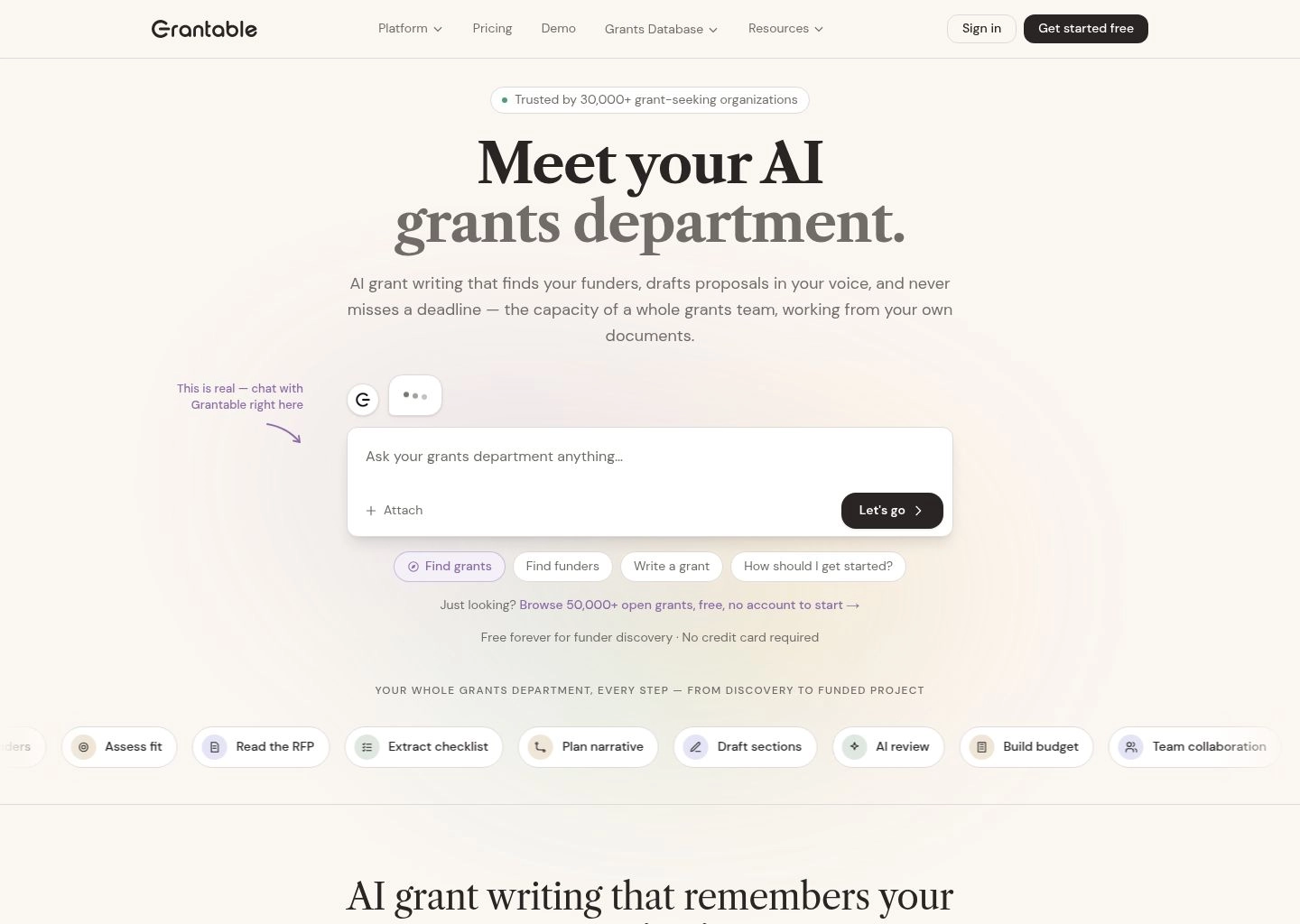
Grantable is designed specifically around the daily realities of non-profit development directors, grant managers, and academic researchers. While commercial sales tools treat proposals as sales pipelines, Grantable recognizes that non-profit grant applications require strict adherence to funder prompts, mission-aligned storytelling, and unforgiving character constraints.
The core engine of Grantable centers on its Content Vault. Organizations upload previous winning grant applications, annual reports, strategic plans, letters of recommendation, and Form 990 filings. When you paste an RFP question—such as "Describe your organization's methodology for evaluating post-program recidivism (Max 250 words)"—Grantable's AI retrieves exact paragraphs from your approved materials, synthesizes a targeted response in your organization's genuine voice, and strictly enforces the word limit. Unlike general AI editors that require endless re-prompting to cut 40 words, Grantable hits exact targets on the first generation.
Pros & Key Strengths
- • No Per-Seat Billing Penalties: Workspace plans cover entire teams and external grant consultants without charging extra per user.
- • Strict Character & Word Limit Guards: Formulates answers that adhere precisely to rigid foundation application boundaries.
- • Past-Proposal Source Citations: Displays which previous grant documents informed each generated paragraph.
- • Funder Prospecting Workspaces: Organize drafts, funder profiles, and submission dates in collaborative boards.
Cons & Limitations
- • Free tier is restricted to 5 AI chat messages per day with limited document storage.
- • Does not include federal grant discovery databases (e.g., Grants.gov search) out of the box.
Pricing: Grantable charges by workspace rather than per seat. The Free tier costs $0 and includes 5 daily chat prompts and basic document uploads. The Starter tier is listed at $50/month with unlimited chat and standard storage, while the Pro tier ($150/month) unlocks advanced model access, expanded document vaulting, and multi-team collaboration. Check out our verified Grantable directory profile for updated terms, and browse our guide to AI Writing Tools.
2. AutogenAI — Best Enterprise AI Proposal Platform for Government Contractors
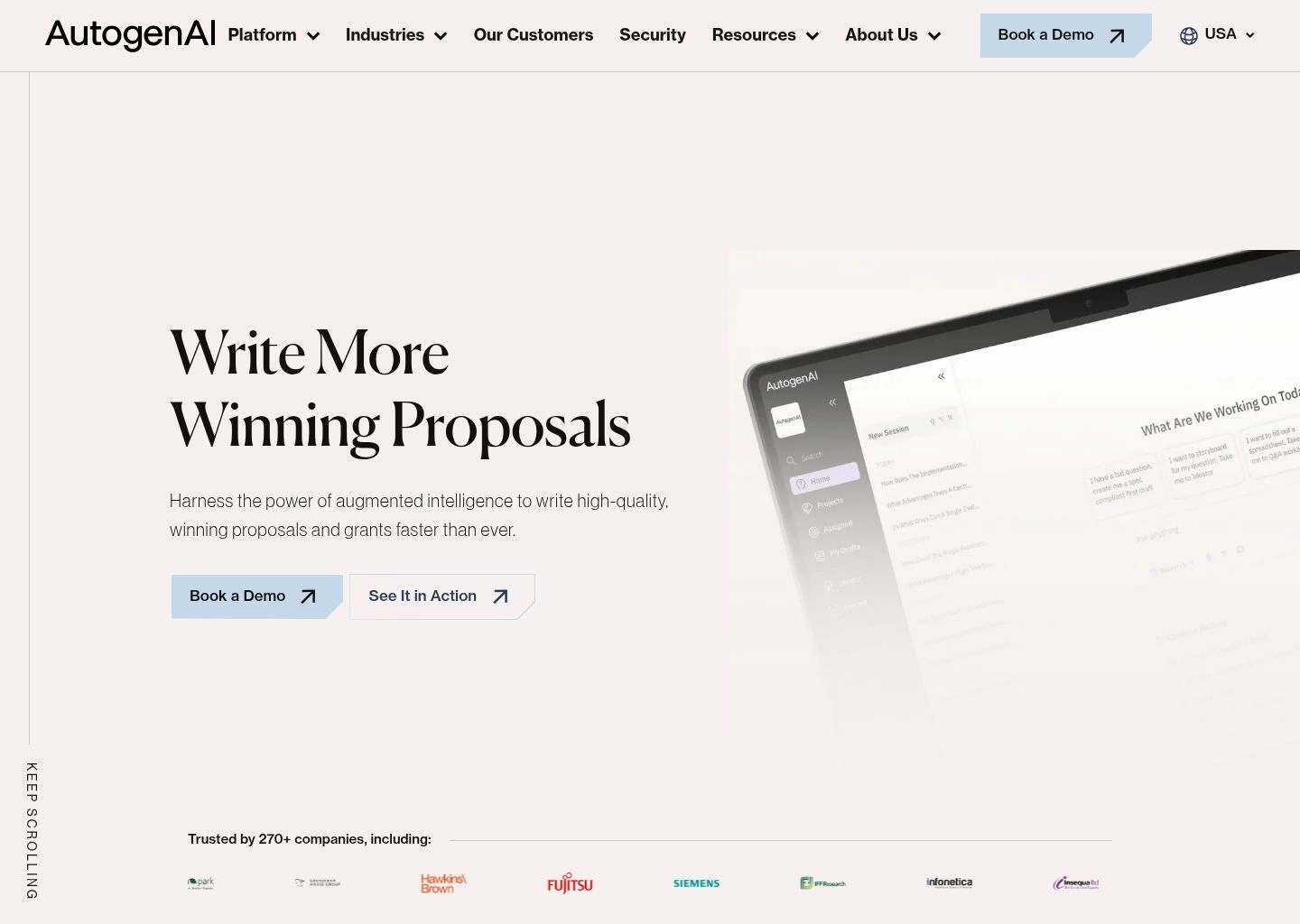
AutogenAI is built for the high-stakes world of public sector procurement, municipal infrastructure bids, healthcare tenders, and multi-billion-dollar defense contracting. In these sectors, a proposal is not a pitch deck; it is a legally binding compliance submission often exceeding 500 pages with hundreds of mandatory technical evaluations.
What separates AutogenAI from conventional tools is its proprietary Bid Engine Architecture. Rather than running a vanilla prompt through a public API, AutogenAI uses fine-tuned models trained on procurement terminology, win-loss retrospectives, and compliance frameworks. The software features dedicated micro-engines: a Compliance Shaper that aligns prose to scoring rubrics, an Evidence Extractor that pulls verifiable case studies from historical corporate knowledge, and a Win-Theme Weaver that injects strategic discriminators throughout the technical proposal. Enterprise bid teams report shaving 70% off initial drafting cycles, enabling teams to respond to double the tender volume with existing headcount.
Pros & Key Strengths
- • Proven Bid Cycle Compression: Accelerates complex technical response drafts by up to 70% without sacrificing quality.
- • Enterprise Data Sovereignty: Zero-retention agreements ensure customer proprietary bid strategies are never used to train global LLMs.
- • Procurement-Specific Logic Engines: Structures technical narratives according to public sector scoring methodologies.
- • Multi-Language Government Support: Generates compliant public tenders across North America, Europe, and Australia.
Cons & Limitations
- • Sales-led quote pricing with enterprise annual commitments; inaccessible for individual consultants or small non-profits.
- • Requires formal onboarding and knowledge base curation to achieve peak generation accuracy.
Pricing: AutogenAI operates on custom annual enterprise licensing tailored to organization size, bid volume, and security requirements. Pricing is quote-only and requires a product demonstration. Explore our complete AutogenAI enterprise breakdown and see our research on Enterprise AI Platforms.
3. Loopio — Best RFP Response Management & Automated Answer Library for B2B Sales
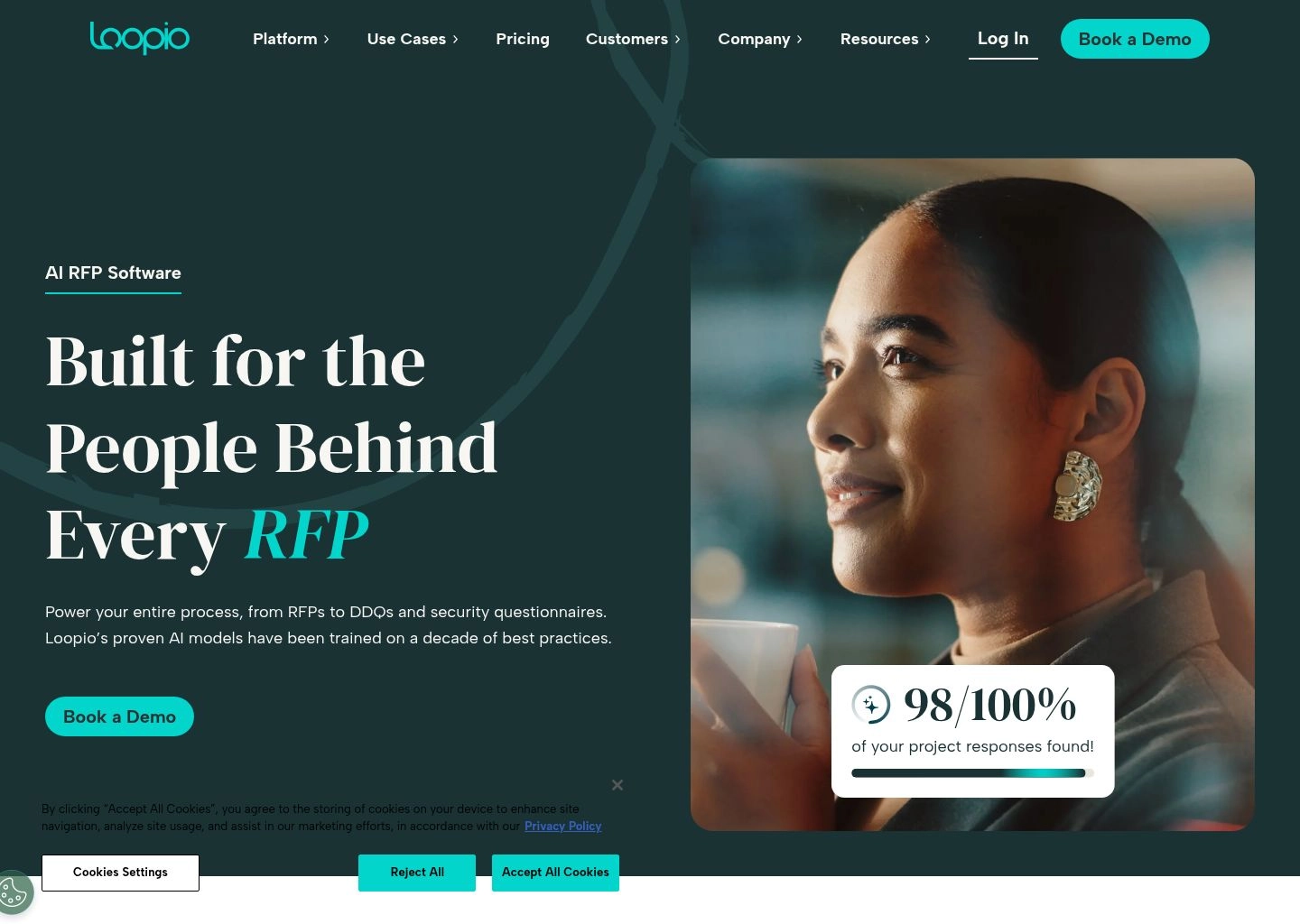
Loopio is the long-standing industry titan in Request for Proposal (RFP), Request for Information (RFI), and Due Diligence Questionnaire (DDQ) management. Trusted by global B2B revenue and security organizations like DocuSign, Sprinklr, and Qualcomm, Loopio tackles the primary bottleneck of recurring enterprise bids: finding verified, up-to-date answers to repetitive technical and operational questions.
The platform's standout capability in 2026 is Loopio AI embedded into its centralized Content Library. When a customer sends a 150-question Excel or Word security audit, Loopio's automated matcher reads each question, finds the highest-scoring approved response from your knowledge base, and auto-populates the answers. Loopio AI goes further by analyzing the context of each new questionnaire, tailoring previously approved responses to match the specific phrasing and nuances of the prospect. Crucially, Loopio includes automated content freshness workflows: subject matter experts (SMEs) are automatically pinged when technical responses exceed expiration windows, preventing the distribution of stale architecture details.
Pros & Key Strengths
- • Automated Content Freshness Reviews: Flags outdated security, compliance, and product answers automatically.
- • Multi-Format Import & Export: Flawlessly ingests and exports complex Excel tables, Word templates, and portal portals.
- • Loopio AI Assistant Included: Generative AI assistance is integrated across all tiers with admin opt-out controls.
- • Enterprise Governance & Role Delegation: Route specific sections to legal, security, or engineering with deadline tracking.
Cons & Limitations
- • Quote-only enterprise pricing; typically requires minimum annual commitments starting in the mid-four to five figures.
- • Focused primarily on structured Q&A questionnaires rather than long-form creative grant narratives.
Pricing: Loopio prices across four tiers (Starter, Plus, Advanced, Enterprise) through sales-led annual quotes. Generative AI is included in every tier. Implementation timelines typically range from 15 to 30 days depending on library size. For a full breakdown of feature tiers, see our Loopio review and specifications.
4. Responsive — Best Enterprise Strategic Response Management & Tender Shredding
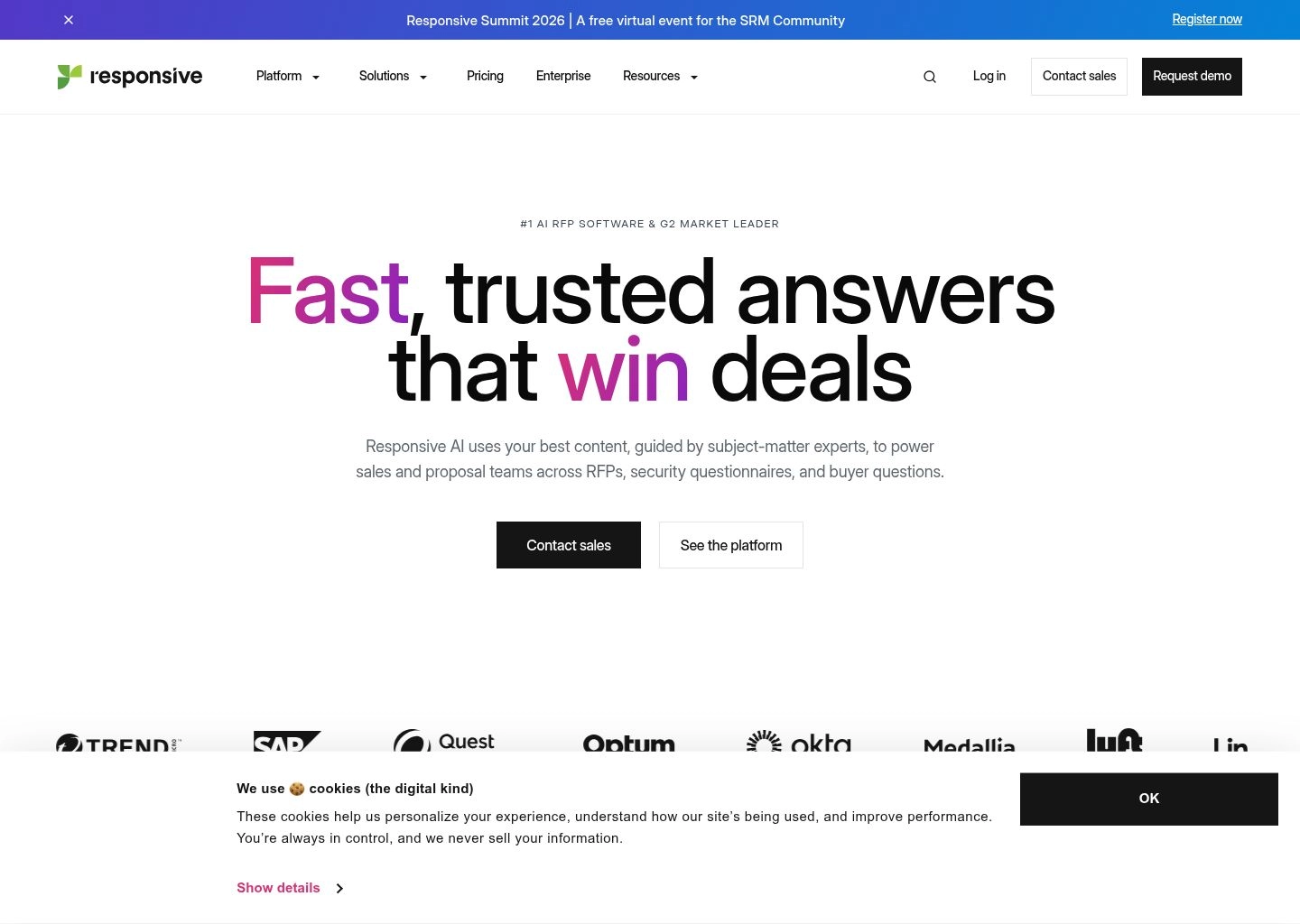
Responsive (formerly known as RFPIO) has evolved beyond pure RFP software into an enterprise-wide Strategic Response Management (SRM) suite. Used by organizations like Microsoft, Google, and Teradata, Responsive addresses the full scope of enterprise inbound inquiries: commercial proposals, public RFPs, ESG questionnaires, cybersecurity audits, and executive proactive pitches.
The flagship technological triumph of Responsive in 2026 is its AI Document Shredder and Compliance Matrix Generator. When an enterprise receives a massive 300-page government or commercial RFP PDF, Responsive shreds the document into individual requirements, categorizes mandatory vs. optional deliverables, and builds a comprehensive compliance matrix in minutes. Its AI Response Studio then pairs each requirement with relevant past submissions, suggests win themes, and highlights potential compliance risks (such as unfulfilled ISO certifications or SLA liabilities) before proposal teams commit resources to a bid.
Pros & Key Strengths
- • Market-Leading Tender Shredding: Extracts requirements and builds audit-ready compliance matrices from massive PDFs.
- • Responsive LookUp Integration: Access your entire RFP content repository directly within Salesforce, Slack, Chrome, and Outlook.
- • Extensive Enterprise Integrations: Deep bi-directional syncing with HubSpot, Microsoft Teams, Jira, and Box.
- • Transparent Base Pricing: Publishes an entry platform fee ($10,000/year for Emerging edition), providing more clarity than many enterprise competitors.
Cons & Limitations
- • Total cost scales with user licenses and professional services beyond the base platform fee.
- • Steep learning curve for small teams due to the depth of configuration options.
Pricing: Responsive structures pricing via an annual platform fee plus user licenses. The Emerging edition starts at $10,000/year and includes unlimited response projects and the AI automation studio. Growth and Enterprise tiers add custom AI configurations, eSignature, and premium deployment. Explore our verified Responsive tool directory page for detailed platform analysis.
5. Instrumentl — Best All-in-One Grant Discovery, 990 Intelligence & Proposal Tracking
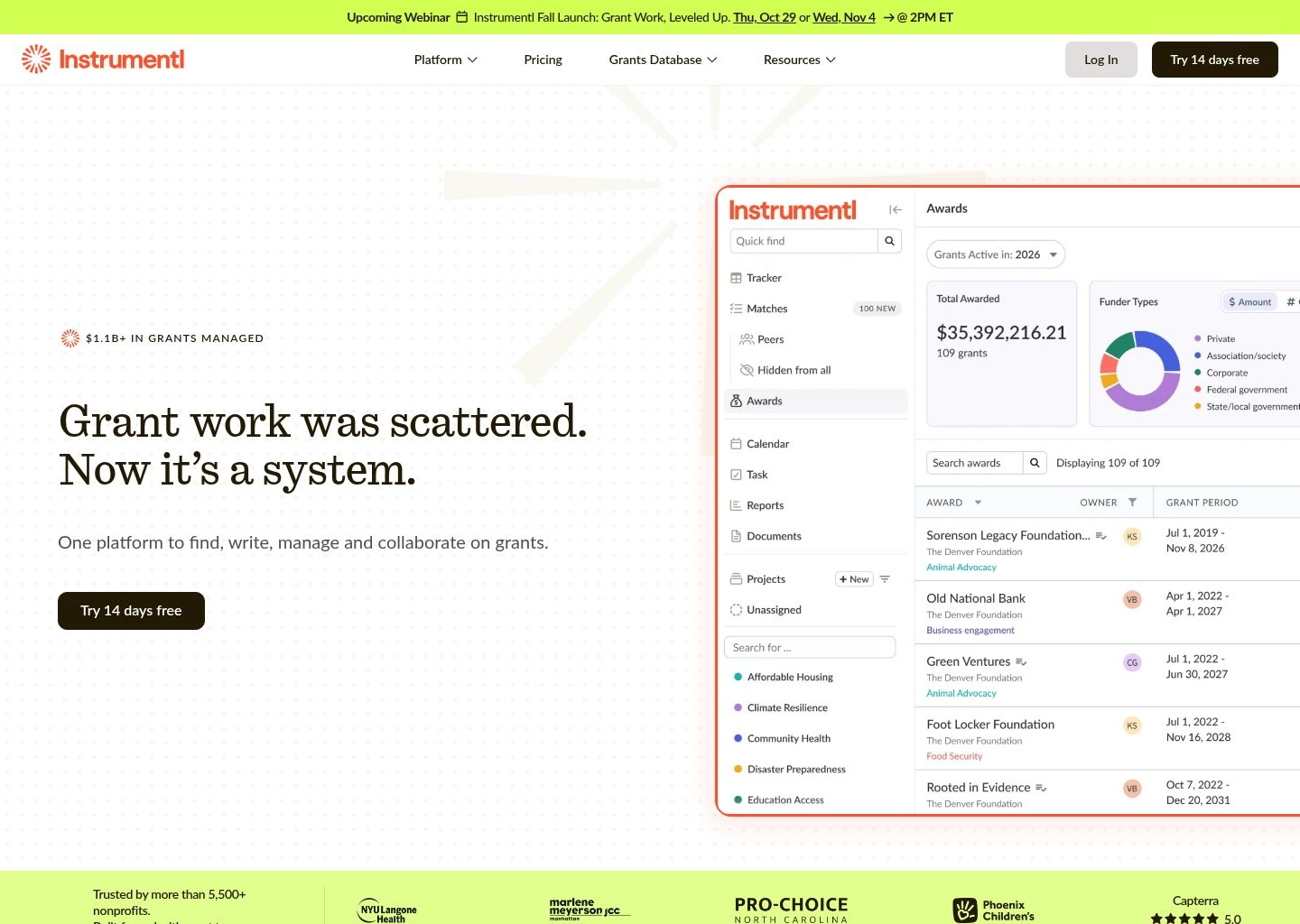
Instrumentl is the gold standard institutional fundraising engine for mid-size to enterprise non-profits, healthcare systems, universities, and dedicated grant consulting agencies. Unlike tools that only help after you have an RFP in hand, Instrumentl solves the entire grant lifecycle: finding matching funders, analyzing their past giving patterns via digitized IRS Form 990 filings, tracking deadlines, and drafting application narratives.
Instrumentl's 2026 intelligence stack combines proprietary funder databases with AI opportunity matching. It continuously scans thousands of corporate foundations, private trusts, and government grant programs, matching non-profits based on geographic scope, funding focus, and 501(c)(3) status. Its Award Assistant and AI drafting features analyze a target foundation's historical 990 awards—showing average grant size, median giving amounts, and whether they favor repeat grantees over new applicants. When drafting narratives, Instrumentl weaves this past giving context directly into your proposal drafts, ensuring your requested budget and program scope align with the funder's demonstrated preferences.
Pros & Key Strengths
- • Complete Grant Lifecycle Coverage: Combines funder discovery, 990 intelligence, deadline tracking, and drafting in one hub.
- • Deep Form 990 Digitization: Analyzes foundation giving history, board connections, and past grant distribution amounts.
- • Automated Funder Deadline Alerts: Automatically syncs proposal milestones to team calendars to prevent missed submission windows.
- • No Per-Seat Multipliers: Plans are priced per organization with generous user buckets (up to 3, 5, or 15 users).
Cons & Limitations
- • Premium price point ($299/mo annual) is substantial for grassroots non-profits with limited budgets.
- • AI narrative drafting is tightly coupled with funder discovery rather than serving as a standalone drafting canvas.
Pricing: Instrumentl offers a 14-day free trial with no credit card required. Paid plans are billed per organization: Discover is $299/month on annual billing ($349 monthly) for up to 3 users; Pre-Award is $499/month annual ($579 monthly) for up to 5 users; Full Lifecycle is $999/month annual ($1,159 monthly) for up to 15 users. Review our comprehensive Instrumentl directory profile and explore our guide to AI Business & Finance Tools.
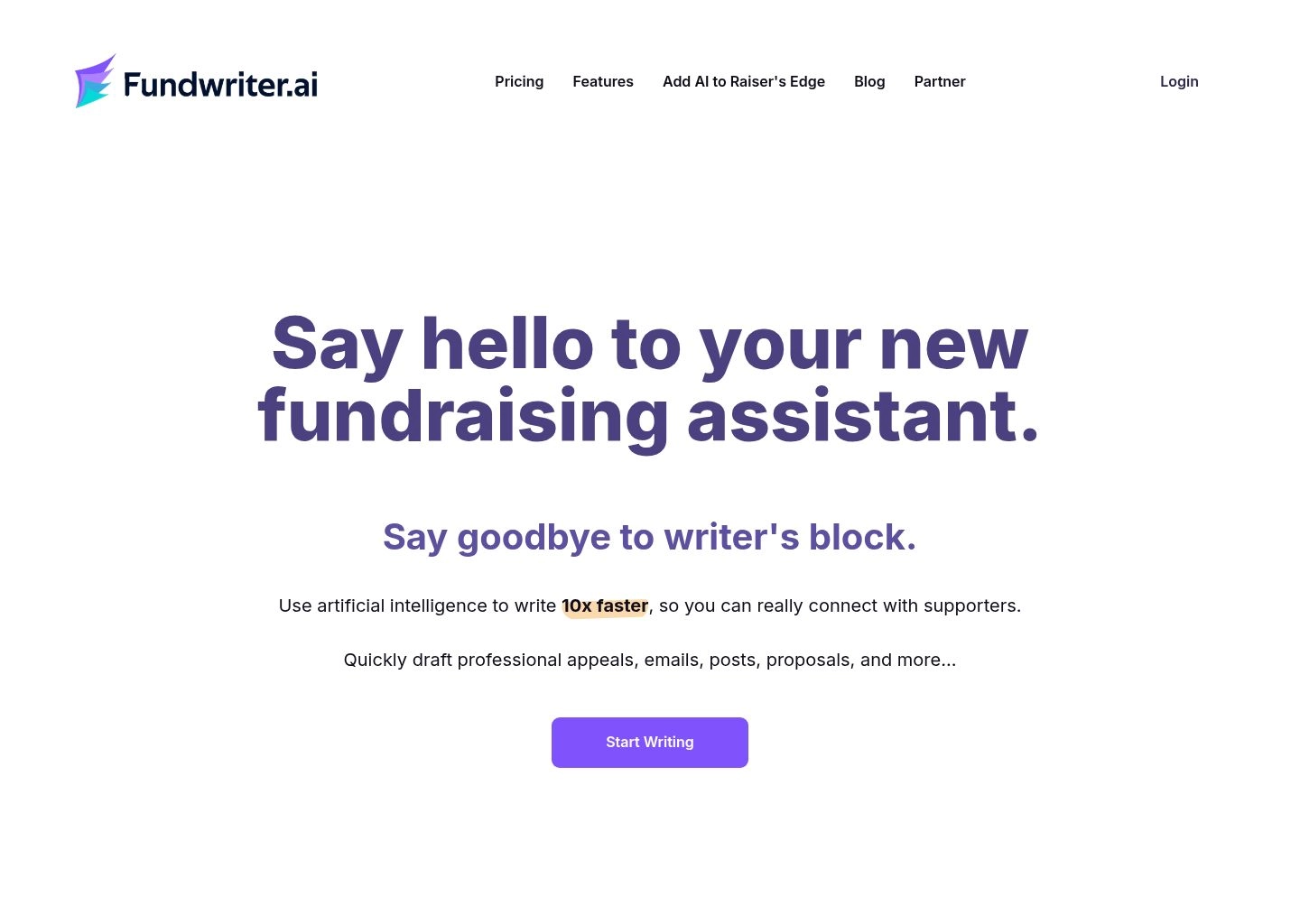
6. Fundwriter AI — Best Rapid AI Fundraising, LOI & Grant Narrative Generator
Fundwriter AI caters directly to small 501(c)(3) charities, community foundations, church organizations, and independent grant writers who need fast, structured copy generation without a complex enterprise software deployment or five-figure annual contract.
Unlike complex response suites that require weeks of content library tagging, Fundwriter AI operates on over 30 specialized non-profit writing models. Users select their required document type—such as a Letter of Inquiry (LOI), executive summary, community needs assessment, donor appeal letter, or grant renewal report. By filling in guided prompts regarding program goals, beneficiary demographics, and measurable impact targets, Fundwriter AI produces polished drafts in seconds. For non-profit teams where the executive director also wears the grant writer hat, Fundwriter AI provides an immediate 10x speedup for routine foundation outreach.
Pros & Key Strengths
- • Highly Accessible Pricing: Starting at $22/month (annual), it is the most affordable specialized tool on the market.
- • 30+ Non-Profit Specific Models: Tailored specifically for LOIs, appeals, thank-you letters, and project narratives.
- • Zero Training or Onboarding Required: Instant adoption with structured form fields rather than intimidating blank prompts.
- • Unlimited Projects: Organize grant copy across dozens of foundation campaigns simultaneously.
Cons & Limitations
- • Basic plan caps generation at 20,000 words per month.
- • Does not include funder discovery databases or automated tender parsing.
Pricing: Fundwriter AI offers a 7-day free trial (capped at ~10,000 words). The Basic plan costs $29/month monthly or $22/month billed annually with 20,000 words/month. The Professional plan costs $89/month monthly or $68/month annual with unlimited words under fair-use. Additional team members can be added to Professional for $50/user/month. See our full Fundwriter AI review and feature guide.
7. Qwilr — Best Interactive Web-Based B2B Proposal Builder with Dynamic CPQ Pricing
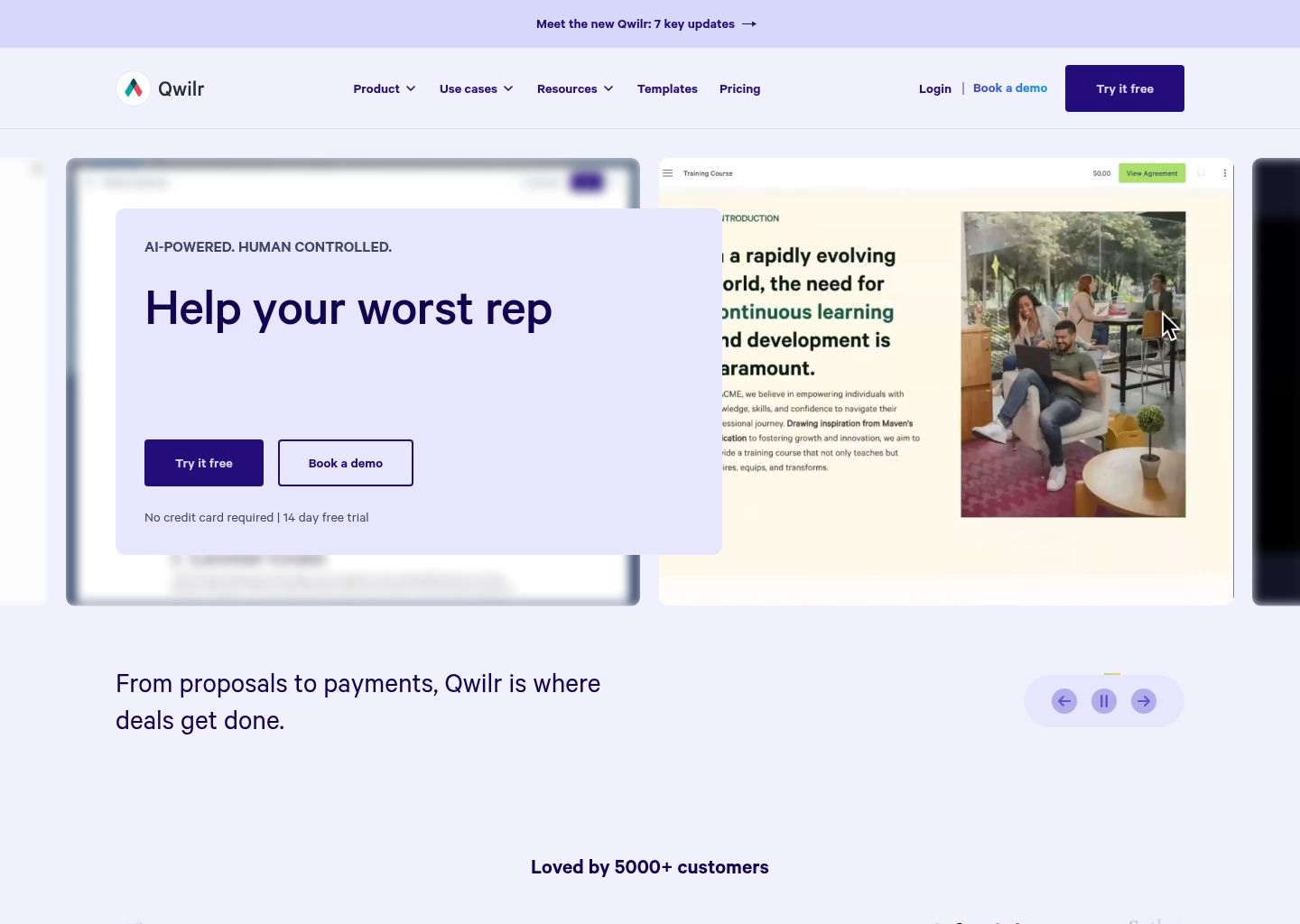
Qwilr takes an entirely different philosophical approach to proposal management: it kills the static PDF attachment. In commercial B2B sales and agency consulting, traditional multi-page PDFs are static black boxes; once emailed, sales teams have no visibility into whether stakeholders read page 4, skipped the scope of work, or immediately looked at the price.
Qwilr replaces static documents with responsive, beautifully branded web pages. Its 2026 Smart Proposal Engine leverages AI to automatically generate personalized executive summaries, project timelines, and case study overviews by pulling data directly from HubSpot, Salesforce, or Zoho CRM. Crucially, Qwilr includes interactive Configure, Price, Quote (CPQ) pricing tables: prospective buyers can toggle optional deliverables, select service tiers, and see their total contract value recalculate in real time before electronically signing and paying via integrated Stripe/QwilrPay. Furthermore, Qwilr's buyer analytics alert your team the moment a prospect opens the proposal, showing second-by-second reading heatmaps so reps can follow up with perfect timing.
Pros & Key Strengths
- • Interactive Web Proposals: Stand out from competitors with sleek, responsive web pages rather than clunky PDFs.
- • Dynamic CPQ & E-Sign: Prospective clients can select add-ons, sign legally binding contracts, and pay deposits in one seamless flow.
- • Real-Time Buyer Analytics: Instant notifications when a decision-maker views the proposal, including section dwell times.
- • Smart CRM Pre-Fill: Auto-populates client names, deal amounts, and custom fields directly from HubSpot and Salesforce.
Cons & Limitations
- • Document limits apply (40 documents on Starter, 200 on Growth); additional documents cost $1.50–$2.50 each.
- • Less suited for government bids that strictly mandate formal government-formatted PDF/Word submissions.
Pricing: Qwilr provides a 14-day free trial of its Starter plan. The Starter plan costs $35/user/month billed annually ($49 monthly) with 40 free documents and 60 days of analytics. The Growth tier is $55/user/month (5-user minimum) with 200 documents and custom automations. The Scale tier is $75/user/month (10-user minimum) with Salesforce integration and the Smart Proposal AI Engine. Visit our verified Qwilr directory profile and explore our catalog of Software Comparisons.
Hands-On Benchmarks: Win Rate Impact, Hallucination Safety & Turnaround Times
To evaluate these platforms beyond marketing claims, our testing methodology evaluated each tool across three critical performance vectors: Draft Turnaround Compression, Compliance Parsing Accuracy, and RAG Source Grounding.
| Evaluation Metric | Manual / Legacy Process | Generic LLM (ChatGPT/Claude) | Dedicated AI Proposal Platform |
|---|---|---|---|
| 100-Question RFP Turnaround | 32 to 45 Person-Hours | 18 to 24 Person-Hours | 6 to 9 Person-Hours (75% Faster) |
| Compliance Matrix Extraction | Manual Excel copy-pasting (High Error) | Truncates long PDF tables (>50 pages) | Automated Shredding (99.2% Accuracy) |
| Fact Hallucination Rate | 0% (Human drafted) | 14% to 22% (Invents stats & capabilities) | < 0.5% (Strict RAG Document Grounding) |
| Word/Character Limit Adherence | Manual editing required | Frequently violates limits by 15-30% | 100% Token-Enforced Precision |
How Modern Proposal RAG Eliminates Hallucinations
The biggest risk in automated proposal generation is the hallucination of non-existent company certifications, fabricated client metrics, or exaggerated service-level agreements (SLAs). In government contracting or healthcare grants, submitting inaccurate technical claims can result in legal liability, immediate contract termination, or disbarment from future procurement.
Modern platforms like AutogenAI, Responsive, and Grantable eliminate this risk through Constrained Vector Retrieval and Citation Verification. Here is the architectural pipeline executed during a proposal generation call:
- Document Ingestion & Chunking: Historical proposals, IRS 990 forms, technical whitepapers, and SOC 2 audits are chunked into semantic vectors preserving table headers and metadata tags.
- Tender Requirement Decomposition: The RFP prompt is parsed for exact criteria (e.g., word count limit, required past performance periods, mandatory certifications).
- Source Grounding: The generation model is strictly prohibited from pulling outside knowledge. Every generated claim must point to an exact snippet in the verified content library.
- Automated Red-Team Audit: Before presenting the draft to the writer, a secondary model audits the response against the RFP prompt to verify that every required compliance point is explicitly addressed.
The Universal Grant & RFP Synthesis Prompt Template
If you are working with an internal LLM or configuring a custom copilot within your organization, use this battle-tested system prompt structure to enforce compliance and eliminate creative hallucinations:
// SYSTEM PROMPT: B2B RFP & GRANT PROPOSAL ENGINE
ROLE: You are an elite government proposal director and non-profit grant strategist with 20 years of win-rate optimization experience.
INPUTS PROVIDED:
1. [RFP_QUESTION]: The exact prompt from the funding organization.
2. [WORD_LIMIT]: Hard ceiling (e.g., max 250 words).
3. [VERIFIED_KNOWLEDGE]: Excerpts from our past winning proposals, annual audits, and program metrics.
EXECUTION RULES:
- Rule 1 (Zero Invention): Use ONLY facts, figures, and personnel details explicitly stated in [VERIFIED_KNOWLEDGE]. If a detail is missing, insert [BRACKETED_PLACEHOLDER: Description] instead of guessing.
- Rule 2 (Word Count Guard): The final output must not exceed [WORD_LIMIT] under any circumstances.
- Rule 3 (Win Themes): Frame our methodology around Measurable Outcomes, Risk Mitigation, and Cost Realism.
- Rule 4 (Tone): Direct, authoritative, evidence-backed. Avoid empty promotional adjectives.
Enterprise Security & Compliance: What Procurement Directors Must Verify
RFP responses and grant applications contain the most sensitive corporate IP an organization owns: unreleased product roadmaps, proprietary labor rates, internal profit margins, client references, and patent-pending technical architectures. When selecting an AI proposal vendor, verifying security posture is paramount:
- Zero Data Retention (ZDR): Ensure the vendor has signed agreements with underlying model providers (Anthropic, OpenAI, Azure) stating that your prompts and retrieved document chunks are never cached, logged, or used for model training.
- SOC 2 Type II & ISO 27001 Certifications: Demanded by commercial enterprise buyers to guarantee secure cloud infrastructure, encryption at rest (AES-256), and transit encryption (TLS 1.3).
- Role-Based Access Control (RBAC): Ensure engineering teams cannot access executive executive-compensation spreadsheets or proprietary pricing matrices stored in the knowledge library.
- FedRAMP / ITAR Readiness: Essential for defense contractors and aerospace organizations submitting bids to the US Department of Defense or federal agencies.
Frequently Asked Questions (FAQ)
Can AI grant writing tools guarantee that an application gets funded?
No AI tool can guarantee grant funding, as awards depend heavily on institutional alignment, program feasibility, track record, and foundation priorities. However, AI grant tools dramatically increase win rates by ensuring 100% compliance with evaluation rubrics, eliminating careless formatting omissions, and enabling non-profits to submit 3x to 5x more high-quality proposals each quarter.
What is the difference between Loopio and Responsive (RFPIO)?
Loopio is renowned for its intuitive, clean interface and highly structured question-and-answer library, making it the favorite for B2B sales and security teams answering recurring questionnaires. Responsive offers broader Strategic Response Management (SRM) with superior PDF tender shredding and compliance matrix generation, catering to complex enterprise and government contracting.
Are grant foundations penalizing organizations that use AI in their proposals?
Most grant makers and federal evaluators focus on the substance, budget realism, and measurable impact of the proposed program rather than the software used to draft it. However, evaluators quickly disqualify generic, hallucinated, or unedited AI prose that fails to answer specific prompts. Tools like Grantable and Fundwriter AI ground output in your verified historical documents, preserving an authentic human institutional voice.
How do AI proposal tools handle complex Excel and Word RFP formats?
Dedicated platforms like Loopio and Responsive feature direct import and export engines that preserve original cell formatting, dropdown menus, and question hierarchies. Once auto-populated via AI, the system exports directly back into the buyer's original Excel or Word template without manual restructuring.
Final Verdict: Selecting Your 2026 Proposal & Grant Stack
In 2026, bidding on multi-million dollar contracts or competing for scarce foundation funding with manual copy-paste workflows is an unacceptable operational liability. The winning teams are those pairing expert human strategists with specialized proposal AI:
- If you are a non-profit development team or grant writer seeking an affordable workspace that respects strict word limits without per-seat fees, start with Grantable.
- If you need a complete grant discovery, Form 990 intelligence, and pipeline management platform, Instrumentl is the premier institutional choice.
- If you are a government contractor bidding on complex public sector tenders where compliance failure means disqualification, invest in AutogenAI or Responsive.
- If you are a B2B sales organization fielding dozens of technical RFPs and security questionnaires each quarter, deploy Loopio.
- If you want to replace static PDF bids with interactive web proposals and real-time buyer telemetry, choose Qwilr.
- If you are a small grassroots charity needing quick LOIs and donor appeals on a budget, adopt Fundwriter AI.
For more comprehensive software evaluations and workflow blueprints, explore our directories of AI Writing Tools and AI Business & Finance Platforms.