

Google Cloud Vertex AI
Google's unified platform for AI agents, models, and MLOps
Gallery
6 items



About Google Cloud Vertex AI
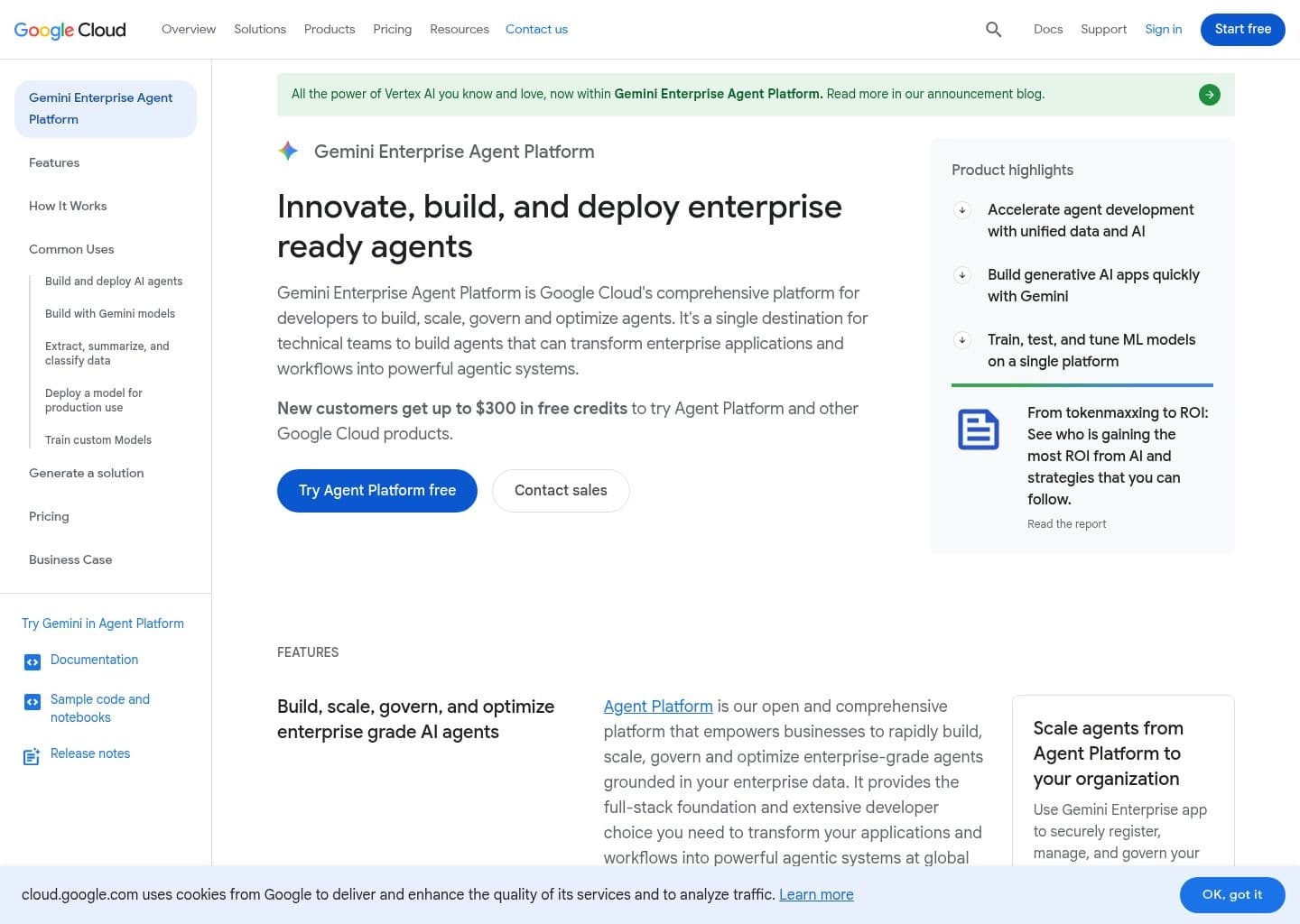
Google Cloud Vertex AI, now rebranded as the Gemini Enterprise Agent Platform, is Google's comprehensive platform for building, training, deploying, and governing both traditional machine learning models and modern AI agents at enterprise scale. Vertex AI was announced at Google I/O and launched generally available on May 18, 2021, unifying Google's previously separate AutoML and Cloud AI Platform offerings under a single API and interface, and later adding generative AI support with foundation models in June 2023. On April 22, 2026, at Google Cloud Next, Google announced the platform's evolution into the Gemini Enterprise Agent Platform, restructuring what was once a "model platform with agent features" into an agent-first architecture where model training, AutoML, and endpoints now sit as sub-features beneath a unified agent-building experience.
The platform gives developers access to over 200 Google and third-party AI models through Model Garden, including Google's Gemini 3.5 family, Anthropic's Claude models, and open models like Gemma, alongside tools for customizing models through fine-tuning and evaluation. Agent Studio offers a low-code environment for designing, testing, and managing prompts and agents using natural language, code, images, or video, while the Agent Development Kit (ADK) supports fully custom, code-first agent development. Newer capabilities include a managed agent runtime for scalable deployment, Memory Bank for persistent cross-session context, and integration with the Agent2Agent (A2A) protocol so agents built on different platforms can communicate.
Beyond agent building, the platform retains its full MLOps foundation, including Model Registry, Pipelines, Feature Store, and Model Evaluation, natively integrated with BigQuery and notebook environments like Colab Enterprise and Workbench, so data scientists and ML engineers can train, tune, and monitor models throughout their lifecycle. Google reports this shift is aimed at competing directly with fragmented multi-vendor AI stacks, offering a single platform spanning models, infrastructure, governance, and deployment. Notably, the underlying API endpoint remains unchanged, so existing integrations continue to work without requiring code changes despite the branding shift.
Key Features
- Agent Studio for designing, testing, and managing prompts and agents with low-code tools
- Agent Development Kit (ADK) for building fully custom, code-first agents
- Model Garden with 200+ Google and third-party models, including Gemini, Claude, and Gemma
- Managed Agent runtime (formerly Agent Engine) for scalable agent deployment
- Memory Bank for persistent, cross-session agent memory
- MLOps tooling including Model Registry, Pipelines, and Feature Store
- Custom model training with your choice of ML framework and hyperparameter tuning
- Model Evaluation service for objective, data-driven model and agent assessment
- Vector Search for grounding agents in enterprise data at scale
- Native integration with BigQuery and Colab Enterprise or Workbench notebooks
Pros
- Access to 200+ models including Gemini, Claude, and open models like Gemma in one platform
- Combines full MLOps lifecycle tooling with modern agent-building capabilities
- Agent2Agent (A2A) protocol support enables interoperability across different agent platforms
- Deep native integration with BigQuery and the broader Google Cloud ecosystem
- $300 in free credits for new customers to explore the platform
- Backed by Google's infrastructure and named a leader in multiple analyst reports
Cons
- Recently rebranded from Vertex AI to Gemini Enterprise Agent Platform, which can confuse teams referencing older documentation or tutorials
- Pricing is spread across many separate tools and services, making total cost estimation more complex than flat-rate competitors
- Custom model training costs require a sales estimate or pricing calculator rather than transparent self-serve rates
- Deep feature set and agent-first restructuring add a learning curve for teams new to the Google Cloud ecosystem
- Some advanced governance and enterprise features are gated behind Google Cloud sales conversations
Pricing
The platform uses pay-as-you-go pricing for the tools, storage, and compute resources used, with new customers getting up to $300 in free credits. Generative AI pricing starts at $0.0001 based on image input, character input, or custom training pricing for Imagen models, and text, chat, and code generation starts at $0.0001 per 1,000 characters based on input (prompt) and output (response). Custom model training pricing is based on machine type used per hour, region, and any accelerators used, available via a sales estimate or the pricing calculator. Notebooks are billed at the same rates as Compute Engine and Cloud Storage, plus separate management fees based on region, instances, and notebooks used. Pipelines start at $0.03 per pipeline run based on execution charges and resources used. Vector Search pricing is based on data size, queries per second (QPS), and number of nodes used. A pricing calculator and custom quotes from sales are available for detailed cost estimates.
Claim Verified Creator Badge
Are you the founder of Google Cloud Vertex AI? Display this listing's verified badge on your website to show your customers that your product has been vetted and listed on AI Central Resources.
<a href="https://www.aicentralresources.com/tool/google-cloud-vertex-ai" target="_blank" rel="noopener">
  <img src="https://www.aicentralresources.com/badges/featured-badge-dark.svg" alt="Featured on AICentralResources" width="200" height="54" style="border: none;" />
</a>
* Place this HTML snippet in your website's footer, landing page, or press section. This creates a search-friendly backlink directly to your verification page.
Connect with Google Cloud Vertex AI
Frequently Asked Questions
Gemini Enterprise Agent Platform is Google Cloud's rebranded and expanded version of Vertex AI, announced in April 2026, providing a unified platform to build, scale, govern, and optimize AI agents alongside traditional ML model training and deployment.
No, the underlying API endpoint (aiplatform.googleapis.com) is unchanged, so existing integrations built on Vertex AI continue working without code changes; only the product name, console navigation, and agent-first framing have changed.
The platform offers 200+ Google and third-party AI models and tools, including Google's Gemini 3.5 family, Anthropic's Claude models, and open models like Gemma through Model Garden.
Pricing is pay-as-you-go based on usage: generative AI features start at $0.0001 per 1,000 characters or per image, Pipelines start at $0.03 per run, and custom model training and Vector Search pricing depend on compute, region, and scale, with $300 in free credits for new customers.
Yes, Agent Studio provides a low-code environment to design, test, and manage prompts and agents using natural language, code, images, or video, while the Agent Development Kit (ADK) supports fully custom, code-first agent development.
Yes, the platform includes MLOps tools such as Model Registry, Pipelines, Feature Store, and Model Evaluation to help data scientists and ML engineers standardize, automate, and monitor both predictive and generative AI projects.
Similar AI Tools to Google Cloud Vertex AI
View all alternatives of Google Cloud Vertex AI
Amazon Bedrock
The fully managed AWS platform for building generative AI applications and agents at production scale


LangChain
The open-source framework and platform for building reliable AI agents

CrewAI
Build, govern, and scale collaborative multi-agent AI crews for enterprise workflows


Compared with Google Cloud Vertex AI
Direct head-to-head feature matrices, pricing, and category breakdowns