

Groq
The fastest inference cloud for open-source LLMs, powered by custom LPU chips
Gallery
6 items

About Groq
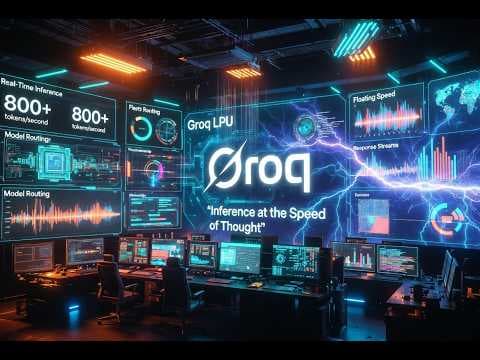
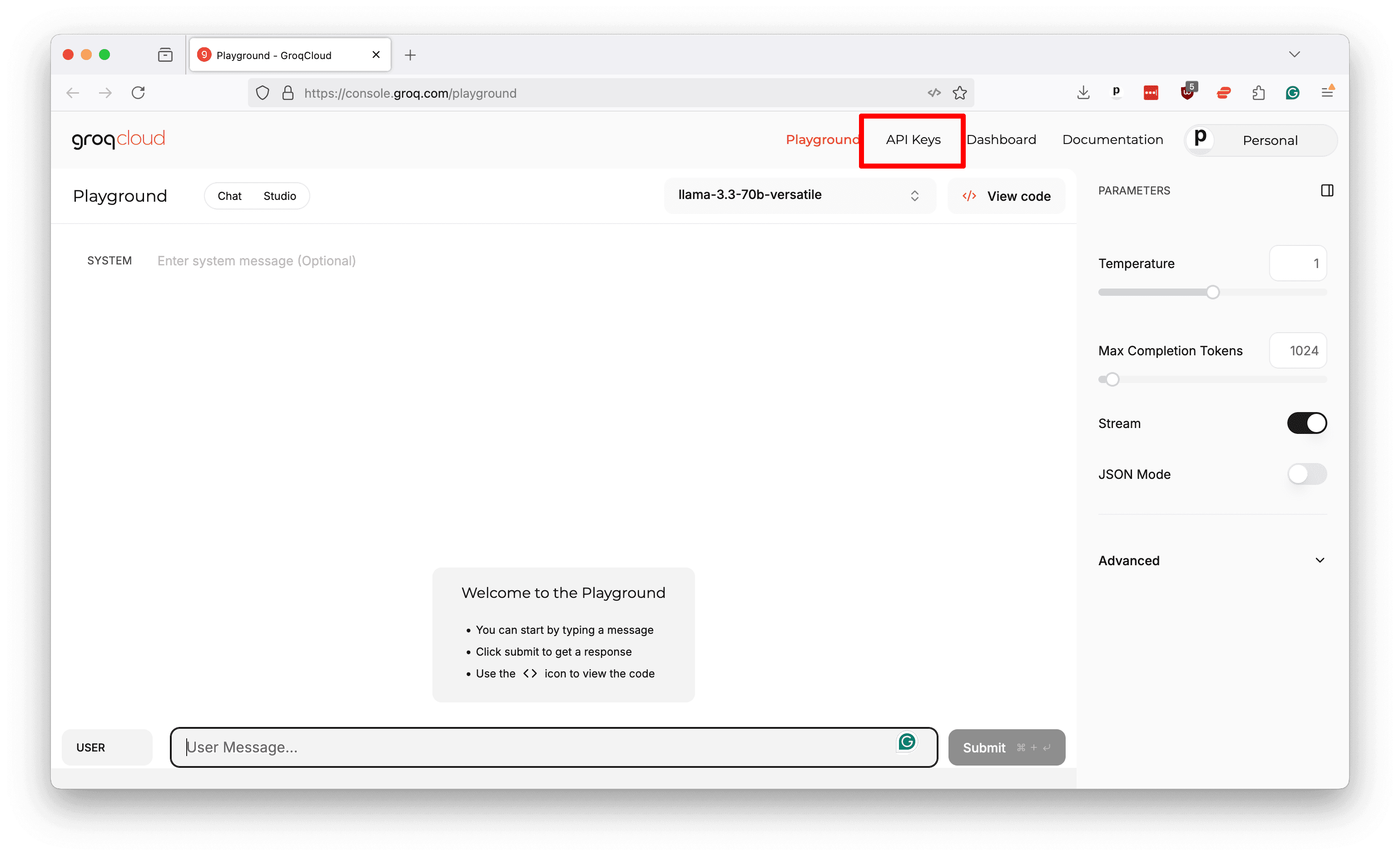
Groq is an AI inference cloud built around its own custom-designed chip, the LPU (Language Processing Unit), engineered specifically to run large language models faster and more predictably than general-purpose GPUs. Where GPUs are parallel processors adapted for AI workloads, the LPU's architecture is built end-to-end around the sequential, memory-bandwidth-heavy nature of transformer inference, letting Groq serve models like Llama 3.3, Mixtral, Gemma, and DeepSeek R1 distills at several hundred to over 1,000 tokens per second, independent benchmarks have repeatedly shown it among the fastest inference providers available. Developers access this hardware through GroqCloud, an OpenAI-compatible API that typically requires only a base URL and API key swap to integrate into an existing codebase, plus a browser-based Playground for testing models before writing any code.
The platform is organized into three composable layers: GroqMetal provides dedicated bare-metal infrastructure, GroqCore turns that capacity into a production-ready inference stack without requiring infrastructure expertise, and GroqAssured layers on enterprise-grade governance, auditability, and access control. Beyond raw model hosting, GroqCloud offers Compound and Compound Mini, agentic systems that give any hosted model built-in web search and code execution without custom orchestration, along with Batch API and prompt caching discounts that can stack to roughly 25% of on-demand pricing for high-volume or asynchronous workloads. Groq currently operates 13 data centers across the US, Canada, Europe, the Middle East, and Australia, and reports serving more than 3 million developers, with customers including the McLaren Formula 1 team, the PGA of America, GPTZero, and Fintool.
Groq only hosts open-source and open-weight models rather than proprietary ones like GPT or Claude, positioning it as an inference speed and cost specialist rather than a model developer. Founded in 2016 by Jonathan Ross, one of the original architects of Google's Tensor Processing Unit, Groq raised roughly $750 million in a September 2025 round at a $6.9 billion valuation before Nvidia announced a landmark non-exclusive licensing deal in December 2025, paying an estimated $20 billion for access to Groq's LPU technology and hiring Ross, President Sunny Madra, and other senior engineers. GroqCloud was explicitly excluded from that transaction and continues operating as an independent cloud business under new CEO Simon Edwards, Groq's former CFO, with the company subsequently announcing a further $650 million fundraise in 2026 to continue scaling its global inference footprint and its next-generation LPX rack, which pairs future LPU accelerators with Nvidia's Vera Rubin platform.
Key Features
- Custom-built LPU (Language Processing Unit) chips purpose-designed for inference rather than training
- OpenAI-compatible API for quick migration from existing integrations
- GroqCloud hosts open-source models including Llama, Mixtral, Gemma, Qwen, and DeepSeek R1 distills
- Compound and Compound Mini agentic systems with built-in web search and code execution
- Batch API and prompt caching, stackable for up to a 75% cost reduction
- Browser-based Playground for testing prompts and comparing model speed before writing code
- GroqMetal, GroqCore, and GroqAssured layered platform for infrastructure, inference, and enterprise governance
- 13 data centers operating across four continents for global low-latency access
Pros
- Consistently ranks among the fastest LLM inference providers thanks to purpose-built LPU hardware
- OpenAI-compatible API makes migration from existing integrations fast
- Generous free tier with no credit card required and access to every hosted model
- Batch API and prompt caching can stack to roughly 25% of on-demand pricing
- Proven at scale with 3M+ developers and demanding real-time customers like McLaren F1
Cons
- Only hosts open-source models (Llama, Mixtral, Gemma, Qwen, DeepSeek distills), so there's no access to proprietary models like GPT or Claude through the platform
- The December 2025 NVIDIA licensing deal and departure of founder Jonathan Ross as CEO introduce some uncertainty about the platform's long-term technical direction
- No self-serve fine-tuning; customization requires contacting Groq's sales team or submitting an Enterprise request
- Free tier is limited by requests-per-minute (30 RPM) rather than a generous token allowance, which can bottleneck bursty workloads
- Full pricing isn't published for every capability, and Enterprise/GroqAssured governance features require a custom conversation
Pricing
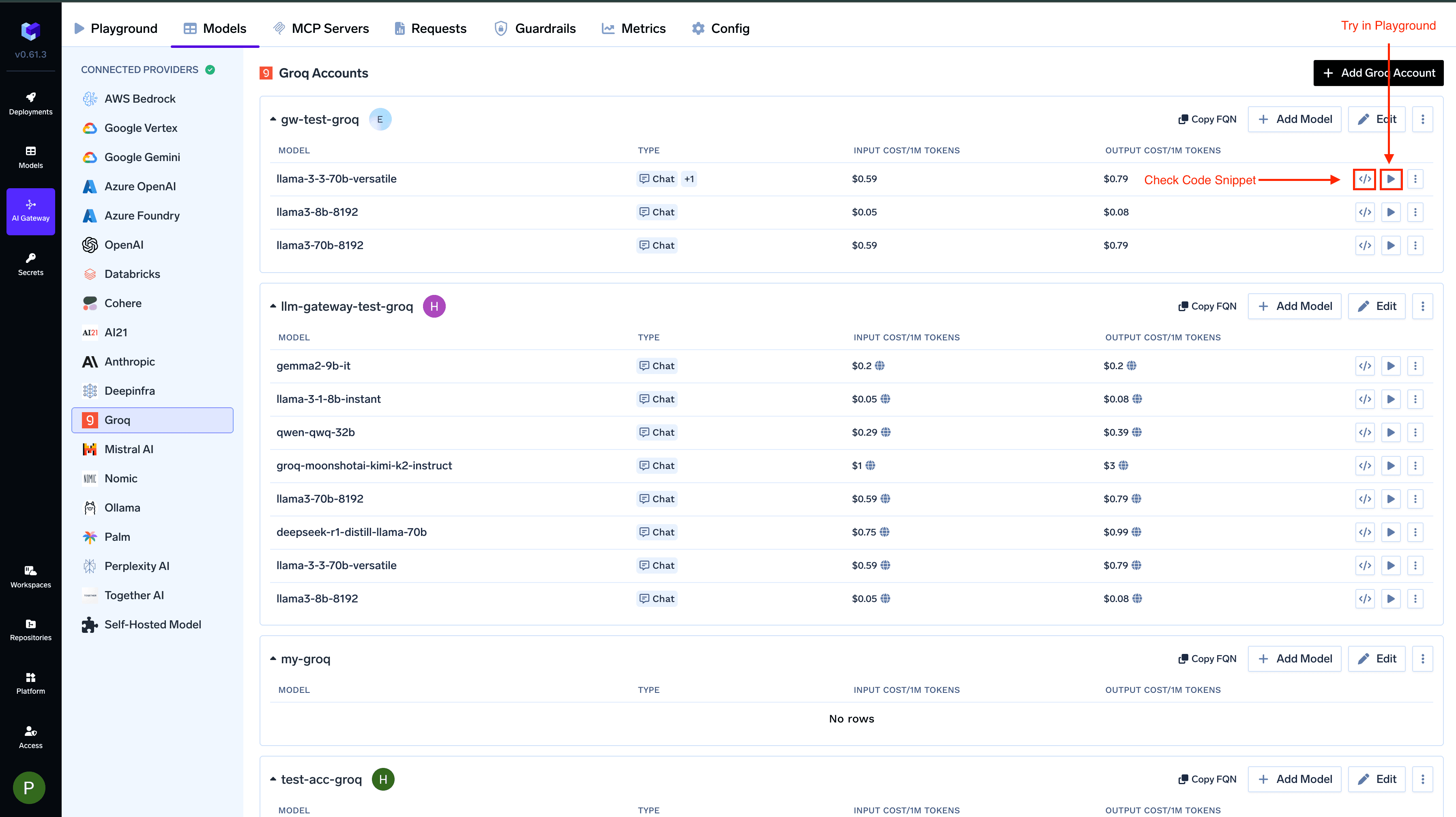
GroqCloud uses pay-as-you-go pricing per million tokens with no seat license or minimum spend. Rates range from roughly $0.05 input / $0.08 output for Llama 3.1 8B Instant up to about $1.00 input / $3.00 output for Kimi K2, with the flagship Llama 3.3 70B Versatile priced at $0.59 input / $0.79 output and GPT-OSS 120B at $0.15 input / $0.60 output. Whisper v3 Turbo transcription is priced at $0.04 per hour of audio. A free tier is available to all registered users with no credit card required, offering access to every model at 30 requests per minute. The Batch API and prompt caching each cut rates by roughly 50%, and can be combined for an effective rate of about 25% of on-demand pricing on eligible workloads. Enterprise pricing, including GroqAssured governance features and dedicated GroqMetal infrastructure, is available by contacting Groq's sales team.
Claim Verified Creator Badge
Are you the founder of Groq? Display this listing's verified badge on your website to show your customers that your product has been vetted and listed on AI Central Resources.
<a href="https://www.aicentralresources.com/tool/groq" target="_blank" rel="noopener">
  <img src="https://www.aicentralresources.com/badges/featured-badge-dark.svg" alt="Featured on AICentralResources" width="200" height="54" style="border: none;" />
</a>
* Place this HTML snippet in your website's footer, landing page, or press section. This creates a search-friendly backlink directly to your verification page.
Connect with Groq
Frequently Asked Questions
Groq is an AI inference cloud built on its own custom LPU (Language Processing Unit) chip, purpose-built to run large language models faster and more predictably than general-purpose GPUs. Developers access it through GroqCloud, an OpenAI-compatible API for running open-source models like Llama, Mixtral, Gemma, and DeepSeek distills at very high tokens-per-second speeds.
Pricing is pay-as-you-go per million tokens with no seat license or minimum spend, ranging from about $0.05 input / $0.08 output for Llama 3.1 8B up to roughly $1.00 input / $3.00 output for Kimi K2. A free tier includes every model at 30 requests per minute with no credit card required. The Batch API and prompt caching each cut costs by 50%, and stacking both can bring effective rates down to about 25% of on-demand pricing.
In December 2025, Nvidia agreed to a non-exclusive licensing deal for Groq's LPU inference technology worth roughly $20 billion, and hired founder-CEO Jonathan Ross, President Sunny Madra, and other senior engineers. Groq continues operating independently, with GroqCloud excluded from the deal and CFO-turned-CEO Simon Edwards now leading the company.
Yes, GroqCloud's API is OpenAI-compatible, so switching typically only requires changing the base_url to https://api.groq.com/openai/v1 and swapping in a GROQ_API_KEY, without rewriting the rest of your integration code.
Groq reports serving more than 3 million developers, with named customers including the McLaren Formula 1 team for real-time race analysis, the PGA of America, GPTZero, and education platforms citing significant cost and latency improvements after migrating from GPU-based inference providers.
Similar AI Tools to Groq
View all alternatives of Groq

Google Gemini API
Build with Google's multimodal Gemini models via API and AI Studio

Fireworks AI
High-performance training and inference platform for open-source AI models



Compared with Groq
Direct head-to-head feature matrices, pricing, and category breakdowns