
AI Agent & Orchestration Frameworks
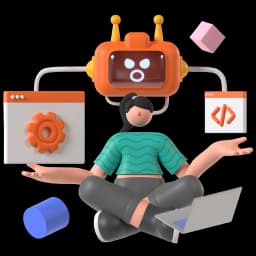
Build AI applications that do more than chat — agents that search the web, run code, query databases, call APIs, and hand off tasks between specialized sub-agents. These frameworks give you the building blocks for multi-step AI workflows without building the orchestration layer from scratch.

ChatGPT
Engage in dynamic conversations, debug code, and generate creative content with advanced AI.




Botpress
Build and deploy LLM-powered AI agents and chatbots with a visual studio and full code control

Hugging Face
The AI community platform for hosting, sharing, and running open machine learning models

Amazon Bedrock
The fully managed AWS platform for building generative AI applications and agents at production scale

Picsart
The AI creative platform for 130M+ creators. Turn any idea into scroll-stopping content.

Google Gemini API
Build with Google's multimodal Gemini models via API and AI Studio



Hume AI
The data and evaluation layer for emotionally intelligent voice AI and empathic speech

Chroma
The open-source search infrastructure for AI — fast, serverless, and scalable


MongoDB Atlas Vector Search
Build intelligent applications with vector search, hybrid search, and generative AI on your live data

CrewAI
Build, govern, and scale collaborative multi-agent AI crews for enterprise workflows

LangChain
The open-source framework and platform for building reliable AI agents

IBM watsonx
IBM's enterprise AI portfolio for building, governing, and deploying AI

NVIDIA ACE
Bring digital humans to life with generative AI microservices for speech, intelligence, and animation

Unity AI Tools
Unity's in-editor agentic assistant, AI gateway, and MCP server for game development (successor to Unity Muse)

Taskfolk
Project management for teams and their AI agents - agents join as members, humans stay in charge






Regression Games
AI agent platform for building Unity bots for QA testing, NPCs, and multiplayer
AI Agent & Orchestration Frameworks for Developers
An AI agent is a system that uses a language model to make decisions and take actions — searching for information, running code, calling external APIs, and stringing multiple steps together to complete a goal. Frameworks like LangChain, LlamaIndex, and CrewAI provide the scaffolding for building these systems: tools, memory, planning, and the logic that routes between steps.
What developers build with these
- Research agents that search the web, read sources, and synthesize a report.
- Customer support agents that look up order details in a database and take action, not just answer questions.
- Multi-agent pipelines where specialized agents handle different parts of a workflow and pass results to each other.
A practical note on the learning curve
These frameworks abstract a lot, but they also have real complexity — managing context windows, handling tool failures gracefully, and making agents reliable in production takes more work than the quick-start demos suggest. Factor that in when estimating development time for anything production-facing.
Compare AI Agent & Orchestration Frameworks Tools
Direct side-by-side feature and pricing evaluations
Also explore in AI Developer APIs & Platforms
AI Cloud ML Platforms
Build, train, deploy, and monitor machine learning models on enterprise-grade cloud infrastructure from AWS, Google, Microsoft, and IBM. These platforms handle the heavy lifting of data management, model training at scale, and deployment pipelines — so your ML team focuses on the models, not the infrastructure.
AI Computer Vision & Speech APIs
Add the ability to see, read, and listen to your applications — via APIs for image recognition, OCR, object detection, speech-to-text, and speaker identification. These are the building blocks behind AI apps that process documents, analyze photos, or transcribe audio at scale.
AI LLM APIs (Foundation Models)
Access the world's most capable language models via API to power your product's AI features — from chatbots and content generation to complex reasoning and data extraction. These platforms handle the model infrastructure so you focus on building, not running GPU servers.
AI Model Hosting & Open-Source Model APIs
Run open-source models like Llama, Mistral, and Qwen at scale without managing your own GPU infrastructure — through APIs that feel familiar but give you access to open-weight models you can customize, fine-tune, or deploy under your own terms.
AI Vector Databases & RAG Infrastructure
Power semantic search and retrieval-augmented generation (RAG) apps with a database built for AI embeddings. Store and query millions of vectors fast — the infrastructure layer behind AI applications that need to search documents, memories, or knowledge bases by meaning, not just keywords.