

MongoDB Atlas Vector Search
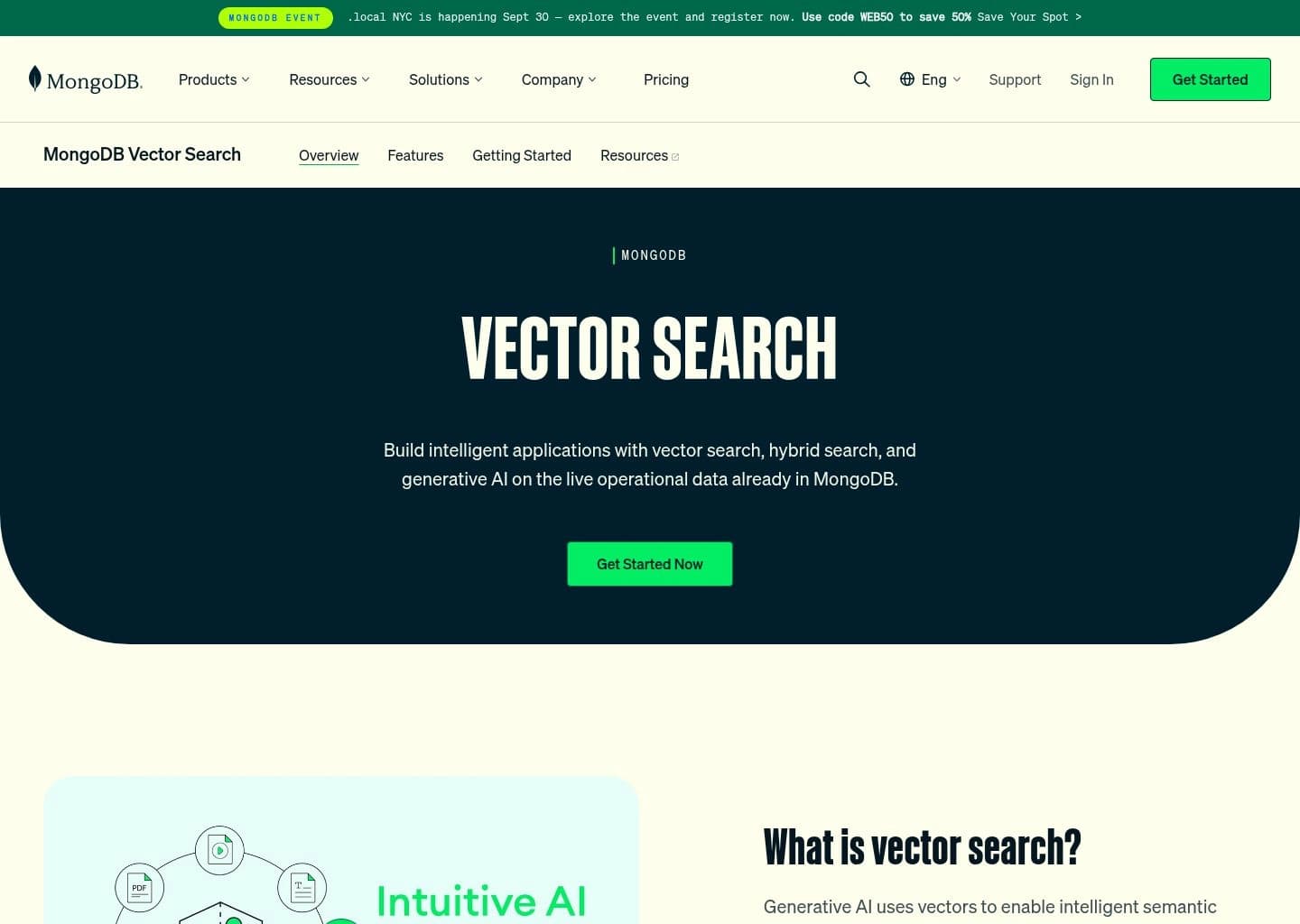
Build intelligent applications with vector search, hybrid search, and generative AI on your live data
Gallery
6 items

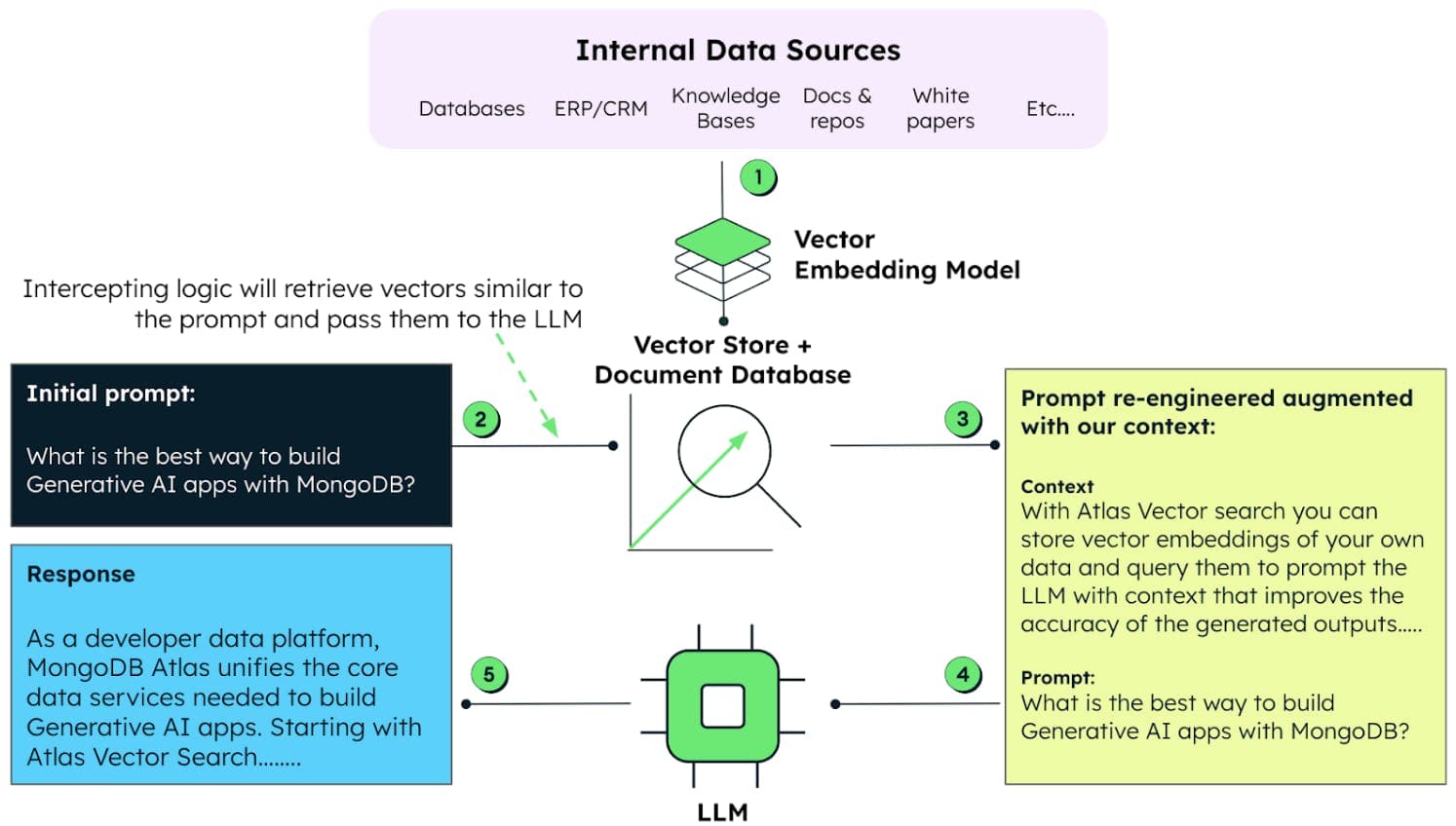
About MongoDB Atlas Vector Search
I tested MongoDB Atlas Vector Search by indexing document embeddings directly alongside existing operational collections to run hybrid text-and-vector queries. Querying vectors natively within standard MongoDB aggregation pipelines eliminates the nightmare of synchronizing dual databases. However, dedicated vector search nodes require careful memory sizing, and high-dimensional vector indexes increase Atlas RAM consumption. With a free M0 sandbox and dedicated clusters from ~$57 monthly, it is the best path for existing MongoDB stacks.
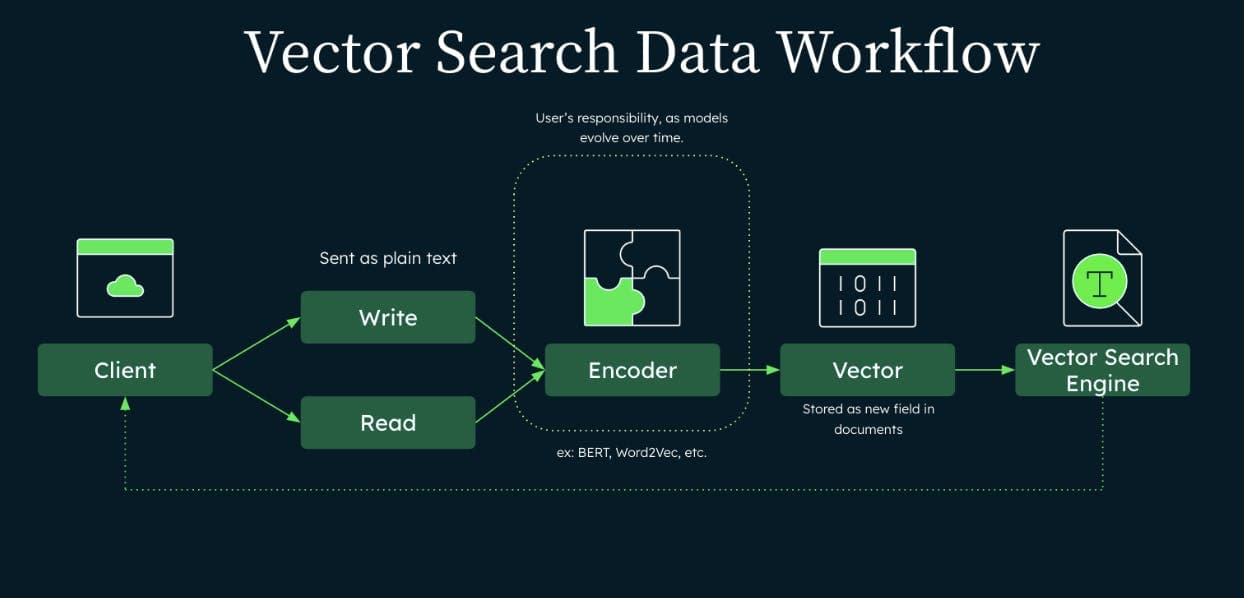
MongoDB Atlas Vector Search is a native vector database capability built directly into MongoDB Atlas, letting developers store and query vector embeddings alongside their existing operational data rather than standing up and syncing a separate, standalone vector database. MongoDB was founded in 2007 in New York City as 10gen by Dwight Merriman, Eliot Horowitz, and Kevin Ryan, three veterans of the ad-tech company DoubleClick who had personally hit the scaling limits of relational databases while serving over 400,000 ads per second. The company renamed itself MongoDB in 2013, launched its fully managed cloud platform, Atlas, in 2016, and went public on Nasdaq under the ticker MDB in 2017, reporting roughly $2.46 billion in annual revenue and over 5,600 employees by 2026.
Atlas Vector Search's core pitch is architectural simplicity: because vector embeddings live in the same document as the rest of an application's data, teams avoid the "synchronization tax" of keeping a separate vector database in sync with a primary datastore. The platform supports both Approximate Nearest Neighbor (ANN) search using a Hierarchical Navigable Small World (HNSW) graph for large-scale performance, and Exact Nearest Neighbor (ENN) search for cases requiring perfect accuracy on smaller result sets. Hybrid search lets developers combine lexical (keyword) and vector search in a single query, and native reranking, powered by Voyage AI (which MongoDB acquired), improves retrieval precision directly within the query engine, reducing token costs and latency for LLM-based applications.
More recent additions extend the platform further into applied AI workflows: Automated Embedding, powered by Voyage AI, generates and syncs vector embeddings directly in the database with no separate ML pipeline required, and dedicated Search Nodes let teams scale vector search compute independently from their core transactional workload, an architectural advantage MongoDB positions as superior to competitors that can't isolate search performance from database performance. The platform supports embeddings from any provider under a 4096-dimension limit, along with scalar and binary vector quantization for more efficient storage. Customers using Atlas Vector Search in production include Novo Nordisk (cutting clinical report creation time to 10 minutes), Okta (30% lower operating costs), and Delivery Hero for real-time product recommendations.
Pricing follows Atlas's broader consumption-based model: Atlas Search and Vector Search run at no additional cost on shared database nodes, while production workloads needing dedicated performance can add Search Nodes (minimum two, requiring an M10+ cluster) starting around $0.12/hour. A free M0 tier with 512MB of storage supports basic vector search for prototyping RAG applications and semantic search at zero cost, making Atlas Vector Search well suited for teams already using or willing to adopt MongoDB as their primary database who want to avoid managing a second, standalone vector search system, though teams specifically seeking the most mature, dedicated vector-only infrastructure at very large scale should still compare it against purpose-built vector databases.
Key Features
- Vector embeddings stored alongside operational data in the same document
- Automated Embedding powered by Voyage AI, generated and synced with no pipeline needed
- Hybrid search combining lexical (full-text) and vector search in one query
- Native reranking using Voyage AI's reranker models directly in the query engine
- Dedicated Search Nodes to scale vector search independently from the core database
- Support for Approximate (ANN/HNSW) and Exact (ENN) nearest neighbor search
- Vector quantization (scalar and binary) for efficient storage and querying at scale
- Native integrations with LangChain, LlamaIndex, OpenAI, AWS, and Spring AI
Pros
- Unified data model eliminates the sync overhead of running a separate standalone vector database
- Search Nodes let you scale vector search compute independently from your core transactional workload
- Automated Embedding (powered by Voyage AI) generates and syncs embeddings with zero ML pipeline setup
- Free M0 tier makes it genuinely possible to prototype RAG and semantic search at zero cost
- Backed by a mature, public company (Nasdaq: MDB) with 125+ global regions and enterprise-grade security
Cons
- Dedicated Search Nodes require an M10+ cluster minimum, adding cost before you get isolated vector search compute
- Vector embeddings must stay under a 4096-dimension limit, which can constrain some newer, higher-dimensional embedding models
- Usage-based pricing across compute, storage, Search Nodes, and data transfer makes total cost harder to predict than a flat-rate competitor
- Best value requires already using or being willing to adopt MongoDB as your primary operational database, not just a vector store
- Serverless instances were retired in January 2026, forcing migrated customers to re-evaluate Free, Flex, or Dedicated tiers
Pricing
MongoDB Atlas Vector Search is not a separately priced product; it runs on your existing Atlas cluster resources. The Free tier (M0) offers 512MB of storage and supports basic vector search for learning and prototyping at no cost. The Flex tier costs between $8 and $30/month (usage-capped, pay-as-you-go hourly), suitable for low-to-moderate production workloads and replacing the deprecated Shared and Serverless tiers as of February 2025. Dedicated clusters start at $57/month for entry-level production workloads, with hourly rates that vary by cloud provider (AWS, Azure, GCP) and region. For production workloads needing isolated vector search performance, dedicated Search Nodes (requiring a minimum of two nodes on an M10+ cluster) are billed separately, ranging from roughly $0.12/hour for an S20 node up to $4.22/hour for the largest S80 tier. Data transfer/egress is billed separately at standard per-GB cloud provider rates, and self-managed Enterprise Advanced deployments require a custom sales quote. Serverless instances were fully retired on January 22, 2026, with existing customers migrated to Free, Flex, or Dedicated tiers.
Claim Verified Creator Badge
Are you the founder of MongoDB Atlas Vector Search? Display this listing's verified badge on your website to show your customers that your product has been vetted and listed on AI Central Resources.
<a href="https://www.aicentralresources.com/tool/mongodb-atlas-vector-search" target="_blank" rel="noopener">
  <img src="https://www.aicentralresources.com/badges/featured-badge-dark.svg" alt="Featured on AICentralResources" width="200" height="54" style="border: none;" />
</a>
* Place this HTML snippet in your website's footer, landing page, or press section. This creates a search-friendly backlink directly to your verification page.
Connect with MongoDB Atlas Vector Search
Frequently Asked Questions
MongoDB Atlas Vector Search lets developers store vector embeddings directly alongside their operational data in MongoDB Atlas, enabling semantic search, RAG (retrieval-augmented generation), recommendation engines, and agentic AI systems without syncing data to a separate standalone vector database.
Atlas Vector Search itself has no separate charge; it runs on your existing Atlas cluster. A free M0 tier (512MB storage) supports basic vector search for prototyping. Paid usage starts with the Flex tier ($8-$30/month), Dedicated clusters from $57/month, and dedicated Search Nodes for production vector workloads priced from about $0.12/hour (S20) up to $4.22/hour for the largest tiers, billed separately from cluster compute.
MongoDB's core advantage is unified data: your operational data, metadata, and vector embeddings all live in the same document, eliminating the synchronization overhead of running a separate vector database alongside your primary datastore. It also supports hybrid search, combining lexical and vector search in a single query.
MongoDB Atlas Vector Search supports embeddings from any provider under a 4096-dimension limit, including OpenAI, Cohere, and Voyage AI (which MongoDB acquired). It also offers Automated Embedding, powered by Voyage AI, which generates and syncs embeddings directly in the database without a separate pipeline.
MongoDB was founded in 2007 as 10gen by Dwight Merriman, Eliot Horowitz, and Kevin Ryan, veterans of DoubleClick who needed a more scalable database for high-volume ad serving. The company renamed to MongoDB in 2013, launched Atlas in 2016, and went public on Nasdaq (MDB) in 2017.
Similar AI Tools to MongoDB Atlas Vector Search
View all alternatives of MongoDB Atlas Vector Search



Chroma
The open-source search infrastructure for AI — fast, serverless, and scalable


Amazon Bedrock
The fully managed AWS platform for building generative AI applications and agents at production scale
Compared with MongoDB Atlas Vector Search
Direct head-to-head feature matrices, pricing, and category breakdowns