

Chroma
The open-source search infrastructure for AI — fast, serverless, and scalable
Gallery
5 items


About Chroma
I deployed Chroma locally inside a Python microservice to benchmark vector ingestion and similarity search for local RAG pipelines. It installs via a single pip command, connects instantly without cloud dependencies, and queries embeddings with negligible latency. However, scaling beyond millions of vectors requires transitioning to distributed cloud infrastructure, as single-node memory caps can bite. Being completely open-source and free, it is the ideal prototyping and local-development vector database for AI engineers.
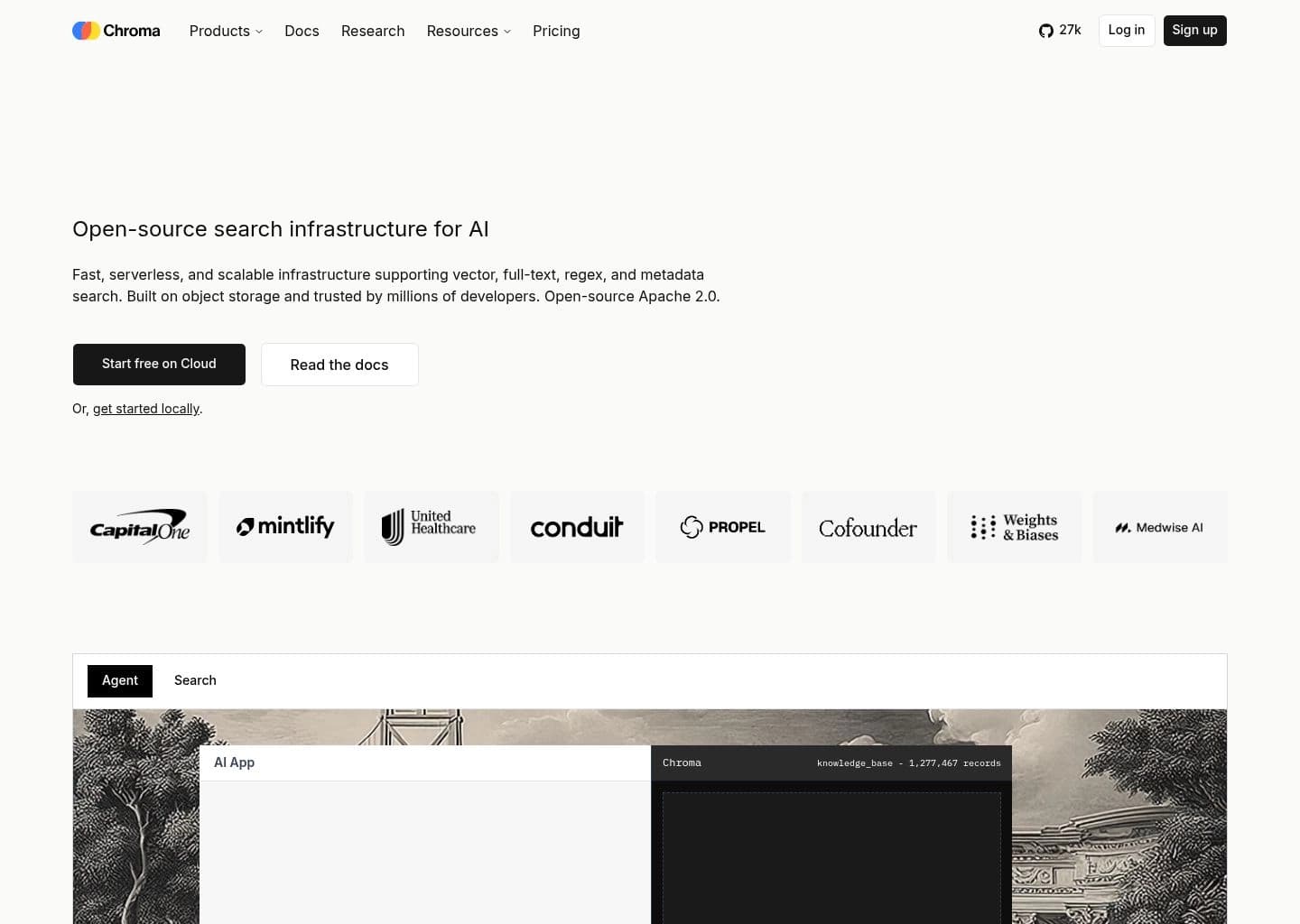
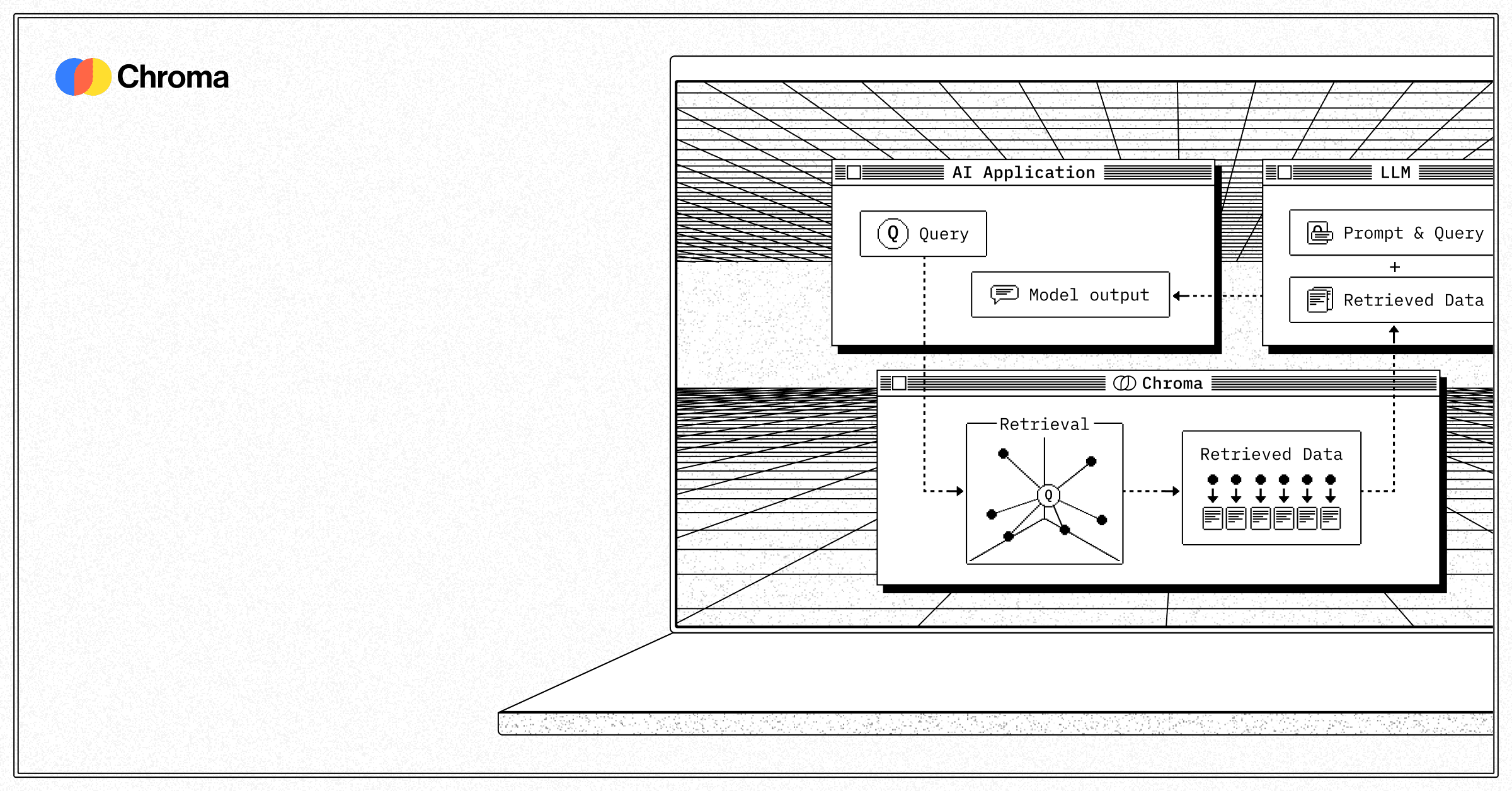
Chroma is an open-source search and retrieval database purpose-built for AI applications, designed to be the storage layer behind retrieval-augmented generation (RAG) pipelines, AI agents, and semantic search systems. The company was founded in 2022 by Anton Troynikov and Jeff Huber and is headquartered in San Francisco, raising an $18 million seed round in April 2023 led by Quiet Capital. Chroma became one of the most widely adopted open-source vector databases during the 2023 LLM boom, spreading primarily through a simple "pip install chromadb" developer experience and deep integration with popular frameworks like LangChain and LlamaIndex. Today it has more than 26,000 GitHub stars, is used in over 90,000 other open-source codebases, and is downloaded more than 11 million times a month, with production users including Capital One, Weights & Biases, UnitedHealthcare, Live Nation, Cisco, Intel, and Sony.
At the core of Chroma's product is a unified query interface spanning five search methods: dense vector search for semantic similarity, sparse vector search using BM25 and SPLADE for lexical precision, full-text and regex matching, and metadata filtering, all combinable through hybrid search for better retrieval quality than any single method alone. The same Apache 2.0-licensed codebase powers both the free, self-hosted single-node version (installable via pip, npm, or Docker, with in-memory or persistent storage) and Chroma Cloud, the company's fully managed, serverless offering that reached general availability in August 2025. Chroma Cloud is built on a Rust engine called Chroma Distributed, running on S3-style object storage with intelligent data tiering between memory, SSD cache, and cold object storage, and is SOC 2 Type 2 certified across AWS and GCP regions in the US and EU.
Newer capabilities extend Chroma well beyond a basic vector store: Forking lets teams duplicate a collection instantly for A/B testing or rollouts without re-indexing costs, Web Sync automatically crawls, chunks, and embeds entire websites (docs, changelogs, support pages) directly into a Chroma collection, and a Package Search MCP lets AI agents query thousands of open-source repositories directly. Technical specs for Chroma Cloud include support for up to 1 million collections per database, 5 million records per collection, 30 MB/s write throughput per collection, and warm query latencies around 20ms at p50, scaling to sub-2-second cold queries at p99.
Chroma's pricing is refreshingly simple for a usage-based infrastructure product: self-hosting is entirely free, and Chroma Cloud starts with $5 in free credits and no minimum spend, billed across four transparent usage dimensions (data written, data stored, data queried, and egress). This makes Chroma an excellent starting point for developers prototyping RAG systems and AI agents who want the simplest possible setup experience, while teams operating at very large scale or requiring the most mature multi-tenant SaaS isolation may still want to evaluate dedicated systems like Pinecone or Weaviate alongside it.
Key Features
- Unified vector, sparse (BM25/SPLADE), full-text, and metadata search in one query
- Hybrid search combining dense and sparse retrieval for higher-quality results
- Single-node, self-hosted mode with in-memory or persistent local storage
- Chroma Cloud: fully managed, serverless, auto-scaling with no manual tuning
- Bring-your-own-cloud deployment with multi-region replication and point-in-time recovery
- Forking for fast, cost-efficient dataset versioning and A/B testing
- Web Sync for automatically crawling, chunking, and embedding websites
- Native clients for Python, TypeScript, and Rust, plus a command-line interface
Pros
- Simplest developer experience of any vector database, with a Pythonic API that gets you running in minutes
- Same open-source codebase powers both self-hosted and Chroma Cloud, avoiding vendor lock-in
- Unifies dense vector, sparse vector, full-text, and metadata search in one query interface
- Transparent, granular usage-based pricing with genuinely free self-hosting and a no-minimum cloud tier
- Massive open-source adoption: 26,000+ GitHub stars, 90,000+ dependent projects, 11M+ monthly downloads
Cons
- Performance at massive scale (millions of vectors, very high query throughput) doesn't yet match dedicated solutions like Pinecone or Weaviate
- Multi-tenancy support is improving but still isn't at the level of Pinecone or Weaviate for true SaaS isolation
- Usage-based pricing across four separate meters (write, storage, query, egress) requires careful modeling for large or bursty workloads
- Chroma Cloud is a relatively newer managed offering (GA since August 2025), with a shorter production track record than older competitors
- Cold query latency (up to ~1.5s at p99) is meaningfully higher than warm queries, which matters for latency-sensitive applications
Pricing
Self-hosting Chroma is completely free and open source under the Apache 2.0 license, installable via pip, npm, or Docker with no usage limits. Chroma Cloud, the managed serverless offering, gives new accounts $5 in free credits with no minimum commitment, then bills usage across four transparent dimensions: $2.50 per GiB written, $0.33 per GiB-month stored, $0.0075 per TiB queried, and $0.09 per GiB of egress. The Team plan includes $100 of usage credits that do not roll over month to month. Enterprise pricing is fully custom and adds features like SOC 2 Type 2 compliance guarantees, dedicated clusters, AWS PrivateLink connectivity, customer-managed encryption keys, and direct Slack support with custom SLAs; interested teams should contact Chroma's sales team directly. Credits generally do not expire outside of the non-rolling Team plan allocation.
Claim Verified Creator Badge
Are you the founder of Chroma? Display this listing's verified badge on your website to show your customers that your product has been vetted and listed on AI Central Resources.
<a href="https://www.aicentralresources.com/tool/chroma" target="_blank" rel="noopener">
  <img src="https://www.aicentralresources.com/badges/featured-badge-dark.svg" alt="Featured on AICentralResources" width="200" height="54" style="border: none;" />
</a>
* Place this HTML snippet in your website's footer, landing page, or press section. This creates a search-friendly backlink directly to your verification page.
Connect with Chroma
Frequently Asked Questions
Chroma is an open-source search and retrieval database purpose-built for AI applications, unifying dense vector search, sparse vector search (BM25/SPLADE), full-text and regex search, and metadata filtering in a single query interface, commonly used as the storage layer behind RAG pipelines, AI agents, and semantic search.
Self-hosting Chroma (via pip, npm, or Docker) is completely free and open source under Apache 2.0. Chroma Cloud, the managed serverless offering, gives new signups $5 in free credits with no minimum, then charges usage-based rates: $2.50/GiB written, $0.33/GiB-month stored, $0.0075/TiB queried, and $0.09/GiB egress. The Team plan includes $100 of credits (non-rolling), and Enterprise pricing is custom.
Chroma works with any embedding model. By default it uses a local all-MiniLM-L6-v2 model for automatic embedding, but you can swap in OpenAI's text-embedding-3-small, Cohere's embed models, any sentence-transformers model, or pass your own pre-computed vectors directly.
Chroma was founded in 2022 by Anton Troynikov and Jeff Huber and became one of the most-adopted open-source vector databases during the 2023 LLM boom, spreading through its pip install chromadb developer experience and deep integration with LangChain and LlamaIndex. It has over 26,000 GitHub stars and is downloaded more than 11 million times a month.
Chroma is best known for its simple, Pythonic developer experience and fast local prototyping via its embedded, in-memory mode. Teams typically prototype with Chroma, evaluate pgvector if they already run Postgres, and move to dedicated systems like Pinecone or Weaviate when they need very large-scale, high-throughput production infrastructure.
Similar AI Tools to Chroma
View all alternatives of Chroma



MongoDB Atlas Vector Search
Build intelligent applications with vector search, hybrid search, and generative AI on your live data


Amazon Bedrock
The fully managed AWS platform for building generative AI applications and agents at production scale
Compared with Chroma
Direct head-to-head feature matrices, pricing, and category breakdowns