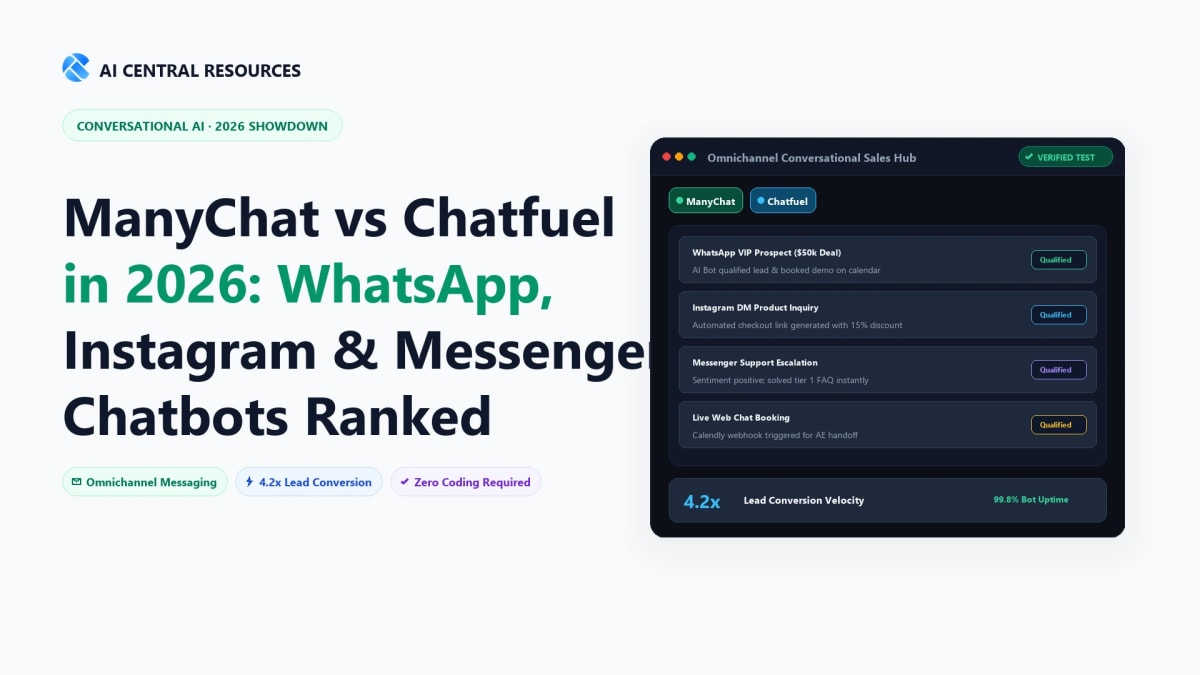
Direct messaging has officially dethroned email as the highest-converting digital channel in modern e-commerce, creator monetization, and lead generation. When an Instagram user drops a comment saying "LINK" on your latest Reel, or a prospective buyer sends a WhatsApp query asking "Do you ship to Canada?", waiting even 15 minutes to respond causes conversion rates to plummet by over 400%. Automated messaging isn't a luxury anymore; it is the frontline of your sales pipeline.
For years, two platforms have dominated conversational marketing: ManyChat and Chatfuel. Both started as simple Facebook Messenger bot builders, but as Meta's ecosystem shifted toward Instagram DMs and WhatsApp Business API, both tools underwent radical reinventions—incorporating ChatGPT-powered autonomous agents, e-commerce checkouts, and CRM integrations. However, they have evolved in very different directions.
In this in-depth, hands-on comparison, we pit ManyChat against Chatfuel across every critical dimension: Instagram DM trigger versatility, official WhatsApp Business API management, visual flow construction, AI agent autonomy, and the hidden traps of their pricing models.
⚡ The 30-Second Executive Verdict
Choose ManyChat if your primary growth engine is Instagram. Its comment-to-DM triggers, Story mention automations, and intuitive infinite-canvas flow builder make it the undisputed king for creators, course creators, and DTC brands driving viral social traffic.
Choose Chatfuel if your business runs on WhatsApp and you need an autonomous ChatGPT support agent. Chatfuel's seamless green-badge WhatsApp Business API onboarding, knowledge-base training (PDF/URL ingestion), and flexible per-conversation billing make it superior for international customer service and high-volume e-commerce stores.
ManyChat vs. Chatfuel: 2026 Feature & Capability Matrix
| Key Capability | ManyChat | Chatfuel | Category Verdict |
|---|---|---|---|
| Instagram DM Automation | Exceptional (Reels, Stories, Comments, Live) | Good (Standard DMs & Comments) | 🏆 ManyChat Wins |
| Official WhatsApp Business API | Supported (Add-on fees apply) | Native Meta Cloud API Partner | 🏆 Chatfuel Wins |
| Native AI Agent (LLM Integration) | Basic AI Step + OpenAI API Webhook | Native ChatGPT Bot trained on docs/URLs | 🏆 Chatfuel Wins |
| Flow Builder Experience | Visual Node Canvas (Mind-map style) | Block-based / Card sequence list | 🏆 ManyChat Wins |
| Shopify & E-commerce Sync | Native Shopify App & Webhooks | Native Shopify App & WhatsApp Catalog | ⚖️ Tie |
| Multi-Agent Live Chat Inbox | Basic Team Inbox with tags | Shared Inbox with Agent routing | ⚖️ Tie |
| Pricing Model Structure | Billed by total active contacts/subscribers | Billed by monthly conversations / flat tier | Depends on List Size |
1. Instagram DM Automation: Why ManyChat Still Rules Social

If you've ever commented the word "RECIPE" or "GUIDE" on an influencer's Instagram Reel and immediately received a DM containing the link 2 seconds later, you were interacting with ManyChat. It was the first platform officially recognized as a Meta Business Partner for Instagram Messaging, and it remains the gold standard for Instagram growth funnels.
Where ManyChat Dominates on Instagram:
- Reels & Post Comment Triggers: Automatically detects specific keywords in comments on all posts, specific Reels, or future posts. It replies publicly with varying randomized comments (to appease Instagram's spam algorithm) while instantly sending the direct message payload.
- Instagram Story Mention Auto-Responders: When a customer tags your brand in their Instagram Story, ManyChat detects the mention instantly and delivers a thank-you message with an exclusive discount code or personalized greeting.
- Story Reply Triggers: Prompt viewers on your Stories with "DM me 'SCALE' to get the PDF". ManyChat captures the inbound DM, collects their email address directly inside the chat window, and pings your CRM.
- Instagram Live Automations: During a live broadcast, pin a comment instructing viewers to type a keyword in the chat. ManyChat delivers the purchase link directly to their inbox while you continue presenting.
Chatfuel also supports Instagram DM automation and comment triggers, but its setup is noticeably more rigid. Chatfuel requires navigating through disconnected trigger blocks, whereas ManyChat allows you to visualize the entire comment-to-DM-to-email-capture journey on a single interactive drag-and-drop map.
2. WhatsApp Business API: Why Chatfuel Wins Global Messaging

While Instagram is the primary sales channel in North America and Western Europe, WhatsApp is the undisputed backbone of commerce across Latin America, Europe, the Middle East, India, and Southeast Asia. If your customers live on WhatsApp, Chatfuel is built specifically for your needs.
Where Chatfuel Dominates on WhatsApp:
- Frictionless WhatsApp Business API Setup: Setting up an official WhatsApp Business API account through Meta's Cloud API can be a bureaucratic nightmare. Chatfuel streamlines this into a 10-minute self-serve onboarding process, handling phone number porting and green checkmark badge verification applications.
- Native WhatsApp Catalog Checkout: Sync your entire Shopify or WooCommerce inventory directly into WhatsApp. Customers can browse product collections, select sizes, add items to a WhatsApp cart, and checkout without ever leaving the chat.
- Compliant Broadcast Campaigns: Easily submit pre-approved Meta message templates for order notifications, back-in-stock alerts, and promotional broadcasts while strictly adhering to Meta's 24-hour customer service window guidelines.
- Multi-Agent Number Sharing: Connect one single official business WhatsApp phone number to 50+ customer support agents with smart ticket routing and department assignments.
ManyChat does support WhatsApp, but it feels like a secondary add-on bolted onto an Instagram-first engine. Its WhatsApp template approval workflow is clunky, and its pricing structure introduces unexpected surcharges on top of Meta's standard conversation fees.
3. AI Agents & ChatGPT Integration: Traditional Rules vs. Autonomous Reasoning
The most significant divergence between these two platforms in 2026 is how they handle generative AI. Old-school chatbots relied on rigid if-this-then-that keyword matching. If a user asked "Do you have vegan options?", the bot would look for the word "vegan". But if the user typed "Is this made with plant-based ingredients?", the bot broke and displayed an embarrassing "Sorry, I didn't understand that."
Chatfuel's Approach: The Native Autonomous AI Agent
Chatfuel has embraced OpenAI's GPT-4o architecture at a foundational level. Inside Chatfuel, you can create an autonomous AI Agent in minutes by uploading your company's knowledge base:
- Upload PDF product manuals, return policies, and FAQ spreadsheets.
- Input your public website URL for automatic web crawling and indexing.
- Set strict guardrails, brand personality guidelines, and prohibited topics.
When a customer asks a complex question in any language (e.g. Portuguese, Arabic, or German), Chatfuel's AI synthesizes an accurate, contextual answer directly from your documentation. If the customer expresses frustration or asks to speak with a human, the AI smoothly routes the conversation to a live agent without dropping context.
ManyChat's Approach: AI Steps Inside Deterministic Flows
ManyChat treats AI as an optional node within its traditional flow architecture. You can add an "AI Step" to recognize user intent or generate a dynamic response, but it lacks Chatfuel's native document-upload training suite. To build an equivalent autonomous agent in ManyChat, you often need to set up external webhooks to Make or Zapier to query an external vector database—adding unnecessary latency and complexity to your tech stack.
4. The Visual Flow Builder: Canvas Usability Comparison
Building messaging funnels requires rapid iteration. Here is how their building interfaces compare:
ManyChat's Flow Builder:
ManyChat features an expansive, infinite-canvas visual flow builder that feels like Miro or Figma. You drop message blocks, add delay timers, create condition checks (e.g., "Has user clicked link?"), and connect them with intuitive bezier curves. You can zoom out to view your entire multi-channel marketing architecture at a glance, duplicate entire branching sequences in seconds, and execute built-in A/B split tests with live conversion tracking.
Chatfuel's Flow Builder:
Chatfuel uses a hybrid block/card approach. While it has introduced visual mapping elements, it still retains its heritage of vertical card stacks. Creating linear conversational paths is straightforward, but when you build intricate multi-tier logic—such as evaluating lead scores, checking inventory tags, and scheduling follow-up delays—the interface feels cramped compared to ManyChat's fluid canvas.
5. The Pricing Trap: Contacts vs. Conversations
Before entering payment details, you must understand the fundamental difference in how these two platforms bill your account. Choosing the wrong pricing structure can easily inflate your monthly software bill by hundreds of dollars.
| Billing Metric | ManyChat Model | Chatfuel Model |
|---|---|---|
| Core Billing Basis | Total Active Contacts in Database | Monthly Conversation Volume |
| Starting Plan Cost | $15/month (up to 500 contacts) | $29/month (up to 500 conversations) |
| Scaling at 25,000 Volume | ~$195 / month | Custom / Conversation tiers |
| The Hidden Gotcha | You pay for old, dormant subscribers every month unless you run automated list-pruning rules. | Meta's native per-conversation utility and marketing fees apply on top of Chatfuel's tier. |
The ManyChat Gotcha: ManyChat charges based on your total subscriber list size, identical to email marketing software like Mailchimp or Klaviyo. If 30,000 people DM your Instagram account over 6 months to claim a discount code, your ManyChat bill jumps to over $200/month—even if 28,000 of those users never message you again. To keep costs low on ManyChat, you must configure automated rules to delete or unsubscribe dormant contacts every 90 days.
The Chatfuel Gotcha: Chatfuel charges based on conversation volume rather than static contact counts. If someone messages you once this month, they count toward your monthly conversation allowance. If they don't message you next month, they cost you $0. However, on WhatsApp, you must factor in Meta's mandatory per-conversation utility and marketing rates, which vary by recipient country code.
Looking for Alternatives? Two Tools to Consider
If neither ManyChat nor Chatfuel fits your operational model, consider these two specialized alternatives:
- Tidio: If your primary traffic lands on your website rather than Instagram or WhatsApp, Tidio is superior. It combines website live chat, automated chatbot sequences, and an AI agent (Lyro) with an integrated helpdesk ticketing system.
- Intercom: For funded SaaS startups and enterprise businesses needing deep product analytics, automated user onboarding tours, and enterprise-grade SLA routing, Intercom's Fin AI Agent is the gold standard (though at a significantly higher price point).
Final Verdict: Which Tool Should You Pick?
Pick ManyChat If:
- Your core lead generation channel is Instagram (Reels, Story mentions, DM triggers).
- You want an intuitive, visual drag-and-drop canvas to design multi-branch promotional funnels.
- You are a creator, coach, course seller, or influencer who relies on organic comment-to-DM viral hooks.
- You are disciplined about running automated list-pruning workflows to prevent subscriber creep.
Pick Chatfuel If:
- WhatsApp is your business's primary customer communication and sales channel.
- You need an autonomous ChatGPT agent that learns from your website and PDF documentation.
- You run an international e-commerce store with catalog shopping and multi-agent customer support.
- You prefer paying for active conversation volume rather than paying perpetual fees for an inactive contact list.
Related Social Automation & Marketing Guides
Scale your social customer acquisition pipelines with our tested playbooks and automation benchmarks:
- 10 Best No-Code AI Automation Tools in 2026 — Discover top workflow platforms like Make, n8n, and Relay.app.
- How to Automate Your Entire Work Life with AI — Connect CRM leads, email notifications, and automated follow-ups.
- Interactive ManyChat vs. Chatfuel Feature Matrix — Side-by-side comparison of channels, pricing tiers, and API limits.
- Explore All AI Productivity & Marketing Tools — Browse verified software listings with real community reviews.
Frequently Asked Questions
Is ManyChat or Chatfuel better for Instagram DM automation?
ManyChat is the undisputed industry leader for Instagram automation. Its visual flowchart builder makes it effortless to trigger automated direct messages whenever someone comments a specific keyword on your Reel, replies to your Story, or sends an initial DM. Chatfuel supports Instagram, but its ecosystem and community templates are heavily geared toward WhatsApp.
Can using ManyChat or Chatfuel get my Instagram or WhatsApp account banned?
No. Both ManyChat and Chatfuel are official Meta Business Partners. They connect exclusively through Meta's verified Instagram Graph and WhatsApp Cloud APIs via secure OAuth authentication. They never request your account password and strictly operate within Meta's authorized rate limits and anti-spam safety rules.
What is Meta's 24-hour messaging window and how does it work?
Meta enforces a 24-hour customer service window on Instagram DMs and WhatsApp. When a user initiates a message, businesses have 24 hours of unrestricted, free automated back-and-forth messaging. After 24 hours elapse, you cannot send unprompted marketing broadcasts on Instagram without a user re-engaging, while WhatsApp requires approved, paid Message Templates.
How does Chatfuel's conversation-based pricing compare to ManyChat's contact tier pricing?
ManyChat charges based on your total active contact list size, while Chatfuel charges per conversation session. With ManyChat, you continue paying for contacts in your database even if they haven't interacted in months (requiring periodic list cleanup). With Chatfuel, you only pay when an active conversation occurs within the billing cycle, which can be significantly more economical for seasonal e-commerce stores.
Can I connect both ManyChat and Chatfuel to the same social media profile?
No, you should never connect two bot providers to the same social profile simultaneously. Doing so creates conflicting webhook listeners that send duplicate, overlapping automated replies. However, you can safely use ManyChat for Instagram DMs and Chatfuel for your dedicated WhatsApp Business phone number.
Do I need coding skills to train an AI customer service agent?
No coding is required. Both platforms provide visual no-code builders. In Chatfuel, you can upload PDF product manuals or paste your website URL to instantly ground ChatGPT responses in your business knowledge. In ManyChat, you can integrate ChatGPT and OpenAI API prompts directly into visual flow nodes.