For modern finance leaders, corporate controllers, and VP-level CFOs, managing company spend has evolved far beyond reimbursing employee coffee runs or handing out plastic credit cards with shared limits. In 2026, mid-market companies and hyper-growth enterprises manage hundreds of software subscriptions, thousands of cross-border vendor invoices, complex purchase order approval hierarchies, and multi-entity general ledger reconciliations. Operating with fragmented tools—a corporate card from a legacy bank, an accounts payable portal from Bill.com, expensing in Expensify, and manual procurement in Google Sheets—creates unmanageable operational drag and audit risk.
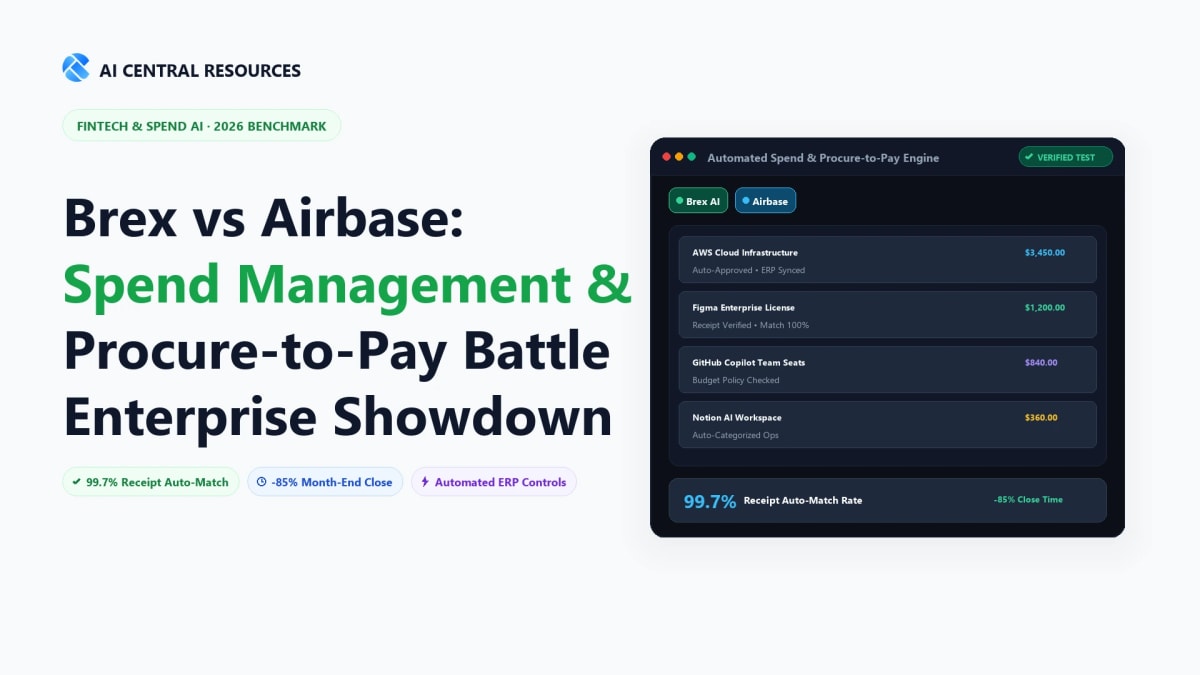
This operational friction has accelerated the battle between all-in-one spend management powerhouses: Brex and Airbase (by Paylocity). While both platforms promise to consolidate non-payroll expenditures into a unified command center, they approach the spend problem from fundamentally opposing architectural paradigms:
- Brex originated as a venture-backed corporate credit card for high-growth tech startups and has expanded into Brex Empower—a global financial operating system offering high-limit corporate cards, multi-currency local accounts in 50+ countries, automated expense management, travel booking, and venture treasury vaults.
- Airbase was architected from day one around Intake-to-Pay procurement and guided AP workflows for mid-market and enterprise accounting teams. Following its acquisition by Paylocity, Airbase now combines deep 3-way PO matching, complex multi-stakeholder legal/IT approval routing, and tight payroll/HR headcount synchronization.
Whether you are transitioning from early-stage Series A growth to mid-market maturity or consolidating legacy finance tools ahead of an ERP migration to NetSuite or Sage Intacct, this 2026 comparative breakdown evaluates real-world procurement workflows, card controls, AP automation, multi-entity ERP syncing, and total cost of ownership.
⚡ The 30-Second Executive Verdict
Choose Brex if you are a high-growth tech company, multinational corporation, or venture-backed enterprise requiring high-limit corporate cards without personal guarantees, local currency card issuance in 50+ countries, built-in global travel booking, and high-yield treasury management.
Choose Airbase (by Paylocity) if your primary operational bottleneck is guided procurement intake, mandatory 3-way purchase order (PO) matching, complex multi-tier approval chains (Legal, IT, InfoSec, Finance), and seamless integration with Paylocity HR/payroll.
Choose Ramp if your primary objective is AI-driven vendor contract price benchmarking, automated receipt extraction, and aggressive cost-reduction intelligence without requiring high-touch procurement configuration.

Core Architectural Differences: Card-First vs. Procurement-First
To understand why CFOs choose one platform over the other, you must look at where each platform sits in the transaction lifecycle. Spend management platforms are fundamentally built from one of two directions: Point of Sale (Post-Spend Governance) or Intake Requisition (Pre-Spend Governance).
1. Brex: The Card-Led, Autonomous Spend Engine
Brex was designed for velocity. In traditional corporate cards, employees swipe first, submit receipts weeks later, and accounting teams spend days reconciling discrepancies. Brex flips this with Empower Budgets. Finance leaders assign dynamic budgets (e.g., $10,000/quarter for Marketing Demand Gen or $1,500 for a San Francisco conference), and Brex automatically applies card-level policy logic in real time. If an employee tries to swipe outside the designated merchant category or over the assigned budget limit, the transaction is declined at the terminal.
Receipt matching in Brex is nearly invisible. Thanks to Brex AI and direct data feeds with merchants (like Lyft, Uber, DoorDash, and Amazon Business), line-item receipt metadata is captured automatically. If manual verification is required, employees simply text a photo of the receipt or let the Brex mobile app match it via OCR within seconds.
2. Airbase: The Intake-to-Pay Procurement Fortress
Airbase approaches spend from the perspective of an enterprise corporate controller who cannot afford rogue SaaS purchases or compliance failures. Airbase starts before a dollar is committed. When an engineering manager needs a $50,000 annual Datadog contract, they don't swipe a card; they initiate a Procurement Request inside Airbase or directly via Slack/Teams.
Airbase automatically orchestrates the intake journey: it routes the contract to Legal for redlining, to InfoSec for SOC 2 compliance review, to the Department VP for budget verification, and finally to the AP team to generate a Purchase Order (PO). Once the vendor delivers the service and sends the invoice, Airbase performs automated 3-way matching (Purchase Order + Receiving Confirmation + Vendor Invoice) before releasing payment. This eliminates duplicate payments and ensures complete audit-readiness.

Head-to-Head Feature Comparison
To help finance and operations teams evaluate both solutions systematically, we evaluated Brex and Airbase across five core operational pillars.
Pillar 1: Procurement & Purchase Order Management
Airbase Winner: Airbase is unquestionably the superior tool for organizations that require structured procurement protocols. Its guided intake forms allow non-technical employees to submit purchase requests without knowing which general ledger code or approval chain is required. Airbase dynamically asks contextual questions based on spend threshold (e.g., requests over $25,000 trigger CFO review, while software handling PII triggers InfoSec sign-off).
Airbase supports line-item purchase orders, blanket POs for recurring service retainers, and seamless two-way and three-way matching against NetSuite, Sage Intacct, and QuickBooks Online. Furthermore, Airbase tracks software renewals, alerting procurement teams 90 days before contracts auto-renew.
Brex Capabilities: Brex has invested heavily into procurement features with Brex Pay and purchase order workflows. However, Brex's procurement module is designed primarily for lightweight approvals rather than complex multi-department contract negotiation pipelines. If your organization processes hundreds of complex POs each quarter with line-item receiving requirements, Airbase offers deeper granularity.
Pillar 2: Corporate Credit Cards & Global Multi-Currency Issuance
Brex Winner: Brex is the undisputed leader in corporate cards and global treasury flexibility. For international enterprises and multinational teams, Brex offers native local currency card issuance across 50+ countries. This means a London-based employee receives a card billed and settled in GBP via local UK rails, avoiding costly 2-3% foreign exchange (FX) conversion fees and cross-border interchange penalties.
Brex provides flexible underwriting options: venture-backed companies can qualify for dynamic limits based on cash balance (up to 10-20x traditional bank limits without personal guarantees), while mature mid-market firms can choose 30-day billing terms or daily auto-pay schedules. Brex also offers dedicated single-use virtual cards for vendor subscriptions with automated budget caps.
Airbase Capabilities: Airbase offers robust physical and virtual corporate cards issued on the Visa network with up to 1.75% cash back. Airbase cards excel at vendor subscription management—you can create a dedicated virtual card locked to a specific vendor with a monthly spend ceiling. However, Airbase's card capabilities are centered heavily around US and Canadian entities; its international card footprint relies on partner networks rather than native local banking rails in dozens of jurisdictions.
Pillar 3: Accounts Payable & Invoice Processing Automation
Both platforms provide automated AP workflows, OCR invoice scanning, and multi-method payment execution (domestic ACH, international wire, corporate check, and virtual card). However, their operational depth diverges:
- Airbase AP Automation: Airbase functions as a complete replacement for legacy accounts payable platforms like Bill.com. It features dedicated vendor self-service onboarding portals where suppliers securely upload W-9s, banking details, and contact info. When an invoice arrives in the AP inbox, Airbase's AI OCR parses line items, tax IDs, and payment terms, matching them to existing POs and flagging discrepancies before posting to the general ledger.
- Brex Bill Pay: Brex Bill Pay has improved dramatically, offering smart invoice ingestion via email forwarding, automatic GL code prediction, and global payment execution across 120+ countries. Brex Bill Pay is exceptionally fast for high-volume international wires and recurring SaaS invoices, though it lacks Airbase's specialized vendor compliance portal.
Pillar 4: ERP Integrations & Multi-Entity Reconciliation
For finance teams managing multiple subsidiaries, international branches, and consolidated accounting, real-time general ledger synchronization is vital. Both Brex and Airbase offer native bidirectional integrations with enterprise ERP systems including Oracle NetSuite, Sage Intacct, QuickBooks Online, and Xero.
Airbase ERP Depth: Airbase is renowned in the NetSuite and Intacct communities for its advanced multi-entity synchronization. Airbase syncs line-item detail, amortization schedules, prepaid expense allocations, and intercompany transactions directly into NetSuite without requiring third-party middleware (like Celigo). Each transaction is categorized with the correct department, class, location, and subsidiary tags before it touches the general ledger.
Brex ERP Depth: Brex provides real-time transaction syncing, automated rule mapping, and multi-entity consolidation. Brex automatically creates journal entries for card swipes, bill payments, and reimbursements. For standard mid-market setups, Brex's ERP sync cuts month-end close time from days to hours. However, for complex accrual accounting and amortized software contracts, Airbase offers deeper out-of-the-box configuration.
Pillar 5: Travel Management & Global Employee Expense Reimbursements
Brex Winner: In 2026, corporate travel cannot be separated from spend management. Brex includes Brex Travel, built on the next-generation Spotnana travel engine. Employees can search, book, and modify flights, hotels, and rail directly inside the Brex app while enterprise travel policies are enforced dynamically (e.g., flight price caps, hotel star ratings, approved airlines). Brex covers out-of-pocket reimbursements in 40+ local currencies, depositing funds directly into international employee bank accounts in 1-2 business days.
Airbase Capabilities: Airbase handles out-of-pocket expense reimbursements efficiently with automated mileage tracking, receipt OCR, and rapid direct deposit. However, Airbase does not provide a native travel booking engine; companies using Airbase typically pair it with dedicated travel software like Navan or TravelPerk.
Comprehensive Feature Comparison Matrix
| Evaluation Dimension | Brex (Empower) | Airbase (by Paylocity) | Ramp (Alternative) |
|---|---|---|---|
| Primary Focus | Global Cards, Spend & Travel | Guided Procurement & AP Automation | AI Cost Optimization & Spend Controls |
| Credit Card Limits | Dynamic cash-backed (up to 10-20x) or 30-day terms | Pre-funded or 30-day corporate limits | Dynamic limits based on cash flows |
| Global Local Card Issuance | 50+ Countries (Local currency settlement) | US & Canada native (International via partners) | US, UK, and select EU entities |
| Procurement Intake Workflows | Standard pre-spend budget approvals | Advanced guided intake, legal/IT routing & POs | Ramp Procurement & contract reviews |
| 3-Way PO Matching | Supported (Basic to Intermediate) | Enterprise-grade 2-way & 3-way line item match | Supported with ERP sync |
| Integrated Travel Booking | Built-in (Brex Travel / Spotnana) | Integrates with 3rd-party tools (Navan) | Ramp Travel & integrated booking |
| ERP Integration Depth | NetSuite, Intacct, QuickBooks, Xero | Deep NetSuite & Intacct multi-entity sync | NetSuite, Sage Intacct, QuickBooks, Xero |
| HR & Payroll Ecosystem | Universal HRIS sync (Workday, Gusto, Rippling) | Native Paylocity HR/Payroll + HRIS sync | Universal HRIS sync (Rippling, Gusto, Workday) |
| Cashback / Rewards | Brex Rewards points (Transferrable to miles/cash) | Up to 1.75% cash back on card spend | Up to 1.5% - 2.0% cash back |
Top 3 Alternatives to Consider in 2026
If neither Brex nor Airbase aligns perfectly with your financial operations, three other major players dominate the 2026 spend management landscape.
1. Ramp: The Cost-Cutting & Vendor Price Intelligence Leader
Ramp is Brex's fiercest rival in the modern corporate card and spend space. Where Brex emphasizes global venture banking and international scale, Ramp focuses relentlessly on saving finance teams money. Ramp analyses your company's vendor contracts against thousands of anonymized data points across other Ramp customers, telling you if you are overpaying for Zoom, Slack, Salesforce, or AWS.
Ramp's automated receipt matching, AI contract parsing, and clean UI make it a favorite for US and UK mid-market businesses that want minimal friction and transparent 1.5% cashback on all transactions.

2. Navan (Formerly TripActions): The Unified Travel & Expense Powerhouse
For organizations where 60%+ of corporate spend is generated by business travel, field sales teams, and client entertainment, Navan offers the most integrated corporate travel and card ecosystem. Navan combines a world-class consumer-grade travel booking engine (with 24/7 live travel agent support via chat) and automated Navan Expense corporate cards that enforce travel per diems in real time at the point of purchase.

3. BILL (Bill.com): The SMB Accounts Payable & Receivable Clearinghouse
For small-to-midsize businesses (SMBs) and accounting firms that primarily need reliable domestic and international vendor bill pay without complex procurement hierarchies, BILL remains the entrenched standard. While its user experience is more traditional than Brex or Ramp, BILL's payment network connects over 5 million network members, simplifying payment routing and two-way QuickBooks / Xero reconciliations.

Pricing, Licensing Models & Total Cost of Ownership (TCO)
Understanding the financial model of spend management platforms requires looking beyond the advertised monthly SaaS license. Platforms monetize through three streams: Software Subscription Fees, Interchange Share (from card swipes), and Transaction Fees (wire fees, FX spreads, ACH costs).
Brex Pricing Architecture
- Brex Essentials (Free Tier): Basic corporate cards, expense tracking, Bill Pay, and travel booking for startups and emerging teams at zero monthly software cost. Brex monetizes via card interchange fees.
- Brex Enterprise (Empower): Custom enterprise seat pricing (typically $12 - $18 per active user per month) for global multi-currency card issuance, custom ERP sync, advanced audit controls, and multi-entity budget governance.
- FX & Banking: Zero foreign transaction fees on international card purchases; competitive FX spreads on cross-border wire transfers.
Airbase (by Paylocity) Pricing Architecture
- Tiered Subscription Model: Airbase is sold as an enterprise software suite with three tiers: Standard (up to 100 employees), Premium (up to 500 employees), and Enterprise (500+ employees with multi-subsidiary NetSuite sync). Pricing is quote-based, typically starting around $5,000 to $20,000+ annually depending on employee headcount, modules activated (Procurement, AP, Cards), and ERP connectors.
- Paylocity Bundles: Companies utilizing Paylocity for HR and payroll can negotiate attractive unified bundle discounts combining payroll, benefits, and Airbase spend management into a single vendor contract.
- Cashback Offset: Airbase provides up to 1.75% cash back on corporate card spend, which many mid-market finance teams use to fully offset the annual software licensing cost.
Implementation & Migration Playbook for Finance Teams
Migrating financial infrastructure requires careful planning to prevent payment interruptions or accounting sync failures. Here is the practitioner implementation timeline:
Phase 1: General Ledger & Chart of Accounts Mapping (Days 1–7)
Connect your ERP (NetSuite, Sage Intacct, QuickBooks) in sandbox mode. Map your Chart of Accounts, tracking categories (Departments, Classes, Locations, Subsidiaries), and tax codes. Verify bidirectional sync permissions.
Phase 2: Policy & Approval Matrix Configuration (Days 8–14)
Establish spend thresholds and approval workflows. In Airbase, configure legal/IT intake questionnaires and PO thresholds. In Brex, build departmental budgets, auto-decline merchant categories, and receipt submission rules.
Phase 3: Vendor & Banking Transition (Days 15–21)
Transition recurring software subscriptions to virtual vendor cards. In Airbase, initiate vendor onboarding requests for W-9 collection. In Brex, fund local treasury accounts and configure automated daily or 30-day settlement accounts.
Phase 4: Employee Onboarding & Card Distribution (Days 22–30)
Roll out the mobile app to employees via Single Sign-On (Okta, Google Workspace, Microsoft Entra ID). Issue physical and Apple Pay / Google Wallet virtual cards. Run a 30-minute training session on receipt submission via Slack/SMS.
Decision Framework: Which Solution Fits Your Company in 2026?
Choose Brex If:
- ✓ You have a remote or international workforce needing cards in 50+ local currencies.
- ✓ You are a venture-backed tech startup requiring high credit limits without personal liability.
- ✓ You want built-in corporate travel booking (Brex Travel) unified with expense policies.
- ✓ You want an integrated venture banking and yield-bearing treasury account.
- ✓ Your culture favors autonomous employee spending governed by real-time budget guardrails.
Choose Airbase If:
- ✓ You require formal intake-to-pay procurement with multi-stakeholder approval routing.
- ✓ You rely on strict 3-way PO matching and line-item receiving before releasing AP payments.
- ✓ Your organization already uses (or plans to adopt) Paylocity for HR, payroll, and benefits.
- ✓ You operate complex multi-subsidiary NetSuite or Sage Intacct accounting structures.
- ✓ You want to consolidate procurement, AP automation, and corporate cards into one compliance workflow.
Frequently Asked Questions
Airbase or Brex: Which is better for complex multi-level budget approvals?
Airbase is superior for complex, procurement-heavy budget approvals and vendor purchase orders (POs). Airbase enforces strict pre-spend approval workflows before a single dollar is committed. Brex excels for high-velocity global corporate cards, automated receipt matching via SMS/WhatsApp, and real-time travel booking.
Which platform offers stronger vendor controls and contract tracking?
Airbase provides dedicated vendor management software including contract expiration tracking, automated W-9 collection, and amortization schedules. Brex provides virtual cards with custom category/merchant spending limits, but relies more on third-party integrations for full contract lifecycle management.
How does Paylocity’s acquisition of Airbase impact existing customers?
Paylocity's acquisition combines Airbase's AP automation and procurement suite directly with full-service payroll and HRIS capabilities. This gives mid-market finance teams a unified platform to manage employee payroll, 1099 contractor payouts, and corporate spend from a single general ledger interface.
How do Brex and Airbase compare to Ramp in 2026?
Ramp is the top-ranked alternative for high-growth tech companies looking to eliminate software seat licensing fees. While Airbase charges software subscription tiers for its advanced procurement module and Brex charges for Brex Pay/Enterprise, Ramp offers 1.5% cashback corporate cards with built-in AI price intelligence and contract negotiation assistants.
Can Brex support multi-currency spend across international subsidiaries?
Yes. Brex is one of the strongest global spend platforms, supporting local currency billing in 50+ countries with zero foreign transaction fees. This allows distributed global teams to issue virtual corporate cards funded directly from local foreign currency accounts without expensive FX conversions.
Explore Related Finance & Automation Guides
Streamline corporate workflows and financial tracking with our breakdowns: