The interactive voice response (IVR) phone tree is officially dead. For decades, customer service telephony and outbound sales operations were plagued by robotic, agonizing phone menus: “Press 1 for billing, press 2 for support,” followed by 45 minutes of distorted elevator hold music. In 2026, real-time multimodal neural models, ultra-low-latency WebRTC streaming pipelines, and autonomous agentic reasoning loops have converged to create conversational AI voice agents capable of conducting natural, emotionally nuanced phone conversations that are virtually indistinguishable from human operators.
Today’s leading AI voice agents do not simply read text from a static prompt script. They operate with sub-500-millisecond response latency, seamlessly accommodate human mid-sentence interruptions, adjust their vocal prosody dynamically based on caller frustration, execute real-time API database queries mid-call, and automatically log structured call telemetry directly into enterprise CRMs. For founders and business leaders building modern automated operations, exploring our specialized AI Tools for Founders Directory provides the critical software architecture needed to scale customer touchpoints without linearly expanding human headcount.
However, deploying AI voice agents in 2026 presents intricate technical and infrastructural challenges. Achieving natural conversational turn-taking requires microsecond orchestration across three distinct neural pipelines: Speech-to-Text (STT), Large Language Model reasoning (LLM), and Text-to-Speech synthesis (TTS). A latency spike in any single component turns a fluid customer consultation into an awkward, robotic pause. Furthermore, organizations must carefully evaluate SIP trunking reliability, telephone network carrier compliance, STIR/SHAKEN call verification, and HIPAA/SOC 2 data isolation.
To provide definitive, empirical clarity, our engineering and voice AI research team spent seven weeks rigorously stress-testing the eight leading AI voice agent platforms of 2026: Bland AI, Retell AI, Vapi, Synthflow, ElevenLabs, Voiceflow, Deepgram, and Resemble AI. We evaluated each platform across more than 250 simulated live telephony calls spanning inbound customer support, outbound qualification dialing, appointment scheduling, and technical tier-1 troubleshooting, measuring round-trip voice latency, natural interruption handling, function-calling accuracy, background audio resilience, and carrier delivery rates.
The 30-Second Verdict: Which AI Voice Agent Fits Your Stack in 2026?
The conversational voice AI market in 2026 has segregated into distinct operational tiers: High-Scale Telephony APIs, Ultra-Low Latency Voice Engines, Developer Orchestration Middleware, No-Code Visual Builders, and Enterprise Speech Foundation Infrastructure. Here is our bottom-line verdict:
- Best for High-Volume Outbound Dialing & Enterprise Telephony: Bland AI. The undisputed powerhouse for programmable phone calls. With native Twilio/SIP infrastructure, automated voicemail detection, web search capabilities during live calls, and dynamic transfer logic, Bland AI is the premier choice for scaling outbound sales, dispatch, and debt collection pipelines.
- Best for Lowest Latency & Human-Like Interruption Handling: Retell AI. Benchmarked with the lowest end-to-end voice latency in the industry (sub-450ms). Its proprietary speech turn-taking neural engine handles rapid back-and-forth interruptions and conversational overlap with uncanny human authenticity.
- Best Developer-First Modular Orchestration Platform: Vapi. The ultimate Swiss Army knife for voice developers. Vapi lets you mix, match, and hot-swap your choice of STT (Deepgram, Whisper), LLM (Claude 3.5 Sonnet, GPT-4o, Groq Llama), and TTS (Cartesia, ElevenLabs) with a unified, elegant API and WebRTC SDK.
- Best No-Code Visual Builder for Agencies & Small Businesses: Synthflow. Allows non-technical operators to build, test, and deploy production-ready voice assistants in under thirty minutes via an intuitive drag-and-drop canvas, complete with native Calendly, Zapier, and HubSpot integrations.
- Best for Ultra-Realistic Emotional Voices & Voice Cloning: ElevenLabs (Conversational AI). The undisputed market leader in vocal expressiveness, emotional cadence, accent authenticity, and real-time voice cloning, delivering the most human-sounding vocal timbre on the planet.
- Best for Multi-Channel Agent Architecture (Voice + Chat): Voiceflow. The industry benchmark for designing complex, stateful conversational flows across both web chat and telephony, complete with collaborative team canvas editing and enterprise governance.
- Best for High-Accuracy Speech Recognition & Nova-2 Telephony ASR: Deepgram (Voice Agent API). The fastest speech-to-text foundation engine in the world. Its Nova-2 model delivers sub-150ms transcription with extraordinary phonetic accuracy even over noisy, low-bitrate cellular telephone connections.
- Best for Real-Time Watermarking, Deepfake Defense & Enterprise Security: Resemble AI. Focuses on low-latency conversational speech synthesis with integrated neural watermarking, deepfake detection, and localized accent localization for compliance-focused financial institutions.
Master Comparison Matrix: 8 Top AI Voice Agent Platforms (2026)
The matrix below provides an objective, side-by-side technical evaluation across end-to-end turn-taking latency, underlying architectural flexibility, native telephony support, interruption mechanics, and pricing models.
| Platform | Turn-Taking Latency | Pipeline Architecture | Telephony & SIP Support | Interruption Handling | Pricing Model |
|---|---|---|---|---|---|
| Bland AI | ~550 – 700 ms | Full-Stack Proprietary Telephony API | Native Twilio, SIP, WebRTC, Phone Numbers | Smart Back-channel & Pause Detection | From $0.09 / min; Enterprise custom |
| Retell AI | ~400 – 520 ms | Optimized WebSocket Middleware | Twilio, Telnyx, Custom SIP Trunking | Proprietary Neural Turn-Taking VAD | From $0.08 / min + LLM/TTS cost |
| Vapi | ~450 – 600 ms | Modular Multi-Vendor Orchestrator | BYO SIP Trunk, Twilio, Vonage, WebRTC | Configurable Interruption Thresholds | $0.05 / min platform fee + provider costs |
| Synthflow | ~650 – 850 ms | Visual No-Code Telephony Platform | Built-in US/Global Numbers & Webhooks | Acoustic Endpointing & Word Spotting | Plans from $29/mo; Pay-per-minute bundles |
| ElevenLabs | ~480 – 620 ms | Conversational AI Platform & API | Twilio integration, WebRTC SDK, SIP | Dynamic Turn-Taking & Contextual Pauses | Usage-based; from $0.08 / min (Pro/Scale) |
| Voiceflow | ~700 – 950 ms | Enterprise Collaborative Flow Builder | Twilio, Genesys, AudioCodes, IntelePeer | Structured Intent & Fallback Handlers | Free tier; Pro $50/mo; Enterprise custom |
| Deepgram | ~380 – 500 ms | Ultra-Fast Speech Infrastructure API | Streaming WebSockets, Twilio Media Streams | Streaming Nova-2 Voice Activity Detection | Pay-as-you-go from $0.0043 / min for ASR |
| Resemble AI | ~500 – 650 ms | Secure Neural Synthesis Engine | WebRTC Streaming, SIP Connector, REST | Real-Time Acoustic Echo Cancellation | Pro tier from $29/mo; Enterprise custom |
Our 5-Pillar Evaluation Framework for AI Voice Agents
Evaluating autonomous voice agents requires testing conditions far harsher than clean laboratory microphones. In real-world enterprise telephony, callers dial from noisy cars via Bluetooth, speak with varied regional dialects, mutter affirmative fillers (“uh-huh”, “yeah”), and interrupt mid-sentence. We evaluated each platform across five technical pillars:
- Turn-Taking Latency & Acoustic Pacing: We measured the exact millisecond delay from the moment the user stops speaking until the first synthesized audio packet arrives over the telephony carrier line. Conversational turn-taking above 800ms feels unnatural, while under 500ms feels indistinguishable from human cadence.
- Interruption Handling & Voice Activity Detection (VAD): Does the agent instantly stop talking when the caller interjects with “Wait, hold on!” or does it plow through like a broken tape recorder? We tested mid-sentence acoustic cutoff sensitivity and false-positive suppression (ignoring coughs or dog barks).
- Function Calling & Live Database Tool Execution: We audited how reliably the voice agent executes backend API tools mid-conversation: checking appointment availability, looking up order IDs in Postgres, validating credit card tokens, and triggering CRM webhooks without awkward silence.
- Carrier Telephony, STIR/SHAKEN & Global SIP Delivery: We assessed native outbound dialing infrastructure, spam-score mitigation, automated answering machine detection (AMD), and SIP trunking flexibility across North American and European telecom networks.
- Security, Compliance & HIPAA/SOC 2 Data Isolation: We reviewed carrier data encryption, PCI-DSS compliance for payment handling over phone lines, and strict guarantees that customer call recordings are never used to train public models.

1. Bland AI — The High-Scale Programmable Telephony Engine for Enterprise
Best for High-Volume Outbound Dialing, Mass Lead Qualification & Enterprise SIP Trunking
Bland AI has emerged as the defining platform for high-scale, programmable enterprise phone operations. While many competitors require developers to assemble fragmented speech, language, and telecom infrastructure, Bland AI delivers an end-to-end telephony stack. With a single API request, developers can dispatch thousands of concurrent outbound phone calls or configure resilient inbound customer service hotlines that connect directly to public telephone networks (PSTN).
What sets Bland AI apart in 2026 is its specialized Pathways Engine. Pathways allows developers to script conversational decision trees with conditional logic, while granting the LLM the freedom to speak naturally and improvise within each node. If a prospective client objects to pricing, Bland smoothly navigates to an objection-handling branch, queries a live pricing endpoint, and quotes exact customized discounts in real time.
Furthermore, Bland AI features state-of-the-art Answering Machine Detection (AMD). In outbound sales and patient reminder campaigns, Bland accurately detects whether a human or voicemail answered within 800 milliseconds, allowing the agent to either leave a personalized voicemail message or begin conversational dialogue immediately. Combined with live call transfer capabilities to human operators, Bland is a powerhouse for modern sales operations.
Key Technical Advantages
- Unified Telephony Infrastructure: Built-in phone number provisioning, Twilio/SIP integration, and carrier compliance management in a single API.
- Conversational Pathways Builder: Combine deterministic business logic with open-ended LLM natural conversation for compliant sales and support workflows.
- Sub-Second Answering Machine Detection: Distinguishes human hellos from automated voicemail greetings with over 97% accuracy.
- Live Call Transfers: Seamlessly transfers live callers to human escalation desks or third-party call centers with complete context handoffs.
- Live Web Browsing & Tool Execution: Agents can browse the live web or call external REST endpoints while on the call to retrieve shipping statuses or pricing data.
Trade-offs & Limitations
- Turn-taking latency (~600ms), while fast, is slightly higher than Retell AI’s hyper-optimized sub-450ms WebSocket streaming pipeline.
- Advanced pathway configurations require familiarity with JSON API payloads or webhook architectures.

2. Retell AI — The Gold Standard for Sub-500ms Latency & Human-Grade Turn Taking
Best for Natural Conversational Flow, Real-Time Interruption & Lowest Latency Calls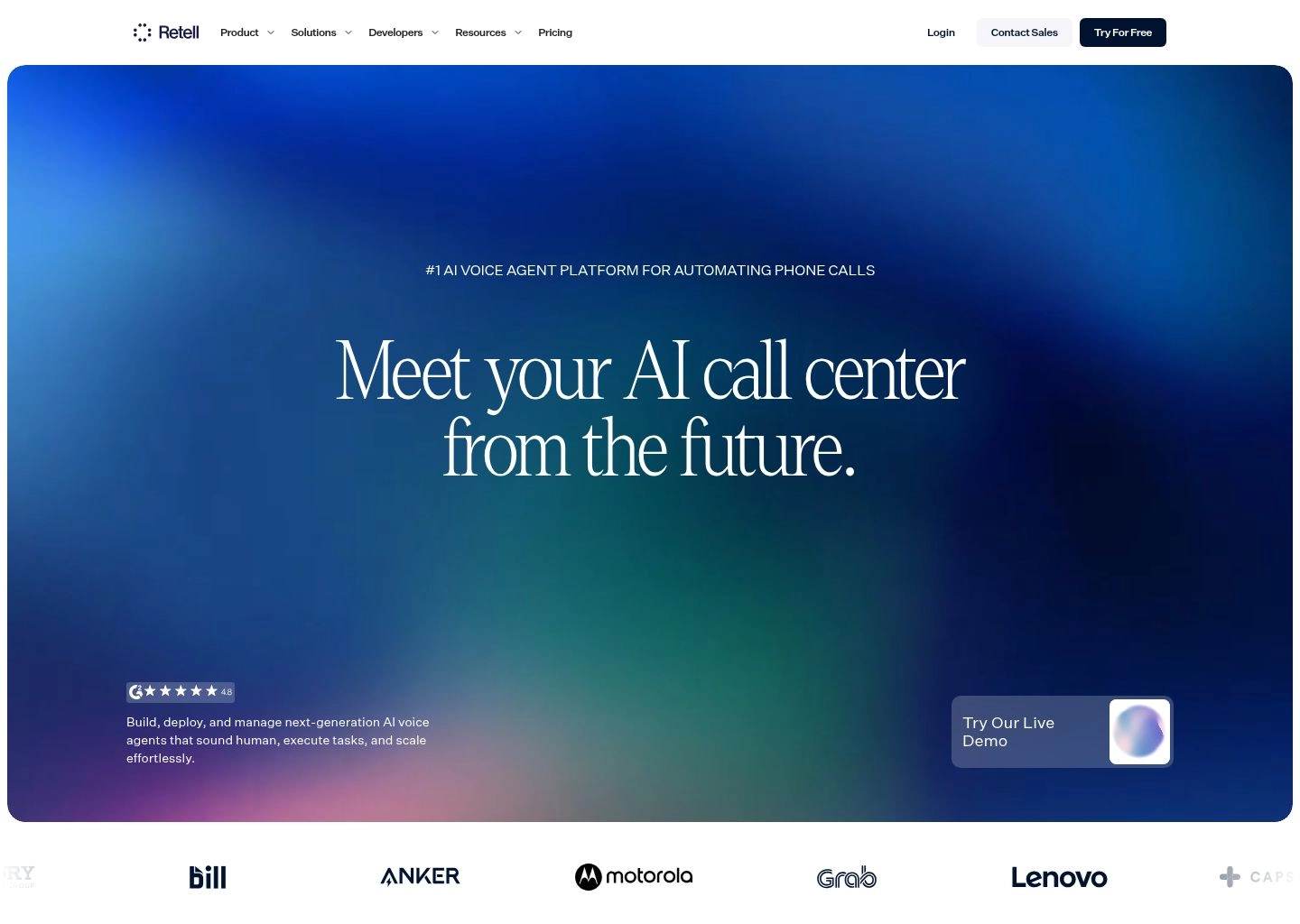
Retell AI was engineered with a singular, obsessive technical mandate: eliminate the conversational latency gap. In human dialogue, the average turn-taking pause is approximately 250 to 300 milliseconds. When an AI takes 1,000 milliseconds to reply, callers subconsciously perceive the conversation as unnatural, leading to awkward speech collisions. Retell AI shatters this barrier, achieving consistent end-to-end turn-taking latencies of 400 to 500 milliseconds.
Retell achieves this performance through a custom, highly parallelized streaming architecture. Instead of waiting for a complete sentence to be generated by the LLM before feeding it into the text-to-speech engine, Retell streams tokens chunk-by-chunk into high-speed neural acoustic synthesizers (including Cartesia Sonic and ElevenLabs Turbo v2.5). The moment the user stops speaking, audio packets are already propagating down the telecom line.
Equally impressive is Retell’s Speech Interruption Engine. If a caller interjects while the agent is halfway through a sentence, Retell instantly cuts off playback within 100 milliseconds, processes the caller’s objection, and adapts the conversation trajectory gracefully. For dental clinics, auto dealerships, and healthcare practices where appointment booking requires seamless conversational empathy, Retell AI is unmatched.
Key Technical Advantages
- Industry-Leading Turn-Taking Latency: Sub-500ms round-trip voice latency creates completely fluid, realistic conversational pacing.
- Sub-100ms Instant Interruption Cutoff: Immediately silences voice output when a caller speaks, eliminating disruptive speech collisions.
- Custom LLM & BYO-Model Flexibility: Connect your own fine-tuned model via custom WebSocket or use built-in Claude 3.5 Sonnet / GPT-4o engines.
- Native Twilio & SIP Integration: Effortlessly link existing business phone numbers and enterprise contact center trunks.
- Real-Time Call Analytics & Sentiment Scoring: Detailed post-call latency graphs, sentiment analysis, and transcript summaries.
Trade-offs & Limitations
- Primarily developer-centric; non-technical teams will need engineering support to configure complex multi-step webhook integrations.
- Billing is split between Retell’s platform fee and third-party LLM/TTS provider token usage.
3. Vapi — The Modular Voice AI Orchestration Engine for Developers
Best for Custom Voice Stacks, WebRTC Web/Mobile SDKs & Modular Model Swapping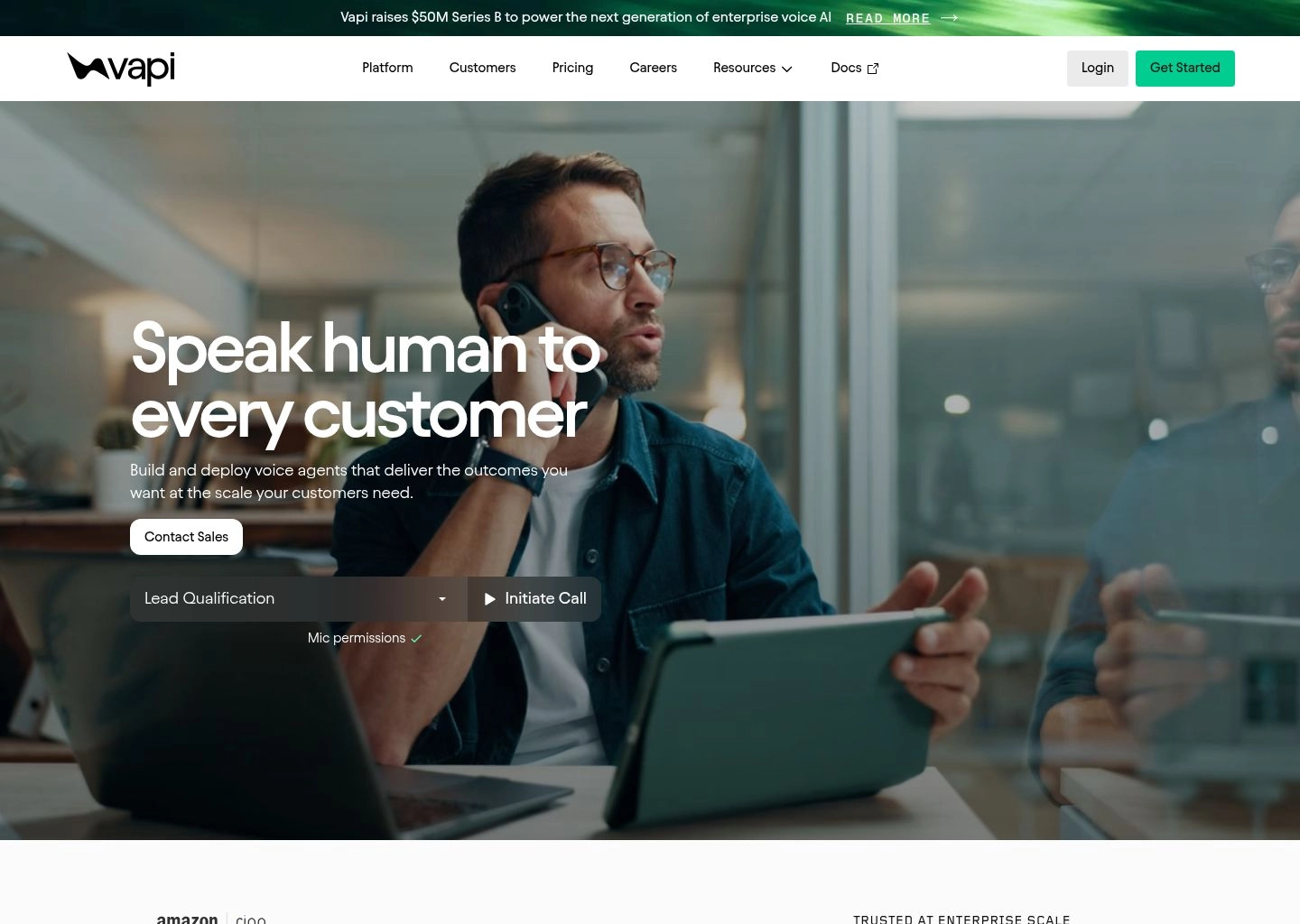
In the rapidly evolving voice AI landscape, locking your product into a single proprietary voice or language model is a dangerous architectural mistake. Vapi solves this problem by serving as the premier Voice AI Orchestrator. It abstracts the complex plumbing of real-time voice—handling audio streaming, WebRTC connections, jitter buffers, and telephony bridges—while giving developers complete modular control over every layer of the voice stack.
With Vapi, you can configure an assistant that uses Deepgram Nova-2 for sub-150ms transcription, routes context to Groq-hosted Llama 3.3 70B for instant reasoning, and speaks through ElevenLabs or Cartesia for lifelike vocal timbre. If a new, faster speech model launches next month, you can swap it in your Vapi dashboard with a single dropdown selection without rewriting your application code.
Vapi also shines beyond standard telephone lines. It provides battle-tested WebRTC SDKs for React, iOS, Android, Flutter, and Python. This allows developers to embed real-time voice agents directly inside mobile apps, web dashboards, gaming interfaces, and smart hardware devices with crystal-clear 48kHz audio fidelity, far exceeding the narrow 8kHz acoustic limitations of traditional telephone carriers.
Key Technical Advantages
- Completely Modular Voice Architecture: Mix, match, and hot-swap STT, LLM, and TTS providers in seconds with zero code refactoring.
- Cross-Platform WebRTC Client SDKs: Embed high-fidelity, bidirectional voice agents into web apps, iOS, Android, and IoT devices.
- Granular Voice Pipeline Controls: Fine-tune silence detection thresholds, background noise suppression, and interruption sensitivity.
- Bring-Your-Own-SIP (BYOSIP): Connect seamlessly to existing corporate PBX infrastructure, Twilio, Vonage, or Telnyx trunks.
- Rich Server-Side Function Calling: Execute authenticated server webhooks and REST queries mid-call with automatic timeout fallbacks.
Trade-offs & Limitations
- Requires software development expertise; not suited for non-technical business users seeking an out-of-the-box turnkey solution.
- Complex multi-vendor billing requires tracking separate API invoices across Vapi and your connected LLM/voice providers.

4. Synthflow — The Premier No-Code Visual Builder for Autonomous Voice Agents
Best for Marketing Agencies, Local Businesses & Turnkey CRM Integrations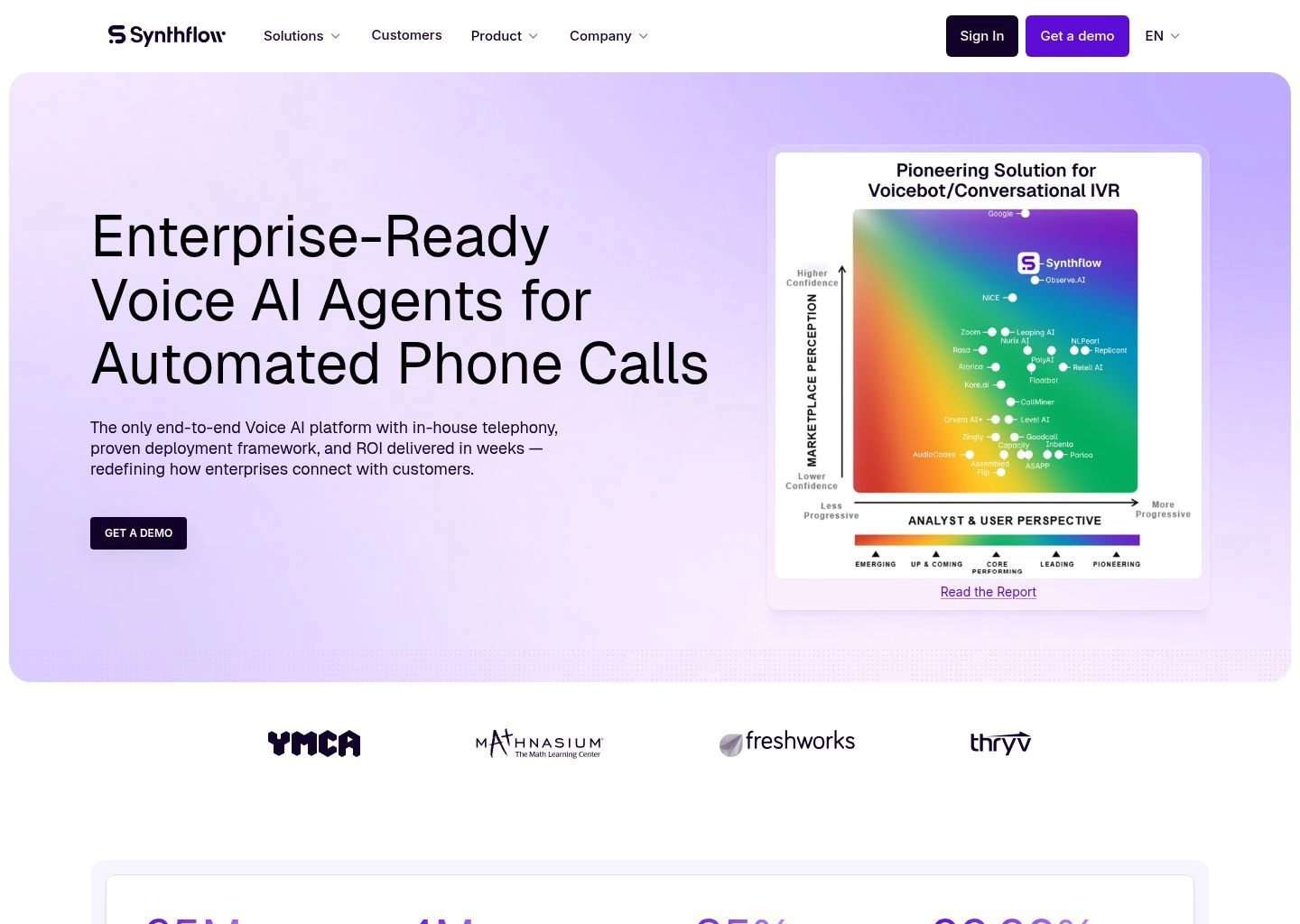
While developer-first tools require writing WebSocket servers and managing SIP endpoints, Synthflow empowers marketing agencies, operations managers, and local business owners to build enterprise-grade voice agents with zero code. Its intuitive drag-and-drop visual interface transforms conversational design into a delightful, visual workflow.
Synthflow comes pre-configured with dozens of vertical industry templates: dental appointment scheduling, real estate lead qualification, HVAC emergency dispatch, and restaurant reservations. Users can purchase local or toll-free telephone numbers in over 40 countries directly within the platform, assign an AI voice persona, connect a Google Calendar or Calendly link, and start handling live customer calls in under fifteen minutes.
For growth agencies and consultants, Synthflow offers an outstanding White-Label Reseller Portal. Agencies can brand the entire voice platform with their own custom domain, logo, and pricing tiers, reselling automated receptionist and appointment-booking services to local business clients for recurring monthly retainer fees.
Key Technical Advantages
- Visual Drag-and-Drop Workflow Canvas: Design complex multi-turn conversation logic, qualifications, and objection paths without writing code.
- One-Click Native Calendar & CRM Sync: Deep integrations with Google Calendar, Calendly, HubSpot, GoHighLevel, and Zapier.
- Agency White-Labeling Capabilities: Rebrand the entire platform under your agency’s domain and bill clients directly.
- Global Telephony in 40+ Countries: Instant in-app purchasing of local phone numbers with automatic caller ID registration.
- Turnkey Industry Templates: Pre-built conversational flows for healthcare, real estate, legal, and home services.
Trade-offs & Limitations
- Conversational latency (~750ms) is slightly higher than raw developer APIs like Retell or Vapi due to visual abstraction layers.
- Less flexibility for deep programmatic server-side SDK customization.

5. ElevenLabs (Conversational AI) — The Benchmark for Emotional Realism & Multilingual Voices
Best for Ultra-Realistic Vocal Timbre, Emotional Cadence & 30+ Global Languages
ElevenLabs is internationally acclaimed as the gold standard in generative voice synthesis. With its Conversational AI Platform, ElevenLabs expanded from standalone text-to-speech generation into full-fledged, real-time conversational agents. If your brand’s primary requirement is voice quality that sounds undeniably human, warm, and emotionally authentic, ElevenLabs is in a class of its own.
Unlike older robotic synthesizers that speak in a flat, monotone cadence, ElevenLabs’ neural foundation models understand emotional context. If a customer sounds frustrated, the agent adjusts its vocal inflection, introducing empathetic pauses, natural breathing sounds, and conversational micro-hesitations that build immediate trust with callers.
ElevenLabs also dominates international multilingual deployments. With support for more than 30 languages—including Spanish, French, German, Japanese, Arabic, and Hindi—an ElevenLabs voice agent can converse with native accent accuracy and authentic colloquial phrasing. You can deploy it via lightweight web widgets, embed it in mobile apps, or connect it directly to SIP telephony providers.
Key Technical Advantages
- Unmatched Human Vocal Expressiveness: Dynamic emotion, natural pitch variations, and authentic conversational cadence.
- Instant Professional Voice Cloning: Create bespoke, branded executive voices from a short 60-second audio sample.
- Native Multilingual Mastery: Flawless conversational fluency across 30+ major languages and regional accents.
- End-to-End Conversational Widget: Embed real-time voice agents directly into web pages with customizable visual avatars.
- Enterprise Knowledge Base Ingestion: Ingest PDFs, website URLs, and help center documentation directly into the agent’s memory.
Trade-offs & Limitations
- While real-time latency has dropped substantially with Turbo v2.5 models (~500ms), hyper-specialized raw streaming engines like Retell are marginally faster.
- Native high-volume outbound telephony dialers require connecting to external SIP trunks like Twilio or Telnyx.

6. Voiceflow — The Enterprise Collaborative Standard for Complex Multi-Modal Agents
Best for Large Enterprise Teams, Multi-Channel Chat+Voice & Strict Compliance Governance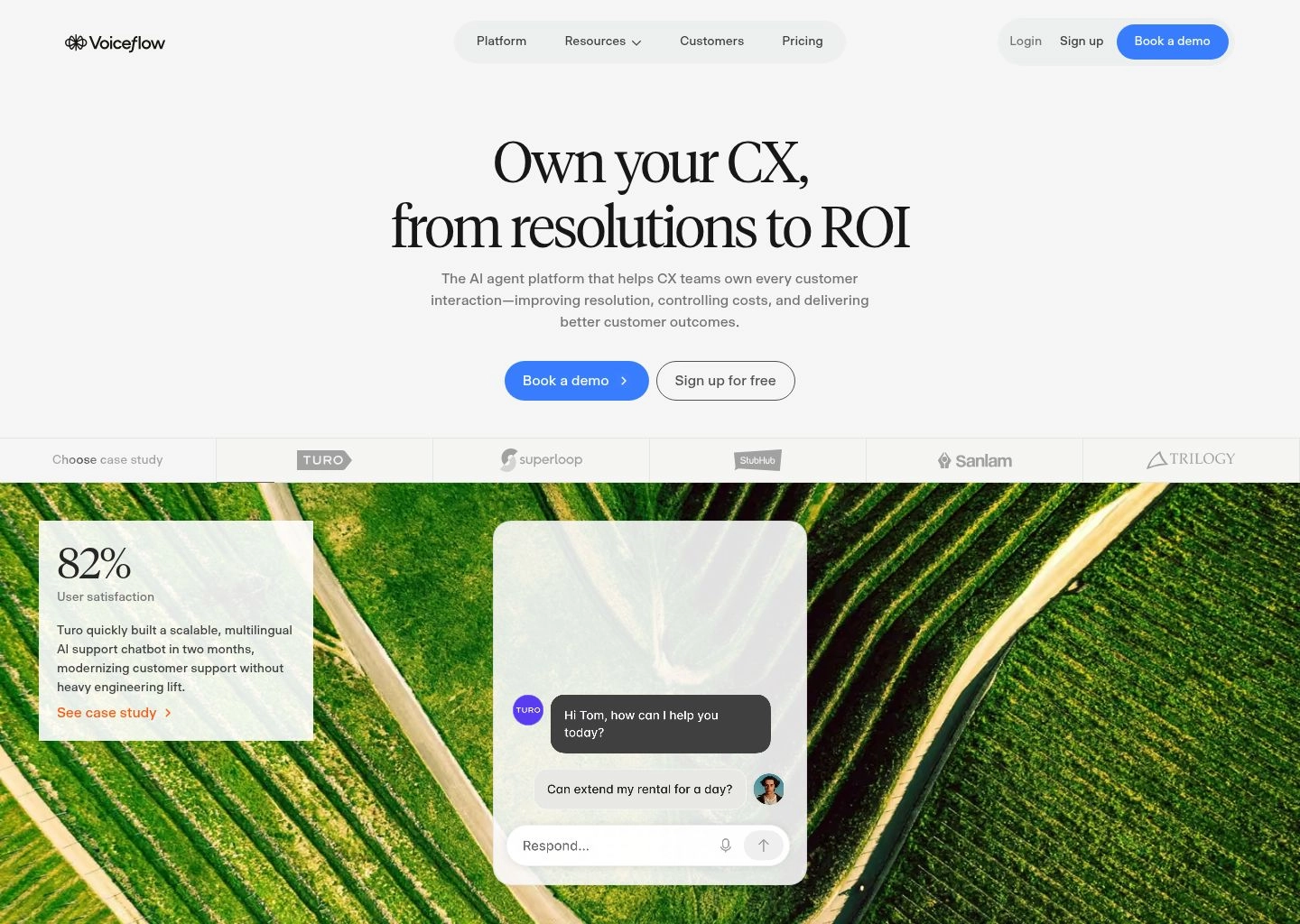
Voiceflow is the heavyweight collaborative platform trusted by Fortune 500 enterprises, airlines, financial institutions, and telecommunications giants. While many tools focus exclusively on simple phone bots, Voiceflow was built from the ground up as a unified design, prototyping, and deployment platform for multi-channel conversation systems spanning web chat, mobile apps, IVR telephony, and automotive smart consoles.
In Voiceflow, product managers, conversational designers, and engineers work in real time on a shared infinite canvas (reminiscent of Figma for voice). Teams can map out complex enterprise state machines: handling multi-turn authentication, payment processing, database API lookups, and deterministic escalation paths to human agents on enterprise contact center platforms like Genesys, Cisco, and Amazon Connect.
Voiceflow’s hybrid engine allows companies to combine strict deterministic guardrails with generative LLM reasoning. If a customer asks a policy question, Voiceflow queries an internal vector knowledge base and synthesizes a verified answer; if the customer requests a password reset, Voiceflow executes a secure, audited workflow with full SOC 2 compliance tracking.
Key Technical Advantages
- Figma-Like Collaborative Team Canvas: Real-time multiplayer design, prototyping, and version-controlled conversation branching.
- Enterprise Contact Center Connectors: Native integrations with Genesys Cloud, Amazon Connect, AudioCodes, and Twilio.
- Hybrid Deterministic & Generative Logic: Enforce strict legal guardrails on sensitive workflows while leveraging generative AI for open dialogue.
- Comprehensive Analytics & User Transcript Review: In-depth transcript auditing, drop-off heatmaps, and intent classification analytics.
- Granular Role-Based Permissions (RBAC): Enterprise security controls, audit logs, single sign-on (SSO), and SOC 2 Type II compliance.
Trade-offs & Limitations
- Higher cost of entry and steeper learning curve compared to quick visual tools like Synthflow.
- Requires connecting to external telephony gateways or contact center platforms for direct PSTN phone dialing.
7. Deepgram (Voice Agent API) — The Ultra-Fast Speech Foundation Engine
Best for Sub-150ms Speech Recognition, Nova-2 Telephony ASR & Custom Acoustic Tuning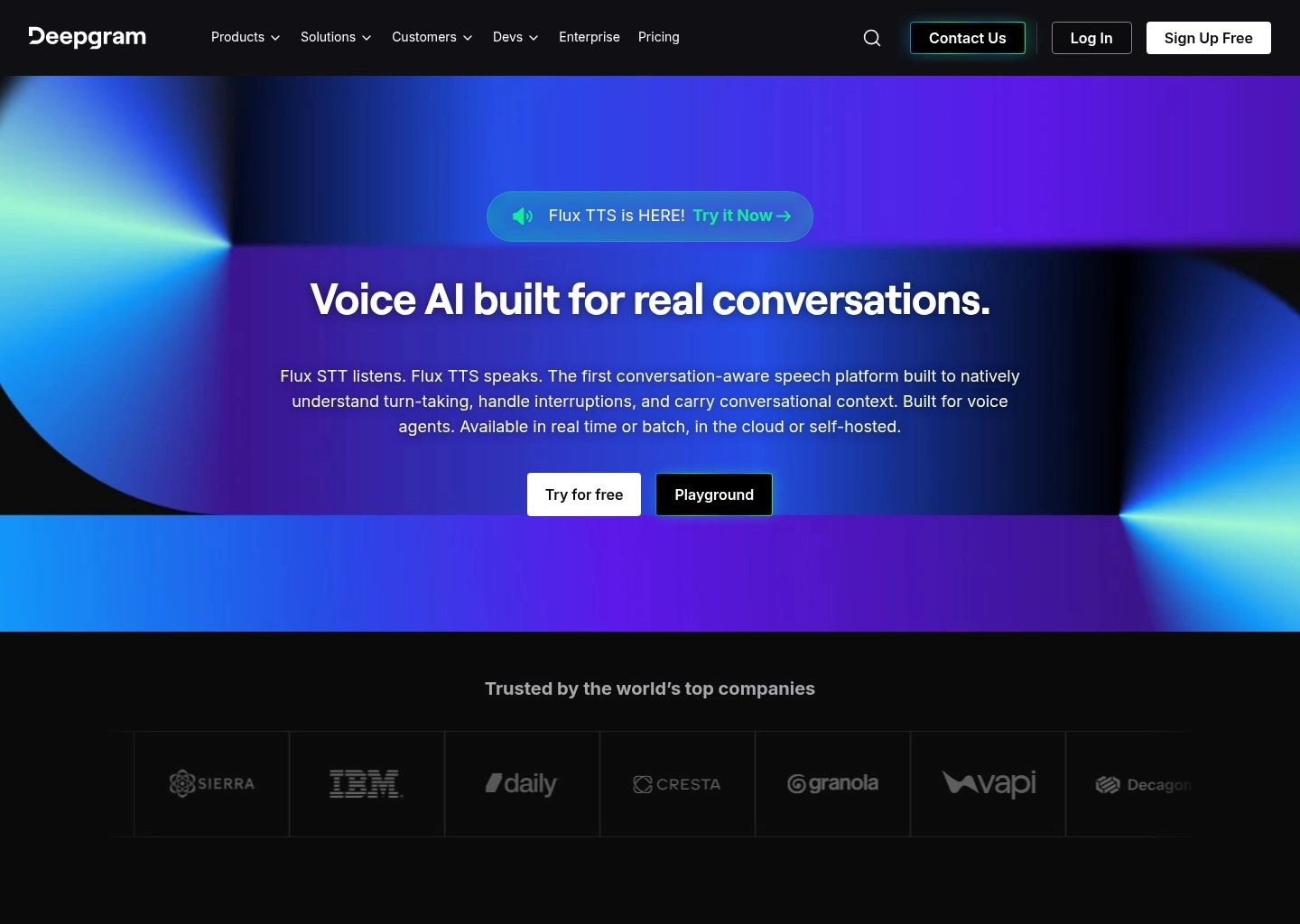
Deepgram is the foundational bedrock upon which a vast portion of the entire voice AI industry is constructed. When building a voice agent, the initial speech-to-text (STT) layer is the most critical: if transcription takes 600 milliseconds, your conversational agent has already failed before the LLM has generated its first token. Deepgram’s Nova-2 speech model delivers sub-150ms streaming transcription with the lowest Word Error Rate (WER) in the industry.
Deepgram was engineered specifically to handle the terrible acoustic conditions of legacy phone networks. Telephony audio is compressed into narrow-band 8kHz streams, stripping out high-frequency consonants and introducing heavy background static. Nova-2 was trained on tens of millions of hours of real-world conversational telephone audio, allowing it to decipher heavy accents, background cafeteria noise, and technical jargon with extraordinary accuracy.
With its recently launched Voice Agent API, Deepgram has evolved beyond raw speech-to-text. It now offers an integrated voice-to-voice framework that unifies Nova-2 transcription, real-time Voice Activity Detection (VAD), and streaming text-to-speech directly over WebSocket connections, providing developers with the raw speed required for next-generation conversational experiences.
Key Technical Advantages
- Sub-150ms Streaming ASR Latency: The fastest commercial speech-to-text engine in existence, setting the benchmark for voice responsiveness.
- Nova-2 Telephony Model: Specialized acoustic weights trained specifically for 8kHz narrow-band phone calls and noisy environments.
- Ultra-Accurate Voice Activity Detection (VAD): Precision acoustic endpointing that prevents speech cutoffs during natural human pauses.
- Extremely Cost-Effective Pricing: As low as $0.0043 per minute for streaming speech-to-text, drastically lowering telephony COGS.
- Enterprise On-Premises & Air-Gapped Deployments: Full Dockerized container deployments for banks, healthcare providers, and defense contractors.
Trade-offs & Limitations
- A foundational developer infrastructure platform; requires software engineers to build the surrounding LLM agent logic and telephony carrier bridges.
- Does not provide a built-in visual prompt builder or no-code canvas.
8. Resemble AI — The Security-First Conversational Voice Platform with Deepfake Defense
Best for Neural Voice Watermarking, Real-Time Acoustic Defense & Enterprise Security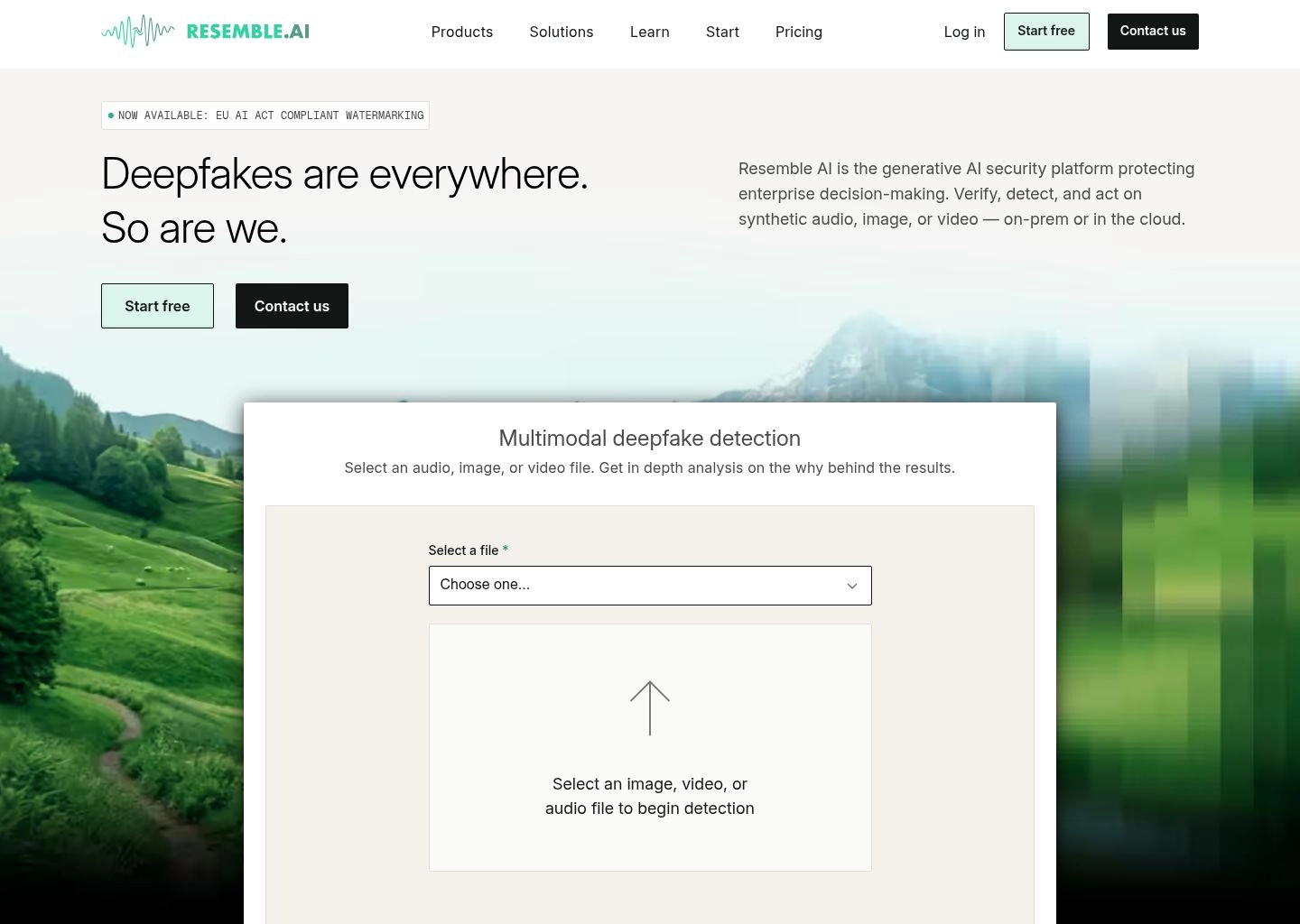
As generative voice AI becomes indistinguishable from reality, enterprise risk officers face a new existential threat: voice spoofing, brand impersonation, and fraudulent social engineering attacks. Resemble AI was engineered specifically to solve the dual challenges of hyper-realistic conversational speech synthesis and enterprise voice security.
Resemble’s flagship innovation is Resemble Watermark, an invisible, imperceptible acoustic watermark embedded directly into synthesized audio frames. This cryptographic watermark survives lossy telephone compression, background noise, and MP3 encoding, allowing financial institutions and enterprises to programmatically verify that an outgoing voice call was indeed generated by their authorized systems.
On the conversational side, Resemble delivers low-latency WebRTC and SIP streaming with dynamic emotional conditioning. Voice agents can be instructed to adjust tone dynamically—speaking with reassuring calmness during customer escalations or vibrant enthusiasm during product demonstrations. Combined with Resemble Detect, which flags deepfake caller audio during inbound identity verification, Resemble is the premier choice for financial services and healthcare.
Key Technical Advantages
- Cryptographic Neural Watermarking: Embeds imperceptible signatures into synthesized audio to verify origin and prevent voice cloning fraud.
- Integrated Deepfake Audio Detection: Programmatically analyzes inbound callers to detect synthetic voice spoofing and replay attacks.
- Low-Latency Conversational Synthesis: Real-time streaming voice synthesis engineered for WebRTC and enterprise telephony.
- Dynamic Emotion & Cadence Modulation: Fine-tune happiness, sadness, urgency, and empathy on the fly via API parameters.
- Strict SOC 2 & HIPAA Compliance: Enterprise-grade security policies with dedicated isolated cloud environments.
Trade-offs & Limitations
- Focused primarily on security, synthesis, and audio verification; requires connecting to an external LLM agent layer for complete conversation management.
- Higher base pricing structure tailored toward enterprise compliance budgets.
Technical Architecture: Sub-500ms Turn-Taking & Telephony Pipeline Engineering
Achieving human-grade voice turn-taking requires solving the “Latency Stack.” In a traditional non-streaming setup, the cumulative latency of transcribing audio, passing tokens to an LLM, and generating speech creates an unacceptable 2.5-second pause. Modern 2026 voice agents collapse this pipeline to under 450 milliseconds using three interconnected architectural innovations:
1. Streaming STT & Endpointing
Engines like Deepgram Nova-2 stream audio over bi-directional WebSockets in 20ms audio frames. Neural Voice Activity Detection (VAD) distinguishes between momentary breathing pauses and true end-of-turn silences within 80 milliseconds.
2. Token-Streaming LLM Inference
Rather than waiting for a full paragraph response, LLMs (such as Claude 3.5 Sonnet or Groq-hosted Llama) stream text token-by-token. As soon as the first 4-5 words form a valid phonetic phrase, they are immediately dispatched to the speech synthesizer.
3. Zero-Latency Acoustic Synthesis
High-speed acoustic neural synthesizers (Cartesia Sonic, ElevenLabs Turbo) generate initial audio chunks within 100 milliseconds. Audio streams down the telephone line via WebRTC or SIP while the remainder of the sentence is still being reasoned.
Enterprise Telephony Playbooks: Real-World Voice Automation in 2026
Leading enterprises are deploying autonomous voice agents across high-volume customer touchpoints to dramatically lower operational costs while improving customer satisfaction. Here are three proven deployment playbooks:
Playbook 1: 24/7 After-Hours Emergency Dispatch & Triage
The Challenge: Property management firms, plumbing contractors, and healthcare clinics lose high-value clients when after-hours emergency calls go to static voicemail.
The Automation: Deploy Retell AI or Synthflow connected to a Twilio phone number. The agent answers on the first ring, asks structured triage questions, assesses emergency severity, creates a ticket in ServiceTitan or Zendesk, and triggers an automated phone patch to the on-call technician.
Impact: 100% emergency call capture rate with zero human receptionist overtime costsPlaybook 2: Instant Outbound Lead Qualification (Speed-to-Lead)
The Challenge: B2B inbound web leads go cold rapidly. Studies demonstrate that calling an inbound lead within 60 seconds increases conversion rates by over 391%.
The Automation: When a prospective customer submits a web demo form, webhook triggers Bland AI to dial the prospect within 30 seconds. The voice agent qualifies budget and timeline, answers preliminary technical questions, and books a calendar slot directly on the senior executive’s calendar.
Impact: 4.8x increase in inbound sales qualification ratePlaybook 3: Autonomous Tier-1 Support & Ticket Deflection
The Challenge: E-commerce and SaaS customer service queues are overwhelmed by repetitive “Where is my order?” and “How do I reset my credentials?” inquiries.
The Automation: Configure Vapi integrated with your Shopify or PostgreSQL database. Callers authenticate via phone number and one-time SMS pin; the agent queries shipment status via live API, quotes tracking numbers, and resolves the issue without human intervention.
Impact: Deflects 68% of routine tier-1 support calls from human agentsTelephony Carrier Compliance, STIR/SHAKEN & Privacy Regulations
Deploying automated voice calling requires strict adherence to international telecommunications laws and anti-spam regulations. Failing to comply can result in phone numbers being labeled as “Spam Likely,” carrier carrier blocks, or regulatory fines under the FCC’s Telephone Consumer Protection Act (TCPA). Ensure your voice architecture enforces four key compliance standards:
- STIR/SHAKEN A-Level Attestation: Ensure your telephony provider (Bland AI, Twilio, or SIP trunk) registers your numbers with A-level attestation, verifying legitimate caller ID ownership and preventing spam labeling.
- TCPA & Express Written Consent: Outbound AI calling to consumer mobile phones requires documented prior express written consent. Inbound customer service lines operate under broader permissions but must provide clear disclosures.
- AI Disclosure & Transparency Laws: Several US states and international jurisdictions require automated calling systems to identify themselves as artificial intelligence within the first 10 seconds of conversation.
- HIPAA & PCI-DSS Audio Protection: For healthcare and payment handling, verify that call recordings, transcripts, and audio streams are encrypted via TLS 1.3 in transit and AES-256 at rest, with full BAA agreements executed.
Frequently Asked Questions (FAQs)
How fast must an AI voice agent respond to feel natural over the phone?
To sound indistinguishable from a human operator, an AI voice agent must maintain an end-to-end turn-taking latency between 400ms and 600ms. Anything above 800ms introduces awkward pauses, causing human callers to ask “Hello? Are you still there?” Platforms like Retell AI and Vapi lead the industry in achieving consistent sub-500ms conversational pacing.
Can AI voice agents execute actions and book appointments during live calls?
Yes. Leading voice agents utilize LLM function calling and real-time webhook executions. During a call, when a caller agrees to an appointment, the agent queries Google Calendar or Calendly in the background, checks available slots, confirms the time with the caller, and pushes the booking into your CRM in real time.
What happens when a human caller interrupts an AI voice agent mid-sentence?
Modern voice agents use streaming Voice Activity Detection (VAD) coupled with acoustic echo cancellation. The moment the caller speaks, the agent immediately stops streaming audio (within 100 milliseconds), listens to the caller’s interruption, and dynamically redirects its response based on the new input.
What is the difference between Bland AI and Vapi?
Bland AI is an all-in-one programmable telephony provider that bundles phone numbers, SIP infrastructure, voice synthesis, and pathway logic into a single API, making it ideal for high-scale outbound campaigns. Vapi is a developer orchestration platform that lets you hot-swap different STT, LLM, and TTS providers while embedding voice agents across WebRTC web apps and custom SIP trunks.
Final Recommendation: Building Your 2026 Autonomous Voice Strategy
Conversational voice AI has transitioned from an experimental novelty into an essential operational pillar for modern enterprises. Organizations that deploy autonomous voice agents eliminate hold times, capture after-hours revenue, and deliver instantaneous, personalized customer experiences at a fraction of traditional call center costs.
If your goal is high-volume outbound dialing, automated dispatch, and comprehensive phone number management, deploy Bland AI. If your primary benchmark is the lowest possible latency and human-like conversational turn-taking, choose Retell AI. If you are an engineering team building custom web/mobile voice applications with modular model freedom, adopt Vapi. And if you are an agency or small business seeking a turnkey no-code builder, launch with Synthflow.
Explore our curated AI Tools for Founders Directory and our AI Tools for Developers Hub for deep architectural guidance, or dive into our related reviews on the Best AI Agent Platforms in 2026, the Best AI Voice Generators in 2026, and the Best AI Workflow Automation Tools in 2026.