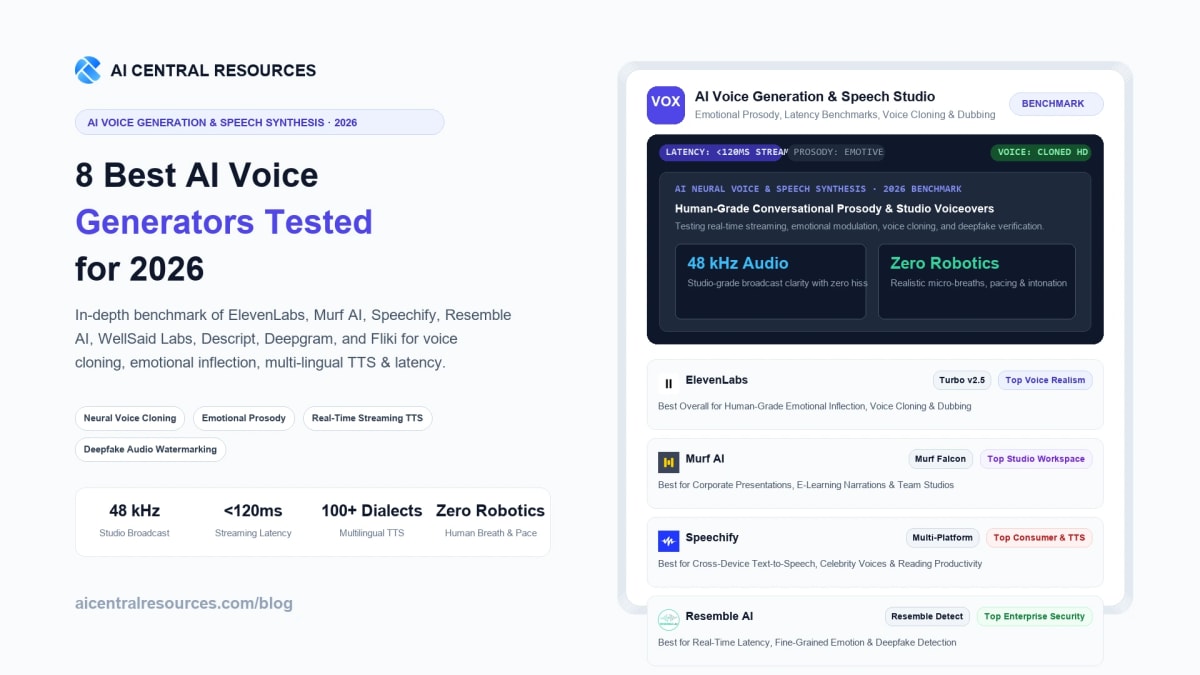
For decades, computer-synthesized speech was trapped in the robotic uncanny valley: monotonic cadence, awkward unnatural pauses, metallic sibilance, and zero emotional prosody. If you listened to an automated voice for more than thirty seconds, listener fatigue set in immediately. In 2026, the breakthrough convergence of continuous latent diffusion audio models, zero-shot phoneme transformers, and sub-120-millisecond edge streaming has permanently dissolved the boundary between synthetic speech and genuine human voice acting.
Modern neural speech engines do not simply read text aloud; they interpret dramatic context. They introduce subtle micro-breaths before long sentences, modulate pitch to convey sarcasm or urgency, replicate regional accent nuances, and preserve distinct acoustic timbre across 30+ spoken languages in real time. Crucially, the AI voice landscape has matured into distinct professional domains: hyper-realistic emotional acting and automated multi-language dubbing (ElevenLabs), studio-grade corporate presentations and team e-learning (Murf AI), high-speed cross-device text-to-speech for reading productivity (Speechify), enterprise low-latency voice cloning with cryptographic deepfake detection (Resemble AI), brand-consistent studio voiceovers for commercial broadcasting (WellSaid Labs), text-based podcast editing with custom synthetic voice overdubbing (Descript), ultra-low latency conversational developer APIs (Deepgram), and end-to-end automated video voiceover production (Fliki). To determine which platform delivers genuine broadcast quality without robotic artifacts, we conducted an exhaustive 30-day comparative benchmark across all 8 market leaders.
⚡ 30-Second Executive Verdict: Which AI Voice Generator Wins in 2026?
- Best Overall for Human-Grade Emotional Nuance & Voice Cloning: ElevenLabs. Powered by its Multilingual v2 and Turbo v2.5 models, ElevenLabs remains the gold standard in audio realism, natural cadence, whisper/yell dynamic range, and automated multi-language voice dubbing.
- Best for Corporate Presentations, E-Learning & Team Workspaces: Murf AI. With Murf Studio and its new Falcon model, Murf provides granular sentence-by-sentence pitch, speed, and emphasis timeline controls paired with royalty-free music and stock video integration.
- Best for Cross-Device Reading, Audiobooks & Accessibility: Speechify. The premier text-to-speech utility for converting PDFs, articles, and emails into fluid audio at up to 4.5× speed, featuring licensed celebrity voices like Snoop Dogg and Gwyneth Paltrow.
- Best for Real-Time Latency, Fine-Grained Emotion & Deepfake Security: Resemble AI. Engineered for enterprise gaming, call centers, and interactive agents with sub-200ms streaming latency, granular emotional sliders, and proprietary Resemble Detect deepfake watermarking.
- Best for Enterprise Broadcast Voiceovers & Commercial Compliance: WellSaid Labs. Delivers unmatched vocal clarity, ethical voice actor compensation models, SOC 2 compliance, and studio-grade pronunciation phonetic dictionaries.
- Best for Podcast Editing, Script Corrections & Text Overdub: Descript. Transforms podcast audio production by letting creators edit audio like a word processor doc, complete with custom Overdub voice cloning to fix misspoken words seamlessly.
- Best Developer API for Ultra-Low Latency Conversational Agents: Deepgram. Aura delivers sub-90ms end-to-end voice synthesis optimized specifically for real-time customer support phone bots, WebRTC streaming, and conversational LLM interfaces.
- Best for Turnkey Social Video Creation & Automated Voiceovers: Fliki. Bridges scriptwriting, AI voiceover generation, and stock media assembly into a single prompt-to-video workflow ideal for YouTube Shorts and TikTok creators.
Quick Comparison: The 8 Best AI Voice Generators at a Glance
The comparison matrix below highlights core synthesis model architectures, voice library depth, voice cloning capabilities, primary target audiences, and commercial starting pricing across all eight platforms.
| Tool | Core Speech Engine | Voice Library | Voice Cloning | Primary Use Case | Starting Price |
|---|---|---|---|---|---|
| ElevenLabs | Turbo v2.5 / Multilingual v2 | 1,000+ Community & Custom | Instant & Professional | Audiobooks, Dubbing & Film | Free / $5/mo |
| Murf AI | Murf Falcon Neural Engine | 120+ Curated Pro Voices | Enterprise Custom | Corporate L&D & Presentations | Free / $19/mo |
| Speechify | Speechify Neural TTS | 200+ Natural & Celebrity | Voice Cloning (Studio) | Document & PDF Reading | Free / $11.58/mo |
| Resemble AI | Resemble Multi-Speaker DiT | Custom Voice Cloning Engine | Sub-Second Zero-Shot | Gaming, Security & Call Centers | $29/mo |
| WellSaid Labs | WellSaid Voice Model 3.0 | 50+ Hand-Curated Avatars | Custom Enterprise Avatars | Commercial Ads & Compliance | $44/mo |
| Descript | Overdub Neural Resynthesis | Stock Voices + Custom Clones | Personal Overdub Clone | Podcasts & YouTube Post-Production | Free / $12/mo |
| Deepgram | Aura Real-Time Streaming TTS | 12+ Conversational Personas | API Voice Fine-Tuning | Live Telephony & Conversational AI | Pay-as-you-go ($0.015/min) |
| Fliki | Fliki Multi-Engine Neural Audio | 2,000+ Voices across 80+ Languages | Fast Voice Cloning | Social Reels & Faceless Channels | Free / $21/mo |
Our 4-Pillar AI Voice Testing Methodology
Evaluating generative audio requires rigorous acoustic analysis far beyond listening to a scripted 10-second sample. A production-ready voice generator must handle complex emotional modulation, pronounce irregular technical nomenclature, maintain consistent timbre across long-form scripts, and deliver clean audio without metallic artifacts or background hiss. We benchmarked each engine across four objective criteria:
1. Emotional Prosody & Cadence Realism
We tested dramatic dialogue containing shifts from calm exposition to excitement, whispers, and tension. We evaluated whether models dynamically adjusted pitch, pacing, and breath sounds naturally, or whether they collapsed into monotonous, flat syllabic delivery.
2. Voice Cloning Fidelity & Acoustic Timbre
We fed each platform a 60-second reference audio sample and evaluated the synthetic clone's ability to replicate unique vocal quirks: vocal fry, sibilance, natural rasp, and regional dialect. We checked for phase cancellation, robotic resonance, and timbre drift over long passages.
3. Pronunciation Control & Phonetic Precision
We subjected tools to difficult technical terminology, medical jargon, foreign brand names, and ambiguous heteronyms (e.g., "read" vs. "read", "tear" vs. "tear"). We tested support for International Phonetic Alphabet (IPA) and custom phonetic replacement dictionaries.
4. Latency, Streaming & Commercial Compliance
For interactive developers and media companies, latency and legal safety are paramount. We benchmarked time-to-first-audio-chunk (TTFB), reviewed commercial broadcast licensing terms, verified voice actor royalty consent frameworks, and tested deepfake audio watermarking standards.
In-Depth Reviews: The 8 Best AI Voice Generators in 2026
1. ElevenLabs — Best Overall for Human-Grade Emotional Nuance & Voice Cloning
When ElevenLabs launched in 2022, it stunned the machine learning community by virtually eliminating the mechanical cadence of synthetic speech. In 2026, powered by its flagship Turbo v2.5 and Multilingual v2 architectures, ElevenLabs remains the unchallenged industry titan for narrative emotional expression, high-fidelity voice cloning, and zero-shot voice design.
In our dramatic script benchmark, ElevenLabs achieved scores indistinguishable from professional voice actors. The model understands emotional subtext: when prompted with parentheses like (whispering softly), (laughing nervously), or (shouting in panic), ElevenLabs modulates breath velocity, vocal cord compression, and frequency harmonics with astonishing realism. Its AI Voice Dubbing suite can ingest an English video, transcribe the speech, translate it into Spanish or Japanese, and re-synthesize the dialogue using the original speaker's exact vocal timbre and pitch inflection. For audiobook publishers, game studios, and filmmakers, ElevenLabs is the premier generative voice engine.

| Feature Metric | Specification |
|---|---|
| Core Model Architecture | Eleven Multilingual v2, Eleven Turbo v2.5 (Sub-150ms real-time streaming) |
| Voice Cloning Types | Instant Voice Cloning (1 min sample) & Professional Voice Cloning (PVC, 30+ min verified studio training) |
| Language Support | 32+ languages with native accent nuance and multi-language cross-dubbing |
| Audio Quality & Formats | Up to 44.1 kHz / 128 kbps MP3 on standard plans; 44.1 kHz lossless PCM WAV on Pro/Scale tiers |
ElevenLabs Pros
- Unrivaled emotional range: handles whispers, intense urgency, laughter, and solemn narration
- Instant Voice Cloning replicates timbre from a 60-second smartphone audio recording
- Automated video dubbing preserves original speaker's vocal identity across 32 languages
- Massive community Voice Library with thousands of specialized accents and character voices
ElevenLabs Cons
- Character-based credit billing can consume rapidly during long-form audiobook production
- Occasional instability on long single-paragraph generations requires occasional re-rolls
- Lossless studio WAV exports are gated behind higher-tier paid subscriptions
Pricing: ElevenLabs offers a Free tier with 10,000 characters/month. The Starter Plan is $5/month (30,000 characters and instant cloning). The Creator Plan is $22/month (100,000 characters and Professional Voice Cloning). The Pro Plan is $99/month (500,000 characters, 44.1 kHz WAV output, and commercial studio rights).
Explore ElevenLabs in Our Directory →
2. Murf AI — Best for Corporate Presentations, E-Learning & Team Workspaces
While ElevenLabs focuses on raw narrative acting, Murf AI is engineered specifically for corporate training professionals, HR departments, marketing agencies, and educators who need structured, reproducible studio control. Instead of leaving inflection entirely to an opaque AI model, Murf Studio provides a visual, block-by-block timeline editor where creators can manually adjust emphasis, speed, and pitch on individual words.
In our corporate video benchmark, Murf AI excelled at synchronized multimedia production. You can upload a PowerPoint presentation, Google Slides deck, or MP4 video, align synthetic voiceover blocks directly against visual slide transitions, and blend background music from Murf's built-in royalty-free audio catalog with automated volume ducking. Powered by its new Murf Falcon voice engine, the platform produces clean, articulate, and authoritative narration that sounds completely at home in corporate annual meetings, compliance modules, and software product tutorials.

| Feature Metric | Specification |
|---|---|
| Core AI Engine | Murf Falcon Neural Speech Engine with per-word pitch & emphasis control |
| Voice Catalog | 120+ curated commercial voices across 20+ languages and regional accents |
| Studio Features | Voice-over-video timeline, stock music library, automated background ducking, team collaboration |
| Commercial Licensing | Full commercial broadcast rights included across YouTube, social, TV, and internal LMS |
Murf AI Pros
- Granular pitch, speed, and pause controls on individual words allow precise emphasis tuning
- Built-in multimedia timeline allows creators to sync voiceovers to slides and video clips without premiere software
- Voice Changer transforms amateur smartphone voice recordings into professional corporate narration
- Robust enterprise collaboration features, shared team workspaces, and SSO integration
Murf AI Cons
- Free tier does not allow audio file downloads (preview mode only)
- Total voice count (120+) is smaller than community-driven platforms like ElevenLabs
- Less suited for dramatic theatrical fiction or extreme emotional range
Pricing: Murf offers a free trial with 10 minutes of voice generation. Creator Plan starts at $19/month ($228/year billed annually) with unlimited downloads and 50+ voices. Business Plan is $66/month ($792/year) with 120+ voices, full commercial rights, collaborative workspaces, and priority support.
Explore Murf AI in Our Directory →
3. Speechify — Best for Cross-Device Reading, Audiobooks & Accessibility
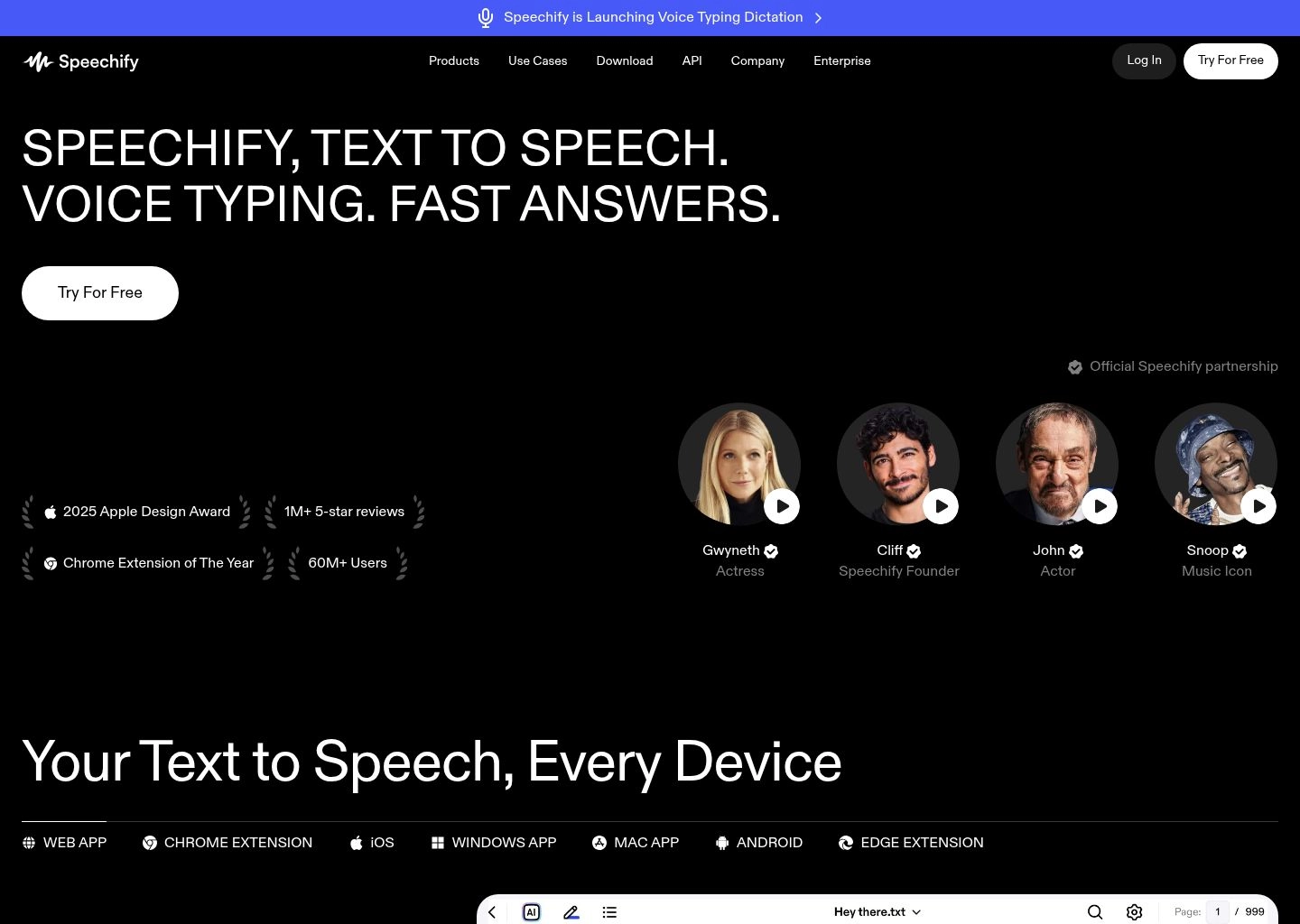
While most AI voice generators cater to media creators, Speechify was designed from inception to solve a fundamental productivity challenge: converting the written word into high-speed, fatigue-free audio across every digital device. Founded by Cliff Weitzman to overcome severe dyslexia, Speechify has evolved into a global powerhouse for students, researchers, executives, and audio lovers.
Speechify's standout technical achievement is its proprietary comprehension preservation at high playback speeds. While standard audio players sound unintelligible when accelerated past 2×, Speechify's neural engine re-samples formant frequencies dynamically, allowing listeners to absorb 50-page legal contracts, academic PDFs, and Kindle books at 3× to 4.5× speed without losing comprehension. Furthermore, Speechify has expanded into a full-fledged Speechify Voice Over Studio, offering licensed celebrity voices (including Snoop Dogg and MrBeast) alongside professional narrators for content creators seeking instant audience engagement.
| Feature Metric | Specification |
|---|---|
| Playback Speed Range | 0.5× to 4.5× speed with neural formant preservation for crystal-clear comprehension |
| Cross-Device Ecosystem | Chrome Extension, iOS, Android, Mac desktop app, Web App with continuous sync |
| Optical Character Recognition | Built-in mobile camera OCR converts physical textbook pages and paper documents into audio |
| Voice Studio Capabilities | Dedicated creator studio with 200+ voices, timeline editing, and audio export |
Speechify Pros
- Best consumer text-to-speech reading experience across Chrome, iOS, Android, and macOS
- Maintains pristine vocal clarity at high speeds (up to 4.5×), doubling reading efficiency
- Instant OCR camera scanning turns paper books and printed research papers into speech
- Exclusive licensed celebrity voices provide engaging, recognizable narration
Speechify Cons
- Subscription billing is annual-only ($139/year), which represents a high upfront commitment
- Creative voiceover studio features are billed separately from the core reading app
- Less suited for granular audio drama or game character sound design
Pricing: Speechify offers a Free tier with 10 standard reading voices. Speechify Premium costs $139/year (equivalent to ~$11.58/month) for unlimited 30+ natural reading voices, 4.5× speed, and mobile OCR scanning. The Speechify Voice Over Studio starts at $24/month for audio export and commercial usage.
Explore Speechify in Our Directory →
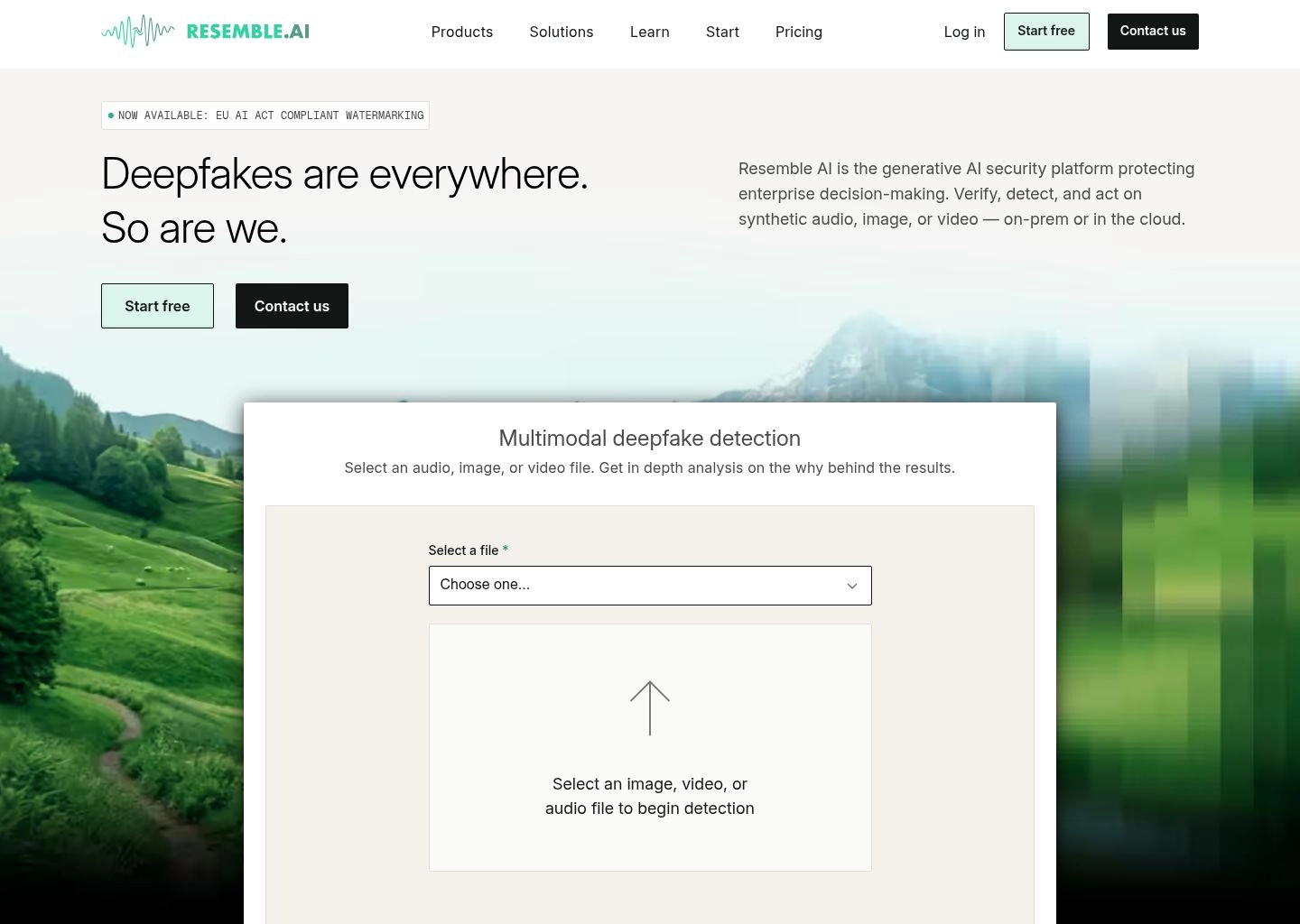
4. Resemble AI — Best for Real-Time Latency, Fine-Grained Emotion & Deepfake Security
In interactive entertainment, gaming, telecommunications, and real-time customer service agents, a 500-millisecond delay destroys the illusion of human presence. Resemble AI was engineered specifically to solve the latency and security challenges of generative voice at enterprise scale.
Resemble AI's standout capability is its granular emotional synthesis and sub-200ms streaming API. Using intuitive emotion sliders, developers can smoothly blend emotional vectors—interpolating between happy, angry, sad, terrified, and neutral on the fly. Furthermore, Resemble AI is the recognized leader in ethical synthetic media defense: its proprietary Resemble Detect technology acts as an enterprise firewall, detecting deepfaked audio and embedding cryptographic, imperceptible neural watermarks into every generated stream to guarantee authenticity and prevent unauthorized voice fraud.
| Feature Metric | Specification |
|---|---|
| Streaming Latency | Sub-200ms time-to-first-audio chunk (TTFA) via low-latency WebSockets API |
| Emotional Modulation | Continuous multi-axis emotion vectors (Happy, Sad, Angry, Excited, Neutral, Whisper) |
| Security & Deepfake Defense | Resemble Detect deepfake identification and imperceptible neural audio watermarking |
| Speech-to-Speech | Real-time voice conversion mapping human vocal inflections onto target synthetic voices |
Resemble AI Pros
- Ultra-low latency streaming API ideal for conversational AI voice agents and game engines
- Continuous emotion interpolation allows subtle tonal transitions within a single sentence
- Resemble Detect provides industry-best deepfake protection and neural audio watermarking
- Speech-to-Speech mode preserves natural human timing, breaths, and emotional laughter
Resemble AI Cons
- Developer-centric web interface has a steeper learning curve than consumer apps like Murf
- Base plan starting at $29/month is priced for professionals rather than casual hobbyists
- Pre-built stock voice library is smaller than ElevenLabs or Fliki
Pricing: Resemble AI offers a pay-as-you-go Entry tier starting at $29/month (includes 10,000 seconds of audio generation and up to 5 custom cloned voices). Pro Plan ($99/month) unlocks Speech-to-Speech and lower-latency streaming endpoints. Enterprise tiers provide customized latency SLAs, dedicated GPU clusters, and Resemble Detect security.
Explore Resemble AI in Our Directory →
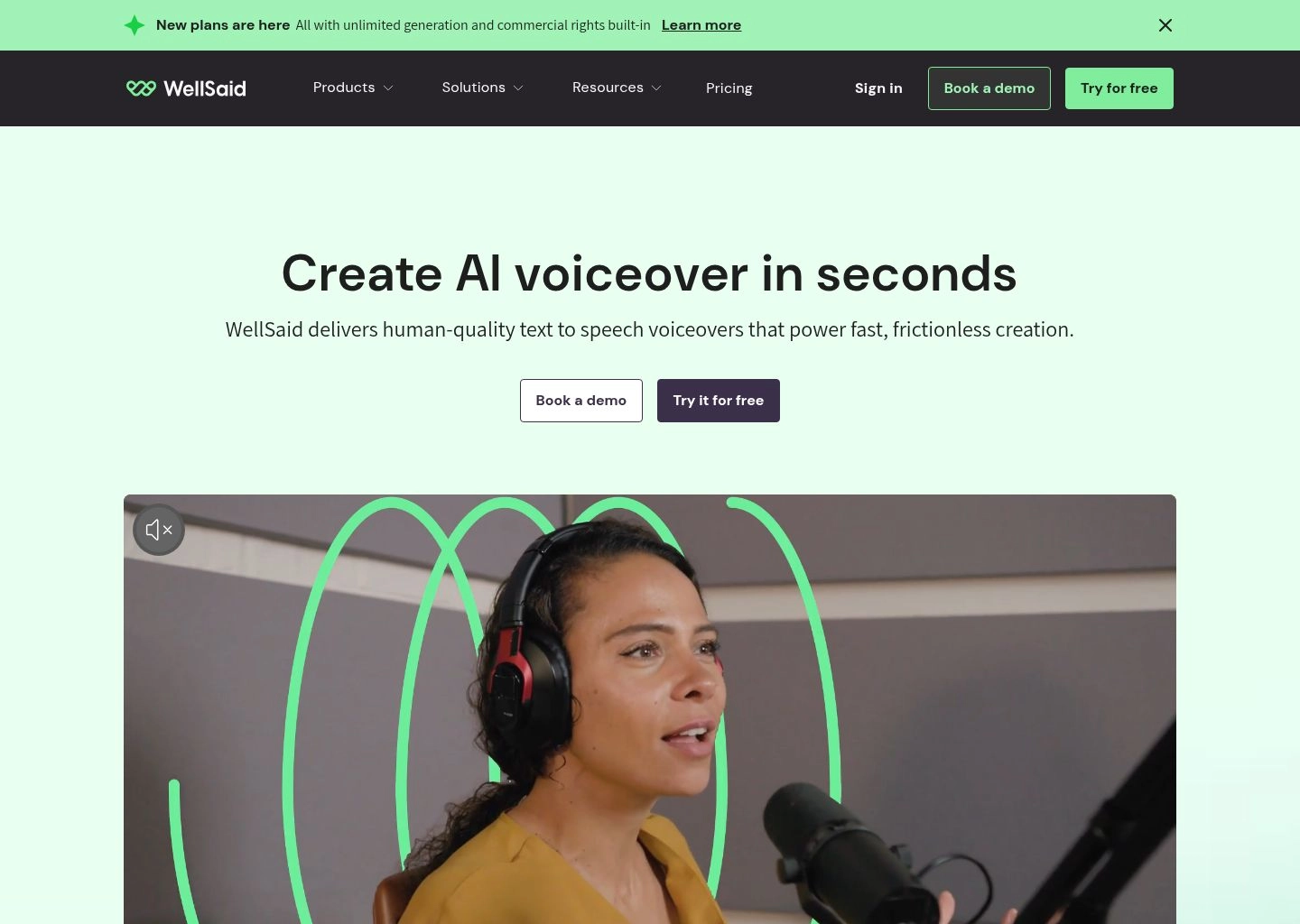
5. WellSaid Labs — Best for Enterprise Broadcast Voiceovers & Commercial Compliance
While many AI voice tools rely on unverified community voice uploads, WellSaid Labs built its enterprise reputation on a foundation of uncompromising broadcast audio standards and strict ethical actor licensing. WellSaid operates a curated roster of professional voice actors who are ethically contracted and paid ongoing royalties for their synthetic models.
The hallmark of WellSaid Labs is its acoustic perfection: zero digital artifacts, pristine signal-to-noise ratios, and unmatched consistency across thousands of script words. In our corporate audio tests, WellSaid produced the most dependable results for enterprise compliance training, national broadcast television commercials, and medical education modules. Furthermore, WellSaid features a robust Phonetic Replacement Library that allows corporate communications teams to standardize brand pronunciations across entire enterprise organizations permanently.
| Feature Metric | Specification |
|---|---|
| Acoustic Clarity | Broadcast-standard 48 kHz uncompressed WAV audio with zero digital phase distortion |
| Actor Compensation & Ethics | 100% contracted voice actors with ongoing usage royalties; SOC 2 Type II certified |
| Pronunciation Engine | Global phonetic dictionary with respelling and IPA support across corporate teams |
| Voice Personas | 50+ curated voice avatars categorized by regional dialect, energy level, and pacing |
WellSaid Labs Pros
- Pristine, broadcast-grade audio fidelity with zero metallic hiss or background noise
- Ethical licensing model guarantees voice actors are fairly compensated and copyrighted
- Team-wide pronunciation dictionary ensures consistent medical and technical terminology
- Enterprise SOC 2 Type II compliance guarantees data security for confidential scripts
WellSaid Labs Cons
- Starting price of $44/month is significantly higher than consumer tools like ElevenLabs or Murf
- Focused primarily on English accents (US, UK, Australia); limited multi-lingual library
- No instant one-click voice cloning from short user audio clips
Pricing: WellSaid Labs offers a 7-day free trial. The Maker Plan is $49/month ($44/month billed annually) with 250 retakes and 24 voice avatars. The Creative Plan is $89/month ($80/month billed annually) with 50+ avatars, unlimited retakes, and 48 kHz WAV downloads. Team & Enterprise tiers provide custom voice avatar creation and API access.
Explore WellSaid Labs in Our Directory →
6. Descript — Best for Podcast Editing, Script Corrections & Text Overdub
Unlike standalone text-to-speech generators, Descript revolutionized podcast and video production by tightly integrating synthetic voice generation directly into an interactive media editing suite. Instead of cutting audio waveforms manually in Audacity or Pro Tools, Descript transcribes your spoken audio into text, allowing you to edit sound simply by cutting and pasting words like a Google Doc.
Descript's flagship voice synthesis feature, Overdub, is an absolute lifesaver for podcasters and YouTubers. If you realize during post-production that you mispronounced an interviewee's name or cited the wrong quarterly metric, you do not need to schedule a re-recording session. Simply highlight the error in the transcript, type the correct word, and Descript's Overdub engine synthesizes the correction using your cloned voice, seamlessly matching the surrounding room tone and acoustic reverb. Combined with Studio Sound (which removes background noise and room echo with a single toggle), Descript is an indispensable studio workhorse.

| Feature Metric | Specification |
|---|---|
| Overdub Synthesis | Custom synthetic voice cloning designed specifically to patch audio mistakes via text edits |
| Studio Sound Processing | Neural background noise removal, echo cancellation, and acoustic frequency enhancement |
| Editing Paradigm | Text-document audio and 4K video editing with multi-track timeline support |
| Automation Features | One-click filler word removal ("um", "uh", "you know"), automatic captions, eye-contact AI |
Descript Pros
- Overdub fixes audio mistakes without re-recording by typing replacement text
- Studio Sound instantly transforms cheap microphone audio into studio broadcast quality
- Document-style editing makes audio trimming 5× faster than conventional DAWs
- Automatically strips filler words ("ums" and "ahs") across multi-track recordings
Descript Cons
- Overdub is designed for quick patch repairs; less suited for full audiobook narration from scratch
- Desktop application can consume significant RAM on long multi-hour video timelines
- Voice cloning training requires reading a strict verification phrase to prevent unauthorized use
Pricing: Descript offers a Free tier with 1 hour of transcription per month. Hobbyist Plan is $16/month ($12/month billed annually) with 10 transcription hours. Creator Plan is $24/month ($20/month billed annually) unlocking 30 hours of transcription, 4K exports, and unlimited Overdub voice synthesis. Business Plan is $40/month.
Explore Descript in Our Directory →
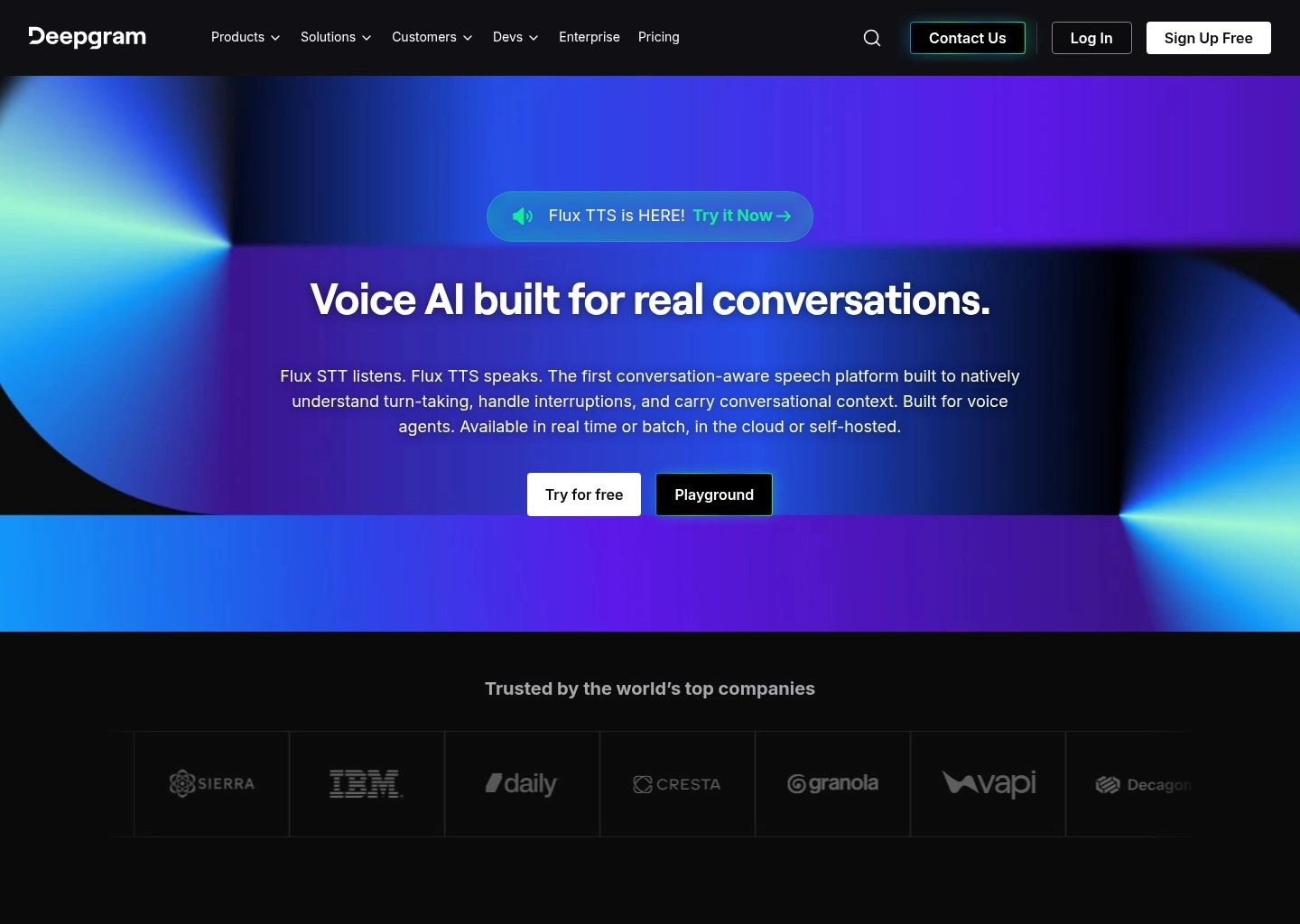
7. Deepgram (Aura) — Best Developer API for Ultra-Low Latency Conversational Agents
For software engineers, product teams, and startups building interactive conversational AI agents, traditional text-to-speech tools introduce far too much latency. When a user asks an AI customer service agent a question over the phone, waiting two seconds for audio generation results in awkward cross-talk. Deepgram solved this barrier with its revolutionary Aura text-to-speech engine.
Aura was engineered from scratch specifically for high-speed streaming conversations. In our technical API latency benchmarks, Aura achieved an astonishing sub-90-millisecond time-to-first-audio-chunk (TTFA) over WebSockets, making it over 3× faster than conventional cloud speech APIs. Paired with Deepgram's industry-leading Nova-2 speech-to-text model, developers can construct full-duplex voice AI bots that listen, process through an LLM, and respond with natural human-like pacing in under 500 milliseconds end-to-end.
| Feature Metric | Specification |
|---|---|
| Streaming Latency (TTFA) | Sub-90ms time-to-first-audio-chunk via persistent WebSockets / REST endpoints |
| Developer Ecosystem | Official SDKs for Python, Node.js, Go, Rust, and cURL; WebRTC and SIP telephony support |
| Voice Personas | 12+ conversational voice models optimized for telephone bandwidth and high intelligibility |
| Pricing Model | Transparent per-character usage pricing ($0.015 per 1,000 characters; ~$0.012 per minute) |
Deepgram Pros
- Unbeatable sub-90ms streaming latency makes real-time conversational voice agents feel instant
- Highly affordable pay-as-you-go pricing (up to 70% cheaper than legacy cloud providers)
- Seamless unified pipeline combining speech-to-text (Nova-2) and text-to-speech (Aura)
- Enterprise scalability handles millions of concurrent WebSocket voice connections with ease
Deepgram Cons
- API-first architecture requires developer integration; no consumer drag-and-drop video studio
- Voice library currently focused on conversational personas rather than theatrical character acting
- No instant consumer voice cloning UI included
Pricing: Deepgram provides $200 in free API credits upon signup. Aura TTS is billed purely on usage at $0.015 per 1,000 characters (roughly $0.012 per audio minute). High-volume enterprise contracts offer custom discounted volume tiers and dedicated on-premise deployments.
Explore Deepgram in Our Directory →
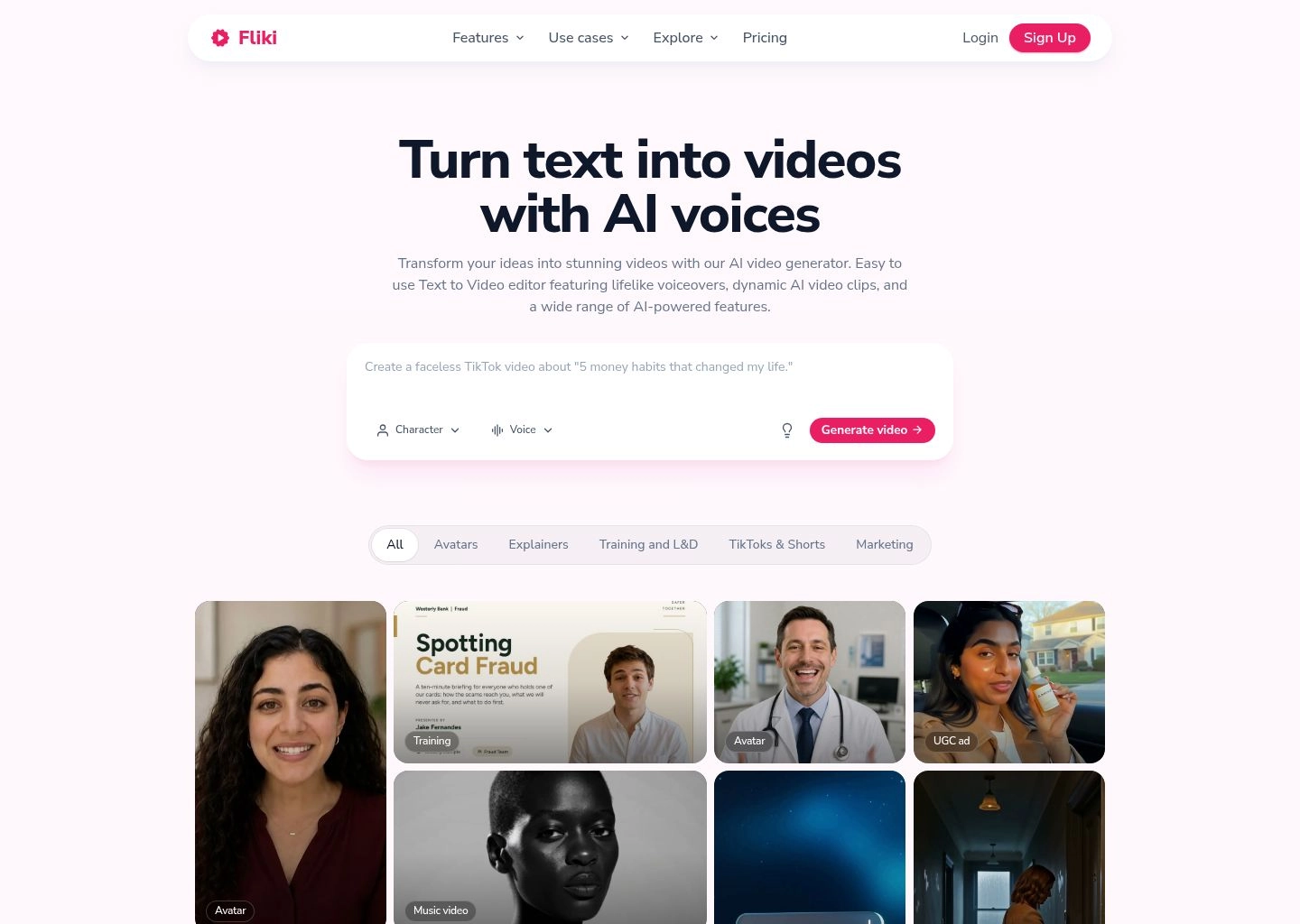
8. Fliki — Best for Turnkey Social Video Creation & Automated Voiceovers
For solo content creators, affiliate marketers, and growth teams running faceless YouTube channels, generating a voiceover is only step one. You still have to source background b-roll, align captions, sync audio tracks, and format aspect ratios for TikTok and Instagram Reels. Fliki eliminates that multi-step friction by integrating prompt-to-video, scriptwriting, and AI voice synthesis into a single automated pipeline.
With Fliki, you can paste an article URL, an idea prompt, or a raw script, and Fliki automatically breaks the content into scenes, assigns context-appropriate AI voiceovers, sources relevant royalty-free stock footage, and overlays animated social captions in under two minutes. Fliki boasts one of the largest multilingual libraries in existence—featuring over 2,000 realistic voices across 80+ languages and 100+ dialects. For high-velocity social media publishing, Fliki delivers unmatched end-to-end automation.
| Feature Metric | Specification |
|---|---|
| Voice Catalog Scope | 2,000+ AI voices across 80+ languages and 100+ regional dialects |
| Automated Workflows | Text-to-Video, Blog-to-Video, Tweet-to-Video, Product-to-Video, Voice Cloning |
| Media Stock Asset Access | 10M+ commercial royalty-free video clips, photos, and background music tracks |
| Social Optimization | Dynamic subtitle animations, 9:16 vertical, 1:1 square, and 16:9 landscape exports |
Fliki Pros
- All-in-one automation: generates voiceover, selects b-roll, and animates captions in 120 seconds
- Gigantic voice library of 2,000+ voices spanning 80+ global languages and regional dialects
- Blog-to-Video feature converts written articles directly into engaging social reels
- Zero technical video editing skills required to produce publish-ready social collateral
Fliki Cons
- Automated stock video selections sometimes require manual replacement for niche topics
- Raw voiceover dramatic nuance is slightly less refined than ElevenLabs' top models
- High-volume video exports require higher-tier paid plans
Pricing: Fliki provides a Free plan with 5 minutes of credit per month. The Standard Plan is $28/month ($21/month billed annually) with 180 minutes of audio/video and 1,000+ voices. The File/Video Pro Plan is $88/month ($66/month billed annually) with 600 minutes, voice cloning, and commercial API access.
Explore Fliki in Our Directory →
The 4-Layer Neural Speech Pipeline: From Phoneme Embeddings to Sub-120ms Latent Diffusion
To understand how modern AI voice generators achieve human-grade warmth and emotional authenticity, one must look beneath the user interface. The transition from legacy concatenative text-to-speech to generative acoustic transformers represents one of the most sophisticated engineering achievements in artificial intelligence. Today, a production neural voice engine operates across four interdependent technical layers:
The Generative Speech Pipeline Architecture
The pipeline begins by converting raw text characters into phonetic representations. Natural language processors parse sentence syntax, detect punctuation pauses, resolve heteronyms (determining whether "bow" refers to a ribbon or an archery weapon based on context), and map words to International Phonetic Alphabet (IPA) tokens. In corporate tools like WellSaid Labs, proprietary phonetic dictionaries intercept proprietary terms to enforce exact brand pronunciations.
The second layer translates phonetic tokens into acoustic features: pitch contours, duration, energy dynamics, and emotional timbre. State-of-the-art models like ElevenLabs and Resemble AI use diffusion transformers (DiT) operating within continuous audio latent spaces. Rather than selecting pre-recorded voice fragments, the model denoises Gaussian noise into high-fidelity mel-spectrograms that account for emotional prompts, breathing patterns, and vocal tract resonance.
A mel-spectrogram is merely a visual frequency map; it must be converted back into a playable physical audio waveform. High-performance neural vocoders (such as HiFi-GAN and BigVGAN architectures) calculate phase alignment and upsample spectrogram frames into 44.1 kHz or 48 kHz uncompressed audio samples at thousands of cycles per second. This layer eliminates digital robotic artifacts and delivers pristine broadcast clarity.
The final production layer handles delivery and ethical governance. For conversational bots, engines like Deepgram Aura stream chunked audio over WebSockets with sub-90ms latency before the full sentence has even finished generating. Concurrently, security systems like Resemble Detect inject imperceptible neural watermarks into the high-frequency spectrum, providing tamper-proof provenance verification to prevent deepfake exploitation.
Strategic Decision Framework: How to Choose Your Voice Generation Stack
No single software platform fulfills every voice synthesis requirement. A game developer building conversational NPCs requires millisecond latency, whereas an audiobook producer prioritizes long-form stamina and dramatic inflection. The strategic matrix below outlines optimal tooling combinations tailored to specific operational profiles:
Narrative & Creative Media
Primary: ElevenLabs + Descript
Audiobook publishers, documentary filmmakers, and narrative podcasters require profound emotional range. ElevenLabs handles dramatic multi-character narration and automated dubbing, while Descript provides text-based audio cleanup and Overdub fixes.
Key Benefit: Studio-grade voice acting with seamless in-document transcript audio corrections.
Enterprise Corporate & L&D
Primary: Murf AI + WellSaid Labs
Enterprise training departments and corporate marketing teams require reliable brand consistency, team workspaces, and strict copyright compliance. Murf offers timeline slide synchronization, while WellSaid guarantees broadcast-safe audio.
Key Benefit: 100% commercially cleared voice models with organizational phonetic standardization.
Real-Time Voice AI Developers
Primary: Deepgram + Resemble AI
Engineers building interactive customer support voice bots, telephone IVR systems, and conversational LLM agents require instant response times. Deepgram delivers sub-90ms streaming TTFA, while Resemble provides dynamic emotion vectors.
Key Benefit: Sub-second conversational turnarounds that eliminate awkward cross-talk on phone lines.
4 Dangerous AI Voice Generation Pitfalls to Avoid
While AI voice technology has achieved astonishing realism, deploying synthetic speech without proper technical and ethical safeguards frequently leads to brand embarrassment or compliance violations. Avoid these four common pitfalls:
-
1. The "Robotic Monotone" Cadence Trap in Long-Form Scripts
When generating full audiobook chapters or 30-minute lectures in a single batch, many neural models gradually lose dynamic range, defaulting to a rhythmic, hypnotic cadence that lulls listeners to sleep. Break long scripts into paragraphs, insert deliberate pause tags (e.g.
[pause 0.5s]), and re-roll sections where emotional emphasis flags. -
2. Unvetted Community Voices and Copyright Infringement
Some consumer platforms allow users to upload unauthorized clones of Hollywood actors, famous singers, and recognizable public figures. Using an un-cleared celebrity voice clone in a commercial advertising campaign exposes your company to severe right-of-publicity lawsuits. Always use verified, commercially licensed voice libraries (WellSaid Labs, Murf AI) for commercial broadcasts.
-
3. The Pronunciation Drift Failure Mode
Neural speech models frequently mispronounce brand names, medical terms, and acronyms (pronouncing "SQL" as "sequel" or spelling it out as "S-Q-L" inconsistently across scenes). Always audit audio passes and leverage phonetic dictionaries or IPA respelling to lock technical pronunciation permanently across your organization.
-
4. Ignoring Room Tone and Acoustic Mismatches
Synthetic voices are generated in pristine, dead acoustic silence. When spliced into video footage recorded in real rooms, the abrupt absence of ambient air noise sounds jarring to human ears. Always blend subtle ambient room tone, Foley sound effects, or low-level background music beneath synthetic voiceover tracks.
Frequently Asked Questions (FAQ)
Can AI voice generators truly replace professional voice actors in 2026?
For corporate e-learning, explainer videos, YouTube narration, and accessibility reading, AI voice generators have largely replaced human voiceover sessions due to massive speed and cost advantages. However, for top-tier Hollywood character acting, nuanced theatrical performance, and high-stakes emotional drama, professional human voice actors still maintain an edge in spontaneous creative collaboration.
Which AI voice generator sounds the most natural and realistic?
ElevenLabs is widely regarded as the most natural-sounding AI voice generator on the market today. Its continuous latent diffusion models simulate natural micro-breaths, pacing variations, emotional inflections (whispers, excitement, tension), and realistic sibilance with virtually zero robotic artifacts.
How much audio data is needed to clone a person's voice?
With modern zero-shot synthesis tools like ElevenLabs and Resemble AI, an Instant Voice Clone requires just 60 seconds to 3 minutes of clean audio. However, for a Professional Voice Clone (PVC) capable of long-form audiobooks without vocal drift, platforms typically require 30 to 120 minutes of studio-quality training audio.
What is the fastest AI voice generator for real-time conversational bots?
Deepgram Aura is the benchmark for speed, clocking an ultra-low time-to-first-audio-chunk (TTFA) of sub-90 milliseconds. This allows interactive conversational AI bots and telephone agents to respond to users without noticeable conversational latency.
Can I legally monetize videos and audiobooks created with AI voices?
Yes, provided you subscribe to paid commercial plans on reputable platforms like ElevenLabs, Murf AI, WellSaid Labs, or Fliki. Commercial plans grant you full distribution and monetization rights across YouTube, Spotify, Audible, and commercial TV broadcasts, while free tiers are generally restricted to personal non-commercial evaluation.
Final Verdict & Implementation Roadmap
Generative neural speech has permanently disrupted audio engineering. In 2026, creating high-converting voiceovers, international video dubs, and interactive conversational agents no longer requires booking recording studios, renting expensive acoustic booths, or paying thousands of dollars for hourly talent.
Our Definitive 2026 Implementation Recommendations:
- If you produce audiobooks, dramatic videos, or multi-language dubbing: Deploy ElevenLabs for industry-best emotional prosody and instant voice cloning.
- If you manage corporate training, e-learning slides, or marketing teams: Choose Murf AI for per-word pitch/emphasis timeline controls and collaborative workspaces.
- If you need hands-free reading productivity across documents and PDFs: Use Speechify for cross-device synchronization and high-speed audio playback.
- If you require enterprise broadcast safety and ethical voice licensing: Rely on WellSaid Labs for pristine 48 kHz uncompressed WAV masters.
- If you edit podcasts or video interviews and need to fix mistakes via text: Adopt Descript for its text-based Overdub synthetic voice replacement.
- If you are building low-latency conversational AI agents or phone bots: Integrate Deepgram Aura for sub-90ms streaming speech synthesis.
- If you produce high-volume faceless social reels for TikTok and YouTube: Utilize Fliki to automate scriptwriting, voiceover, and b-roll assembly.
To continue advancing your generative media stack, read our in-depth guides on the 9 Best AI Audio & Transcription Tools in 2026, the 8 Best AI Video Generators, the 8 Best AI Script Writing Software, and the 8 Best AI Graphic Design Tools. Explore our complete directory of verified software in the AI Tools Directory and Content Creation Category.