Auphonic
Automatic AI audio mastering for podcasts — noise reduction, loudness leveling, and transcription in one click
Gallery
5 items


About Auphonic
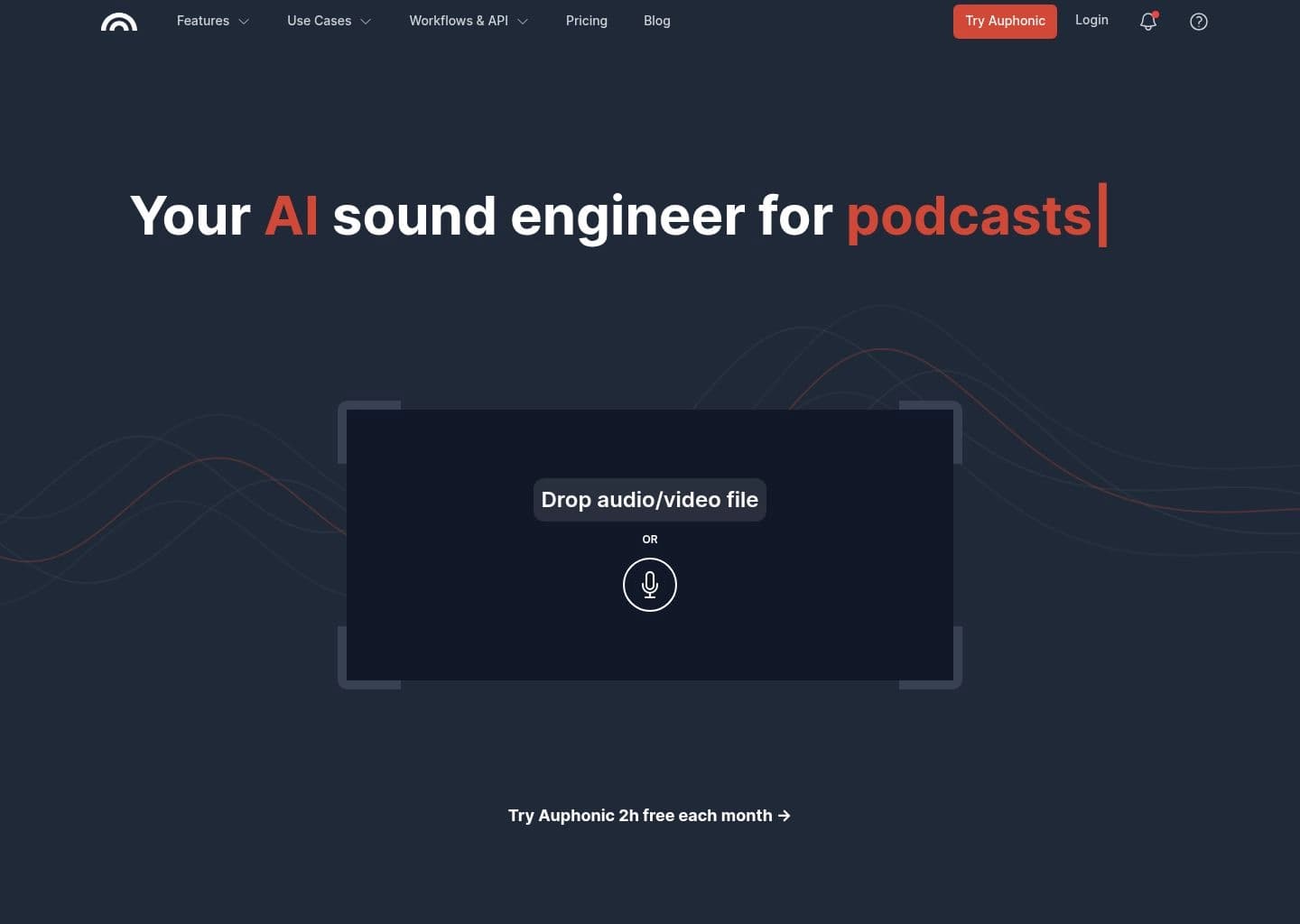
I ran raw, multi-track podcast recordings with uneven mic levels and background air conditioner hum through Auphonic, and its automated mastering algorithms balanced loudness to strict -16 LUFS standards in under a minute. The adaptive leveler and cross-talk removal sound completely transparent. The web interface is strictly utilitarian without timeline waveform editing, designed purely as an automated batch processing pipeline. Offering 2 hours of free processing monthly and recurring plans at $11/month, it is a mandatory utility for serious podcasters.
Auphonic is an automatic AI audio post-production service that acts as a one-click sound engineer for podcasters, video creators, broadcasters, and audiobook producers. Founded in 2013 in Graz, Austria, Auphonic has grown to over 2 million users including production teams at BBC Radio, iHeartRadio, and MSNBC. It processes your audio or video file automatically — applying noise reduction, adaptive loudness leveling, EQ, de-essing, filler word removal, and broadcast loudness normalization without requiring any audio engineering expertise.
Auphonic's processing pipeline covers all the steps a professional sound engineer would handle in post-production: its adaptive leveler balances volume between speakers, music, and speech throughout the recording; AutoEQ and bandwidth extension improve voice clarity; CryptoGuard-style noise and reverb reduction cleans up room noise and background interference; and automatic silence and filler word detection removes hesitations in multiple languages. For podcast interviews with multiple guests recorded on separate tracks, Auphonic's multitrack engine handles per-track denoising, noise gating, automatic ducking of music under speech, and mic bleed removal — producing a clean, broadcast-ready mixdown from raw multitrack recordings. Loudness output is normalized to your target standard: EBU R128, ATSC A/85, Apple Podcasts, Spotify, YouTube, Netflix, or ACX audiobooks.
Beyond audio cleanup, Auphonic includes multilingual speech-to-text transcription powered by a self-hosted Whisper model, generating shareable transcripts, automatic shownotes, and chapter markers. Workflow automation connects via watch folders, Zapier, Dropbox, Google Drive, and direct publishing to YouTube, Libsyn, Soundcloud, Spreaker, and PodBean. A free REST API and CLI enable integration into production pipelines and DAWs. Pricing starts with a genuinely generous free plan of 2 hours per month (all core algorithms, no credit card needed), scaling to paid plans from $11/month (annual) for 9 hours through to custom Business contracts for 1,000+ hours monthly.
Auphonic is best suited for solo podcasters who want one-click professional audio without learning a DAW, broadcast and radio teams needing EBU R128 compliance, audiobook narrators requiring ACX-compliant masters, video creators processing lecture or interview recordings, and production operations that need API-driven automated audio workflows at scale.
Key Features
- AI-powered noise and reverb reduction with adjustable intensity
- Intelligent adaptive leveler that balances speaker, music, and speech volume
- AutoEQ, De-Esser, De-Plosive filtering, and bandwidth extension for clearer voice
- Automatic cutting of filler words, coughs, throat-clearing, and silence in multiple languages
- Multitrack processing with automatic ducking, noise gate, and mic bleed removal
- Loudness normalization to podcast, streaming, broadcast, and ACX audiobook specifications
- Multilingual speech-to-text with shareable transcripts, auto-generated shownotes, and chapters
- Video support with audio extraction, waveform audiogram generation, and automatic publishing to podcast/video platforms
Pros
- Generous free tier of 2 hours per month with all core algorithms included
- One-click automated processing requires no audio engineering expertise
- Strong multitrack support with mic bleed removal and per-track denoising
- Broad platform integrations for file transfer, publishing, watch folders, and Zapier
- Free CLI and full API make it easy to integrate into existing workflows
- Trusted by large broadcasters like BBC Radio and iHeartRadio as well as independent podcasters
Cons
- No timeline or waveform editor; it is a finishing/mastering layer, not a full audio editor
- Free plan output includes an Auphonic jingle and multitrack use is capped under 20 minutes
- Speech-to-text accuracy is solid but trails dedicated transcription services like Rev or Otter.ai
- Watch folders and batch productions are locked behind paid plans
- Interface design is functional but visually dated compared to newer competitors
Pricing
Free plan: 2 hours of processed audio per month, all basic algorithms included, but output files carry an Auphonic jingle. Recurring Credits (Monthly & One-Time tier, cheaper when billed yearly): Auphonic S at roughly $13/month (about $11/month billed annually) for 9 hours/month; Auphonic M at roughly $27/month ($23/month annually) for 21 hours/month; Auphonic L at roughly $53/month ($45/month annually) for 45 hours/month; Auphonic XL at roughly $105/month ($89/month annually) for 100 hours/month; an XXL tier covers 250 hours/month, and custom Business contracts exist beyond 1000 hours/month. One-Time Credits are also sold in blocks from 5 hours up to 3000+ hours, never expire, and can auto-renew when the balance runs low. Paid tiers unlock multilingual speech-to-text, automatic shownotes/chapters, watch folders, and batch productions; yearly and Business plans add priority processing, team accounts, and priority support. Billing is based on processed audio duration with a 3-minute minimum per production.
Claim Verified Creator Badge
Are you the founder of Auphonic? Display this listing's verified badge on your website to show your customers that your product has been vetted and listed on AI Central Resources.
<a href="https://www.aicentralresources.com/tool/auphonic" target="_blank" rel="noopener">
  <img src="https://www.aicentralresources.com/badges/featured-badge-dark.svg" alt="Featured on AICentralResources" width="200" height="54" style="border: none;" />
</a>
* Place this HTML snippet in your website's footer, landing page, or press section. This creates a search-friendly backlink directly to your verification page.
Connect with Auphonic
Frequently Asked Questions
Auphonic offers a free plan with 2 hours of processed audio per month — no credit card required — with all core algorithms included (noise reduction, adaptive leveling, loudness normalization). Free productions include an Auphonic jingle on output files. Paid plans start from $11/month (annual) or $13/month (monthly) for 9 hours of processing per month and remove the jingle while unlocking speech-to-text, shownotes, and watch folders.
Yes. Auphonic supports full video file uploads. It extracts the audio track, applies noise reduction, loudness normalization, and all other processing algorithms, then re-merges the cleaned audio back into the video without any loss in video quality. It can also publish processed video directly to YouTube.
Auphonic supports loudness normalization to all major standards: EBU R128 (broadcast), ATSC A/85, Apple Podcasts, Spotify, YouTube, Netflix, and ACX audiobook standards. You select the target standard and Auphonic automatically hits the integrated loudness, true peak, and LRA targets — no manual calculation needed.
Yes — Auphonic includes multilingual speech-to-text powered by a self-hosted Whisper model, with optional third-party engine support. It generates full transcripts, auto-formatted shownotes, and chapter markers from your audio. Speech-to-text is available on paid plans starting at $11/month (annual billing).
The best Auphonic alternatives in 2026 are: Adobe Podcast (free, browser-based voice enhancement and recording — best for simplicity), Descript (full podcast editor with AI editing and transcription — best for editorial workflow), Cleanvoice AI (filler word removal and silence cutting — best for cleanup only), Riverside (studio-quality recording and AI editing — best for remote guest recordings), and Alitu (all-in-one podcast maker — best for complete beginners). Auphonic remains the strongest choice for automated loudness normalization, EBU R128 compliance, and multitrack mastering without manual editing.
Auphonic's multitrack processor accepts separate audio files for each speaker, music tracks, and other sources. It applies per-track denoising and noise gating, handles mic bleed between channels, and auto-ducks background music under speech — then mixdowns everything into a polished single stereo file. This makes it particularly useful for podcast interviews recorded with multiple microphones or remote guests on separate tracks.
Similar AI Tools to Auphonic
View all alternatives of Auphonic

Riverside
Studio-quality podcast and video recording, editing, and publishing powered by AI

Adobe Podcast
AI-powered audio recording, enhancement, and editing, all in the browser

Async
Record, edit, and generate podcasts and videos in one AI-powered creative studio

Cleanvoice AI
AI podcast editor that removes filler words, noise, and dead air in minutes

Compared with Auphonic
Direct head-to-head feature matrices, pricing breakdowns, and real-world performance benchmarks