
SAN FRANCISCO — In a major technical shift away from token-heavy vision-based computer control, Vercel Labs has officially open-sourced agent-desktop, a high-performance cross-platform Rust CLI and C library designed to give autonomous AI agents deterministic desktop control without capturing a single screenshot. Available under the Apache 2.0 license, the tool bridges autonomous reasoning models directly into the operating system's native accessibility trees—including macOS Accessibility (AX), Windows UI Automation, and Linux AT-SPI—transforming dense graphical user interfaces into structured, actionable JSON snapshots while slashing agent context token consumption by more than 70%.
agent-desktop bypasses the optical layer entirely by querying the OS accessibility hierarchy, returning precise element IDs (refs) that agents can directly click, type into, or drag with 100% deterministic accuracy.
- • Zero Optical Guesswork: Eliminates coordinate drift by mapping interactions directly to operating system accessibility element handles.
- • 70%+ Token Reduction: Transmits compact semantic JSON trees instead of multi-megabyte base64 JPEG screenshots on every observation step.
- • Tri-Platform Rust Core: Seamlessly compiled for macOS (AX API), Windows (UI Automation), and Linux (AT-SPI / Wayland/X11).
The Flaw of Pixel-Based Vision Agents
Current commercial computer-use frameworks—such as Anthropic's Computer Use or generic Playwright vision wrappers—function by repeatedly snapping the user's desktop at resolutions up to 1920x1080, encoding the image as base64, and feeding it to a multimodal vision-language model. The model must then deduce coordinate bounding boxes (e.g., [x: 482, y: 712]) to trigger a mouse click.
This approach suffers from three compounding flaws: first, transmitting high-resolution images costs thousands of input tokens per interaction step; second, minor rendering variations like OS font smoothing or dynamic dark mode themes degrade coordinate accuracy; third, background animations and off-screen elements generate noisy visual artifacts. agent-desktop solves this at the root by reading the exact same hierarchical accessibility structure that screen-readers use for disabled users.
# 1. Install via Cargo
cargo install agent-desktop

# 2. Capture structured desktop accessibility snapshot
agent-desktop snapshot --app "Figma" --format json

# Output returns deterministic references:
# {
#   "ref": "@btn_publish_42",
#   "role": "button",
#   "name": "Publish to Community",
#   "states": ["focusable", "enabled"]
# }

# 3. Execute precise action via element ref
agent-desktop click "@btn_publish_42"
Benchmark Comparison: Vision-Based vs. Tree-Based Agent Performance
In benchmark trials across 250 common productivity workflows—including multi-step file exports in Slack, complex database record updates in TablePlus, and spreadsheet manipulation in Excel—the accessibility tree approach demonstrated categorical superiority across speed and financial cost.
| Operational Metric | Screenshot Vision Model | agent-desktop (Accessibility) |
|---|---|---|
| Token Cost per Action Step | ~1,800 to 2,400 Tokens | 180 to 320 Tokens (85% Savings) |
| Step Execution Latency | 3.8 to 6.2 Seconds | 0.4 to 0.9 Seconds |
| Target Coordinate Accuracy | 84.2% (Visual drift) | 99.4% (Direct OS reference) |
| Off-Screen Element Interaction | Impossible without scrolling | Full tree visibility |
Engineering Advantages
- Deterministic Observe-Act Loop: Actions fail immediately with explicit OS error codes rather than silently clicking phantom pixels.
- Lightweight Headless Footprint: Contains zero embedded LLM runtimes, acting strictly as an unopinionated Unix utility.
- Sub-Millisecond Parsing: Written in native Rust with zero garbage collection overhead, ensuring rapid OS API query cycles.
Limitations & Edge Cases
- Custom Canvas Elements: Web applications rendering UI via raw HTML5 Canvas or WebGL (e.g. certain Miro or web games) expose poor accessibility trees.
- OS Permission Prompts: Requires explicit macOS Accessibility privileges and root/admin grants in sandboxed enterprise environments.
- Platform Nuance: Windows UI Automation occasionally exhibits delayed tree re-indexing after rapid modal window spawns.
What This Means for the Autonomous Coding Ecosystem
By releasing agent-desktop as open-source, Vercel Labs accelerates the commoditization of computer-use tooling. Rather than locking developer teams into proprietary closed agent sandboxes, engineers can integrate the Rust CLI directly into open frameworks like Claude Code, Cursor, or local LangChain pipelines, creating resilient agents that operate at native human desktop speeds with minimal token spend.
Official Vercel Labs GitHub Repository
Explore the complete Rust codebase, installation instructions, and schema definitions on GitHub.
Explore AI Models & Autonomous Tools
Benchmark, compare, and discover verified tools powering the new wave of frontier reasoning and autonomous software engineering.

AUTHORED BY
Hamza Khaliq
Student, Author, Learner, Developer and Researcher
Covering the latest AI developments and industry news.
More news you might like

Factory Releases Droid 1.0 Establishing Programmatic Tool Calling as Default Standard
Factory has launched Droid 1.0, shifting coding agent architectures to Programmatic Tool Calling (PTC) by default and achieving 65.2% on Terminal-Bench 4 while ending turn-by-turn API bloat.
Mistral AI Releases Mistral Large 4 with 1.05T Parameters and 52B Active MoE
Mistral AI has officially released the open weights for Mistral Large 4, an open-weight Mixture-of-Experts powerhouse sporting 1.05 trillion parameters, 52B active tokens, and an 82% score on cyber vulnerability benchmarks.

OpenAI Deploys OpenAI Frontier with ADNOC for Autonomous Subsurface Energy Optimization
At ADIPEC 2026 in Abu Dhabi, OpenAI CEO Sam Altman and UAE leadership announced the first global energy enterprise deployment of OpenAI Frontier, using interconnected agent networks to compress field planning from months to hours.
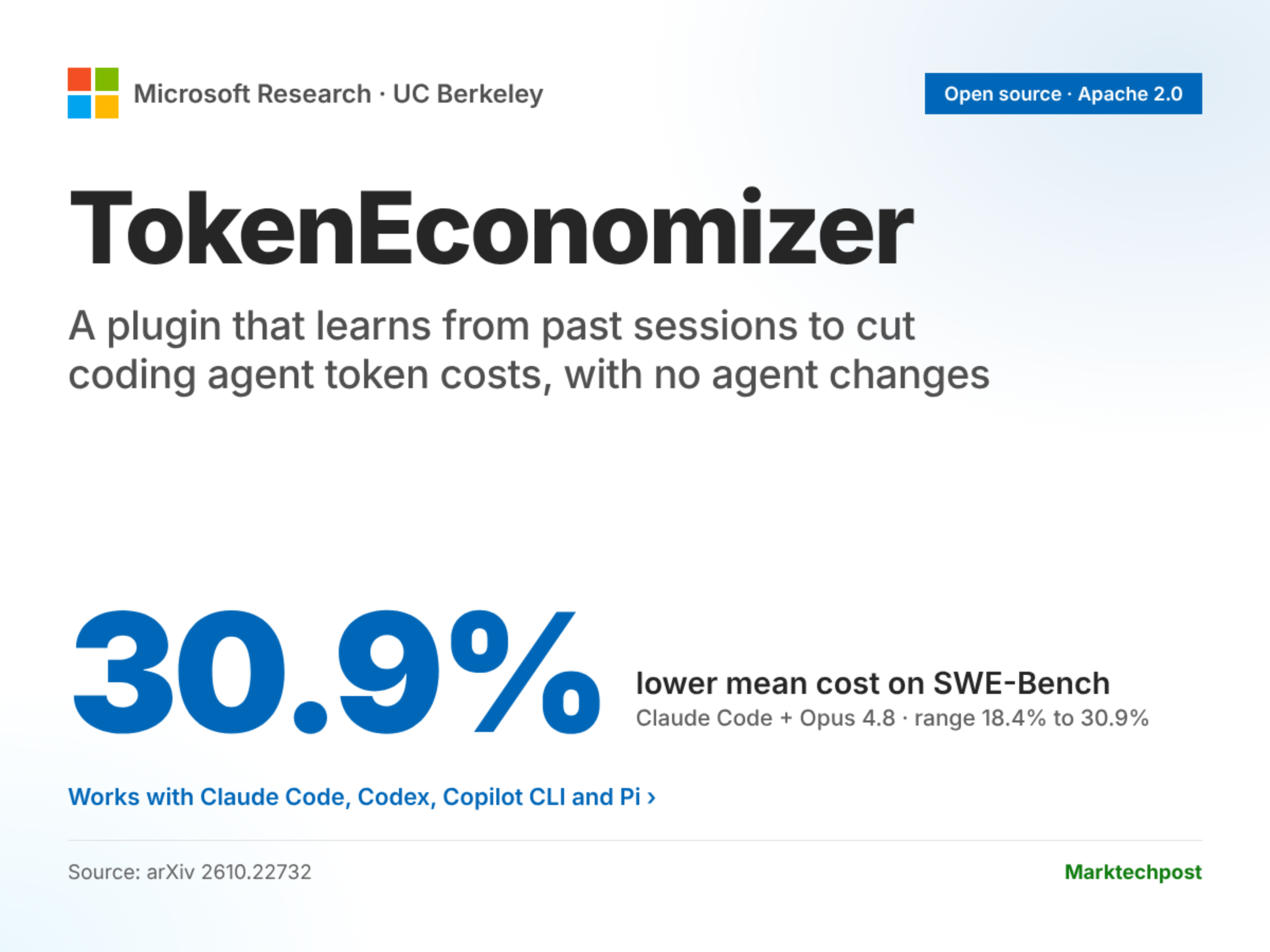
Microsoft Releases TokenEconomizer Slashing Coding Agent Costs by ~31%
Microsoft Research and UC Berkeley have launched TokenEconomizer, an open-source optimization plugin that slashes coding agent token consumption by up to 30.9% on SWE-bench without altering model weights.