
SAN FRANCISCO — Challenging the conventional turn-by-turn design of autonomous coding software, AI software harness pioneer Factory has officially launched Droid 1.0, a major architectural release that elevates Programmatic Tool Calling (PTC) to the default execution standard. Packaged as a model-independent developer harness available as both a terminal UI and a native desktop environment, Droid 1.0 shifts coding agents away from chat-like conversational tool loops, enabling frontier models to author and execute complex multi-step automation scripts within a single inference roundtrip. The resulting architecture achieved a record-breaking 65.2% score on Terminal-Bench 4 using Claude Opus 5.5 and 57.6% with GPT-6.1 Sol while slashing context window bloat by up to 60%.
- • Script-Mode Execution: Executes bulk tool actions within an isolated local runtime, drastically curtailing context window pollution.
- • Terminal-Bench 4 Dominance: Sets the new open harness benchmark record at 65.2% with Claude Opus 5.5.
- • Model-Agnostic Gateway: Supports seamless hot-swapping between Anthropic, OpenAI, DeepSeek, and Vercel AI Gateway endpoints.

Why Turn-by-Turn Tool Calling Breaks on Complex Repositories
Traditional coding assistants like Cursor Composer or early LangChain agent loops operate via rigid conversational turns: the model emits a JSON tool call (e.g., readFile("src/auth.ts")), the host environment responds with the file text, the model reads the file, decides it needs a second file, emits readFile("src/db.ts"), and so on. In repositories containing hundreds of microservices, an agent routinely burns 30 to 50 roundtrips just to map import dependencies.
Every single step reinjects the entire conversation history back into the LLM's context window. By step 20, input prompt caching costs skyrocket, context limits are breached, and the model begins hallucinating earlier instructions. Droid 1.0 breaks this paradigm by introducing Programmatic Tool Calling (PTC). Instead of issuing individual requests, the model writes a unified Python or Bash script that executes inside Droid's local sandbox.
# 1. Initialize Droid inside your repository
droid init

# 2. Launch autonomous refactoring with script-mode PTC enabled
droid run --ptc --model claude-opus-5-5 \
  "Refactor all authentication middlewares to use JWT RS256 with unit tests"

# Droid authors an executable sandbox script that reads 14 files,
# runs pytest, patches syntax errors, and commits cleanly in 1 roundtrip:
# [PTC] Executing batch refactor script (14 operations)... Done.
# [Test] All 38 unit tests passed in 1.4s.
# [Commit] Created branch feat/jwt-rs256 (commit 8a1e2f).
Benchmark Comparison: Terminal-Bench 4 Performance
To validate the impact of Programmatic Tool Calling, Factory evaluated Droid 1.0 on Terminal-Bench 4, the industry standard benchmark measuring end-to-end command-line bug resolution in real Linux environments.
| Harness & Architecture | Underlying Frontier Model | Terminal-Bench 4 Score | Avg API Roundtrips per Task |
|---|---|---|---|
| Factory Droid 1.0 (PTC Mode) | Claude Opus 5.5 | 65.2% | 2.4 Roundtrips |
| Factory Droid 1.0 (PTC Mode) | GPT-6.1 Sol | 57.6% | 2.9 Roundtrips |
| Legacy Turn-by-Turn Harness | Claude Opus 5.5 | 48.1% | 18.6 Roundtrips |
| Standard Developer Terminal CLI | DeepSeek-V3 | 41.2% | 22.4 Roundtrips |
Architectural Pros
- Dramatic Latency Reductions: Compressing 20 sequential network trips into a single script saves minutes per coding task.
- Context Window Cleanliness: Intermediate bash error logs and debug stack traces stay inside the sandbox and never pollute the parent chat context.
- Zero Model Lock-In: Freely switch between Anthropic, OpenAI, or local open-weights endpoints without changing workflow scripts.
Operational Considerations
- Sandbox Isolation Requirements: Running arbitrary model-authored scripts requires robust Docker or Firecracker VM sandboxing on production workstations.
- Debugging Complex Script Failures: When a synthesized multi-step script fails halfway through, root-cause triage can be harder than step-by-step review.
- Strict Resource Limits: Infinite loop safeguards are required to prevent scripts from consuming 100% CPU on runaway unit tests.
The Verdict on Droid 1.0
Factory Droid 1.0 proves that the future of agentic software engineering is programmatic, not conversational. By letting AI models author executable code rather than conversational tool calls, developer teams achieve faster resolutions, lower monthly token invoices, and superior benchmark performance on demanding real-world codebases.
Official Factory Droid Documentation
Read the complete release notes, benchmark specifications, and architecture breakdown on Factory's official site.
Explore AI Models & Autonomous Tools
Benchmark, compare, and discover verified tools powering the new wave of frontier reasoning and autonomous software engineering.

AUTHORED BY
Hamza Khaliq
Student, Author, Learner, Developer and Researcher
Covering the latest AI developments and industry news.
More news you might like
Vercel Labs Open-Sources Agent Desktop Replacing Vision Screenshots with Accessibility Trees
Vercel Labs has open-sourced agent-desktop, a high-speed Rust tool allowing autonomous AI agents to interact with desktop apps via OS accessibility trees instead of heavy vision screenshots.
Mistral AI Releases Mistral Large 4 with 1.05T Parameters and 52B Active MoE
Mistral AI has officially released the open weights for Mistral Large 4, an open-weight Mixture-of-Experts powerhouse sporting 1.05 trillion parameters, 52B active tokens, and an 82% score on cyber vulnerability benchmarks.

OpenAI Deploys OpenAI Frontier with ADNOC for Autonomous Subsurface Energy Optimization
At ADIPEC 2026 in Abu Dhabi, OpenAI CEO Sam Altman and UAE leadership announced the first global energy enterprise deployment of OpenAI Frontier, using interconnected agent networks to compress field planning from months to hours.
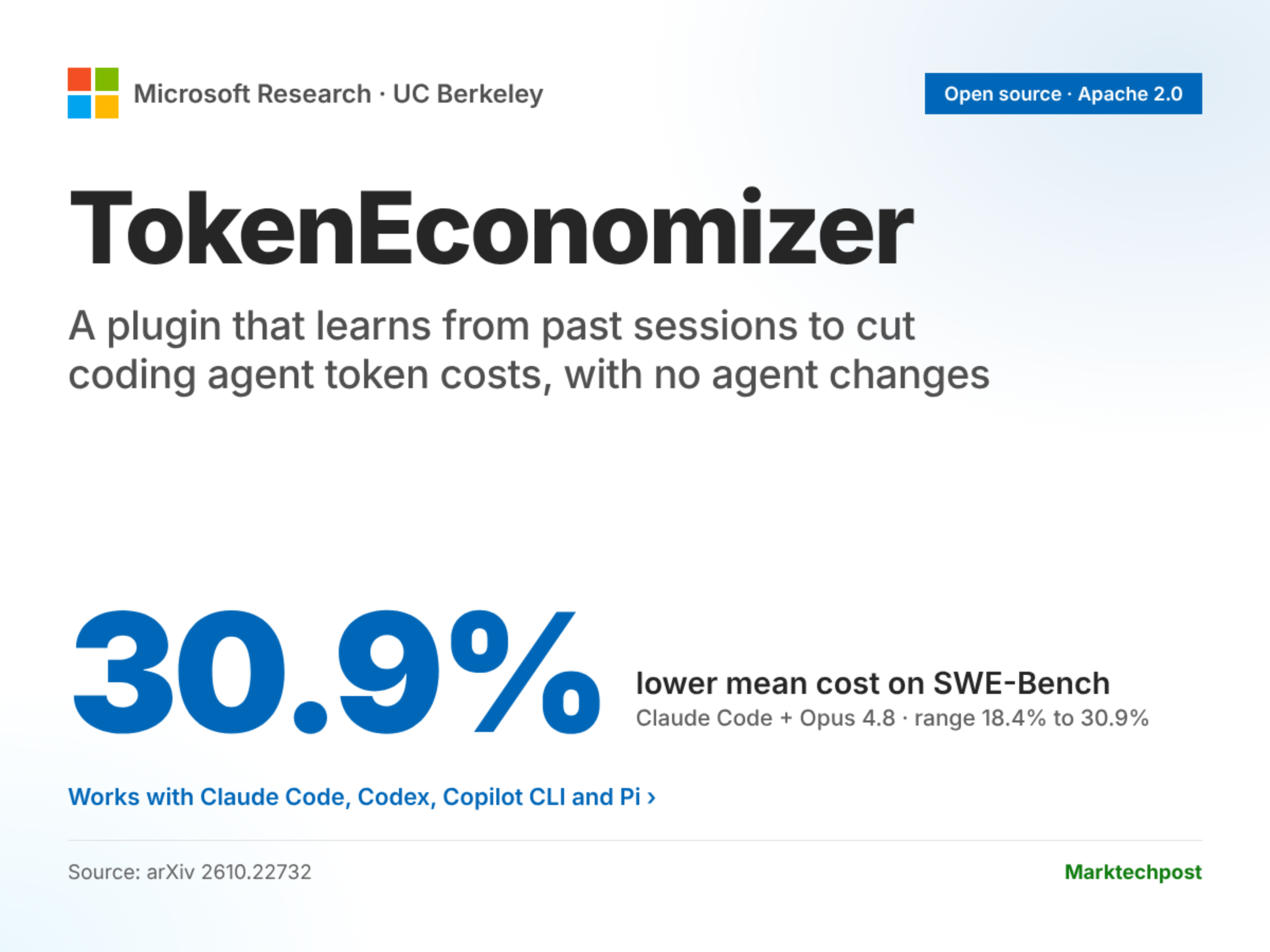
Microsoft Releases TokenEconomizer Slashing Coding Agent Costs by ~31%
Microsoft Research and UC Berkeley have launched TokenEconomizer, an open-source optimization plugin that slashes coding agent token consumption by up to 30.9% on SWE-bench without altering model weights.