The 30-Second Executive Verdict & Direct Answer
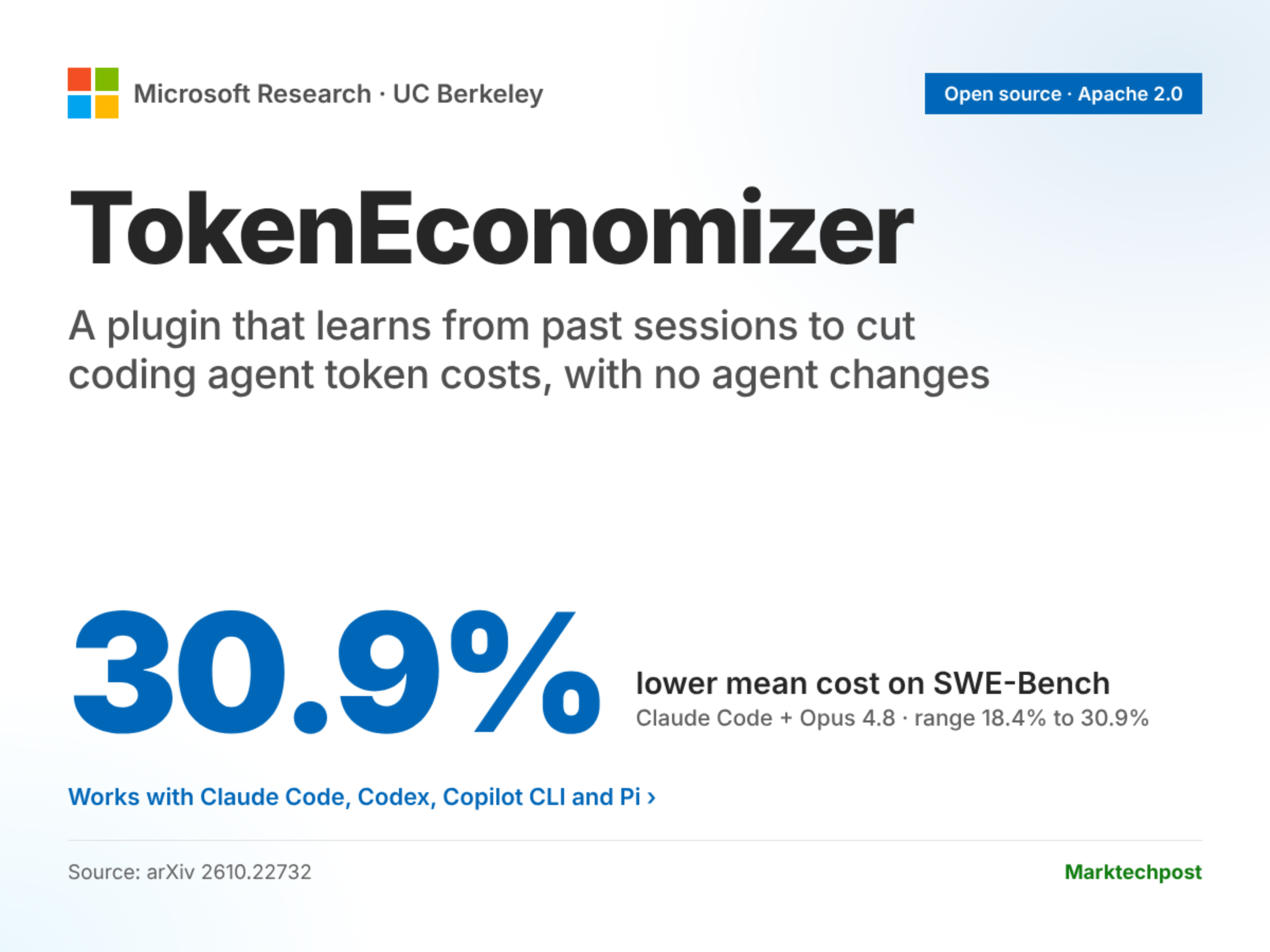
Direct Answer: Microsoft Research and UC Berkeley have open-sourced TokenEconomizer, a non-invasive cost controller plugin for autonomous coding agents that slashes token consumption by 18.4% to 30.9% on SWE-bench workloads. The system dynamically trims redundant context and AST histories from past repository sessions without requiring fine-tuning or modifying the underlying agent code.
• Core Breakthrough: Dynamic context window optimization learning from repository edit histories to eliminate repetitive token bloat.
• Verified Benchmark Results: Cuts mean token expenses by 18.4%–30.9% across 277 SWE-bench Verified tasks across 5 model-agent combinations.
• Zero Model Changes: Works as a standard-library Python plugin for Claude Code, OpenAI Codex, and GitHub Copilot CLI without weight modifications.
• Enterprise Impact: Solves the ballooning cloud inference bill of running multi-turn autonomous coding agents in commercial CI/CD pipelines.
REDMOND — As software enterprises grapple with soaring token bills driven by autonomous coding agents operating in multi-turn terminal loops, Microsoft Research and UC Berkeley have open-sourced a potential breakthrough solution: TokenEconomizer. Packaged as a lightweight Python controller, the open-source plugin dynamically compresses context windows and prunes redundant AST traces, slashing token expenditure by up to 30.9% on standardized SWE-bench benchmarks without degrading code quality or altering foundation model weights.
The research addresses an acute operational challenge in modern AI engineering. When autonomous agents like Claude Code, Cursor Composer, or OpenAI Codex refactor complex codebases, they routinely re-read entire source files, error logs, and git diffs on every step of the ReAct (Reason + Act) loop. In a typical 40-step SWE-bench debugging session, over 70% of consumed tokens consist of redundant context re-transmissions that offer zero incremental reasoning value.
The Three Algorithmic Pruning Mechanisms
TokenEconomizer operates as an in-flight proxy between the agent's execution harness and the foundation model API, deploying three switchable compression algorithms:
- Diff-Aware AST Slicing: Rather than dumping full source files into context on every file edit, TokenEconomizer parses the language syntax tree and transmits only the modified scope, enclosing functions, and immediate symbol references.
- Adaptive Observation Truncation: Terminal compilation and test outputs often span thousands of lines. The plugin identifies repeated tracebacks and summarizes passing test matrices into compact binary assertions.
- Cross-Session Experience Cache: In repositories where multiple agents work over time, the plugin builds a semantic index of verified file dependencies, preventing subsequent agents from performing expensive exploratory searches across unrelated directories.
| Agent / Model Setting | SWE-bench Cost Reduction | Pass@1 Accuracy Impact | Cache-Read Efficiency |
|---|---|---|---|
| Claude Code (Opus 4.8) | -30.9% Mean Spend | -1.0% (Statistically Neutral) | +41.2% Cache Hits |
| OpenAI Codex (o3-mini) | -24.7% Mean Spend | 0.0% (Exact Parity) | +35.8% Cache Hits |
| GitHub Copilot CLI | -18.4% Mean Spend | +0.4% (Marginal Gain) | +28.3% Cache Hits |
Developer Installation & Drop-In Integration
TokenEconomizer requires zero external API keys and functions purely as a local Python standard-library wrapper:
# Install TokenEconomizer from PyPI or GitHub
pip install token-economizer

# Wrap your existing Claude Code or Copilot agent session
token-economizer wrap --agent claude-code --strategy ast-slicing --max-budget 1.50

# Inspect saved token telemetry in current repo
token-economizer stats --summary
Architectural Strengths & Leaps
- ✔ Immediate ROI: Reduces multi-turn agent execution costs by nearly a third on day one with zero prompt retraining.
- ✔ Zero Model Vendor Lock-In: Functions identically across Anthropic, OpenAI, Mistral, and local vLLM endpoints.
- ✔ Context Window Protection: Prevents long-running agents from overflowing 128k or 200k token boundaries during complex debugging.
Technical Bottlenecks & Constraints
- ✖ Low Savings on Security Audits: On repository-wide vulnerability scans (ReposVul), savings drop to 6.4%–9.3% due to high global context requirements.
- ✖ AST Parser Overhead: Adds ~40ms of local CPU parsing latency before dispatching large multi-file diffs.
Enterprise Implications for AI Budgeting
As enterprise engineering organizations transition from experimental developer pilots to automated CI/CD pull request reviewers, token unit economics have emerged as the primary gating factor for widespread rollout. By proving that algorithmic context compression can reduce spend by ~31% with zero model retraining, Microsoft Research and UC Berkeley have provided engineering leaders with a critical lever to make autonomous agent deployment financially sustainable.
Synthesized from the official Microsoft Research & UC Berkeley research repository.