
ABU DHABI — In a landmark industrial agreement unveiled at the opening of ADIPEC 2026, the Abu Dhabi National Oil Company (ADNOC) has officially become the first global energy enterprise to deploy OpenAI Frontier, OpenAI's sovereign multi-agent coordination platform designed to execute autonomous scientific planning across physical infrastructure. Announced during an executive summit between OpenAI CEO Sam Altman, Abu Dhabi Crown Prince Sheikh Khaled bin Mohamed bin Zayed Al Nahyan, and ADNOC Group CEO Dr. Sultan Ahmed Al Jaber, the multi-year partnership establishes an interconnected network of autonomous reasoning agents capable of continuous subsurface reservoir simulation, automated seismic cross-examination, and dynamic underground oil valuation across thousands of operating wells.
- • Enterprise Orchestration: Operates directly on top of ADNOC's proprietary ENERGYai architecture, coupling frontier LLM reasoning with sovereign geophysical solvers.
- • Autonomous Reservoir Modeling: Continuously recalculates crude supply, demand margins, and flow dynamics to assign dynamic financial valuations to oil deposits prior to extraction.
- • Sovereign Infrastructure: Executed entirely within the UAE on G42's Inception42 national AI cluster, guaranteeing zero cross-border data transit for mission-critical national infrastructure.

The Architectural Shift: From Conversational Chat to Industrial Multi-Agent Swarms
While consumer-facing LLMs remain bounded by interactive text prompts, OpenAI Frontier operates as a headless, stateful multi-agent orchestrator. At ADNOC, the system integrates over 80 years of unstructured petrophysical core logs, 3D seismic vibration surveys, and high-frequency real-time pressure transducers across onshore and offshore reservoirs. Instead of relying on human geologists to manually format input decks for numerical simulation suites like ECLIPSE or CMG, Frontier deploys specialized sub-agents that operate in parallel loops.
One cluster of agents continually monitors acoustic telemetry to identify micro-fractures in drilling bits, while a secondary synthesis layer models reservoir depletion curves against global spot oil prices and European shipping refinery bottlenecks. By bridging physical reservoir physics with downstream commodity trading dynamics, the platform assigns probabilistic recovery margins to unextracted hydrocarbons, allowing ADNOC operators to dynamically adjust choke settings on individual wellheads in real time.
| Operational Dimension | Legacy Energy Planning (2023–2025) | OpenAI Frontier at ADNOC (2026) |
|---|---|---|
| Field Master Plan Generation | 3 to 6 Months per reservoir cluster | < 4 Hours autonomous synthesis |
| Subsurface Data Integration | Batch manual CSV and Petrel exports | Real-time streaming agent memory graph |
| Computational Infrastructure | Siloed on-prem HPC workstations | Sovereign Inception42 GPU superclusters |
| Decision Loop Architecture | Human-in-the-loop manual review | Agent-proposed, human-verified execution |
Sovereign Data Fencing and National Infrastructure Security
Deploying cutting-edge artificial intelligence into critical national energy infrastructure introduces acute data sovereignty and geopolitical risk. Under the contractual terms negotiated with the Abu Dhabi Department of Government Enablement and Mubadala, OpenAI Frontier does not send proprietary ADNOC geological telemetry back to OpenAI's US-based datacenters for model pre-training. Instead, the model weights and reasoning runtime are hosted within G42's Inception42 sovereign computing enclosures in Abu Dhabi.
ADNOC has explicitly confirmed that all wellhead valves and emergency shutdown sequences remain governed by air-gapped Programmable Logic Controllers (PLCs). The OpenAI Frontier runtime is strictly restricted to prescriptive and predictive advisory recommendations, generating executable runbooks that require dual-key human engineering signoff before physical field execution.
Operational Strengths & Production Advantages
- Unprecedented Cycle Acceleration: Cuts complex reservoir planning timelines by over 90%, allowing ADNOC to rapidly pivot extraction schedules in response to global price swings.
- Cross-Silo Knowledge Unification: Seamlessly synthesizes historical paper well logs from the 1960s with modern streaming fiber-optic borehole sensors.
- Air-Gapped Sovereign Enforcement: Guarantees that sensitive national resource reserves and subterranean maps remain insulated on UAE territory.
Integration Bottlenecks & Engineering Risks
- Hallucination Risks in Physical Systems: Even low probability reasoning drift in geological porosity estimates can translate to multimillion-dollar exploratory drilling misses.
- Legacy Hardware Friction: Adapting legacy SCADA protocols and 40-year-old analog field sensors to high-throughput agent REST APIs requires extensive custom middleware.
- Vendor Concentration: Deep dependency on proprietary OpenAI agent runtime layers limits easy interoperability with competing open-weights models.
Broader Strategic Impact: OpenAI's Sovereign Playbook
The ADNOC partnership signals a dramatic evolution in OpenAI's monetization strategy. As standard API inference costs face severe downward pricing pressure from open-weight models like DeepSeek and Qwen, enterprise-scale sovereign deployments offer multi-hundred-million-dollar annual contract values. By partnering with sovereign wealth entities like Mubadala and national hyperscalers like G42, OpenAI is cementing its foothold as the operating system for sovereign nation-states seeking economic diversification before the close of the decade.
Official ADIPEC 2026 Executive Announcement
Read the complete joint press release published by ADNOC and the Abu Dhabi Department of Government Enablement.
Explore AI Models & Autonomous Tools
Benchmark, compare, and discover verified tools powering the new wave of frontier reasoning and autonomous software engineering.

AUTHORED BY
Hamza Khaliq
Student, Author, Learner, Developer and Researcher
Covering the latest AI developments and industry news.
More news you might like

Factory Releases Droid 1.0 Establishing Programmatic Tool Calling as Default Standard
Factory has launched Droid 1.0, shifting coding agent architectures to Programmatic Tool Calling (PTC) by default and achieving 65.2% on Terminal-Bench 4 while ending turn-by-turn API bloat.
Vercel Labs Open-Sources Agent Desktop Replacing Vision Screenshots with Accessibility Trees
Vercel Labs has open-sourced agent-desktop, a high-speed Rust tool allowing autonomous AI agents to interact with desktop apps via OS accessibility trees instead of heavy vision screenshots.
Mistral AI Releases Mistral Large 4 with 1.05T Parameters and 52B Active MoE
Mistral AI has officially released the open weights for Mistral Large 4, an open-weight Mixture-of-Experts powerhouse sporting 1.05 trillion parameters, 52B active tokens, and an 82% score on cyber vulnerability benchmarks.
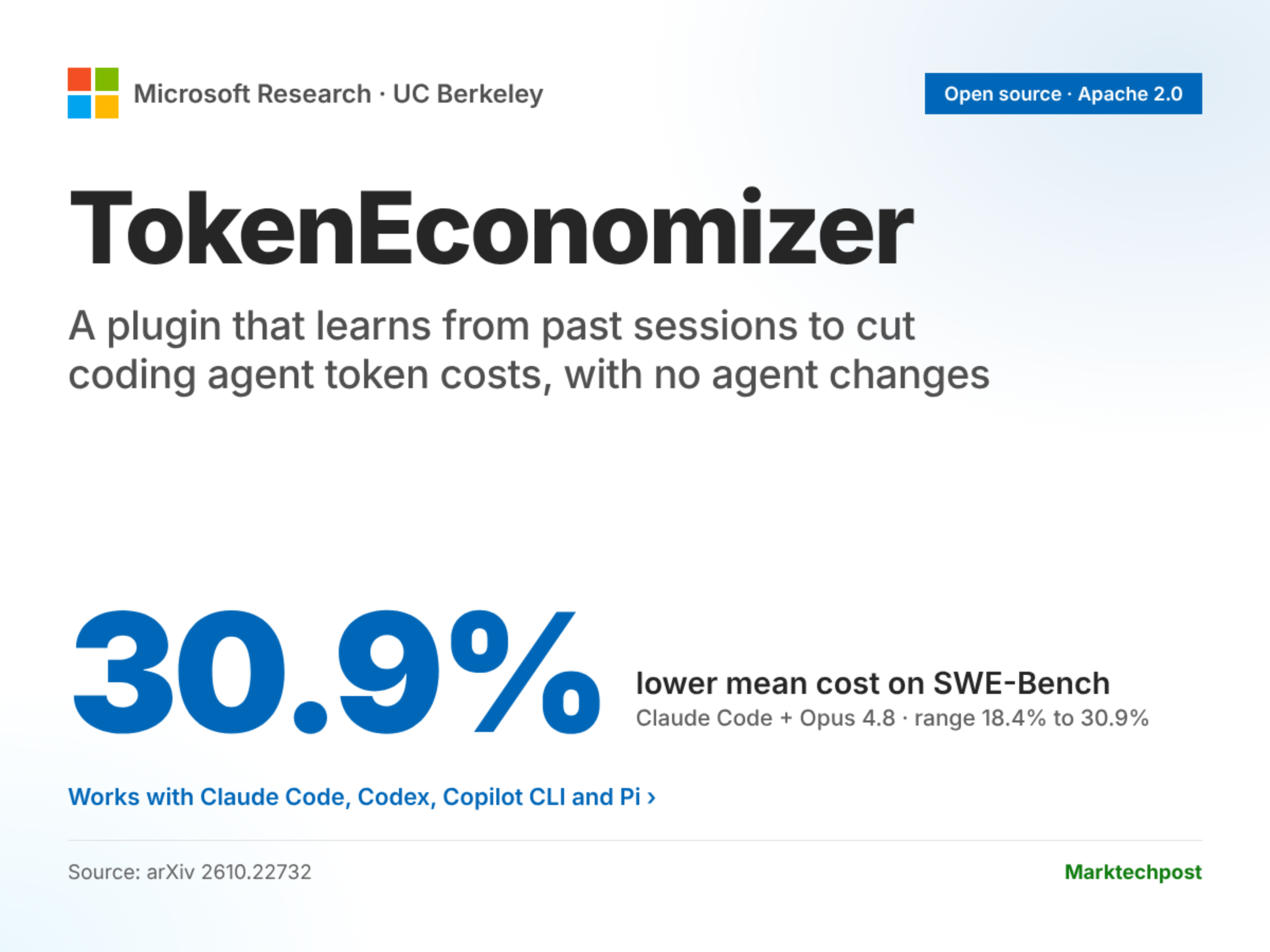
Microsoft Releases TokenEconomizer Slashing Coding Agent Costs by ~31%
Microsoft Research and UC Berkeley have launched TokenEconomizer, an open-source optimization plugin that slashes coding agent token consumption by up to 30.9% on SWE-bench without altering model weights.