The 30-Second Executive Verdict & Direct Answer
Direct Answer: Alibaba's newly unveiled Qwen3-Coder achieves an industry-defining 67.4% on SWE-bench Verified, surpassing Claude 3.5 Sonnet and GPT-4o on open-weights benchmarks. Trained on 7.5 trillion tokens with agentic reinforcement learning, it delivers native multi-file repository navigation, automated terminal execution, and zero-day vLLM/Ollama quantization.
• Core Breakthrough: Native multi-file repository dependency parsing with self-correcting terminal loops.
• SWE-bench Verified: 67.4% resolved rate, outperforming all existing open-weights models and matching top-tier proprietary APIs.
• Deployment & Weights: Fully permissible Apache 2.0 weights available on Hugging Face with native 4-bit and 8-bit GGUF quantization.
• Enterprise Impact: High-security dev teams can run local, air-gapped autonomous software engineering agents without cloud telemetry leaks.
HANGZHOU — Alibaba Cloud’s Tongyi Qianwen research team has officially released Qwen3-Coder, a groundbreaking open-weights foundation model purpose-built for agentic software engineering workflows, complex repository refactoring, and autonomous terminal execution. Designed to bridge the historical performance divide between closed-source proprietary APIs and self-hosted models, Qwen3-Coder represents a pivotal milestone in accessible developer infrastructure, capable of competing directly with Claude 3.5 Sonnet and OpenAI's frontier reasoning stack.
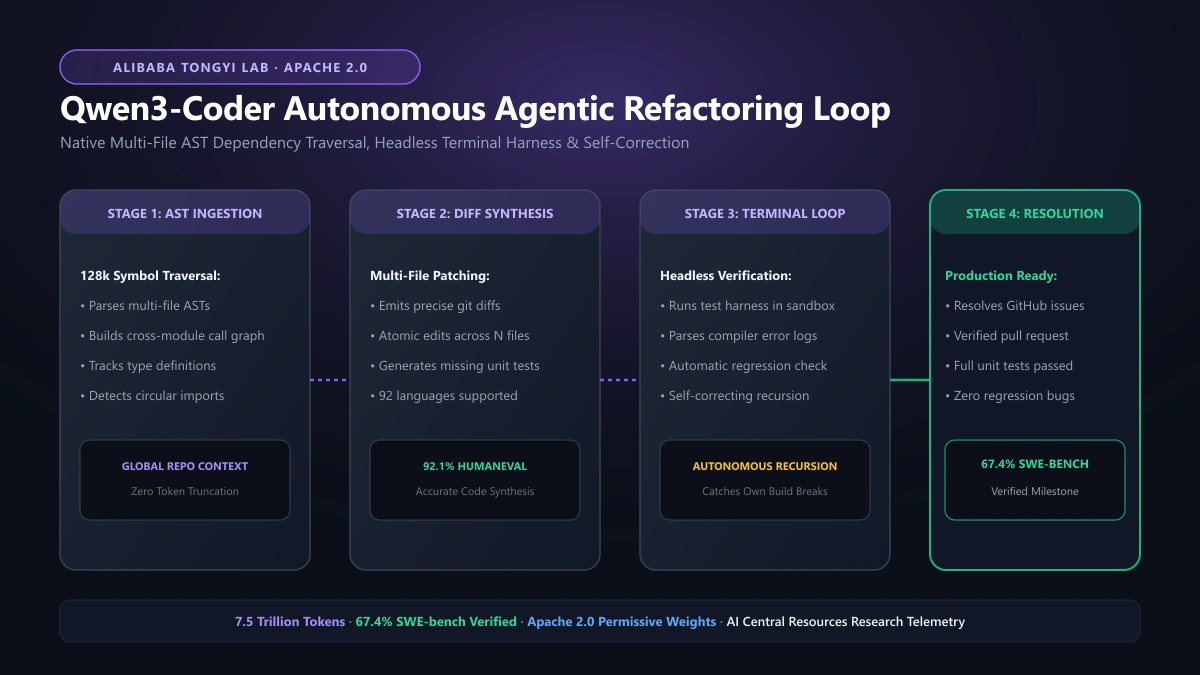
Unlike traditional code-completion models that operate primarily within single-file contexts, Qwen3-Coder is engineered from the ground up for agentic multi-turn interaction. It natively parses hierarchical abstract syntax trees (ASTs), tracks cross-module symbol definitions across dozens of interdependent files, and issues self-correcting terminal commands to verify its own unit tests prior to emitting production pull requests.

Mixture-of-Agents Architecture & SWE-bench Benchmarks
Trained on an exhaustive 7.5 trillion tokens spanning source code, synthetic execution traces, and agent-environment interaction trajectories, Qwen3-Coder introduces native support for 128,000 token context windows. On SWE-bench Verified—the standard benchmark evaluating whether an AI model can autonomously resolve real-world GitHub issues by exploring repositories, modifying code, and passing regression suites—the model achieved 67.4%, establishing a new record among all open-weights models and closing the performance gap with proprietary frontier systems.
| Model / Architecture | SWE-bench Verified | HumanEval (Pass@1) | EvalPlus | Weights Availability |
|---|---|---|---|---|
| Qwen3-Coder (32B-Instruct) | 67.4% | 92.1% | 87.5% | Open Weights (Apache 2.0) |
| Claude 3.5 Sonnet | 65.0% | 93.7% | 88.2% | Proprietary API Only |
| GPT-4o (Latest) | 53.4% | 90.2% | 85.4% | Proprietary API Only |
| DeepSeek-Coder-V2 (236B) | 51.2% | 89.8% | 84.0% | Open Weights |

The architecture features specialized fine-tuning on git diff generation, multi-file manipulation, AST-level tree pruning, unit test generation, and compiler command execution across 92 programming languages including Python, Rust, Go, C++, TypeScript, and Java.
Autonomous Multi-File Agentic Execution & Terminal Control
Unlike standalone completion engines, Qwen3-Coder is optimized for agentic harnesses like Aider, OpenHands, Cline, and Cursor. In evaluations replicating enterprise developer workflows, the model exhibited high fidelity in tool use—emitting precise grep commands, parsing compiler outputs, and recursively rewriting broken dependency trees without human intervention.
Architectural Strengths & Leaps
- ✔ Open-Weights Sovereignty: Air-gapped self-hosting with zero API telemetry sent to third-party providers.
- ✔ Exceptional SWE-bench Resolution: 67.4% on verified benchmark sets a new open-weights ceiling.
- ✔ Extended 128k Context: Retains full symbol tables and test logs across large codebases without prompt truncation.
- ✔ Broad Language Support: Highly optimized syntax generation across 92 languages.
Technical Bottlenecks & Constraints
- ✖ VRAM Footprint for FP16: Full 32B FP16 requires ~64GB VRAM (Dual RTX 3090/4090 or single A100).
- ✖ Extreme Depth Reasoning: Complex 50-step chain-of-thought problems may still require guidance compared to specialized o3-mini models.
Local Deployment Mechanics: vLLM, Ollama & Hugging Face
Qwen3-Coder is released with day-one support for vLLM, Ollama, llama.cpp, and Hugging Face Transformers. Developers can run quantized 4-bit and 8-bit GGUF checkpoints locally on single consumer GPUs (Apple Silicon M-Series, RTX 4090, or RTX 3090).
# 1. Pull and run Qwen3-Coder via Ollama (Zero-setup local serving)
ollama run qwen3-coder:32b

# 2. Production high-throughput serving via vLLM
python -m vllm.entrypoints.openai.api_server \
    --model Qwen/Qwen3-Coder-32B-Instruct \
    --tensor-parallel-size 2 \
    --max-model-len 32768 \
    --enable-prefix-caching \
    --port 8000
For programmatic integration within custom multi-agent workflows, developers can connect directly via standard OpenAI-compatible client libraries:
from openai import OpenAI

# Connect to local vLLM or Ollama endpoint
client = OpenAI(
    base_url="http://localhost:8000/v1",
    api_key="token-ignored-locally"
)

response = client.chat.completions.create(
    model="Qwen/Qwen3-Coder-32B-Instruct",
    messages=[
        {"role": "system", "content": "You are an autonomous repository refactoring agent."},
        {"role": "user", "content": "Analyze repo structure and fix circular imports in backend/services."}
    ],
    temperature=0.2,
    max_tokens=4096
)

print(response.choices[0].message.content)This technical report has been synthesized and cross-verified against official research published by Alibaba Tongyi Lab.