Direct Answer: Tencent's Hunyuan AI Infrastructure group open-sourced DFly2 under the Apache-2.0 AngelSpec suite (arXiv:2611.34776), introducing a zero-KV-cache 0.85B block-parallel drafter that reuses target sparse-attention caches to deliver up to 3.19x single-stream speedups and 1.73x concurrency at 32K context.
- →Zero-KV Drafter Architecture: A 0.85B-parameter 5-layer drafter omits its own KV cache entirely, borrowing target model sparse KV states and top-k indices (~2K keys/token) while skipping prefill.
- →Supported Open Models: Ships production weights and AngelSpec kernels for DeepSeek-V4.1-Flash, GLM-5.3-Flash, Tencent Hy4, and Hy4-flash under Apache-2.0.
- →Long-Context & Agentic Speedups: Boosts mean accepted length by 10.0% to 31.5% on long-context workloads and delivers +81% SWE 64K and +62% CodeSpan 64K throughput on DeepSeek-V4.1-Flash.
- →Memory & Serving Gains: Keeps drafter KV memory flat across sequence length and unlocks 1.73x higher concurrency at 32K compared to speculative setups holding separate 3-layer caches.

DeepSeek
Supported Target ModelDeepSeek-V4.1-Flash is a primary verified target model accelerated by DFly2 up to 2.97x end-to-end speedup.
SHENZHEN, China — Tencent's Hunyuan AI Infrastructure team has open-sourced DFly2 inside its Apache-2.0 AngelSpec training and inference framework (technical report arXiv:2611.34776), solving a stubborn memory bottleneck blocking speculative decoding on modern sparse-attention Mixture-of-Experts models. By forcing a compact 0.85B-parameter drafter to reuse the frozen target model's sparse KV cache directly, DFly2 keeps serving memory flat while accelerating long-context coding and agentic reasoning on NVIDIA H20 clusters.
Traditional speculative drafters—such as DSpark and DFlash—maintain private multi-layer KV caches that expand linearly during 32K to 128K autonomous coding traces, eroding batch concurrency on memory-bound GPUs. Tencent's architecture eliminates that duplicate state cleanly and releases ready-to-serve drafter checkpoints on Hugging Face under AngelSlim for DeepSeek-V4.1-Flash, GLM-5.3-Flash, and Tencent Hy4 / Hy4-flash.
How Zero-KV Sparse Cache Reuse Eliminates Drafter Prefill
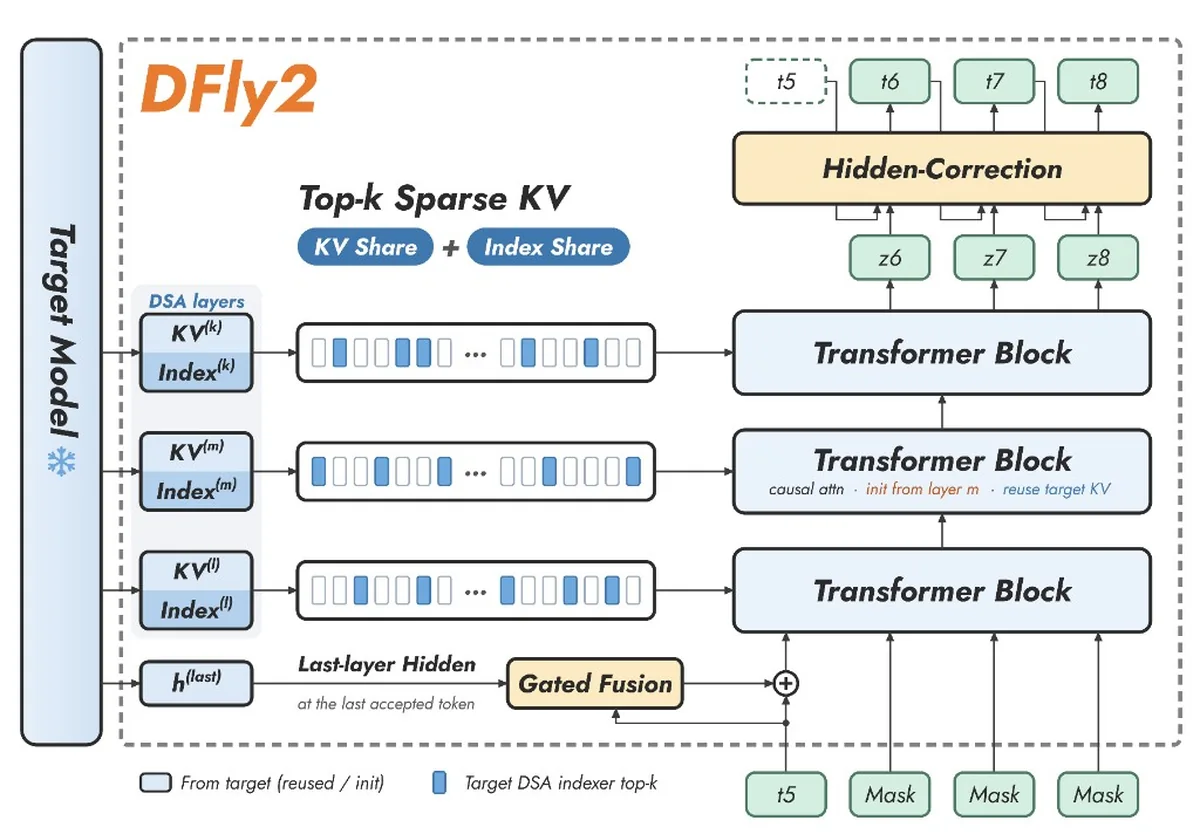
Instead of allocating independent attention projections and running a redundant prompt-prefill pass through the drafter, DFly2 hooks directly into target models equipped with DeepSeek Sparse Attention (DSA) or compatible top-k indexers. During drafting, DFly2 transfers just a single last-layer hidden state vector at the accepted token boundary, fuses it cleanly through a lightweight gated-fusion gate, and pulls the target's already-indexed sparse KV slices (~2,000 keys per drafted token) across five block-parallel transformer layers initialized from target model blocks.
An output-stage Hidden-Correction module aligns parallel draft logits cleanly against target residual distributions before verification, recovering multi-token draft accuracy even across complex multi-file diffs. Because the drafter never stores independent keys or values, skipping drafter prefill cuts prompt-processing overhead on ultra-long repositories while reserving almost all GPU HBM strictly for target KV batches—yielding 1.73x higher request concurrency at 32K context relative to separate 3-layer drafter caches. For inference clusters running multi-turn coding agents, higher effective batch concurrency lowers idle tensor-core stalls directly alongside faster per-token decode latency.
| Target Model (H20 TP8, vLLM) | Concurrency-1 E2E Speedup | Mean Accepted Length / Gain | Long-Context / Agentic Gain |
|---|---|---|---|
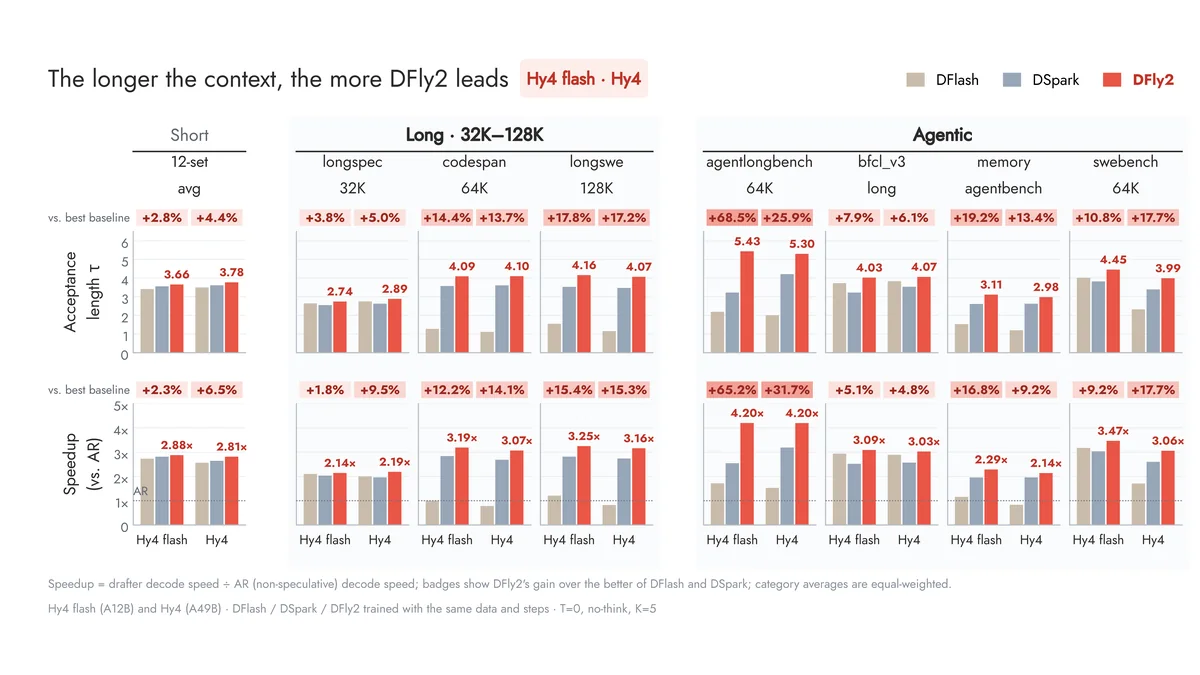
| Tencent Hy4-flash | 3.19x (Peak 4.2x–4.55x) | 3.66 short / 5.43 AgentLongBench 64K | +68.5% acc. len & 4.20x speedup on AgentLongBench |
| DeepSeek-V4.1-Flash (T=0) | 2.97x | 4.12 (vs. DSpark 3.81, DFlash 3.65) | +28% short, +62% CodeSpan 64K, +81% SWE 64K |
| GLM-5.3-Flash | 2.36x | +3.9%–10.5% general accepted len | +10.0%–31.5% long-context & agentic accepted len |
Verified Speedups on 64K Software Engineering Agents
Evaluations benchmarked on NVIDIA H20 TP8 clusters running vLLM confirm that DFly2's relative advantage widens sharply as context length grows. On standard short-text Temperature 0 prompts targeting DeepSeek-V4.1-Flash, DFly2 lifts mean accepted length to 4.12 tokens, edging past both DSpark (3.81) and DFlash (3.65) while adding 28% net throughput.
Shifting to multi-turn 64K agentic engineering traces unlocks substantially larger dividends. On DeepSeek-V4.1-Flash, DFly2 boosts serving throughput by +62% on CodeSpan 64K and +81% on SWE 64K, hitting 2.97x concurrency-1 end-to-end speedup. On Tencent's own Hy4-flash, DFly2 pushes concurrency-1 speedups to 3.19x overall, reaching 4.20x on AgentLongBench 64K and peaking between 4.2x and 4.55x decode acceleration.
# Clone Apache-2.0 AngelSpec suite for MTP & DFly2 block-parallel training/serving
git clone https://github.com/Tencent/AngelSpec.git
cd AngelSpec

# Download pre-trained DFly2 zero-KV drafter weights from Hugging Face:
# - AngelSlim/ (DeepSeek-V4.1-Flash, GLM-5.3-Flash, Tencent Hy4 / Hy4-flash)
# Technical Paper: arXiv:2611.34776 (vLLM sparse KV reuse runtime supported)
Deployment Trade-Offs for Serving Engineers
Because DFly2 relies directly on sparse-attention top-k KV indices (~2K keys per token), inference operators gain maximum benefit exclusively on compatible sparse-KV architectures such as DeepSeek-V4.1-Flash, GLM-5.3-Flash, and Hy4-family checkpoints rather than legacy dense-attention models lacking top-k indexers. Within supported stacks, however, eliminating drafter KV duplication solves one of the most expensive VRAM constraints limiting autonomous 64K–128K code-agent clusters, where conventional draft caches would otherwise force cluster operators to halve concurrent request limits whenever context lengths climb past 32K tokens.
Across GLM-5.3-Flash workloads specifically, DFly2 adds +3.9% to +10.5% in general mean accepted length and +10.0% to +31.5% on long-context and agentic evaluations while sustaining a 2.36x end-to-end speedup. Together, Apache-2.0 AngelSpec training pipelines and ready-to-run Hugging Face checkpoints give self-hosted inference teams a drop-in route to higher decoding efficiency without sacrificing lossless verification guarantees.
Production Benefits of Tencent DFly2
- +Eliminates drafter KV cache memory completely, unlocking 1.73x concurrency at 32K over separate 3-layer drafters.
- +Skips drafter prompt prefill by transferring only a single last-layer hidden vector per accepted boundary.
- +Delivers +81% SWE 64K throughput on DeepSeek-V4.1-Flash and 3.19x E2E speedup on Tencent Hy4-flash.
- +Open-sourced under Apache-2.0 in AngelSpec with production vLLM support and ready weights on Hugging Face.
Architectural Constraints to Consider
- −Requires target models featuring compatible sparse-attention top-k KV indexers rather than universal dense KV models.
- −Block-parallel hidden-correction requires paired target checkpoints rather than drop-in universal unaligned drafters.
- −Published peak metrics (2.97x–3.19x) reflect concurrency-1 H20 TP8 benchmarks; heavy batching narrows relative gains.
- −Still uses 0.85B active drafter weights across five transformer layers, adding modest compute overhead per draft step.
Inspect Apache-2.0 training scripts, DFly2 zero-KV kernels, and AngelSlim Hugging Face drafter checkpoints.
Frequently Asked Questions
How does Tencent DFly2 eliminate drafter KV cache overhead? +
DFly2 is a 0.85B-parameter, 5-layer block-parallel drafter with zero private KV cache; it reuses the paired target model's sparse KV cache and top-k sparse indices (~2K keys per token) and skips drafter prefill.
Which frontier models are supported by DFly2 out of the box? +
Tencent provides Apache-2.0 weights and AngelSpec tooling targeting DeepSeek-V4.1-Flash, GLM-5.3-Flash, Tencent Hy4, and Tencent Hy4-flash.
What real-world speedups does DFly2 achieve on long-context coding benchmarks? +
On NVIDIA H20 TP8 vLLM tests, DFly2 delivers 2.97x concurrency-1 speedup and +81% throughput on SWE 64K for DeepSeek-V4.1-Flash, and 3.19x E2E speedup (peaking at 4.2x–4.55x decode) on Hy4-flash.
What license governs Tencent's AngelSpec and DFly2 release? +
Both the AngelSpec framework on GitHub and the accompanying DFly2 tooling are open-sourced under the permissive Apache-2.0 license.