Qdrant
Open-source vector search engine for production-grade AI retrieval
Gallery
7 items

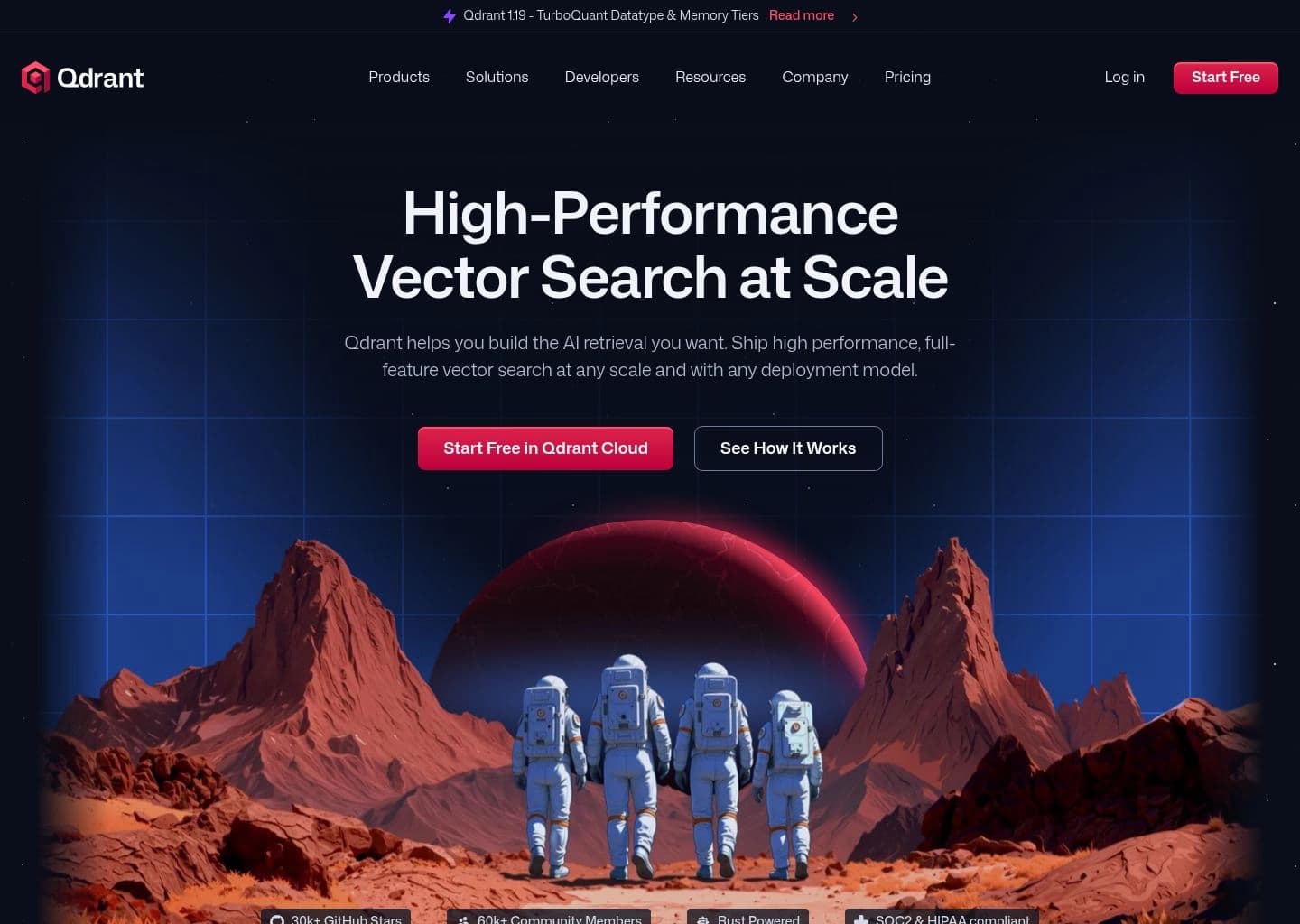
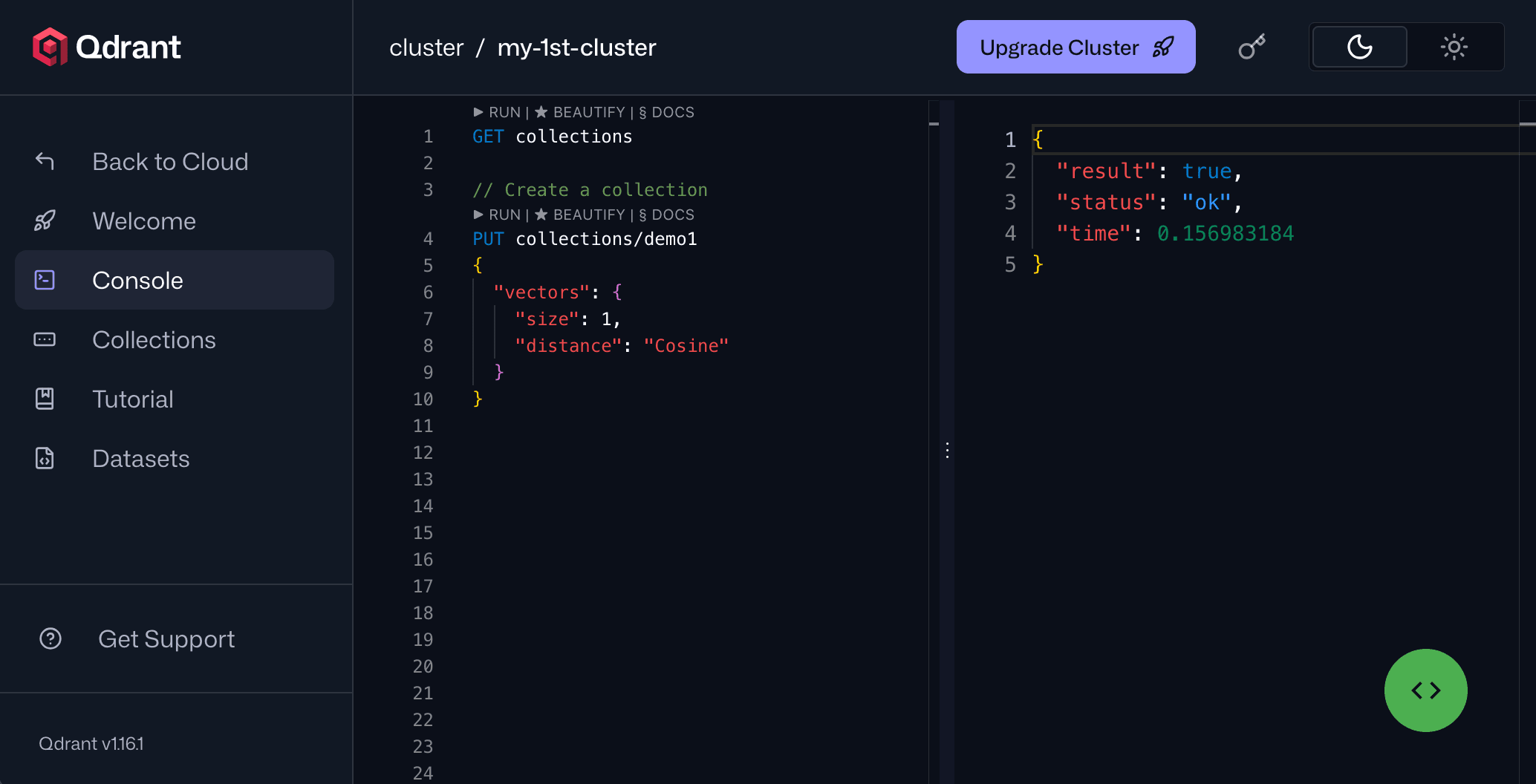
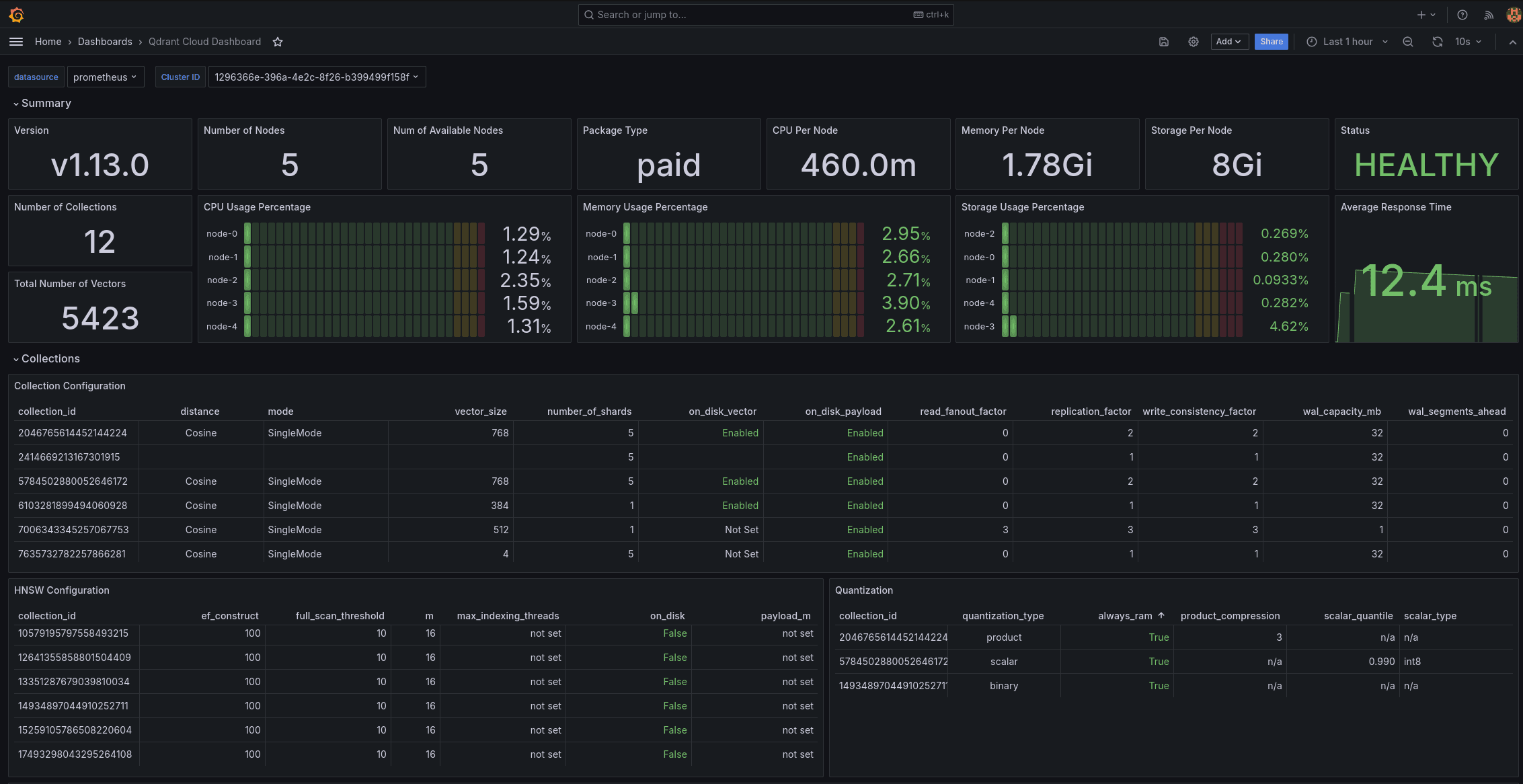
About Qdrant
I benchmarked Qdrant's Rust-based vector search engine on a dedicated server under high-concurrency payload filtering and similarity searches. Its HNSW implementation delivers blistering sub-10ms search latencies while payload-based filtering avoids redundant post-filtering queries. However, configuring advanced cluster sharding and replication requires solid DevOps chops when running self-hosted deployments. Offered under Apache 2.0 open-source with managed cloud starting at $25 monthly, it is our top choice for production vector workloads.
Qdrant is an open-source vector search engine and database purpose-built for the demands of production AI applications. Written entirely in Rust with SIMD optimization and a custom storage engine called Gridstore, Qdrant is designed to deliver fast, memory-efficient similarity search at scale, going beyond the static-benchmark limitations of early vector libraries by offering persistence, payload storage, real-time indexing, and full production-grade operational tooling. Its retrieval layer combines dense and sparse vector search in a single query (supporting BM25, SPLADE++, and miniCOIL), applies metadata filters directly during HNSW graph traversal for high recall at low latency, and supports built-in multivector representations, score boosting, and late interaction reranking models like ColBERT.
Founded in 2021 in Berlin by CEO Andre Zayarni and CTO Andrey Vasnetsov, Qdrant grew out of the founders' work building a matching engine for large volumes of unstructured text data, pivoting toward neural search and open-sourcing the engine on GitHub the same year. The company has since raised a $28 million Series A led by Spark Capital and a $50 million Series B in March 2026 led by AVP with participation from Bosch Ventures, Unusual Ventures, Spark Capital, and 42CAP, positioning itself around the idea that "retrieval is what makes models useful in production." Qdrant is used across RAG pipelines, AI agent memory, recommendation systems, semantic search, and anomaly detection, with production case studies from Tripadvisor, HubSpot, Deutsche Telekom, Dust, and Canva.
Qdrant can be deployed however a team needs: as a fully managed Qdrant Cloud cluster on AWS, GCP, or Azure; as Hybrid Cloud running on a customer's own Kubernetes infrastructure while still managed through Qdrant's control plane; as an air-gapped Private Cloud for the strictest compliance needs; or as lightweight Qdrant Edge for low-latency search close to where data is generated. The platform is SOC 2 and HIPAA compliant with GDPR-aligned options, and offers developer-friendly REST and gRPC APIs, official client libraries, a built-in Web UI for visual exploration, and native Cloud Inference for generating embeddings without standing up a separate pipeline.
Key Features
- Highest-performance vector search engine built entirely in Rust with SIMD optimization
- Native hybrid search blending dense and sparse vectors, supporting BM25, SPLADE++, and miniCOIL
- Expansive metadata filtering with nested, text, geo, and has_vector filter types
- Efficient one-stage filtering applied directly during HNSW graph traversal
- Built-in multivector support for more expressive, multimodal retrieval
- Full-spectrum reranking with score boosting, late interaction models, and MMR diversification
- Real-time indexing so new data is searchable the instant it's added
- Asymmetric, scalar, and binary quantization reducing memory usage by up to 64x
- Native Cloud Inference for generating embeddings without a separate pipeline
- Flexible deployment via Cloud, Hybrid Cloud, Private Cloud, or Edge (Beta)
Pros
- Free forever tier with no time limit, ideal for testing and small projects
- Open-source core under Apache 2.0 with full self-hosting flexibility
- High-performance Rust architecture built for real-time, large-scale vector search
- Native hybrid dense-sparse search and advanced filtering in a single query
- Flexible deployment across managed cloud, hybrid, private, and edge environments
- SOC 2 and HIPAA compliant with strong enterprise security options
Cons
- Standard and Premium Cloud tiers use usage-based or minimum-spend pricing rather than flat, published rates
- Premium tier features like SSO and private VPC links require talking to sales for pricing
- Self-hosting the open-source engine requires managing your own infrastructure and scaling
- As a specialized vector database, it requires pairing with separate embedding models and application logic
- Some advanced enterprise features like custom SLAs are only available through Hybrid or Private Cloud contracts
Pricing
Qdrant's Free Tier is free forever, offering a single-node cluster with 0.5 vCPU, 1GB RAM, and 4GB disk, plus free cloud inference with selected models, ideal for testing and prototypes. The Standard Tier uses usage-based pricing for production workloads, billed hourly based on compute (vCPU), memory (GB), storage (GB), backup storage, and used inference tokens for paid models; it includes dedicated resources, flexible vertical and horizontal scaling, high availability setups, backup and disaster recovery, and a 99.5% uptime SLA. The Premium Tier requires a minimum spend and adds SSO, private VPC links, a 99.9% uptime SLA, and extra support for enterprises with additional security and compliance needs, available by contacting sales. Qdrant Hybrid Cloud lets teams run managed Qdrant clusters on their own infrastructure for local data residency and regulated workloads, while Private Cloud offers a fully isolated, air-gapped deployment for large enterprises; both require contacting the Qdrant team for pricing. The open-source Qdrant engine itself remains free and self-hostable under an Apache 2.0 license.
Claim Verified Creator Badge
Are you the founder of Qdrant? Display this listing's verified badge on your website to show your customers that your product has been vetted and listed on AI Central Resources.
<a href="https://www.aicentralresources.com/tool/qdrant" target="_blank" rel="noopener">
  <img src="https://www.aicentralresources.com/badges/featured-badge-dark.svg" alt="Featured on AICentralResources" width="200" height="54" style="border: none;" />
</a>
* Place this HTML snippet in your website's footer, landing page, or press section. This creates a search-friendly backlink directly to your verification page.
Connect with Qdrant
Frequently Asked Questions
Qdrant is an open-source vector search engine and database, written in Rust, that stores and queries high-dimensional embeddings for use cases like retrieval-augmented generation, semantic search, recommendation systems, and AI agent memory.
Qdrant offers a Free Tier forever at no cost with a single-node cluster (0.5 vCPU/1GB RAM/4GB disk), a usage-based Standard Tier for production workloads, and a Premium Tier with a minimum spend requirement for enterprises needing SSO and private VPC links.
Yes, Qdrant's open-source core is licensed under Apache 2.0 and can be self-hosted on your own infrastructure, or run as a fully managed service through Qdrant Cloud, Hybrid Cloud, or Private Cloud.
Yes, Qdrant supports native hybrid search that blends dense and sparse vectors in a single query, with support for BM25, SPLADE++, and miniCOIL, plus full-spectrum reranking including late interaction models like ColBERT.
Yes, Qdrant is SOC 2 and HIPAA compliant, with GDPR-aligned options, encryption at rest and in transit, and enterprise SSO authentication available on Premium and Enterprise plans.
Yes, Qdrant offers Cloud Inference to generate text and image embeddings and run vector search together, removing the need for a separate embedding pipeline or infrastructure for supported models.
Similar AI Tools to Qdrant
View all alternatives of Qdrant


Chroma
The open-source search infrastructure for AI — fast, serverless, and scalable

MongoDB Atlas Vector Search
Build intelligent applications with vector search, hybrid search, and generative AI on your live data


Amazon Bedrock
The fully managed AWS platform for building generative AI applications and agents at production scale
Compared with Qdrant
Direct head-to-head feature matrices, pricing breakdowns, and real-world performance benchmarks