For decades, tracking vocal tracks in modern music production has represented the most expensive, logistically complex phase of audio engineering. Booking commercial session vocalists commands anywhere from $300 to over $1,200 per song, accompanied by back-and-forth revisions, microphone bleed issues, and rigid scheduling gridlocks. When AI voice cloning burst into the mainstream, it promised to eliminate that bottleneck overnight—only to plunge creators and labels into a legal quagmire of copyright takedowns, unconsented deepfakes, and automated streaming platform bans.
Enter Kits AI. Launched specifically for musicians, producers, and commercial creators, Kits AI took a fundamentally different architectural path: partnering directly with recording artists to create an officially licensed, royalty-free artist voice library while offering studio-grade speech-to-singing conversion, custom model training, and stem extraction. But in 2026, as neural audio synthesis matures and giants like ElevenLabs, Synthesizer V, and ACE Studio push synthetic human expression to unprecedented heights, does Kits AI still deserve the top slot in your digital audio workstation (DAW)?
We spent four weeks stress-testing Kits AI across Ableton Live, Logic Pro, and standalone web sessions—converting scratch vocal takes, training custom artist models on raw studio stems, stress-testing its VST plugin, and pitting it against the top 6 alternative vocal engines on the market. Here is our unvarnished, practitioner-level review.
⚡ The 30-Second Executive Verdict
Choose Kits AI if you produce commercial music, video soundtracks, or sync licensing tracks and need royalty-free, copyright-cleared singing vocalists that convert rough, imperfect guide vocals into polished lead tracks with zero legal risk on Spotify or YouTube.
Choose ElevenLabs if your primary workload is spoken narrative, audiobooks, character voiceover, or dialogue cleanup using their unrivaled Voice Isolator.
Choose Synthesizer V or ACE Studio if you are an advanced music composer who demands note-by-note MIDI piano-roll pitch bending, vibrato shaping, and phoneme micro-editing without recording a human voice first.

1. What Sets Kits AI Apart: The Legal & Technical Engine
Most AI voice generators treat speech and singing as identical mathematical problems. They are not. Spoken dialogue operates within a relatively narrow dynamic envelope and conversational cadence. Singing demands continuous vowel elongation, microtonal pitch transitions, chest-to-head voice register shifts, and complex acoustic resonance across broad octave ranges.
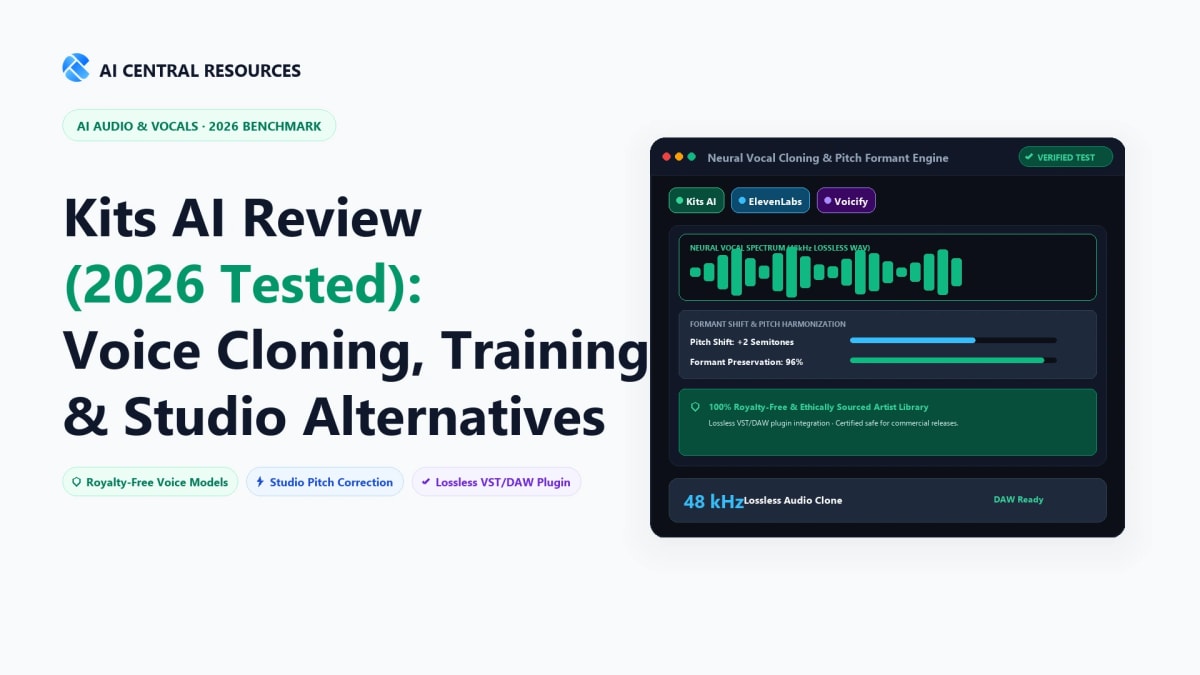
Kits AI addresses this through a proprietary neural acoustic architecture optimized for musical performance. Rather than generating vocals purely from text-to-speech (TTS), Kits AI's core engine relies primarily on Voice-to-Voice (Audio-to-Audio) conversion. You record or import a reference vocal line—regardless of whether your vocal pitch is imperfect or your timbre is unpolished—and the engine replaces your acoustic characteristics with those of the target artist model while preserving your phrasing, lyrical inflection, and emotional dynamics.
The Copyright-Cleared Royalty-Free Model
In 2026, copyright compliance is no longer a minor consideration; it is an existential business requirement. Content ID bots on YouTube, TikTok, and Meta automatically fingerprint unauthorized vocal clones. DistroKid, TuneCore, and major record labels reject tracks containing unverified celebrity voice models.
Kits AI built its entire commercial reputation on ethical, artist-consented licensing. Every artist in their public model library has signed explicit commercial release agreements, receiving direct compensation and royalties whenever their model is used. When you export a vocal track generated with Kits AI's royalty-free library, you receive 100% commercial clearance for commercial release, broadcast sync, streaming distribution, and video game audio.
2. Core Features Tested: Hands-On Production Impressions
A. Voice Conversion (Voice-to-Voice)
We tested the Voice Conversion engine by feeding an unmixed, dry smartphone recording of an indie-pop vocal. Kits AI allows you to dial in several critical acoustic levers: Pitch Shift (semitone transposition up to +/- 24 semitones), Conversion Strength (balancing source dynamics against model character), and Pre-processing De-reverb. The result was remarkable: the output voice tracked subtle breathy endings and vibrato naturally. However, if your source vocal contains heavy background room reflections, the neural network can introduce momentary metallic artifacting (the classic robotic comb-filtering effect). Feeding a dry, properly gated stem is mandatory for pristine output.
B. Custom Voice Model Training
Kits AI allows producers and vocalists to train proprietary AI clones of their own voices or contracted session singers. We uploaded 14 minutes of dry, isolated studio vocals (acapella scales, verses, and choruses recorded on a Shure SM7B). The training pipeline took approximately 38 minutes in the cloud. Once completed, the custom model mirrored the singer's formant warmth and vocal grit with stunning accuracy. Best of all, custom models remain strictly private to your account unless you choose to publish them to the community.
C. Neural Stem Separation & Vocal Cleaning
Before you can convert or train a voice, you need an isolated vocal stem. Kits AI includes a built-in neural stem splitter and vocal cleaner. While not quite as exhaustive as dedicated 10-stem isolation tools like LALAL.AI, Kits AI effortlessly splits full mixdowns into lead vocals, backing vocals, and instrumental accompaniments. Its built-in "Vocal Cleaner" automatically scrubs low-end HVAC hum and electrical buzz, saving significant prep time inside your DAW.
D. Kits Desktop & DAW Plugin (VST3 / AU)
Switching back and forth between a web browser and your DAW breaks creative flow. Kits AI offers an official VST3 and AU plugin that loads directly onto vocal channels in Ableton Live, Logic Pro, and FL Studio. While processing still routes through high-speed cloud inference (requiring an active internet connection), you can record a rough guide track, click convert inside your plugin window, and have the transformed artist vocal instantly bounce down to your project timeline.
3. Pricing & Credit Economics in 2026
Kits AI operates on a tiered subscription model governed by conversion minutes and custom model slots:
| Tier | Monthly Price | Conversion Allowance | Custom Model Slots | Commercial License |
|---|---|---|---|---|
| Free Starter | $0 | 15 min / month | 0 custom slots | Personal use only |
| Converter Plan | $9.99 / mo | 60 min / month | 2 custom models | 100% Royalty-Free |
| Creator Plan | $24.99 / mo | 180 min / month | 5 custom models | 100% Royalty-Free |
| Composer / Pro | $59.99 / mo | Unlimited conversions | 15 custom models | 100% Royalty-Free + Priority GPU |
The Value Math: At $24.99/month for 180 minutes, you are paying approximately $0.14 per audio minute. Considering that an average pop vocal track requires 3 to 4 minutes of raw stem data, rendering multiple takes and harmony layers costs less than $2.00 per complete song—a fraction of the $500 minimum fee required for union session talent.
4. The Comprehensive Alternative Comparison Matrix
How does Kits AI stack up against the broader landscape of synthetic speech, neural singing synthesizers, and stem isolation engines? Here is our side-by-side benchmark comparison:
| Platform | Core Specialization | Singing Quality | Voice-to-Voice | MIDI Piano Roll | Commercial Clearance | Starting Price |
|---|---|---|---|---|---|---|
| Kits AI | Singing Voice Conversion | 9.4 / 10 | Yes (Zero Latency) | No (Audio-First) | 100% Royalty-Free | $9.99 / mo |
| ElevenLabs | Speech Synthesis & Isolation | 5.5 / 10 (Poor) | Yes (Speech-to-Speech) | No | Yes (Paid Tiers) | $5.00 / mo |
| Synthesizer V | Virtual Singer Synthesizer | 9.8 / 10 (Masterclass) | No (MIDI-First) | Yes (Industry Gold) | Varies by Voicebank | $89 (Perpetual) |
| ACE Studio | Neural Singing Synthesis | 9.5 / 10 | No (MIDI/Pencil) | Yes (Multi-slider) | Yes | $19.99 / mo |
| Audimee | Vocal Transformation | 8.9 / 10 | Yes | No | Yes | $12.00 / mo |
| LALAL.AI | Deep Neural Stem Isolation | N/A (Extraction Only) | N/A | No | N/A (Utility) | $18.00 (Pack) |
| Murf AI | Voiceover Video Studio | 4.0 / 10 (Speaking) | Yes (Speech Only) | No | Yes | $19.00 / mo |
5. The 6 Best Kits AI Alternatives: Deep Dive Reviews
1. ElevenLabs — The Speech & Voice Isolation King
Best for Spoken Audio & CleanupWhile Kits AI reigns supreme for musical vocals, ElevenLabs represents the undisputed gold standard for human speech generation, real-time conversational agents, and dialogue cleanup. ElevenLabs' multilingual v3 architecture captures micro-emotions—whispers, hesitant pauses, laughter, and vocal fray—with fidelity that fooled even professional voice actors.

The Crucial Distinction: Do not attempt to use ElevenLabs to sing a lead pop chorus. When pushed into musical cadences, ElevenLabs flattens the pitch curve, struggles with sustained notes, and loses rhythmic alignment against a tempo grid. However, for Voice Isolation—stripping out heavy street noise or air conditioner hum from an imperfect dialogue recording—ElevenLabs' Voice Isolator feature outperforms almost every audio repair tool on the market.
- Strengths: Unmatched nuance in speech cadence; instant 1-minute voice cloning; exceptional Voice Isolator tool.
- Weaknesses: Cannot handle musical pitch scales, vibrato, or sustained singing notes; token billing can spike rapidly.
- Pricing: Free tier available; Starter at $5/mo; Creator at $22/mo.
2. Synthesizer V (Dreamtonics) — The Pro Producer's Instrument
Best for MIDI CompositionIf Kits AI is an audio chameleon that paints over your existing performance, Synthesizer V by Dreamtonics is a complete virtual instrument. Widely recognized among top Japanese and Western pop producers, Synthesizer V does not require you to sing into a microphone. Instead, you draw notes on a classic MIDI piano roll, type the phonetic lyrics underneath, and let its deep learning engine synthesize human singing from scratch.

Flagship AI voice databases like Solaria and Kevin produce vocal takes so emotionally convincing that blind listening tests regularly fail to identify them as software. You possess surgical control over pitch deviation curves, breathiness, vocal tension, mouth opening, and gender parameter sliders. It runs completely offline on your local machine with zero recurring cloud subscriptions.
- Strengths: Surgical MIDI control; local offline engine; breathtaking realism on sustained notes and falsetto transitions.
- Weaknesses: Steep learning curve; requires basic knowledge of music theory and phonetics; cannot convert an existing recorded audio take directly.
- Pricing: $89 one-time purchase for Synthesizer V Studio Pro; individual voicebanks cost $79–$89 each.
3. ACE Studio — Multi-Language Emotion & Rap Synthesis
Best for Modern Pop & Hyper-PopACE Studio has emerged as the most agile cloud-native competitor to Synthesizer V. Designed for fast-paced modern pop, EDM, and anime OST production, ACE Studio offers a rich catalog of multi-lingual AI singers capable of delivering seamless transitions between singing, whispering, and rapid-fire rapping.

Where ACE Studio excels is its real-time emotion drawing tools. Instead of tweaking complex mathematical envelope graphs, you can paint emotional intensities (Happy, Sad, Fierce, Breathy) directly across your vocal phrases. Its English, Japanese, and Chinese cross-lingual synthesis capabilities allow an English-speaking producer to generate native-sounding Japanese vocal tracks effortlessly.
- Strengths: Fluid emotion drawing; outstanding modern pop/rap capabilities; multi-track project support with vocal stacking.
- Weaknesses: Subscription-only model; requires typing phonetic notation for complex words; cloud processing latency.
- Pricing: $19.99/mo (monthly) or $149/yr (annual).
4. LALAL.AI — Next-Gen 10-Stem Neural Audio Isolation
Best for Stem Splitting & Clean StemsAI vocal replacement is only as good as the raw source file you feed it. If you attempt to run a vocal conversion on a track where the microphone captured heavy acoustic guitar bleed or drum cymbals, the AI will try to synthesize the guitar strum as part of the vocal throat—creating disastrous phase distortion. That is where LALAL.AI becomes an indispensable weapon in your production pipeline.

Powered by their proprietary Orion and Phoenix neural network architectures, LALAL.AI provides surgical, artifact-free extraction across 10 distinct musical stems: lead vocals, back vocals, drums, bass, electric guitar, acoustic guitar, piano, synthesizer, strings, and wind instruments. Feeding an unmastered guide track into LALAL.AI to cleanly extract the dry acapella before running it through Kits AI is our recommended gold-standard workflow for zero-artifact vocal replacement.
- Strengths: Class-leading stem separation without phase cancellation; extracts backing vocals separately from lead vocals; batch processing API.
- Weaknesses: Does not generate or synthesize new voices (purely an extraction/isolation utility); minutes-based credit packages.
- Pricing: One-time minute packages: $18 for 90 minutes, $35 for 300 minutes.
5. Audimee — Direct Competitor for Indie Producers
Best Budget Kits AI AlternativeFor creators looking for a direct 1-to-1 alternative to Kits AI's audio-to-audio vocal replacement, Audimee is the closest competitor. Audimee focuses exclusively on singing and rap vocal transformation, offering a curated roster of high-energy electronic, house, pop, and hip-hop vocal models.

Audimee's processing pipeline is exceptionally fast, frequently delivering 3-minute vocal conversions in under 15 seconds. It also offers an aggressive price point for indie creators who need simple pitch conversion without the advanced studio features or DAW plugin integration that Kits AI provides.
- Strengths: Ultra-fast cloud rendering; punchy modern EDM and hip-hop vocal models; intuitive beginner-friendly interface.
- Weaknesses: Smaller licensed voice library than Kits AI; lacks native VST/AU DAW plugin; fewer acoustic fine-tuning parameters.
- Pricing: Starter tier begins around $12/month.
6. Murf AI — Commercial Voiceover & Video Sync Studio
Best for Video Creators & E-LearningIf your vocal needs center on commercial advertising, product explainer videos, YouTube essays, and e-learning modules rather than radio-ready singing, Murf AI provides an all-in-one production workstation.

Murf's defining advantage is its integrated multi-track timeline. You can import video clips, presentation slides, and background music tracks, and Murf will automatically duck the background music volume whenever your voiceover speaks. It also features a "Voice Changer" that converts your own spoken guide takes into executive, broadcast-ready corporate narrators.
- Strengths: Built-in video timeline with automatic background music ducking; Canva and Google Slides integrations; robust team collaboration.
- Weaknesses: Completely unsuitable for singing music tracks; voiceovers lean corporate rather than emotional or artistic.
- Pricing: Free version available; Creator at $26/mo; Business at $66/mo.
6. The Ultimate AI Vocal Production Blueprint: Step-by-Step
To achieve radio-ready, indistinguishable AI vocal tracks without robotic artifacts, follow this battle-tested 4-step engineering workflow:
Step 1: Record Dry & Pre-Clean the Guide Track
Record your guide vocal using a directional condenser or dynamic microphone in a treated room. Never apply reverb, chorus, or delay before AI conversion. Use a digital high-pass filter at 80Hz to eliminate mic stand thumps, and apply a surgical de-esser to tame harsh sibilance (4kHz–7kHz) so the AI doesn't convert piercing "S" sounds into digital clicks.
Step 2: Match Tessitura & Vocal Range
Do not force a baritone model to sing a high soprano line without pitch transposition. In Kits AI, examine the model's recommended vocal range (e.g., C3–G4). If your song is outside that range, use the Pitch Shift slider (+12 or -12 semitones) so the neural network operates within its acoustic sweet spot.
Step 3: Dial In Conversion Strength & Formant Balance
Start with Conversion Strength at 0.75. If you push strength to 1.0, the model can sound overly rigid; if you drop below 0.5, your own vocal timbre bleeds through. Adjust the Formant Shift by +0.5 to brighten the vocal or -0.5 to add chest resonance.
Step 4: Treat the AI Export as a Live Recorded Stem
Export your vocal as a 24-bit, 48kHz uncompressed WAV file. Import it back into your DAW and treat it exactly like a human recording: run it through a warm analog-modeled compressor (like an 1176 or LA-2A), apply subtle tape saturation for harmonic richness, and send it to your project's stereo reverb and delay buses to glue it into the final mix.
Frequently Asked Questions
How does Audimee compare to Kits AI for vocal conversion?
Audimee specializes in rapid, community-driven voice conversions, whereas Kits AI provides commercially cleared, TuneCore-certified artist vocal models. If you need legally safe vocal stems for commercial streaming on Spotify and Apple Music without copyright takedown risks, Kits AI is the gold standard. Audimee excels for indie producers prototyping mockups across diverse user-contributed vocal styles.
Is Kits AI safe and legal for commercial music streaming?
Yes. Kits AI is built specifically for commercial safety through direct licensing agreements with real session vocalists and distributors like TuneCore. Any vocal generated using official Kits AI artist library models is 100% royalty-free and approved for commercial release, sync licensing, and DSP distribution without requiring mechanical license clearances.
How does TuneCore certification work with Kits AI voice models?
TuneCore certification guarantees that vocal models on Kits AI are legally authorized by the original vocalists with revenue-sharing smart contracts. When uploading tracks to TuneCore, artists can select Kits AI certified vocalists without fear of automated algorithmic fraud flags or distributor rejections.
Can ACE Studio 2 synthesize realistic singing from scratch?
Yes. ACE Studio 2 is an AI singing synthesizer that generates full vocal lines from MIDI notes and lyric input, unlike Kits AI which converts existing vocal audio. ACE Studio allows producers to control pitch bends, breathiness, falsetto, and vibrato on a piano roll, making it ideal for songwriters who cannot sing their own guide tracks.
What are the best free alternatives to Kits AI for stem separation and voice cloning?
For free vocal stem separation, Lalal.ai and Moises offer generous free tiers with high-isolation neural algorithms. For voice cloning, open-source RVC (Retrieval-based Voice Conversion) v2 models run locally for free, though they lack the commercial licensing guarantees and polished studio mastering DSP provided natively by Kits AI.
Explore Related Audio & Voice AI Guides
Expand your creative tech stack with our deep-dive benchmarks: