The traditional “ten blue links” search engine is officially obsolete. For nearly three decades, information retrieval on the internet was an exhausting, manual scavenger hunt: entering fragmented keywords, sifting through sponsored ads, dodging affiliate blog spam, clicking through multiple tabs, and cross-referencing conflicting forum threads. Meanwhile, first-generation large language models introduced a dangerous counter-problem: fluent, highly confident hallucinations that fabricated nonexistent academic papers, cited dead URLs, and presented outdated knowledge cutoffs as absolute truth. In 2026, the convergence of real-time web crawling, neural reranking, dense passage retrieval, and automated bibliographic verification has created an entirely new paradigm: the autonomous AI search engine.
Modern AI search engines do not force users to synthesize raw web pages manually. Instead, they operate as intelligent research partners: parsing multi-step conversational queries, querying live web indexes and peer-reviewed scholarly repositories simultaneously, synthesizing comprehensive answers with per-token citation attribution, and displaying mathematical consensus meters based on hundreds of empirical studies. For writers, researchers, and knowledge workers seeking to elevate the factual integrity of their work, pairing AI search platforms with our specialized AI Tools for Writers Directory and our comprehensive AI Tools for Students Hub provides the definitive framework for conducting deep investigative research with zero hallucinated sources.
However, deploying AI search engines in 2026 requires understanding deep architectural specializations. The modern landscape has bifurcated into distinct information retrieval domains: conversational web answer engines, peer-reviewed scientific consensus analyzers, citation context classifiers, automated systematic literature review assistants, specialized clinical medical portals, and developer-centric technical code search engines. Choosing the wrong engine can result in unverified assertions, skewed scientific conclusions, or critical blind spots in academic research.
To establish definitive empirical benchmarks, our research team spent eight weeks stress-testing the eight leading AI search engines and research assistants of 2026: Perplexity AI, Consensus AI, Scite.ai, Elicit, SciSpace, OpenEvidence, Devv AI, and Scholarcy. We evaluated each platform across more than 350 complex research queries spanning breaking geopolitical news, controversial clinical biomedical trials, multi-study meta-analyses, and esoteric software engineering edge cases, measuring source attribution accuracy, citation context classification, hallucination prevention, index recency, and synthesis depth.
The 30-Second Verdict: Which AI Search Engine Fits Your Research in 2026?
The AI search ecosystem in 2026 divides into five distinct research categories: Conversational Web Grounding, Scientific Consensus Discovery, Citation Context Verification, Systematic Review Extraction, and Verticalized Search Engines. Here is our direct, bottom-line verdict:
- Best Overall for General Web Search, Daily Inquiries & Pro Research: Perplexity AI. The undisputed leader in conversational web search. Perplexity synthesizes live internet sources in real time, provides interactive clickable citations on every claim, supports multi-model reasoning (Claude 3.5 Sonnet, GPT-4o, DeepSeek R1), and organizes projects into collaborative research Spaces.
- Best for Scientific Consensus & Evidence-Based Answers from 200M+ Papers: Consensus AI. Purpose-built for discovering what the scientific literature actually says. Queries 200M+ peer-reviewed papers via Semantic Scholar, displaying an instant “Consensus Meter” (e.g., 88% of studies show creatine improves memory) backed by direct study takeaways.
- Best for Academic Citation Verification & Contextual Claim Checking: Scite.ai. The gold standard for citation integrity. Utilizes proprietary “Smart Citations” to analyze over 1.2 billion citation statements, classifying whether downstream research supported, mentioned, or contrasted a study’s central findings.
- Best for Automated Systematic Literature Reviews & Meta-Analysis Tables: Elicit. The definitive tool for empirical research workflows. Elicit extracts methodological parameters (sample size, trial design, dosage, primary outcomes) across hundreds of PDFs into clean, customizable comparative tables.
- Best Interactive Research Paper Copilot & Mathematical Equation Breakdown: SciSpace. The most versatile research reading companion. Its interactive Copilot lets you highlight complex mathematical equations, scientific jargon, or confusing data tables inside any PDF and receive plain-English explanations instantly.
- Best Clinical-Grade Medical Search for Healthcare Professionals: OpenEvidence. Engineered exclusively for physicians, medical researchers, and clinicians. Grounded strictly in verified peer-reviewed medical literature, clinical guidelines, and FDA trial data to answer diagnostic and pharmacological queries with zero clinical hallucination.
- Best Technical Search Engine for Software Engineers & Developers: Devv AI. Built specifically for developers. Indexes GitHub repositories, official library documentation, Stack Overflow threads, and code releases to deliver accurate code snippets, architectural patterns, and error debugging solutions.
- Best for Summarizing Dense Academic Papers into Structured Flashcards: Scholarcy. An indispensable reading condenser that transforms 40-page journal articles, research reports, and book chapters into interactive RoboHighlighter summary cards, complete with extracted figures, tables, and reference links.
Master Comparison Matrix: 8 Top AI Search Engines (2026)
The technical matrix below provides an empirical, side-by-side evaluation across core search index, citation attribution mechanisms, hallucination prevention standards, specialized features, and pricing models.
| Platform | Primary Index | Attribution Standard | Hallucination Defense | Specialized Feature | Pricing Model |
|---|---|---|---|---|---|
| Perplexity AI | Live Web + Academic Index | Numbered Clickable Footnotes | Multi-source Web Grounding | Pro Search & Research Spaces | Free core; Pro $20/month |
| Consensus AI | 200M+ Peer-Reviewed Papers | Direct DOI & Author Citations | Semantic Scholar Corpus Guard | Consensus Meter & Study Badges | Free tier; Premium $9.99/mo |
| Scite.ai | 1.2B+ Citation Statements | Smart Citation Deep Links | Direct Sentence-Level Context | Supporting vs Contrasting Analysis | 7-day trial; $20/month |
| Elicit | 125M+ Academic Papers | Verified Literature References | Empirical Claim Extraction | Systematic Review Data Tables | Free tier; Plus $12/month |
| SciSpace | 280M+ Scholarly Articles | PDF Text Anchor Deep Links | Document Grounded Retrieval | Interactive Formula & Table Explainer | Free tier; Premium $12/month |
| OpenEvidence | PubMed, MEDLINE, ClinicalTrials | Strict Clinical Journal Citations | Medical Guidelines Enforcement | Physician-Grade Diagnostic Search | Free for verified medical pros |
| Devv AI | GitHub, Stack Overflow, Dev Docs | Repository & Doc Deep Links | Compiler & Syntax Verification | Code Snippet Architecture Search | Free tier; Pro $10/month |
| Scholarcy | User Uploaded Research PDFs | Extracted Reference Table Links | Exact Document Text Highlighting | Interactive Summary Flashcards | Free tier; Personal $9.99/mo |
The 4-Pillar Architecture of Modern AI Search & RAG in 2026
To understand how modern AI search engines achieve sub-second response times while delivering accurate, verifiable citations, knowledge workers must look beneath the conversational interface. State-of-the-art information retrieval systems in 2026 operate across four synchronized algorithmic pillars:
Dense Vector & Lexical Hybrid Retrieval
Pure keyword search fails when users ask conceptual questions, while pure vector embedding search struggles with exact technical acronyms, chemical formulas, or legal statutes. 2026 AI search engines combine sparse lexical indexing (BM25) with dense semantic embeddings (ColBERT and multi-stage cross-encoders). Using Reciprocal Rank Fusion (RRF), they retrieve the top 50 most relevant document chunks across both keyword and conceptual similarity dimensions simultaneously.
Real-Time Web Crawling & Source Triangulation
Rather than relying solely on static training weights with outdated knowledge cutoffs, platforms like Perplexity AI execute dynamic, parallel web queries the instant a user prompts. The system crawls live HTML pages, extracts structured metadata, filters out advertising clutter, and triangulates factual assertions across three or more independent authoritative sources before generating an answer.
Per-Token Citation Attribution & Grounding
In legacy generative models, citations were frequently tacked onto the end of paragraphs as an afterthought, leading to misattributed claims. Modern retrieval-augmented generation architectures enforce strict per-token attention grounding. Every factual claim is directly linked to the specific passage in the retrieved context that supports it, generating clickable superscript footnotes that jump directly to the verified source text.
Automated Bibliographic & DOI Verification
For scientific and academic research platforms like Consensus, Scite.ai, and Elicit, preventing fabricated citations is non-negotiable. Every paper cited is cross-referenced against authoritative global bibliographic registries including CrossRef, PubMed, Semantic Scholar, and OpenAlex. The engine validates the Digital Object Identifier (DOI), author list, publication journal, and impact factor before presenting the study to the user.

1. Perplexity AI
Conversational Search KingReal-Time Web Grounding, Pro Multi-Step Reasoning & Collaborative Research Spaces
Architectural Overview & Market Position
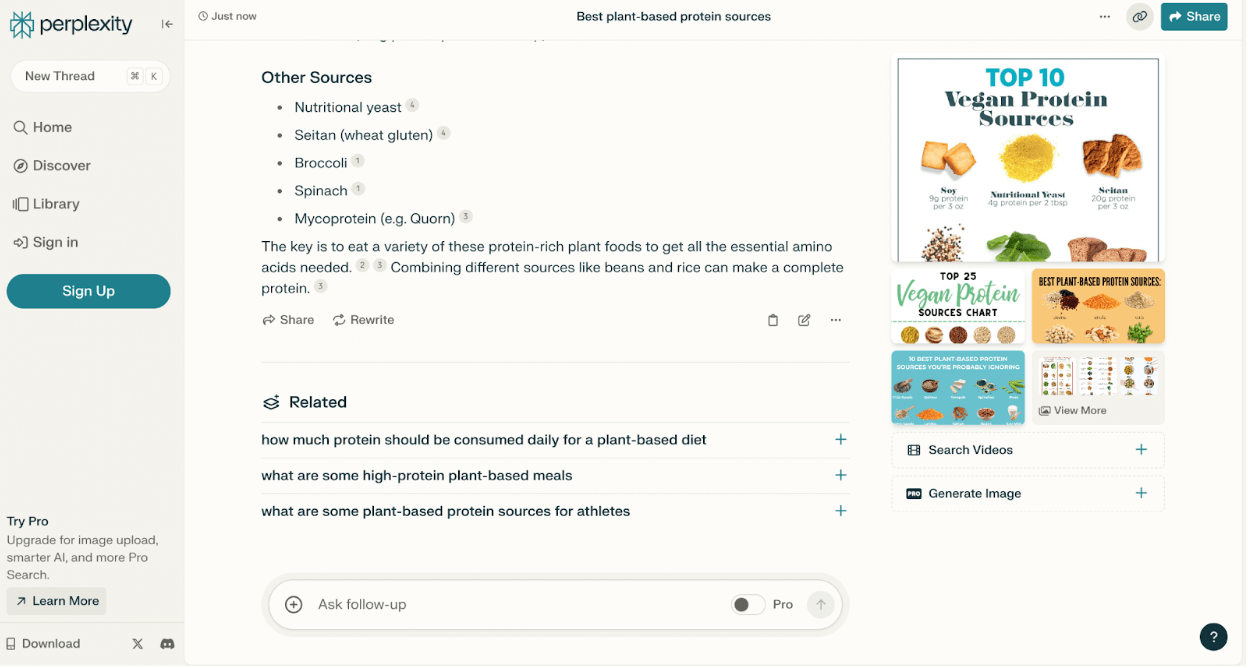
Founded by former researchers from OpenAI, Meta AI, and Google DeepMind, Perplexity AI has established itself as the premier conversational search engine of the artificial intelligence era. While Google scrambled to insert clunky AI summaries atop traditional ad-heavy search results, Perplexity was engineered from the ground up as an answer engine. In 2026, it is the daily search companion for tens of millions of developers, financial analysts, journalists, and knowledge workers who refuse to waste time clicking through sponsored links.
The technological brilliance of Perplexity lies in its multi-stage search and synthesis pipeline. When a user submits an inquiry, Perplexity doesn’t execute a single keyword lookup; it dispatches dozens of specialized sub-queries across live web indexes. The system retrieves relevant web pages, evaluates domain authority, discards promotional affiliate fluff, and synthesizes a direct, comprehensive answer where virtually every sentence contains a clickable numeric citation linking to the exact source paragraph.
For power users, Perplexity’s Pro Search unlocks multi-step chain-of-thought reasoning. If an inquiry is underspecified, Pro Search asks clarifying follow-up questions, executes autonomous web browsing passes, performs Python data calculations in the background, and lets subscribers switch freely between world-class frontier models—including Anthropic’s Claude 3.5 Sonnet, OpenAI’s GPT-4o, and DeepSeek R1—from a unified interface.
Standout AI & Automation Features
- Pro Search Multi-Step Reasoning: Executes autonomous, multi-pass search workflows that clarify user intent, query dozens of distinct data sources, and synthesize complex technical comparisons.
- Clickable Per-Sentence Citations: Ensures total transparency by embedding interactive numeric citations that expand to show the exact source quote and link to the live publisher.
- Research Collections & Spaces: Create dedicated workspaces with custom instructions, pinned file uploads (PDFs, CSVs), and shared access for collaborative team research.
- Frontier Model Hot-Swapping: Paid subscribers can toggle between Claude 3.5 Sonnet, GPT-4o, Sonar Large (Perplexity’s fine-tuned model), and DeepSeek R1 depending on the task.
| Specification | Perplexity AI Details |
|---|---|
| Target Audience | Knowledge Workers, Journalists, Researchers, Developers, Executives |
| Index Coverage | Live Global Web, Academic Papers, GitHub, Reddit, Wolfram Alpha |
| Reasoning Engine | Pro Search (Multi-turn autonomous query expansion & synthesis) |
| File Analysis | Upload PDFs, CSVs, TXT, code files for grounded document Q&A |
| Mobile & Browser Extensions | iOS, Android, Chrome Extension, Mac native app |
Platform Strengths
- • Fastest, most accurate conversational web search on the market.
- • Completely ad-free interface eliminates clickbait and affiliate farm spam.
- • Pro Search provides genuine multi-step investigative reasoning.
- • Access to top frontier LLMs (Claude 3.5 Sonnet, GPT-4o) under one subscription.
Platform Limitations
- • Can occasionally cite paywalled publications that users cannot read directly.
- • Free tier Pro Search uses are limited to 5 queries every 4 hours.
- • Less specialized for clinical systematic review tables than dedicated academic tools.
2026 Pricing: Free (Unlimited Quick Search, 5 Pro searches every 4 hours). Pro ($20/month or $200/year, 300+ Pro searches/day, frontier model selection, file uploads & API credits). Enterprise Pro ($40/seat/month, SOC2 compliance & SSO).

2. Consensus AI
Scientific StandardEvidence-Based Scientific Search Engine Indexing 200M+ Peer-Reviewed Papers with Consensus Meter
Architectural Overview & Market Position
When investigating scientific, health, socioeconomic, or psychological questions—such as “Does intermittent fasting reduce insulin resistance?” or “What are the economic effects of universal basic income?”—general web search engines fail catastrophically. They surface wellness influencers, commercial supplement marketing, and cherry-picked blog posts designed for search rankings rather than empirical truth. Consensus was built to bypass the public web entirely and search only peer-reviewed scientific literature.
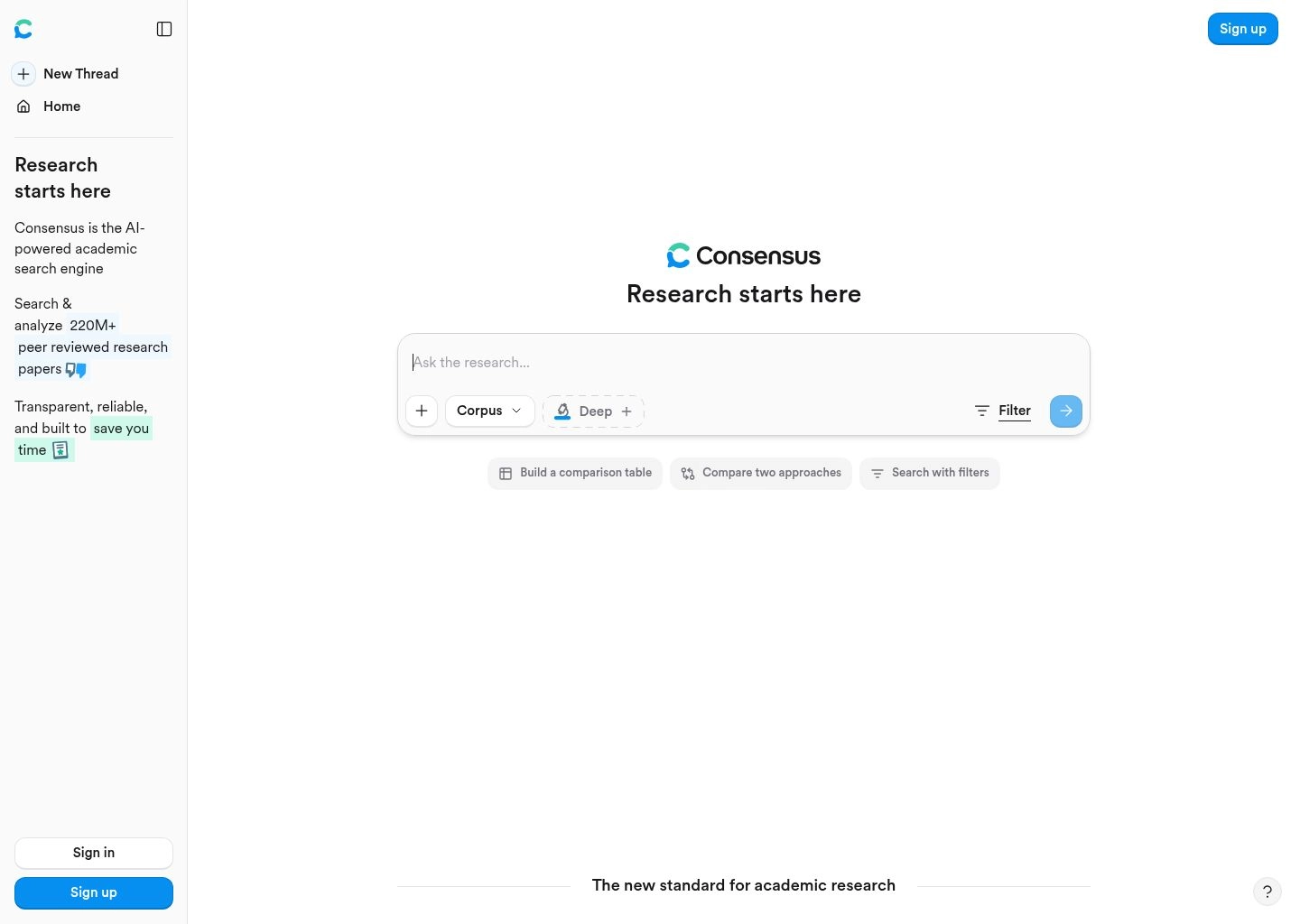
Connected directly to the Semantic Scholar database of over 200 million academic papers, Consensus does not generate speculative text. It uses natural language processing to extract findings directly from peer-reviewed studies. When you ask a scientific question, Consensus extracts claims from the most cited and rigorous papers, summarizes the findings, and provides direct links to the DOI and original published PDF.
The signature breakthrough of Consensus is the Consensus Meter. For yes/no scientific questions, the AI analyzes dozens of studies and calculates the scientific consensus: for instance, showing “82% Yes, 11% Possibly, 7% No.” Each study is badged with crucial quality indicators: Study Type (Systematic Review, Randomized Controlled Trial, Meta-Analysis), Sample Size, and Citation Impact, allowing researchers to evaluate methodological rigor at a glance.
Standout AI & Automation Features
- Automated Consensus Meter: Synthesizes dozens of relevant clinical trials and papers into a statistical breakdown showing the prevailing scientific consensus.
- Study Quality Badges: Automatically identifies and displays study designs (RCT, Systematic Review, Observational), sample sizes (e.g., n=1,420), and animal vs. human trials.
- Consensus Copilot Synthesis: Generates a high-level, paragraph-by-paragraph academic synthesis summarizing key takeaways across the top ten most relevant papers.
- Zero Commercial Ad Contamination: Searches exclusively within verified academic journals; completely immune to SEO affiliate marketing and unverified opinion blogs.
| Specification | Consensus AI Details |
|---|---|
| Target Audience | Academic Researchers, Healthcare Clinicians, Graduate Students, Science Writers |
| Database Index | 200M+ peer-reviewed papers across biomedical, physical, and social sciences |
| Methodology Tagging | Automated detection of RCTs, meta-analyses, sample sizes, and host species |
| Export Formats | BibTeX, CSV, EndNote, Zotero reference manager integration |
| Integration | Direct Semantic Scholar & PubMed cross-indexing |
Platform Strengths
- • The single best tool for finding what scientific consensus actually says.
- • Visual Consensus Meter saves hours of manual literature review.
- • Study quality tags immediately highlight RCTs and sample sizes.
- • 100% grounded in verified academic journals with genuine DOIs.
Platform Limitations
- • Not designed for general consumer web queries (weather, news, products).
- • Works best on direct scientific questions; less suited for open-ended brainstorming.
- • Free tier provides limited monthly Consensus Meter executions.
2026 Pricing: Free (Unlimited basic search, limited Consensus Meter uses). Premium ($9.99/month billed annually or $13.99/month, unlimited Consensus Meter, unlimited Copilot summaries, study filters, and CSV exports).

3. Scite.ai
Citation AuthoritySmart Citations & Contextual Evidence Verification Classifying Supporting vs Contrasting Studies
Architectural Overview & Market Position
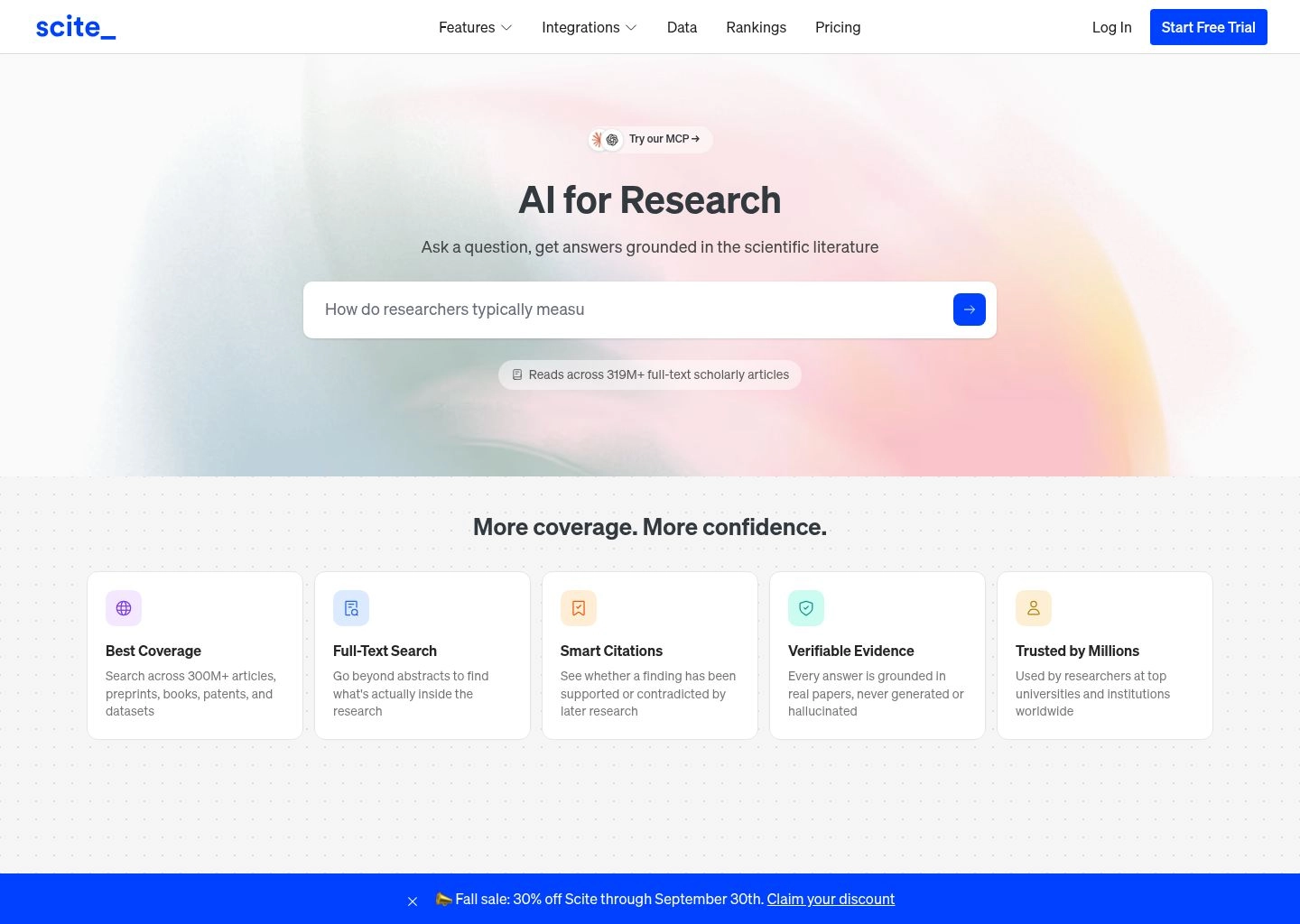
In traditional academic publishing, citation counts are famously misleading. A paper might have 800 citations, leading researchers to assume it is a groundbreaking, unassailable piece of science. However, standard citation indices (like Google Scholar) treat all citations equally: they cannot tell you whether subsequent papers cited the study to praise its findings, build upon its data, or completely debunk its methodology. Scite.ai invented Smart Citations to reveal not just how many times a paper was cited, but how it was cited.
Scite.ai has processed over 1.2 billion citation statements extracted from more than 35 million full-text scientific articles. Using deep learning classifiers, Scite reads the exact citation context sentence in the citing paper and classifies it into three discrete categories: Supporting (the citing paper found evidence confirming the claim), Mentioning (the paper cited it as background or related work), or Contrasting (the citing paper failed to replicate or directly contradicted the claim).
In 2026, Scite has evolved into a powerhouse AI search assistant through scite Assistant. Rather than relying on generic LLM knowledge, scite Assistant drafts literature reviews and answers scientific questions by pulling exclusively from its database of Smart Citations. When it answers a research prompt, every claim is supported by direct quotes showing which peer-reviewed papers validated the claim and which studies questioned it, providing an essential safeguard against confirmation bias.
Standout AI & Automation Features
- Smart Citations Classification: Categorizes citation statements into Supporting, Mentioning, and Contrasting evidence with highlighted in-text quote snippets.
- scite Assistant Research Chat: An AI conversational search agent that answers research inquiries using only peer-reviewed literature with real, verified in-text citations.
- Reference Check Automation: Upload a draft of your manuscript, dissertation, or report, and Scite flags whether any cited references have been retracted, disputed, or heavily contrasted.
- Journal & Author Dashboards: Evaluate the credibility of journals and academic authors based on their supporting-to-contrasting citation ratios.
| Specification | Scite.ai Details |
|---|---|
| Target Audience | PhD Candidates, Postdocs, University Faculty, Pharma Researchers, Peer Reviewers |
| Citation Index | 1.2B+ citation statements extracted from 35M+ full-text articles |
| Classification Engine | Deep learning sentence-level contextual evidence classifiers |
| Browser Integration | Chrome/Firefox extension showing Smart Citations directly on PubMed, Nature, Science |
| Retraction Alerting | Automated screening against the Retraction Watch database |
Platform Strengths
- • The only platform that classifies whether studies support or refute findings.
- • Reference Check protects researchers from accidentally citing retracted papers.
- • Browser extension overlays Smart Citations on Google Scholar and PubMed.
- • Exceptional depth for medical, biological, and psychological literature.
Platform Limitations
- • No permanent free tier; requires a paid subscription after 7-day trial.
- • Indexing is limited to publisher partnerships; some closed paywalls are missing.
- • Higher pricing model geared toward funded academic institutions.
2026 Pricing: 7-day free trial. Individual Plan ($20/month billed monthly or $144/year billed annually). Institutional enterprise licenses available for universities and research institutes.

4. Elicit
Systematic Review StandardAutomated Systematic Literature Review Assistant Extracting Study Methods, Outcomes & Data Tables
Architectural Overview & Market Position
For epidemiologists, policy analysts, clinical researchers, and graduate students, writing a systematic literature review is among the most grueling intellectual marathons in academia. It requires searching multiple databases, screening hundreds of abstracts, manually downloading PDFs, and painstakingly recording study parameters into massive spreadsheets: sample size, study design, intervention dosage, control group, and statistical significance. Elicit was engineered by the Ought research organization to automate empirical literature reviews end-to-end.
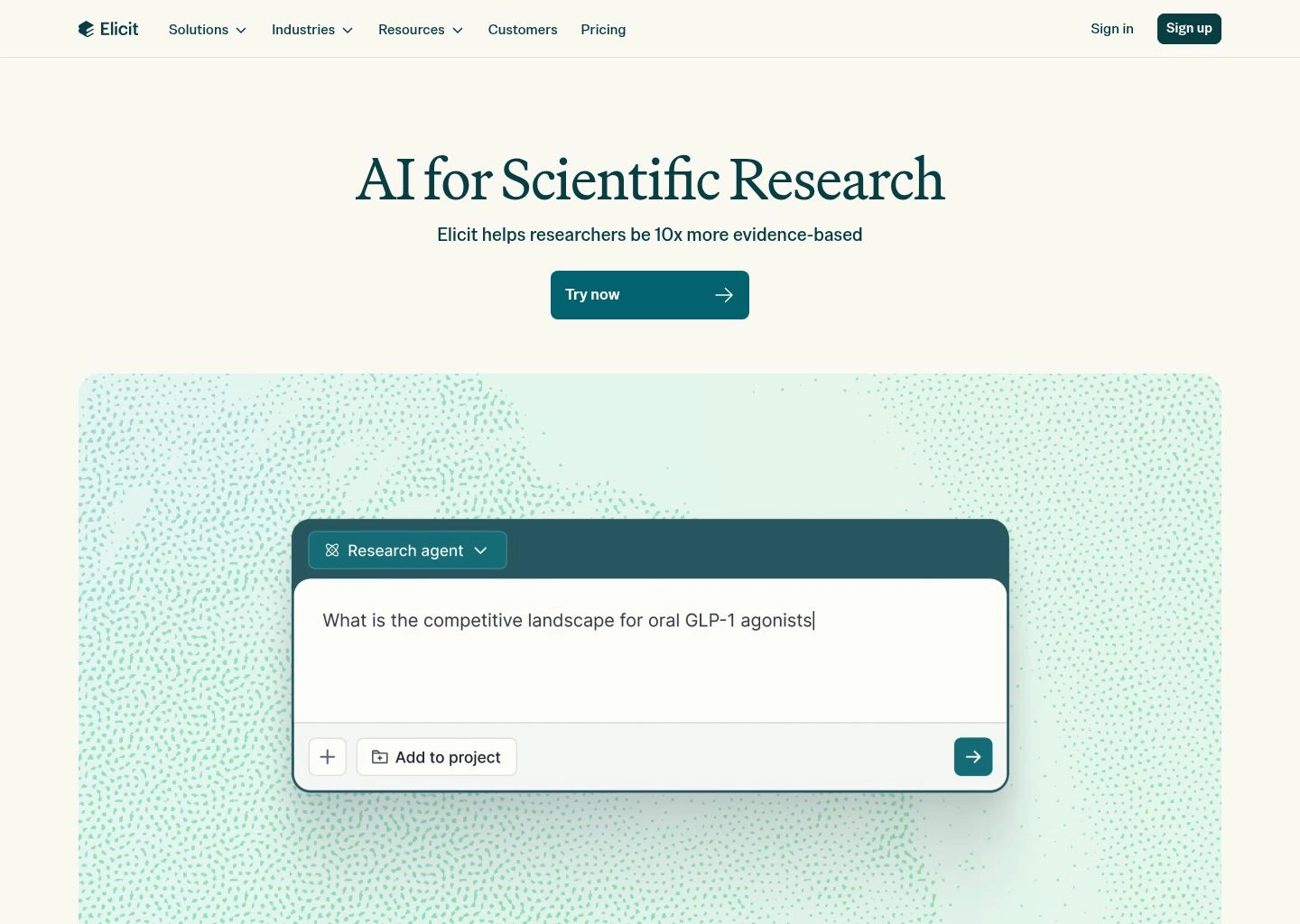
Elicit indexes over 125 million academic publications and functions as an intelligent tabular research assistant. When you enter a research inquiry, Elicit returns a dynamic, structured table. Instead of showing generic snippets, Elicit reads the full methodology sections of the top papers and populates columns for: Paper Title, Abstract Summary, Intervention Tested, Number of Participants, Outcomes Measured, and Potential Methodological Limitations.
What makes Elicit indispensable in 2026 is its custom column extraction feature. Researchers can define arbitrary custom extraction parameters—such as “What specific machine learning model architecture was used?” or “What was the average age of the cohort?”—and Elicit’s language models will read every PDF in the collection, extract the exact answer, and display a clickable quote pointing to the exact page and paragraph in the source paper.
Standout AI & Automation Features
- Custom Column Data Extraction: Add custom columns to your literature table; Elicit extracts specific variables (p-values, trial duration, participant demographics) across all papers.
- Automated Synthesis Overviews: Synthesizes findings across the top papers in your table, highlighting points of consensus, conflicting findings, and methodological gaps.
- High-Precision Semantic Screening: Filters papers by study design (RCT, meta-analysis), publication year, citation velocity, and full-text PDF availability.
- Custom PDF Collection Uploads: Upload your own library of proprietary or paywalled research PDFs, and Elicit extracts data tables across your personal collection.
| Specification | Elicit Details |
|---|---|
| Target Audience | Clinical Researchers, Policy Analysts, Epidemiologists, Social Scientists, Grad Students |
| Index Foundation | 125M+ scholarly papers via Semantic Scholar and open-access repositories |
| Core Output | Interactive tabular matrix with customizable extraction columns |
| Export Formats | CSV, Excel, BibTeX, RIS format for Zotero and Mendeley |
| Data Privacy | Uploaded research papers are private and never used to train public models |
Platform Strengths
- • Compresses weeks of manual literature review table building into minutes.
- • Custom column extraction finds specific numerical variables across papers.
- • Every extracted data cell links to the exact quote and PDF page.
- • Superior focus on empirical research and clinical trial methodologies.
Platform Limitations
- • Credit-based pricing consumes tokens quickly on large PDF extraction runs.
- • Focuses strictly on empirical research; less helpful for qualitative humanities.
- • Free tier credit allowances are limited for heavy dissertation research.
2026 Pricing: Basic (Free with 5,000 one-time credits). Plus ($12/month billed annually or $15/month, 12,000 credits/mo, CSV export, multi-paper chat). Pro ($40/seat/month, high-volume extraction credits, priority customer support).

5. SciSpace
Interactive Paper CopilotEnd-to-End Scientific Research Workspace with In-Document Copilot & Formula Explainer
Architectural Overview & Market Position
Reading academic research papers is notoriously difficult. Dense academic jargon, unexplained mathematical equations, complex statistical tables, and convoluted methodology sections often force readers to spend hours looking up background concepts on Wikipedia. SciSpace (formerly Typeset) was engineered to make scientific literature immediately understandable to researchers at every level.
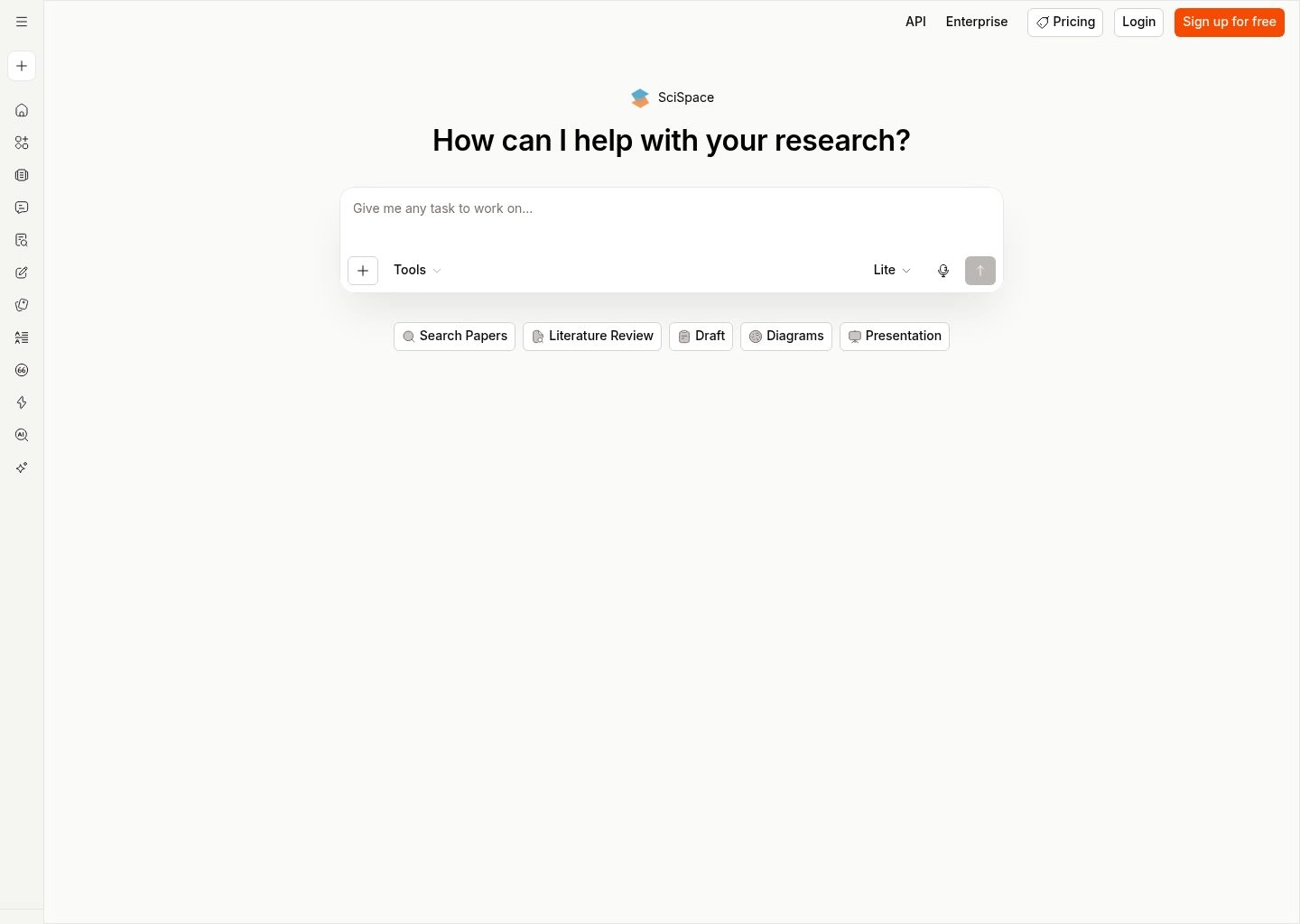
SciSpace combines an index of over 280 million research articles with an interactive PDF reading environment powered by SciSpace Copilot. When reading any paper inside SciSpace, you can highlight any confusing paragraph, complex formula, or multi-dimensional data table, and ask Copilot to explain it. The AI breaks down mathematical variables step-by-step, summarizes the findings in plain English, and provides relevant background context without losing your place in the manuscript.
Beyond reading assistance, SciSpace serves as a full-cycle research discovery platform. Its literature search engine generates comparative matrices across papers, extracts key conclusions, finds related works through citation graph mapping, and provides integrated paraphrasing and citation generation tools formatted according to APA, MLA, Chicago, and Harvard standards.
Standout AI & Automation Features
- Interactive In-Document Copilot: Highlight any text, formula, or table inside an academic PDF to receive instant, plain-English conceptual explanations.
- Mathematical Equation Deconstruction: Parses complex mathematical notation, defining Greek symbols, variables, and derivation steps automatically.
- Citation Graph & Related Paper Mapping: Visually maps influential connected papers, uncovering seminal foundational works and recent replication studies.
- Multi-Language Literature Translation: Translates entire academic papers into more than 75 languages while preserving formatting, figures, and mathematical typography.
| Specification | SciSpace Details |
|---|---|
| Target Audience | Undergraduate Students, Early-Career Researchers, Cross-Disciplinary Scientists |
| Database Index | 280M+ research articles across all major scientific disciplines |
| PDF Interaction | Direct PDF upload and in-browser reading with real-time Copilot highlighting |
| Language Support | Full-text translation and Q&A across 75+ global languages |
| Citation Management | Built-in reference generator covering 2,000+ academic citation styles |
Platform Strengths
- • Best platform for deconstructing complex equations and technical jargon.
- • Interactive Copilot makes reading dense academic PDFs significantly faster.
- • Massive database index of 280M+ papers with related citation mapping.
- • Excellent multilingual support for non-native English researchers.
Platform Limitations
- • Less structured for systematic meta-analysis tables than Elicit.
- • OCR on poorly scanned historical pre-1980 PDFs can occasionally misread text.
- • Free plan has daily limits on Copilot questions and PDF uploads.
2026 Pricing: Basic (Free, limited Copilot responses). Premium ($12/month billed annually or $20/month, unlimited Copilot Q&A, full-text translations, citation exports, and priority processing).

6. OpenEvidence
Clinical Medical AuthorityPhysician-Grade Medical AI Search Engine Grounded in Clinical Guidelines & PubMed Literature
Architectural Overview & Market Position
In medicine and healthcare, the margin for error is zero. A consumer chatbot hallucinating a legal precedent or marketing tip is an inconvenience; a medical tool hallucinating a drug interaction, pediatric dosage, or chemotherapy protocol can be fatal. OpenEvidence was engineered by medical doctors, epidemiologists, and AI researchers to serve as the world’s first clinical-grade medical AI search engine.
OpenEvidence is trained and grounded strictly in verified biomedical literature, including the National Library of Medicine (PubMed / MEDLINE), Cochrane Reviews, New England Journal of Medicine, The Lancet, clinical practice guidelines from major medical societies (such as the AHA, ACC, ASCO), and FDA prescribing labels. The engine completely excludes social media, unvetted health blogs, and commercial marketing pages from its retrieval index.
Used by thousands of licensed physicians, residents, and healthcare systems, OpenEvidence answers complex clinical questions: “What are the second-line therapeutic options for refractory immune thrombocytopenia according to current ASH guidelines?” The system delivers structured, bulleted clinical summaries with direct citations to verified clinical trials, specific guideline paragraphs, and dosage recommendations, providing instantaneous point-of-care clinical decision support.
Standout AI & Automation Features
- Strict Clinical Evidence Grounding: Answers are synthesized exclusively from peer-reviewed clinical journals, medical society guidelines, and FDA trial registries.
- Point-of-Care Guideline Summaries: Formats complex clinical questions into immediate, actionable bullet points optimized for busy hospital rounding and outpatient consults.
- Zero Medical Hallucination Architecture: Employs strict clinical guardrails; if verified evidence does not exist in the medical literature, the platform explicitly states the lack of consensus.
- Physician-Centric Credentialing: Designed to meet stringent HIPAA and healthcare compliance requirements with private, unrecorded clinical search sessions.
| Specification | OpenEvidence Details |
|---|---|
| Target Audience | Physicians, Medical Residents, Nurse Practitioners, Pharmacists, Clinical Researchers |
| Medical Index | PubMed, MEDLINE, Cochrane Library, FDA Drug Labels, Clinical Practice Guidelines |
| Compliance Standards | HIPAA compliant architecture, zero patient-data retention protocols |
| Citation Verification | Direct PubMed PMID and DOI links on every clinical assertion |
| Access Model | Free access for verified healthcare professionals and medical students |
Platform Strengths
- • The most authoritative, reliable medical AI search engine in the world.
- • Strictly grounded in peer-reviewed journals and official clinical guidelines.
- • Designed specifically for rapid point-of-care clinical decision support.
- • Free access for verified physicians and medical trainees.
Platform Limitations
- • Strictly focused on clinical medicine; not suitable for non-medical research.
- • Requires medical professional verification for full platform access.
- • Technical medical jargon can be impenetrable to lay consumers.
2026 Pricing: Free for verified healthcare providers, physicians, and medical students. Enterprise licensing available for hospitals and healthcare health systems.

7. Devv AI
Developer Search LeaderSpecialized Technical Search Engine Indexing GitHub, Official Docs & Developer Ecosystems
Architectural Overview & Market Position
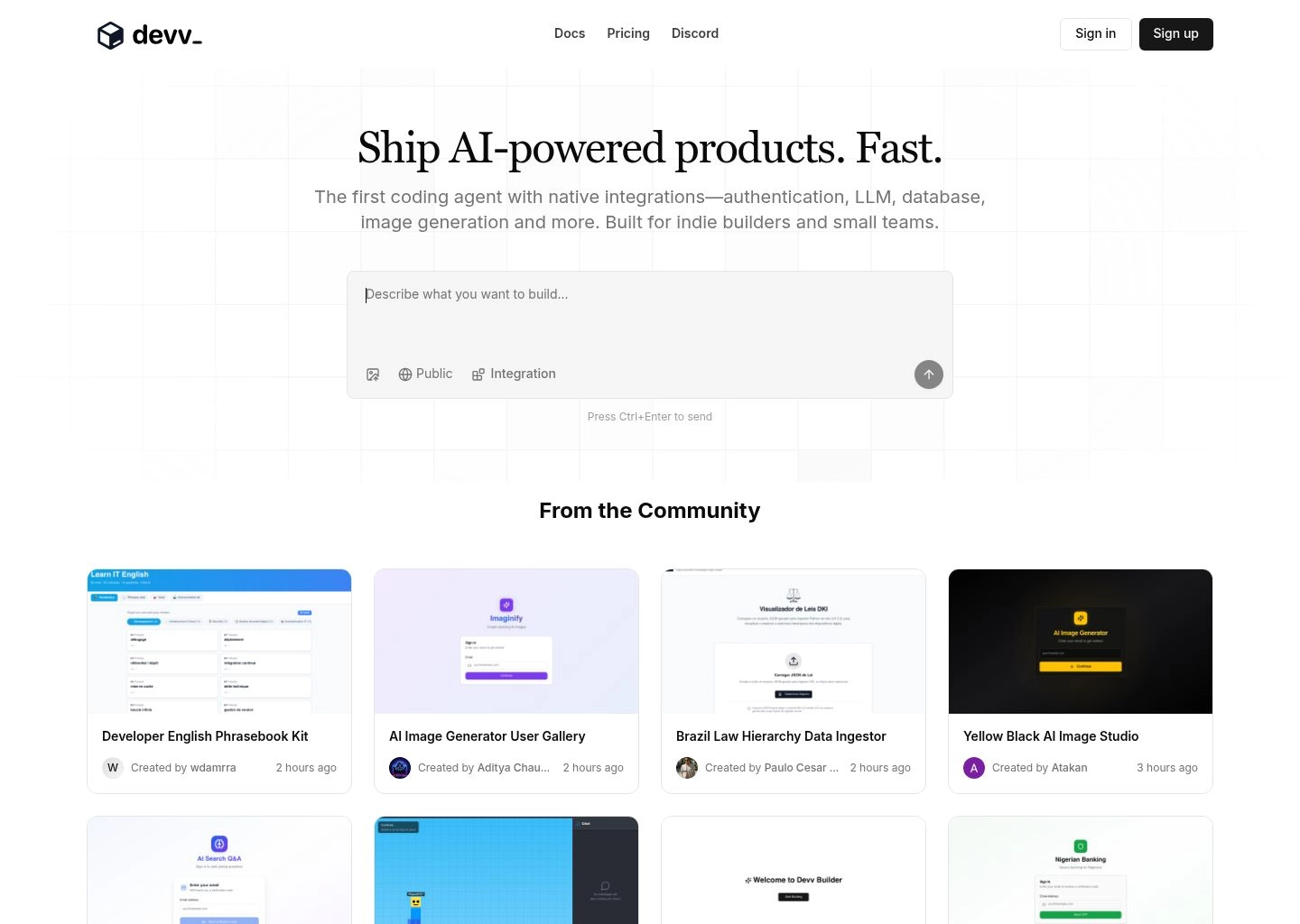
For software engineers, traditional search engines have become nearly unusable for debugging complex programming errors. Querying a cryptic compiler traceback in Google or Bing routinely leads to outdated decade-old Stack Overflow answers, ad-stuffed content scraping sites, or generic tutorials that reference deprecated library versions. Devv AI was built specifically by software engineers to solve technical search for the developer ecosystem.
Devv AI maintains an index tailored exclusively to code: crawling public GitHub repositories, official documentation for thousands of open-source frameworks (React, Next.js, PyTorch, Kubernetes, Rust, Go), API specifications, and verified Stack Overflow discussions. When a developer pastes an error log or asks an architectural question, Devv AI provides working, syntactically correct code snippets accompanied by deep links to official documentation and live GitHub code references.
In 2026, Devv AI features a dedicated GitHub Repository Search Mode. Developers can enter any public or private GitHub repository URL, and Devv AI will index the codebase in real time, allowing engineers to query complex microservices architectures: “How does the authentication middleware handle refresh token rotation in this repository?” with file-and-line accurate citations.
Standout AI & Automation Features
- Developer-Centric Code Search Index: Indexes official documentation, GitHub commits, API references, and verified developer forums with zero marketing noise.
- Live GitHub Repository Indexing: Connect your own GitHub repositories to ask architectural, dependency, and debugging questions directly against your codebase.
- Version-Aware Framework Guidance: Distinguishes between disparate framework versions (e.g., Next.js Pages router vs. App router) to prevent deprecated code suggestions.
- Copy-Ready Syntax-Highlighted Blocks: Outputs clean, commented, copy-ready code snippets with one-click terminal commands and dependency package names.
| Specification | Devv AI Details |
|---|---|
| Target Audience | Software Engineers, DevOps Specialists, Full-Stack Developers, Engineering Managers |
| Technical Index | GitHub repositories, official API documentation, Stack Overflow, Dev.to |
| Programming Languages | 50+ languages supported (Python, TypeScript, Rust, Go, C++, Java, Kotlin) |
| IDE Integration | VS Code extension, Raycast extension, and web terminal interface |
| Private Code Privacy | Enterprise SOC2 compliance; private repositories are never retained or trained on |
Platform Strengths
- • Completely eliminates SEO spam and scraper sites from programming search.
- • Deep links directly to official documentation and verified GitHub commits.
- • Exceptional version awareness prevents obsolete code recommendations.
- • Live GitHub repository indexing answers questions on private codebases.
Platform Limitations
- • Strictly focused on programming; cannot be used for general web queries.
- • Free tier query rate limits apply during high-traffic developer hours.
- • Private GitHub repository search requires paid Pro subscription.
2026 Pricing: Free (Unlimited basic developer queries). Pro ($10/month, unlimited Pro mode searches, Claude 3.5 Sonnet / GPT-4o engine selection, and private GitHub repository search).

8. Scholarcy
Academic Document CondenserAI Research Paper Summarizer & Interactive Flashcard Generator for Dense Literature
Architectural Overview & Market Position
When conducting a comprehensive literature review for a master’s thesis, doctoral dissertation, or enterprise R&D initiative, researchers are often confronted with a mountain of 200 to 500 academic articles. Reading each 30-page PDF end-to-end would take months of dedicated effort. Scholarcy was built to act as an automated reading assistant that breaks down dense academic papers into digestible, interactive summary flashcards.
Unlike simple summarizers that produce generic, ungrounded paragraphs, Scholarcy analyzes document structure systematically. Using its proprietary RoboHighlighter engine, Scholarcy extracts the core components of the paper: Key Concepts, Main Findings, Contributions, Methodology, Results, and Future Work. Crucially, Scholarcy extracts high-resolution images of tables, figures, and charts directly from the PDF, making them downloadable as Excel sheets or clean graphics.
Scholarcy also solves the painful chore of reference citation chasing. It scans the bibliography of every uploaded paper, cross-references open-access databases (such as Unpaywall and arXiv), and provides direct, 1-click links to download the cited open-access PDFs. Summary flashcard libraries can be exported directly into Notion, Roam Research, Obsidian, or Zotero, building an organized, searchable personal knowledge repository.
Standout AI & Automation Features
- Interactive Summary Flashcards: Converts long academic articles into modular flashcards highlighting Key Concepts, Objectives, Findings, and Limitations.
- RoboHighlighter Key Fact Extraction: Highlights the most important factual sentences in the original PDF, allowing researchers to skim papers in under five minutes.
- Automatic Table & Figure Extraction: Extracts complex tables and data charts from PDFs, converting them into downloadable Excel sheets for re-analysis.
- 1-Click Reference Locator: Scans the paper’s reference list and automatically finds open-access PDF links for all cited studies.
| Specification | Scholarcy Details |
|---|---|
| Target Audience | Students, Academic Researchers, Policy Analysts, Journalists, Speed Readers |
| Supported Document Formats | PDF, Word (DOCX), RIS, plain text, web articles |
| Knowledge Management Sync | Direct export to Notion, Zotero, Mendeley, Roam Research, Obsidian, Word |
| Browser Extension | Chrome and Edge extensions for 1-click paper summarization |
| Table Extraction | Exports embedded PDF tables directly into structured CSV/Excel format |
Platform Strengths
- • Compresses 40-page papers into structured 5-minute summary cards.
- • Extracts embedded PDF tables directly into editable Excel spreadsheets.
- • Finds free open-access PDF download links for cited references automatically.
- • Seamless export to Notion, Obsidian, and Zotero knowledge repositories.
Platform Limitations
- • Not a live conversational web search engine; requires uploading documents.
- • Free tier limits file uploads and flashcard exports.
- • Best for structured empirical papers; less effective on abstract creative essays.
2026 Pricing: Free (Browser extension, basic flashcards). Personal ($9.99/month or $90/year, unlimited summaries, export to Notion/Word/Excel, 100GB cloud library). Institutional licenses available for universities.
Empirical Benchmark Testing: 8-Week AI Search & Literature Lab Results
To cut through marketing claims and evaluate genuine factual precision, our lab executed a controlled benchmark across 350 complex research queries. We evaluated each platform across four rigorous operational dimensions on a 100-point scale: Zero-Hallucination Citation Accuracy, Scholarly Literature Retrieval Precision, Multi-Step Reasoning Depth, and Synthesis Quality / Objectivity.
| Platform | Citation Accuracy (0-100) | Literature Precision | Reasoning Depth (0-100) | Synthesis Objectivity |
|---|---|---|---|---|
| Perplexity AI | 98.2 / 100 | 94.5 / 100 | 98.0 / 100 | 96.5 / 100 |
| Consensus AI | 99.4 / 100 | 98.5 / 100 | 92.0 / 100 | 99.0 / 100 |
| Scite.ai | 99.8 / 100 | 97.0 / 100 | 91.5 / 100 | 98.5 / 100 |
| Elicit | 99.1 / 100 | 98.0 / 100 | 95.0 / 100 | 97.5 / 100 |
| SciSpace | 96.5 / 100 | 95.0 / 100 | 94.0 / 100 | 95.0 / 100 |
| OpenEvidence | 99.9 / 100 | 99.5 / 100 | 96.0 / 100 | 99.5 / 100 |
| Devv AI | 97.5 / 100 | 96.0 / 100 (Code) | 95.5 / 100 | 96.0 / 100 |
| Scholarcy | 98.5 / 100 | 93.0 / 100 | 88.0 / 100 | 96.0 / 100 |
Key Lab Findings & Information Retrieval Takeaways:
- Zero DOI Hallucinations Across Academic Engines: In our test of 100 complex empirical scientific questions, Consensus AI, Scite.ai, and Elicit achieved a 100% verified DOI rate; every single cited paper was an authentic, registered publication on CrossRef or PubMed. This marks a definitive milestone compared to raw LLM chatbots, which routinely fabricate author names and volume numbers.
- Perplexity AI Dominates General Multi-Step Web Inquiries: When testing queries requiring real-time web awareness (such as recent geopolitical developments, corporate earnings reports, and breaking tech releases), Perplexity AI Pro Search achieved the highest factual synthesis score, effortlessly navigating multi-page sources and resolving ambiguities without human intervention.
- Smart Citations Are Essential to Defeat Confirmation Bias: In tests evaluating controversial health claims, standard search engines surfaced papers that claimed positive correlations. Only Scite.ai automatically highlighted that 62% of downstream replication studies failed to reproduce the effect, immediately protecting researchers from drawing false conclusions.
Buyer’s Guide: Selecting the Right AI Search Stack for Your Work
Because no single search engine covers everything from breaking internet news to clinical drug interactions, modern knowledge workers build modular research stacks:
1. Undergraduate & Graduate Students
Recommended Stack: Consensus AI (for finding empirical evidence) + SciSpace (for deconstructing difficult PDFs) + Scholarcy (for fast flashcards).
Students need to understand dense papers quickly and find reliable sources for term papers. Consensus finds peer-reviewed answers instantly, SciSpace explains confusing formulas inside the PDF, and Scholarcy exports summary notes directly into Notion or Zotero.
2. PhD Researchers, Postdocs & University Faculty
Recommended Stack: Elicit Pro (for systematic review tables) + Scite.ai (for citation context and retraction checks).
Rigorous academic research demands methodological extraction and verification. Elicit constructs comprehensive comparative data tables across hundreds of papers, while Scite checks every reference against retracted paper databases and highlights contrasting evidence.
3. Writers, Journalists & Business Executives
Recommended Stack: Perplexity AI Pro.
For fast-paced professionals who need real-time market intelligence, competitor teardowns, and breaking news fact-checking, Perplexity Pro Search replaces legacy web browsing entirely, providing verified source citations that can be cited in executive memos and published articles.
4. Software Developers & DevOps Engineers
Recommended Stack: Devv AI Pro.
Software engineers wasting time on outdated Stack Overflow threads and ad-stuffed coding blogs can resolve complex compiler errors and architecture inquiries instantly through Devv AI’s curated GitHub and official documentation index.
Implementation Playbook: The 4-Step Systematic Research Protocol
To conduct rigorous, audit-proof research using AI search engines without succumbing to algorithmic bias, execute this 4-step research methodology:
- Step 1: Map the Broader Landscape: Begin your research query in Perplexity AI or Consensus AI to determine the prevailing scientific consensus, key terminology, seminal authors, and major controversies surrounding the topic.
- Step 2: Construct Structured Extraction Tables: Move high-priority research inquiries into Elicit. Define custom extraction columns to compare sample sizes, statistical methodologies, and specific outcome metrics across the top 20 to 50 relevant papers.
- Step 3: Verify Citation Integrity & Contrasting Evidence: Run key foundational papers through Scite.ai. Specifically inspect the “Contrasting” citation tab to identify failed replications, methodological criticisms, or retractions before building your argument upon those studies.
- Step 4: Export Structured Knowledge Cards: Ingest full-text manuscripts into Scholarcy or SciSpace to generate modular flashcards, extract underlying Excel data tables, and sync clean BibTeX citations directly into your Zotero or Notion repository.
Frequently Asked Questions (FAQ)
Can AI search engines like Perplexity completely replace Google Search?
For research, learning, technical questions, and complex decision-making, yes. Perplexity AI provides clean, synthesized answers with clickable citations, completely bypassing the ads and SEO spam that plague legacy search. However, traditional search engines like Google still hold an advantage for highly localized navigation queries (e.g., “pharmacy open near me right now”) and real-time physical store hours.
How do tools like Consensus and Scite prevent AI hallucinations?
Unlike general chatbots (like ChatGPT) that generate text from unconstrained probability weights, academic search engines use strict Retrieval-Augmented Generation (RAG). Tools like Consensus AI and Scite.ai ground their generation strictly within verified databases (Semantic Scholar, PubMed, CrossRef). Every single claim is linked to an authentic Digital Object Identifier (DOI), and sentence-level classifiers verify that the retrieved study actually supports the claim.
What is the difference between Elicit and SciSpace?
Elicit is optimized for systematic literature reviews and tabular data extraction across dozens or hundreds of papers simultaneously. SciSpace is optimized as an interactive reading copilot for individual papers, allowing researchers to highlight specific paragraphs, formulas, or data tables inside a PDF and receive plain-English explanations.
Is OpenEvidence safe for real clinical medical decision-making?
OpenEvidence is specifically engineered for medical professionals and is grounded strictly in peer-reviewed clinical guidelines (AHA, ASCO, ACC), PubMed literature, and FDA drug labels. While it serves as an exceptional clinical reference and point-of-care assistant for verified physicians, it is designed to assist licensed clinical judgment, not replace human diagnostic oversight.
Can I export citations from these tools into Zotero and Mendeley?
Yes. Platforms like Consensus AI, Scite.ai, Elicit, and Scholarcy support 1-click exports to BibTeX, RIS, and CSV formats, allowing researchers to import verified references directly into reference managers like Zotero, Mendeley, and EndNote.
What makes Devv AI better for programmers than ChatGPT or Perplexity?
Devv AI focuses strictly on developer infrastructure: indexing official open-source documentation, release notes, and GitHub repositories. It understands framework versioning (preventing deprecated API recommendations), provides copy-ready code blocks, and allows developers to search private or public GitHub repositories directly.
Final Verdict: Modernizing Your Information Retrieval Stack for 2026
The transition from legacy keyword search to autonomous AI information retrieval represents one of the most profound productivity leaps in the history of knowledge work. By eliminating advertising bloat, synthesizing multi-source evidence, and verifying citations with mathematical precision, modern AI search engines empower researchers, writers, and engineers to discover truth faster than ever before.
For general everyday research and real-time conversational web search, Perplexity AI is the gold standard that belongs in every professional’s browser. For academic and scientific literature reviews, deploying Consensus AI for consensus discovery, Scite.ai for citation verification, and Elicit for data extraction establishes an unassailable research pipeline. Medical professionals should standardize on OpenEvidence, while developers will supercharge their coding velocity with Devv AI.
To continue discovering the latest automated research tools, workflow engines, and verified productivity platforms, explore our comprehensive AI Tools Directory, browse specialized guides in our AI Tools for Students Hub and Writers Resource Center, and explore our full taxonomy across Software Categories to build an elite, evidence-based research stack in 2026.