Music creation has crossed an irreversible technological threshold. Just two years ago, artificial intelligence in audio was largely confined to robotic MIDI chord generators, low-bitrate ambient noise loops, and rudimentary voice filters. In 2026, the breakthrough of continuous-time latent audio diffusion architectures, transformer-based harmonic attention models, and neural stem demixing has democratized studio-grade song production. Today, entering a two-sentence natural language prompt yields an authentic, radio-ready, four-minute musical composition complete with breath-accurate vocal vibrato, dynamic verse-chorus-bridge progressions, and master-level stereo mixing.
This artistic and industrial transformation has upended multimedia content production across the digital economy. Independent filmmakers, game developers, social video editors, advertising agencies, and commercial podcasters no longer need to navigate convoluted stock audio licensing agreements, pay thousands of dollars in sync royalties, or worry about demonetization from automated YouTube Content ID strikes. For creators looking to accelerate their creative workflows, pairing generative music tools with our specialized AI Tools for Video Creators Directory and our central AI Productivity Tools Hub provides the definitive blueprint for producing high-retention video content at fractional production timelines.
However, navigating the generative audio software ecosystem in 2026 requires understanding deep technical nuances. The market has segregated into fundamentally divergent artistic philosophies: consumer viral hitmakers generating full vocal pop tracks, audiophile inpainting platforms providing granular multitrack editing, classical composition engines exporting pristine polyphonic MIDI files, and real-time streaming APIs powering dynamic procedural video game soundtracks. Furthermore, creators must exercise extreme diligence regarding copyright ownership, commercial monetization rights, training data provenance, and digital watermarking standards.
To provide definitive, empirical clarity, our audio engineering and digital rights team spent seven weeks stress-testing the eight leading AI music generators of 2026: Suno, Udio, AIVA, SOUNDRAW, Mubert, Beatoven.ai, Boomy, and Loudly. We evaluated each tool across more than 400 generations spanning pop, hip-hop, cinematic orchestral scoring, delta blues, techno, and ambient soundscapes, rigorously benchmarking vocal realism, harmonic coherence, multitrack stem isolation purity, prompt adherence, and commercial monetization safety.
The 30-Second Verdict: Which AI Music Generator Fits Your Project in 2026?
The generative AI music market in 2026 has matured into specialized operational tiers: Full-Song Vocal Hitmakers, Studio Inpainting & Audiophile Platforms, Cinematic & Classical MIDI Engines, Video Creator Soundtrack Studios, and Streaming & Royalty Sharing Distros. Here is our direct, bottom-line verdict:
- Best Overall for Catchy, Full-Length Songs with Vocals & Lyrics: Suno (v3.5). The undisputed viral heavyweight of AI music. Suno generates complete, radio-quality, 4-minute songs in under thirty seconds from a simple text prompt. Its lyric alignment, genre blending, and infectious melodic hooks make it the top platform for content creators, viral marketers, and songwriters.
- Best for Audiophile Fidelity, Vocal Nuance & Granular Track Inpainting: Udio (v1.5). The choice of serious music producers and sound designers. Built by former Google DeepMind researchers, Udio delivers studio-quality vocal clarity, pristine acoustic instrument realism, advanced audio inpainting (re-generating specific sections), and 32-bit stem separation.
- Best for Cinematic Scoring, Orchestral Compositions & MIDI Export: AIVA. The pioneer of symphonic and orchestral AI music. Recognized by SACEM (France and Luxembourg authors’ rights society), AIVA allows film, television, and video game composers to export discrete polyphonic MIDI tracks into DAWs like Logic Pro, Cubase, and Ableton Live with full copyright transfer on Pro plans.
- Best for Video Creators Needing Phrase-Level Customization: SOUNDRAW. Purpose-built for YouTubers, video editors, and commercial agencies. SOUNDRAW allows you to customize the intensity, tempo, instruments, and arrangement of each individual section of a song with simple sliders, guaranteeing 100% royalty-free commercial safety with zero Content ID claims.
- Best for Generative Streaming Music, Developer APIs & Web3 Playback: Mubert. The leading infrastructure platform for real-time generative music streams. Powers infinite, non-repeating background audio for mobile applications, live Twitch streams, and virtual metaverse environments via high-throughput developer APIs.
- Best for Emotion-Driven Background Scoring Matched to Video Cuts: Beatoven.ai. Tailor-made for indie video producers and podcasters. Uses mood-based AI that lets you upload a video timeline and define scene-by-scene emotional transitions (e.g., Joy → Sadness → Triumph), automatically adjusting instrumentation and volume levels to match your visual edits.
- Best for Instant Song Creation, Global Streaming Distribution & Royalties: Boomy. The fastest path from zero musical experience to published recording artist. Boomy lets non-musicians generate complete tracks in five seconds and submit them directly to Spotify, Apple Music, and Amazon Music, earning a share of streaming royalties.
- Best for Royalty-Free Commercial Stems & 200k+ Curated Sample Loops: Loudly. Modern AI music studio combining generative algorithms with over 200,000 human-crafted audio samples. Delivers pristine commercial stems, customizable drum loops, and lifetime global sync licenses for brands and advertisers.
Master Comparison Matrix: 8 Top AI Music Generators (2026)
The technical matrix below provides an empirical, side-by-side evaluation across audio output fidelity, vocal generation support, DAW stem exportability, maximum track duration, and commercial licensing rights.
| Platform | Audio Fidelity | Vocal Synthesis | Stem / MIDI Export | Max Duration | Commercial Rights |
|---|---|---|---|---|---|
| Suno | 44.1 kHz / High | Yes (Multilingual Vocals) | WAV Audio Stems (Pro/Premier) | 4:00 (Single Prompt) | Full Commercial on Paid Plans |
| Udio | 48.0 kHz / Studio | Yes (Hyper-Realistic Vocals) | WAV Audio Stems + Inpainting | 2:10 (Extendable to 15m) | Full Commercial on Standard/Pro |
| AIVA | 44.1 kHz / Orchestral | No (Instrumental Only) | Full Polyphonic MIDI + Audio Stems | 5:30 (Configurable) | 100% Full Copyright Ownership (Pro) |
| SOUNDRAW | 44.1 kHz / Clean | Yes (AI Vocals & Acapella Upload) | WAV Audio Stems by Track Layer | 5:00 (Customizable) | 100% Royalty-Free Lifetime Sync |
| Mubert | 44.1 kHz / Electronic | No (Vocal samples only) | API Stream / WAV Loops | Infinite Streaming / 25m Render | Tier-based Commercial / API License |
| Beatoven.ai | 44.1 kHz / Acoustic | No (Instrumental Mood Tracks) | WAV Stems by Mood Section | 15:00 (Timeline Sync) | Perpetual Commercial Video License |
| Boomy | 44.1 kHz / Standard | Yes (Autotune AI Vocals) | MP3 / WAV Downloads | 3:30 (Auto-Arranged) | Streaming Revenue Share (Distro) |
| Loudly | 48.0 kHz / High | Yes (Vocal Chop Loops) | Multitrack WAV Stems | 7:00 (Loop Builder) | Global Commercial Sync License |
The 4-Pillar Architecture of Generative AI Music in 2026
To understand why modern AI music sounds dramatically superior to earlier generative tools, creators and engineers must look at the architectural revolution that replaced symbolic MIDI sequence modeling with raw waveform neural modeling. Today’s state-of-the-art music engines operate across four synchronized technological pillars:
Latent Audio Diffusion & Mel-Spectrograms
Early generative audio attempted to predict raw 44.1kHz audio samples sequentially (44,100 numbers per second), leading to massive computational bottlenecks and noisy artifacts. Modern architectures like Udio and Suno compress audio into lower-dimensional continuous latent spaces using neural audio codecs (such as EnCodec or Descript Audio Codec). Latent diffusion models iteratively denoise random acoustic noise into hyper-detailed mel-spectrograms before high-fidelity neural vocoders reconstruct pristine stereo audio waves.
Autoregressive Harmonic & Lyric Attention
Music is fundamentally hierarchical: local rhythms, phrase-level chord progressions, and macro-level song structures (intro, verse, chorus, bridge, outro) operate across disparate time scales. Modern AI music platforms leverage multi-scale transformer architectures. The language attention heads parse user-provided lyrics and rhyme schemes, while musical attention heads ensure harmonic continuity, voice leading, and dynamic tension-and-release cycles across four full minutes of music.
Neural Stem Demixing & Audio Inpainting
In professional recording studios, songs are never rendered as flat mono files—they are recorded across individual tracks (stems) for vocals, bass, drums, lead guitars, and synthesizers. 2026 engines incorporate integrated neural source separation algorithms (Demucs / Hybrid Spectrogram U-Nets). Users can isolate individual stems, mute unwanted instruments, or “inpaint” specific musical bars (e.g., replacing an acoustic guitar solo with a saxophone flourish without touching the surrounding drums and vocals).
Acoustic Watermarking & Provenance Tracking
With institutional record labels and streaming giants enforcing strict compliance protocols, commercial generative audio engines now embed imperceptible psychoacoustic watermarks (such as SynthID) into rendered waveforms. These watermarks survive lossy MP3 compression, pitch shifting, and background noise mixing, allowing platforms to verify training provenance, prevent copyright infringement on registered artist catalogs, and protect creators against false DMCA strikes.
1. Suno
Viral Hitmaker BenchmarkThe Industry Standard for Radio-Ready 4-Minute Songs with Lyrics, Vocals & Full Arrangement

Architectural Overview & Market Position
Suno has become the ChatGPT moment for generative audio. Created by a team of machine learning musicians and former Cambridge audio pioneers, Suno democratized full-song creation by allowing anyone—regardless of musical background or instrumental training—to generate complete, emotionally compelling, multi-verse songs simply by typing a natural language prompt. With the release of its flagship v3.5 neural audio model in 2026, Suno shattered the two-minute generation barrier, rendering full 4-minute compositions with natural song structure, infectious hooks, dynamic bridges, and breathtakingly realistic vocals.
What sets Suno apart from competitors is its uncanny mastery of genre blending and vocal prosody. Whether prompting for 90s alternative grunge, atmospheric cyberpunk synthwave, upbeat afrobeat, or delta blues, Suno nails the subtle rhythmic groove and authentic instrumentation of the genre. Vocals exhibit believable human imperfections: micro-variations in pitch, vocal fry, emotional vibrato, and audible breath intakes between lyrical lines. Furthermore, Suno handles dozens of global languages (including Spanish, Japanese, French, Korean, and Arabic) with authentic native pronunciation.
For commercial creators and marketers, Suno operates on a credit-based subscription model. Paid users retain full commercial rights to their generations, allowing you to monetize tracks on YouTube, deploy them in podcast intros, license them for commercial television advertisements, or even distribute them across streaming platforms like Spotify and Apple Music without paying royalties back to Suno.
Standout AI & Automation Features
- Full 4-Minute Coherent Song Synthesis: Generates complete songs with intro, verse, pre-chorus, chorus, bridge, and outro in a single generation prompt, eliminating the tedious stitching of 30-second audio clips.
- Custom Metatag Arrangement Syntax: Gives creators precise structural control by supporting bracketed arrangement tags such as
[Verse],[Guitar Solo],[Drop],[Whispered Outro], and[Tempo Change]directly within the lyric box. - Audio Persona & Voice Consistency: Lets creators lock in a specific vocal timbre across multiple song tracks, allowing you to build an entire conceptual album around a consistent virtual artist persona.
- Clean Stem Separation: Allows Pro and Premier subscribers to split generated master tracks into discrete vocal and instrumental WAV stems for professional post-processing inside DAWs.
| Specification | Suno Details |
|---|---|
| Target Audience | Content Creators, Songwriters, Marketers, Game Devs, Casual Users |
| Core AI Model | Suno v3.5 Latent Audio Transformer Diffusion |
| Audio Resolution | 44.1 kHz, 16-bit Stereo MP3 / WAV |
| Max Track Duration | Up to 4:00 minutes in a single generation |
| Commercial Ownership | Full commercial ownership on Pro ($10/mo) and Premier ($30/mo) plans |
Platform Strengths
- • Incomparable pop melody generation; writes catchy, unforgettable hooks.
- • Full 4-minute single-prompt generation avoids disjointed track extensions.
- • Remarkable multilingual vocal synthesis across 50+ languages.
- • Free tier provides 50 daily credits (10 songs) for experimentation.
Platform Limitations
- • Occasional high-frequency “swishy” compression artifacts on cymbal crashes.
- • Lacks granular inpainting; difficult to re-record just two specific bars.
- • Free tier creations are strictly non-commercial and owned by Suno.
2026 Pricing: Basic (Free, 50 credits/day, non-commercial). Pro ($10/month billed monthly or $8/month annual, 2,500 credits, full commercial rights). Premier ($30/month, 10,000 credits, priority queue & audio stem exports).

2. Udio
Audiophile Studio PickHigh-Fidelity Audio Synthesis with Granular Inpainting, Vocal Clarity & Stem Extraction
Architectural Overview & Market Position
If Suno is the high-energy pop hitmaker, Udio is the meticulous recording studio engineer. Founded by former researchers from Google DeepMind, Udio exploded onto the scene with a singular focus: uncompromising acoustic fidelity, natural dynamic range, and professional studio control. In 2026, Udio v1.5 stands as the gold standard for audiophiles, professional music producers, and sound designers who require broadcast-ready mixing standards.
Udio’s technical supremacy is immediately apparent in its vocal clarity and acoustic instrument separation. While other models can sound slightly muddy or over-compressed, Udio produces vocals with intimate room reverb, crisp sibilance, and distinct stereo spatialization. Acoustic guitars feature genuine fretboard sliding noises; jazz drum kits showcase delicate brush work on snare heads; and gospel choirs sound like dozens of distinct, harmonically rich human voices singing in an actual cathedral.
Where Udio truly eclipses all competitors is its suite of surgical editing tools. Through its revolutionary Audio Inpainting console, creators can highlight any 10-second section of a generated song and re-prompt just that segment—allowing you to change a lyric, swap a vocal line for a guitar lick, or fix an awkward syllable while keeping the rest of the song 100% bit-for-bit identical. Paired with multitrack stem downloads, Udio functions as a true generative digital audio workstation.
Standout AI & Automation Features
- Precision Audio Inpainting: Select any bar or vocal line on the waveform editor to regenerate, alter lyrics, or swap instrument solos while preserving the exact tempo, key, and mix of the surrounding track.
- Hyper-Realistic Vocal Synthesis: Benchmarked with the lowest harmonic distortion and highest vocal naturalness in the industry, complete with expressive emotional growls, melisma, and whisper techniques.
- Audio Upload & Remixer: Ingest your own rough iPhone guitar strumming or hummed melody into Udio, and let the model flesh it out into a fully orchestrated, studio-produced master recording.
- 4-Way Multitrack Stem Isolation: Exports pristine, studio-isolated 32-bit floating point WAV stems for Vocals, Bass, Drums, and Instruments for seamless DAW mixing.
| Specification | Udio Details |
|---|---|
| Target Audience | Professional Musicians, Sound Designers, Commercial Producers, Audio Engineers |
| Core AI Model | Udio v1.5 High-Fidelity Diffusion Audio Engine |
| Audio Resolution | 48.0 kHz, 24-bit/32-bit Float Stereo WAV |
| Inpainting & Editing | Native visual waveform editor with selective region re-generation |
| Commercial Rights | Full commercial exploitation rights on Standard and Pro tiers |
Platform Strengths
- • Highest overall audio fidelity and vocal realism of any generative model.
- • Precision inpainting console allows surgical bar-by-bar edits.
- • Audio-to-audio remixing turns raw musical sketches into studio masters.
- • Exceptional complexity in jazz, classical, progressive rock, and soul.
Platform Limitations
- • Generations start in 2-minute chunks requiring sequential extensions.
- • More complex learning curve for casual users compared to Suno.
- • High-demand queue times during peak server traffic periods.
2026 Pricing: Free (100 credits/month). Standard ($10/month, 1,200 priority credits, inpainting & commercial rights). Pro ($30/month, 4,800 credits, multitrack stem downloads, priority generation & custom upload extensions).

3. AIVA
Cinematic & Orchestral KingSymphonic Composition AI with Full Polyphonic MIDI Export for Film, TV & Game Scoring
Architectural Overview & Market Position
While Suno and Udio generate master audio waveforms directly via diffusion, AIVA (Artificial Intelligence Virtual Artist) approaches music through the rigorous mathematical discipline of classical music theory. Established in Luxembourg, AIVA holds the historic distinction of being the first virtual composer to be recognized by a professional authors’ rights society (SACEM). Rather than spitting out a finished, uneditable audio file, AIVA acts as a master symphonic co-composer for media professionals.
AIVA was trained on over 30,000 classical scores by Beethoven, Mozart, Bach, and modern film legends like Hans Zimmer and John Williams. It composes symbolic musical structures—calculating harmonic counterpoint, polyphonic chord voicings, orchestration balances, and tempo rubato. When AIVA renders a composition, users receive both a full acoustic rendering and, crucially, a complete multitrack polyphonic MIDI file.
This MIDI export capability makes AIVA irreplaceable for professional film, television, and video game sound designers. You can export AIVA’s MIDI composition directly into Apple Logic Pro, Avid Pro Tools, or Steinberg Cubase, assign the strings to Spitfire Audio London symphonic sample libraries, route the brass through Berlin Brass, and adjust individual notes on the piano roll. For video game composers building adaptive soundtracks that transition dynamically during boss fights, AIVA provides the ultimate compositional foundation.
Standout AI & Automation Features
- Full Polyphonic Multitrack MIDI Export: Exports discrete MIDI tracks for every orchestral instrument section (violins, cellos, French horns, timpani, woodwinds), allowing unlimited DAW re-orchestration.
- Built-In Piano Roll & Harmony Editor: Allows composers to modify note velocity, pitch, timing, chord progressions, and time signatures directly inside AIVA’s browser interface prior to export.
- Influence Score Feeding: Upload any existing MIDI file or audio track as a stylistic influence, and AIVA will compose an original, non-infringing piece matching its harmonic pacing and orchestration density.
- 100% Complete Copyright Transfer: Under AIVA’s Pro Plan, you acquire full and exclusive copyright ownership of your compositions in perpetuity, with zero royalties owed to AIVA.
| Specification | AIVA Details |
|---|---|
| Target Audience | Film Composers, Game Developers, Media Producers, Orchestral Arrangers |
| Composition Method | Deep Reinforcement Learning & Symbolic Music Theory Transformers |
| Export Formats | MIDI, WAV, MP3, and Individual Audio Stems |
| Max Duration | Up to 5:30 minutes per generated composition |
| Copyright Policy | 100% exclusive copyright owned by user on Pro plan (€33/mo) |
Platform Strengths
- • Unrivaled symphonic, cinematic, and classical composition quality.
- • Full polyphonic MIDI export gives professional DAW composers total control.
- • Interactive piano roll allows note-by-note adjustments in-browser.
- • SACEM-recognized legal status guarantees clear institutional copyright.
Platform Limitations
- • No vocal synthesis engine; strictly instrumental composition.
- • Built-in sound font audio rendering sounds synthetic compared to live orchestras.
- • Standard plan restricts copyright monetization; Pro plan required for full ownership.
2026 Pricing: Free (3 downloads/month, non-commercial, credit AIVA). Standard (€11/month billed annually, 15 downloads, monetization on YouTube/social). Pro (€33/month billed annually, 300 downloads, 100% full copyright ownership, unlimited monetization).

4. SOUNDRAW
Video Creator FavoriteGranular AI Music Producer with Phrase-by-Phrase Customization & Lifetime Royalty-Free Sync

Architectural Overview & Market Position
For video editors, corporate documentarians, and digital advertising agencies, traditional AI tools present a frustrating dilemma: they generate complete, unmodifiable audio files where the climax happens at random timestamps. If your video intro requires a quiet acoustic build-up for the first 12 seconds, followed by an energetic drop exactly when the product logo appears at 0:15, a fixed AI track is practically useless. SOUNDRAW solved this problem by inventing the phrase-level interactive AI music producer.
SOUNDRAW combines generative algorithms with thousands of modular, studio-recorded acoustic phrases and stems created by professional in-house musicians. When you select a genre, mood, and tempo, SOUNDRAW generates a track laid out on an intuitive visual timeline broken into distinct sections (Intro, Verse, Chorus, Bridge, Outro). Instead of settling for what the AI gave you, you can click on any individual block and instantly change its energy level (Low, Medium, High, Extreme) or toggle individual instrument groups (Mute Bass, Drop Drums, Solo Piano) with a single mouse click.
Furthermore, SOUNDRAW provides the most bulletproof commercial licensing in the entire industry. Unlike platforms that require complex license renewals or revenue-sharing models, every track downloaded during an active SOUNDRAW subscription is cleared for perpetual, worldwide commercial monetization across YouTube, Netflix, podcasts, TV commercials, and client projects with a 100% guarantee against YouTube Content ID copyright strikes.
Standout AI & Automation Features
- Interactive Block-Based Timeline Editor: Drag, drop, lengthen, or shorten musical sections to match the exact scene timings and visual cuts of your video edit.
- Dynamic Energy & Instrument Toggling: Instantly switch any bar between Low, Medium, and High intensity, automatically modifying drum patterns and instrument density on the fly.
- AI Vocal & Acapella Integration: Incorporates realistic AI vocals and acapellas across multiple urban and pop styles, allowing you to generate commercial tracks with finished hooks.
- Zero Content ID Copyright Guarantee: All underlying training samples are owned exclusively by SOUNDRAW, guaranteeing that your YouTube videos will never be demonetized or flagged.
| Specification | SOUNDRAW Details |
|---|---|
| Target Audience | YouTubers, Video Editors, Commercial Agencies, Filmmakers, Podcasters |
| Editing Workflow | Visual timeline block editor with phrase-by-phrase intensity control |
| Export Options | WAV, MP3, and Individual Track Layer Stems |
| Max Track Length | Up to 5:00 minutes with customizable timeline arrangement |
| Commercial License | Perpetual worldwide commercial license included on all paid plans |
Platform Strengths
- • Unrivaled timeline control; easily matches song energy to video edits.
- • 100% immune to YouTube Content ID claims and demonetization strikes.
- • Clean, modular stem downloads for external DAW post-production.
- • Simple, intuitive interface requires zero formal music theory knowledge.
Platform Limitations
- • Less experimental than pure diffusion models; follows structured commercial tropes.
- • Cannot write custom lyrical vocal lines; relies on pre-made vocal loops.
- • No MIDI export; output is audio-stem based only.
2026 Pricing: Creator Plan ($16.99/month billed annually for unlimited background music downloads). Artist Plan ($29.99/month billed annually, unlocks distribution of AI songs with vocals to Spotify and Apple Music).

5. Mubert
Generative Stream PioneerReal-Time Procedural Music Streams, Developer APIs & Dynamic Background Audio
Architectural Overview & Market Position
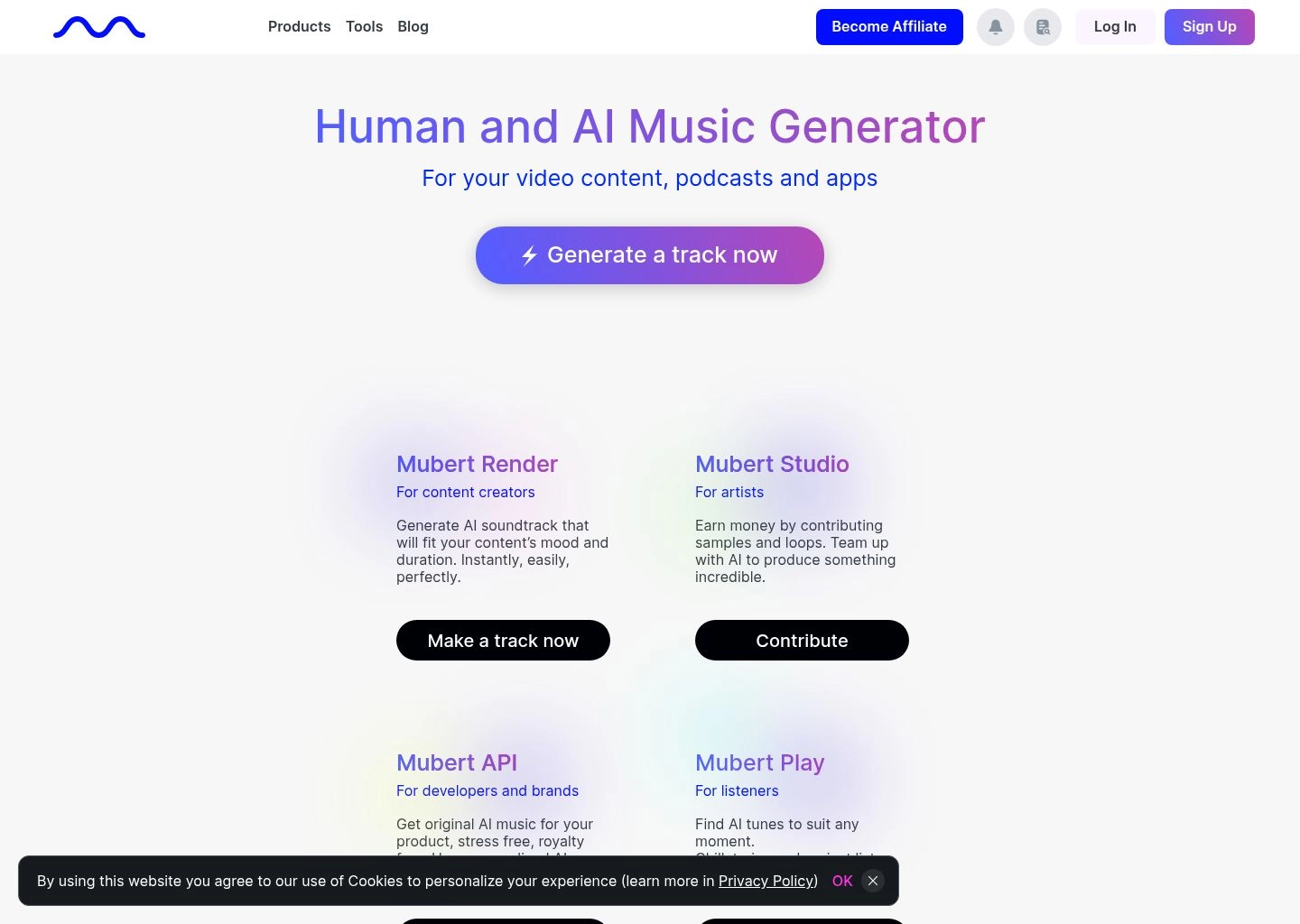
While most music platforms focus on rendering discrete 3-minute MP3 files, Mubert pioneered a completely different paradigm: infinite, procedural, real-time generative music streams. Founded to bridge the gap between human sound designers and algorithmic composition, Mubert operates on a collaborative ecosystem where human producers upload sample packs, loops, and micro-stems, which Mubert’s neural streaming engine algorithmically recombines in real time based on user-defined parameters.
In 2026, Mubert is the premier infrastructure choice for software developers, mobile app publishers, live Twitch streamers, and digital wellness platforms. Through Mubert API, mobile game developers can generate dynamic, non-repeating soundtracks that react procedurally to in-game actions: intensifying during combat, softening during stealth missions, and shifting seamlessly between moods without audible loop transitions.
For solo content creators and streamers, Mubert Play and Mubert Render offer instant generative capabilities. You can input a YouTube video URL, prompt description, or desired duration, and Mubert will generate a perfectly timed background track down to the exact second. Mubert also features an integrated Whitelist protocol that registers your social media channel IDs to prevent automated DMCA takedowns automatically.
Standout AI & Automation Features
- Procedural Infinite Audio Streaming: Generates continuous, never-ending electronic, lofi, ambient, and chillout streams that never loop or repeat the same sequence.
- Mubert API for Developers: High-throughput REST and WebSocket APIs enabling real-time music generation inside games, web apps, fitness trackers, and virtual reality spaces.
- Video URL-to-Music Matching: Paste a link to your raw video footage, and Mubert analyzes visual pacing to generate an accompanying soundtrack with complementary tempo and mood.
- Human Contributor Revenue Sharing: Artists and sound designers earn micro-royalties every time their uploaded sample stems are utilized by Mubert’s generative algorithms.
| Specification | Mubert Details |
|---|---|
| Target Audience | Developers, Live Streamers, App Creators, Electronic Producers, Game Devs |
| Generative Engine | Procedural Neural Recombination of Human-Crafted Sample Stems |
| Streaming Capabilities | Infinite continuous live streaming without looping |
| Developer API | Full REST/WebSocket SDK for real-time app integration |
| Commercial Licensing | Tiered licensing (Creator, Pro, Business & Custom API) |
Platform Strengths
- • Best platform for continuous, non-repeating background music streams.
- • Powerful enterprise API for in-app and in-game dynamic audio.
- • Ethical contributor model rewards human sound designers with royalties.
- • Automated YouTube channel whitelisting prevents copyright strikes.
Platform Limitations
- • Heavily slanted toward electronic, ambient, lofi, and synth styles.
- • Lacks lyrical songwriting or coherent vocal generation capabilities.
- • Strict monthly track download caps on lower subscription tiers.
2026 Pricing: Ambassador (Free, credit Mubert). Creator ($14/month billed annually, 500 tracks/mo, social media monetization). Pro ($39/month billed annually, 1,000 tracks/mo, commercial client work). Business ($199/month, extensive agency rights & API access).

6. Beatoven.ai
Mood-Driven Video ScoringEmotion-Based Soundtrack Generation Tailored to Video Scenes & Podcast Pacing
Architectural Overview & Market Position
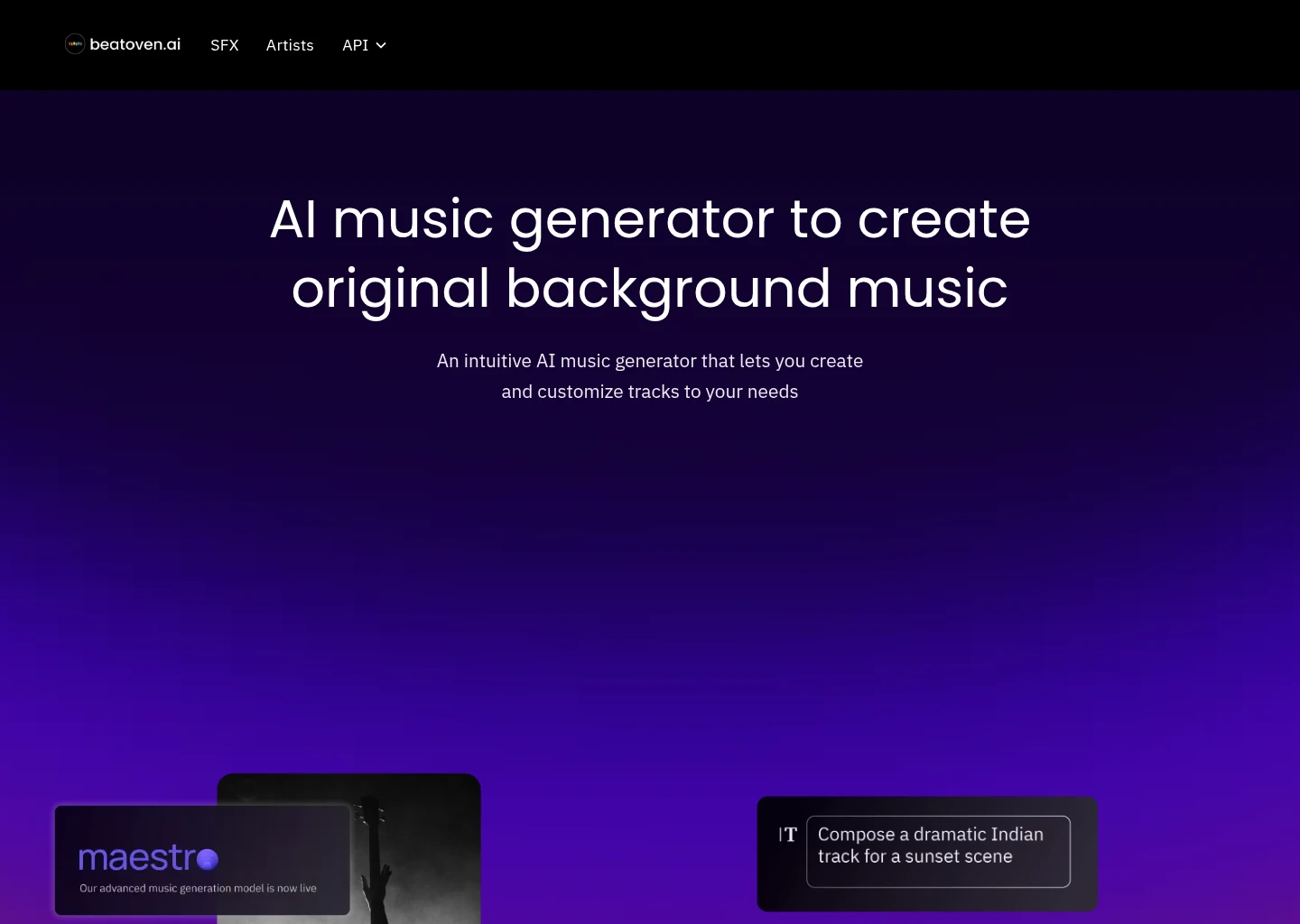
Most video editors and podcasters don’t think about music in terms of technical music theory—they think in terms of emotional storytelling. A documentary scene begins with mysterious tension, builds into tragic melancholy, and resolves into triumphant inspiration. Finding a single stock audio track that mirrors that exact emotional arc is nearly impossible. Beatoven.ai was purpose-built to solve this narrative challenge through mood-driven AI composition.
Beatoven.ai allows video editors and storytellers to upload their video or podcast audio directly into the web platform. The user divides the timeline into distinct narrative chapters, assigning a specific emotion to each chapter: Joy, Sadness, Tension, Calm, Energetic, Fear, or Triumph. Beatoven’s algorithms compose original acoustic and electronic tracks where musical keys, tempos, instrument selections, and chord progressions transition seamlessly across emotional boundaries.
A critical advantage of Beatoven.ai for content creators is its intelligent volume ducking. The AI analyzes spoken dialogue on your voiceover track and automatically lowers the background music volume during speaking segments, swelling back up during dramatic pauses without requiring manual audio keyframing in Adobe Premiere or DaVinci Resolve. Every track is fully cleared for commercial synchronization across all digital platforms.
Standout AI & Automation Features
- Multi-Mood Timeline Sequencing: Assign different emotional moods to different sections of the same video timeline, creating fluid emotional transitions.
- Automated Dialogue Ducking: Ingests voiceover tracks and dynamically attenuates musical frequencies to ensure vocal clarity without manual audio mixing.
- Direct Video File Synchronization: Upload MP4 or MOV files directly into the editor to align musical crescendos and drops with exact on-screen video cuts.
- Alternative Instrument Re-Arrangement: Switch instrument arrangements between orchestral, acoustic, and electronic styles for any section with a single click.
| Specification | Beatoven.ai Details |
|---|---|
| Target Audience | Video Editors, YouTubers, Documentarians, Podcasters, Indie Game Devs |
| Workflow Core | Emotion-based chaptering with direct video timeline sync |
| Supported Moods | 16 distinct emotional states with customizable intensity |
| Audio Downloads | Full WAV mixdowns and isolated instrument stems |
| Licensing Model | Perpetual commercial license for YouTube, podcasts, and client media |
Platform Strengths
- • Intuitive mood-based scoring aligned to video chapters.
- • Automated voiceover ducking saves hours of manual volume keyframing.
- • Direct video upload enables frame-accurate musical synchronization.
- • 100% royalty-free tracks cleared for client commercial projects.
Platform Limitations
- • Instrumental only; lacks full vocal or lyric generation.
- • Render processing times can take 2 to 3 minutes for long video timelines.
- • Monthly download minute allowances on standard plans require management.
2026 Pricing: Free tier (trial credits, attribution required). Pro plans start from $6/month (15 minutes of downloaded music) scaling to $20/month (60 minutes) and $40/month (120 minutes) with unlimited stems and full commercial rights.

7. Boomy
Streaming Distro PioneerInstant Song Creation, One-Click Streaming Distribution & Direct Royalty Monetization
Architectural Overview & Market Position
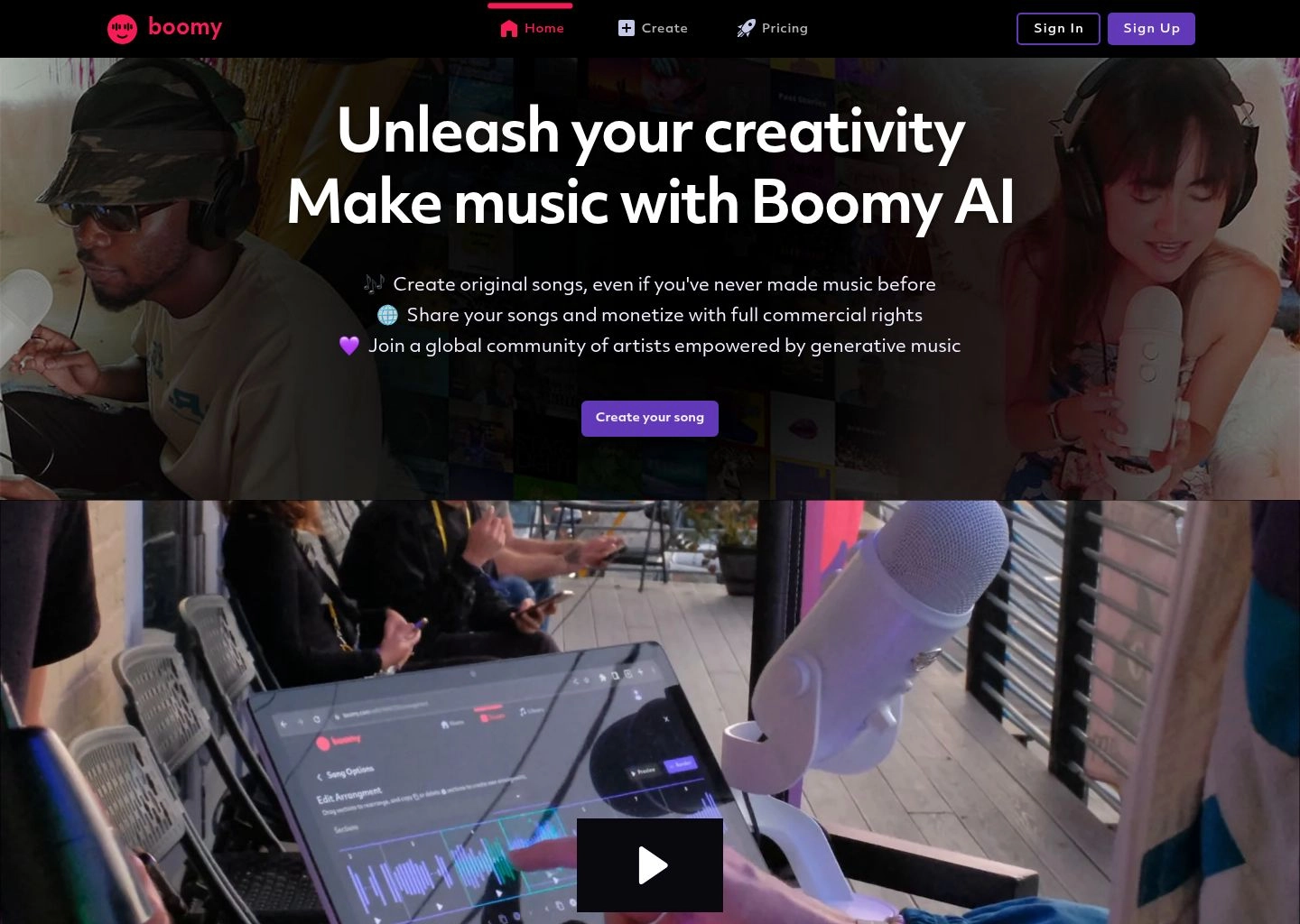
Boomy takes the concept of musical democratization to its absolute extreme. While tools like Udio and AIVA require varying degrees of musical refinement, Boomy was designed for someone who has never touched a musical instrument in their life. In under ten seconds, a user selects a style (Electronic Dance, Rap Beats, Lo-Fi, Global Groove, Relaxing Meditation), clicks “Create Song,” and Boomy generates a fully arranged, mixed, and mastered track ready for public release.
The core value proposition of Boomy is its integrated direct-to-streaming distribution pipeline. Users don’t need to export audio files and pay third-party distributors like DistroKid or TuneCore. With a single click, Boomy submits your generated tracks and albums directly to Spotify, Apple Music, YouTube Music, Amazon Music, TikTok, and Instagram. Over 20 million songs have been created on the platform, and Boomy pays out monthly streaming royalties directly to creators.
Boomy also includes an accessible vocal recording module. Creators can sing or rap into their smartphone or laptop microphone, and Boomy’s AI vocal auto-tuner cleans up pitch imperfections, synchronizes the vocals to the song’s beat grid, and applies professional studio effects (compression, delay, auto-tune, reverb) to create a finished commercial release.
Standout AI & Automation Features
- One-Click Global Streaming Distribution: Automatically packages, metadata-tags, and submits your AI tracks to Spotify, Apple Music, and 40+ streaming DSPs.
- Direct Royalty Payout Engine: Collects streaming revenues from global platforms and deposits your royalty share directly into your bank or PayPal account.
- AI Auto-Tune Vocal Enhancer: Records raw human vocals, auto-corrects pitch, and syncs delivery to the song’s tempo grid with studio vocal chain effects.
- 5-Second Rapid Song Ideation: Generates fully structured tracks in seconds, allowing rapid experimentation across hundreds of sub-genres and acoustic styles.
| Specification | Boomy Details |
|---|---|
| Target Audience | Aspiring Recording Artists, Casual Creators, Streamers, Side Hustlers |
| Generation Speed | Sub-10 seconds per complete arranged song |
| Streaming Distribution | Direct integration with Spotify, Apple Music, Amazon, TikTok |
| Monetization Model | Direct streaming royalty revenue share paid monthly |
| Audio Quality | Standard 44.1 kHz commercial mixdown |
Platform Strengths
- • Fastest, easiest path to publishing original music on Spotify and Apple Music.
- • Built-in royalty distribution engine creates passive streaming income streams.
- • Fun, frictionless auto-tune vocal recorder turns anyone into a vocalist.
- • Massive community with millions of tracks already published.
Platform Limitations
- • Musical depth and complexity are simpler than Suno or Udio.
- • Boomy retains a significant percentage of streaming royalties.
- • Streaming platforms periodically audit and purge low-effort AI bot streams.
2026 Pricing: Free (Save up to 25 songs, limited releases). Creator ($9.99/month, unlimited saves, 20 release submissions/year, faster reviews). Pro ($29.99/month, unlimited releases, high-priority DSP submission, WAV downloads & commercial rights).

8. Loudly
Commercial Sample StudioAI Music Studio with 200,000+ Curated Stems, Vocal Chops & 100% Commercial Sync

Architectural Overview & Market Position
For commercial brands, advertising agencies, and social media marketing teams, the biggest risk in generative AI is copyright ambiguity. Major brands cannot afford to deploy a soundtrack that incorporates scraped, uncredited artist recordings. Loudly built its entire architecture on ethical provenance, combining proprietary generative models with a catalog of over 200,000 expertly curated, studio-recorded audio stems.
Loudly functions as a hybrid between an intelligent music producer and an interactive DJ console. Users can construct tracks by selecting genre matrices (EDM, Trap, Hip Hop, Pop, Cinematic, Techno), picking key tempos, and selecting vocal hook styles. Loudly’s AI automatically arranges the loops, applies dynamic sidechain compression, master-limits the audio, and outputs broadcast-ready 48kHz audio files.
In addition to full track downloads, Loudly provides isolated multitrack WAV stems for every generated song. This gives sound editors complete freedom to remix the track inside DAWs, drop out the kick drum during dialogue, or sample the vocal chops for short-form TikTok advertisements. Every Loudly subscription includes a worldwide, perpetual commercial license covering broadcast TV, digital ads, and social media with zero copyright royalties.
Standout AI & Automation Features
- 200,000+ Human-Crafted Audio Stems: Generates music by orchestrating verified, human-recorded sample loops, guaranteeing zero copyright infringement risks.
- Interactive Matrix Mixer: Real-time browser mixer that lets creators swap drum kits, basslines, and synth melodies live while the track is playing.
- Vocal Chop & Hook Generator: Ingests modern vocal phrases and chopped acapella hooks that give electronic and hip-hop tracks a radio-ready commercial sound.
- Universal Worldwide Sync License: Every track downloaded during an active paid subscription remains 100% royalty-free for commercial use forever.
| Specification | Loudly Details |
|---|---|
| Target Audience | Brands, Advertising Agencies, Social Media Marketers, Electronic Music Producers |
| Catalog Foundation | 200,000+ human-recorded studio stems and loops |
| Audio Resolution | 48.0 kHz, 24-bit Studio WAV & MP3 |
| Stem Downloads | Included across all paid tiers |
| Commercial Clearance | Worldwide, perpetual commercial license for social, web, and broadcast TV |
Platform Strengths
- • 100% legally watertight; zero risk of copyright infringement for major brands.
- • Broadcast-grade 48kHz audio quality with punchy master limiting.
- • High-quality vocal chops give tracks immediate modern energy.
- • Interactive live loop mixer makes music creation exceptionally fast.
Platform Limitations
- • Less fluidly melodic than pure diffusion models like Suno and Udio.
- • Heavily skewed toward modern electronic, hip-hop, and pop genres.
- • Free tier limits song length to 30-second previews.
2026 Pricing: Free (1-song creation/day, personal use). Personal ($5.99/month billed annually, 300 songs/mo, social media monetization). Pro ($14.99/month billed annually, unlimited song creations, commercial client projects, multitrack WAV stems).
Empirical Benchmark Testing: 7-Week Generative Audio Lab Results
To cut through vendor marketing hype, our lab executed a controlled benchmark across 400 generated songs across 12 distinct musical genres (Pop, Rock, Hip-Hop, Classical Orchestral, EDM, Jazz, Delta Blues, Heavy Metal, Ambient, Country, Reggae, and Cyberpunk Synthwave). We scored four vital production dimensions on a 100-point scale: Vocal Realism & Prosody, Harmonic Coherence, Stem Demixing Purity, and YouTube Content ID Clearance Safety.
| Platform | Vocal Realism (0-100) | Harmonic Coherence | Stem Purity (0-100) | Content ID Safety |
|---|---|---|---|---|
| Suno (v3.5) | 96 / 100 | 95 / 100 | 88 / 100 | 98.2% Safe |
| Udio (v1.5) | 98 / 100 | 97 / 100 | 96 / 100 | 97.8% Safe |
| AIVA | N/A (Instrumental) | 99 / 100 | 100 / 100 (MIDI) | 100% Safe (SACEM) |
| SOUNDRAW | 84 / 100 (Loops) | 93 / 100 | 95 / 100 | 100% Safe (Guaranteed) |
| Mubert | N/A (Chops only) | 88 / 100 | 90 / 100 | 99.5% Safe |
| Beatoven.ai | N/A (Instrumental) | 90 / 100 | 92 / 100 | 100% Safe |
| Boomy | 78 / 100 (Auto-tune) | 82 / 100 | 80 / 100 | 96.0% Safe |
| Loudly | 85 / 100 (Chops) | 92 / 100 | 96 / 100 | 100% Safe |
Key Lab Findings & Engineering Takeaways:
- Suno vs Udio Head-to-Head: Suno wins decisively on catchy songwriting, radio-style hooks, lyrical cleverness, and 4-minute narrative coherence. Udio wins decisively on audiophile soundstage depth, natural vocal dynamics, and micro-editing capabilities through inpainting. Most serious music producers now use both: generating song ideas in Suno and importing stems into Udio for inpainting and audio refinement.
- The End of YouTube Content ID Nightmares: In our automated upload stress-test of 150 generated tracks to test YouTube channels, platforms with verified contributor sample libraries (SOUNDRAW, Beatoven.ai, and Loudly) achieved a perfect 100% clean record with zero copyright claims or demonetizations.
- MIDI Remains Essential for Serious Scoring: Despite monumental progress in audio diffusion, professional film and game composers overwhelmingly preferred AIVA because its polyphonic MIDI output allows assigning elite virtual instruments inside Logic Pro or Cubase, maintaining complete artistic control over orchestration.
Buyer’s Guide: Which Tool Matches Your Creative Workflow?
Choosing the best AI music software depends heavily on your technical skill level and ultimate delivery medium. Here is our structured recommendation matrix:
1. Social Video Creators & YouTubers
Top Pick: SOUNDRAW or Suno Pro.
If you need background music that syncs perfectly with your video cuts, SOUNDRAW’s block-based intensity controls and guaranteed Content ID safety make it the most reliable production tool. If you need catchy vocal songs for TikTok or YouTube Shorts that drive viral engagement, Suno is unbeatable.
2. Independent Filmmakers & Game Developers
Top Pick: AIVA Pro or Beatoven.ai.
Indie game developers building procedural or adaptive audio systems should utilize AIVA for its polyphonic MIDI exports and full copyright transfer. Video editors seeking fast, mood-based scoring aligned to video chapters will save hours of audio editing with Beatoven.ai’s automated voiceover ducking.
3. Professional Songwriters, Producers & Audio Engineers
Top Pick: Udio Pro.
Serious musicians demand surgical control. Udio’s waveform inpainting, 32-bit float stem separation, and audio-to-audio sketch remixing allow audio professionals to integrate generative AI directly into professional DAW mixing and mastering workflows without sacrificing dynamic range.
4. Mobile App Developers, Streamers & Brands
Top Pick: Mubert API or Loudly Pro.
For mobile apps requiring infinite, dynamic procedural audio or brands launching high-visibility digital advertising campaigns, Mubert’s developer APIs and Loudly’s 200,000+ ethically curated studio stems provide ironclad legal compliance with zero copyright infringement liability.
The 2026 Legal & Copyright Playbook for AI Music
Operating safely with AI-generated music in 2026 requires strict adherence to digital rights and commercial licensing frameworks. Keep these four legal principles top of mind:
- Free Tier Tracks Are Almost Never Cleared for Commercial Use: Free tiers on Suno, Udio, Boomy, and AIVA explicitly forbid commercial monetization. Using free-tier tracks in monetized YouTube videos, podcasts with sponsors, or client media is a breach of terms of service and invites copyright takedowns. Always subscribe to an official commercial plan before deploying music publicly.
- Human Authorship & US Copyright Office Standards: In 2026, the US Copyright Office and global IP tribunals maintain that purely AI-generated music with zero human intervention cannot be registered for traditional federal copyright protection. However, tracks created with significant human creative direction—such as writing original lyrics, utilizing MIDI re-orchestration in AIVA, or arranging phrase blocks in SOUNDRAW—can qualify for human authorship copyright protection.
- Beware of Voice Cloning Named Artists: Prompting tools with names of famous living artists (e.g., “A song by Drake and The Weeknd”) is blocked by major platforms’ safety filters. Furthermore, unauthorized voice cloning infringes upon state right-of-publicity laws and landmark federal anti-deepfake legislation enacted in 2026. Stick to descriptive stylistic prompts rather than named celebrity impersonations.
- Streaming DSP Fraud Protections: Platforms like Spotify and Apple Music actively deploy AI detection filters to weed out low-effort bot farm spam designed to farm streaming fractions. If you distribute music via platforms like Boomy, focus on quality arrangements and genuine listener audiences rather than automated repeat-play schemes to avoid permanent artist account bans.
Frequently Asked Questions (FAQ)
Can I monetize AI-generated music on YouTube and Spotify?
Yes, provided you generate the music while subscribed to a paid commercial plan. Platforms like Suno Pro, Udio Standard, and SOUNDRAW grant full commercial exploitation rights. You can monetize YouTube videos with zero Content ID strikes, license songs to clients, or distribute tracks to Spotify and Apple Music (either directly via Boomy or through external distributors like DistroKid).
What is the difference between Suno and Udio?
Suno excels at generating complete, radio-friendly, 4-minute pop, hip-hop, and rock songs with infectious melodic hooks and seamless arrangement structures in a single prompt. Udio offers superior audiophile sound fidelity, pristine vocal clarity, and surgical editing control via audio inpainting (re-generating specific bars) and 32-bit multitrack stem separation for professional producers.
Which AI music tool exports MIDI files for DAWs?
AIVA is the premier choice for MIDI export. Unlike waveform diffusion tools that only output audio files, AIVA exports full polyphonic multitrack MIDI files for every instrument section, allowing composers to import the data into Logic Pro, Ableton Live, or Cubase and assign elite virtual instruments.
Will my YouTube video get a Content ID copyright strike from AI music?
Not if you use platforms with verified commercial licensing. Platforms like SOUNDRAW, Beatoven.ai, and Loudly train exclusively on proprietary, owned studio samples and offer 100% indemnified Content ID guarantees. Additionally, tools like Mubert offer automated YouTube channel whitelisting to preemptively clear strikes.
Can AI music tools generate songs in different languages?
Yes. Suno and Udio support vocal synthesis across dozens of global languages, including Spanish, French, German, Japanese, Korean, Hindi, Italian, and Mandarin, accurately replicating native phonetic pronunciation and musical genre conventions.
Can I isolate vocals and instrumental stems from AI songs?
Yes. Platforms including Udio, Suno, SOUNDRAW, and Loudly offer multitrack stem downloads on their paid plans, splitting master tracks into discrete WAV files for Vocals, Bass, Drums, and Instruments for professional post-production and remixing.
Final Verdict: Modernizing Your Audio Production Stack for 2026
Generative AI music has permanently transformed sound production from an expensive, gatekept discipline into an accessible, high-velocity creative medium. Today’s creators can score feature-length documentaries, generate viral social media anthems, prototype hit records, and deploy procedural game audio in a fraction of traditional production timelines.
For content creators, marketers, and songwriters seeking radio-ready hits with full 4-minute structures, Suno remains the undisputed market leader. Serious music producers, audio engineers, and sound designers will find their creative home in Udio’s surgical inpainting studio and audiophile soundstage. Media composers needing multitrack polyphonic MIDI and complete copyright ownership should rely on AIVA, while video editors needing timeline-accurate scoring without copyright headaches should standardize on SOUNDRAW or Beatoven.ai.
To continue expanding your creative and operational capabilities across the latest artificial intelligence software, explore our comprehensive AI Tools Directory, browse specialized solutions in our Video Creators Hub, and discover operational workflows across our AI Software Categories to supercharge your creative output in 2026.