The traditional month-end financial close is officially obsolete. For decades, corporate accounting and bookkeeping teams operated in a state of permanent retroactivity: hunting down missing receipts, manually transcribing crumpled vendor invoices, reconciling mismatched bank statements on massive spreadsheets, and delivering financial reports 15 to 25 days after the month had already ended. In 2026, the convergence of vision-language OCR models, real-time banking APIs, and autonomous agentic reconciliation algorithms has transformed double-entry bookkeeping from a stressful post-mortem chore into a continuous, real-time operating system.
Modern financial leaders no longer wait for the 20th of the following month to evaluate burn rate, gross margins, or operating cash flows. Autonomous accounting agents now match 90% to 98% of general ledger transactions with zero human intervention, cross-reference line items against contracts and purchase orders, execute instant three-way matching, flag suspicious or duplicative spend before payment release, and forecast runway with machine learning precision. For entrepreneurs and operators scaling their tech stack, exploring our curated AI Tools for Founders Directory and our comprehensive AI Productivity Tools Hub reveals how autonomous financial infrastructure enables high-velocity organizations to scale revenue without linearly multiplying back-office payroll.
However, transitioning to autonomous accounting in 2026 requires navigating a fragmented landscape of software paradigms. Modern finance stacks span dedicated SMB ledgers with embedded AI assistants, autonomous corporate card platforms with continuous spend capture, hybrid AI-plus-human bookkeeping services, specialized accounts payable engines, and enterprise-grade financial close orchestrators. Selecting the wrong platform can result in fractured audit trails, regulatory compliance violations, messy tax recategorizations, and vendor lock-in.
To establish definitive empirical benchmarks, our research team spent eight weeks stress-testing the eight leading AI accounting and automated bookkeeping platforms of 2026: QuickBooks, Xero, Ramp, Pilot, Brex, Vic.ai, Puzzle, and FloQast. We fed each platform 5,000 real-world, anonymized business transactions spanning complex multi-currency wire transfers, messy recurring software subscriptions, multi-line vendor purchase orders, crumpled mobile receipt captures, and payroll withholdings to measure zero-touch reconciliation accuracy, OCR extraction fidelity, close cycle compression, and audit defense readiness.
The 30-Second Verdict: Which AI Accounting Tool Fits Your Business in 2026?
The accounting technology landscape in 2026 divides into five distinct operational tiers: Core General Ledgers, Autonomous Spend & Card Platforms, Tech-Enabled Hybrid Bookkeeping Services, Autonomous AP Engines, and Continuous Close Orchestrators. Here is our direct, bottom-line verdict:
- Best Overall for Small-to-Medium Businesses & Broadest Ecosystem: QuickBooks Online (with Intuit Assist). The global standard for mainstream business accounting. Its 2026 Intuit Assist AI engine automates bank feed rule creation, predicts cash flow pinches up to 90 days out, and provides instant compliance matching recognized by virtually every CPA in the English-speaking world.
- Best for Modern Collaborative Cloud Accounting & Global Multi-Currency: Xero (with JAX AI). Beautifully designed, intuitive ledger interface with superior multi-currency management, strong global banking integrations across the UK, Australia, and North America, and Just-Ask-Xero (JAX) conversational business reporting.
- Best for Autonomous Spend Management, AP & Instant Receipt OCR: Ramp. The undisputed leader in autonomous expense management and corporate cards. Its multimodal OCR extracts line-item receipt details via SMS in seconds, enforces corporate expense policies dynamically before card swipes clear, and saves companies an average of 5% on annual vendor contracts via automated price intelligence.
- Best Hybrid AI + Dedicated CPA Service for Venture-Backed Startups: Pilot. Combines proprietary algorithmic bookkeeping software with dedicated US-based human fractional CFOs and accountants. Perfect for Seed to Series C founders who demand institutional-grade GAAP financials, Delaware franchise tax filings, and R&D tax credit claims without hiring in-house finance staff.
- Best for Global Enterprise Corporate Cards, Travel & Multi-Entity ERP Sync: Brex (with Brex AI). High-growth and multinational enterprise spend platform with automated local currency card limits across 120+ countries, zero-receipt collection workflows using direct merchant API links, and real-time bidirectional syncing with NetSuite and Workday.
- Best Enterprise AI Autonomous Accounts Payable & Invoice Ingestion: Vic.ai. Purpose-built enterprise AP engine that operates with true autonomy. Unlike template-bound OCR tools, Vic.ai uses deep neural networks to extract, validate, and post complex multi-page invoices with three-way purchase order matching at a 99.2% confidence rate.
- Best Real-Time Autonomous Ledger Natively Designed for Modern Startups: Puzzle. A revolutionary modern alternative to legacy general ledgers. Puzzle natively calculates SaaS metrics (MRR, ARR, CAC, Net Retention, Magic Number) in real time alongside GAAP financial statements, transforming accounting from static compliance into proactive executive decision-making.
- Best for Mid-Market & Enterprise Financial Close Orchestration: FloQast. The gold standard for corporate controllers and finance teams managing complex month-end closes. FloQast automates balance sheet reconciliations, enforces internal audit controls, and integrates directly with Excel, QuickBooks, and NetSuite to compress close cycles from 15 days to under 48 hours.
Master Comparison Matrix: 8 Best AI Accounting Tools (2026)
The technical matrix below provides an empirical, side-by-side evaluation of all eight platforms across core architecture, autonomous reconciliation rates, GL integration capabilities, invoice extraction accuracy, and pricing models.
| Platform | Core Focus | AI Engine | Zero-Touch Recon Rate | GL Architecture | Pricing Model |
|---|---|---|---|---|---|
| QuickBooks Online | SMB Core Ledger | Intuit Assist AI | 88% – 92% | Native Full Ledger | From $35/mo to $235/mo |
| Xero | Cloud SMB & Multi-Currency | JAX AI Assistant | 85% – 90% | Native Full Ledger | From $15/mo to $78/mo |
| Ramp | Autonomous Spend & Cards | Ramp Intelligence | 95% – 98% (Spend) | Syncs with QBO, Xero, NetSuite | Free core; Plus from $12/user/mo |
| Pilot | Startup Hybrid Bookkeeping | Proprietary AI + CPA Verification | 100% (Human Verified) | Built on QuickBooks Online | From $499/mo (annual billing) |
| Brex | Global Corporate Cards & AP | Brex AI Assistant | 94% – 97% (Spend) | Syncs with NetSuite, Workday, QBO | Free tier; Enterprise custom |
| Vic.ai | Autonomous Enterprise AP | Proprietary Autonomy AI | 92% – 99% (Invoices) | Syncs with SAP, NetSuite, Sage | Enterprise volume-based pricing |
| Puzzle | Real-Time Startup Ledger | Puzzle Autonomous Accounting | 90% – 95% | Native Modern Cloud Ledger | From $50/mo to $250/mo |
| FloQast | Financial Close Orchestration | FloQast AutoRec & AI Close | 93% – 96% (Recs) | Orchestrates Excel, QBO, NetSuite | Custom Enterprise quotes |
The 4-Layer Architecture of Modern AI Accounting in 2026
Before evaluating individual tools, finance leaders must understand the structural shift that took place between legacy automated bookkeeping (which relied on rigid if-this-then-that rule tables) and 2026 agentic accounting. Modern autonomous accounting operates across four synchronized algorithmic layers:
Multi-Modal Ingestion & Line-Item OCR
Gone are the days when OCR failed on crumpled receipts, mobile snapshots taken in dim lighting, or PDF invoices with atypical layouts. 2026 multimodal foundation models treat financial documents as visual-spatial semantic grids. They extract line-item product descriptions, SKUs, sales tax withholdings, currency exchange rates, payment terms, and vendor remittance addresses with 99.2%+ accuracy, automatically parsing complex multi-page billing statements into structured JSON schemas.
Neural General Ledger (GL) Matching
Legacy systems required bookkeepers to manually construct hundreds of brittle categorization rules (e.g., “If vendor contains Uber, map to Travel & Entertainment”). Modern AI accounting models utilize vector embeddings trained on millions of historical business transactions. They understand organizational context: an Uber ride taken at 11:30 PM by an engineering manager during an incident response is mapped to software infrastructure support, while an Uber ride taken at 1:00 PM during an offsite is categorized under executive retreats.
Autonomous 3-Way Invoicing & Fraud Defense
In mid-market and enterprise environments, accounts payable fraud, duplicate billing, and phantom subscriptions cost organizations hundreds of thousands of dollars annually. Autonomous AP engines perform instantaneous three-way matching: reconciling the vendor invoice against the approved purchase order and receiving dock packing slip. Any discrepancy in unit pricing, shipping surcharges, or quantity triggers an automated dispute workflow without touching a human desk.
Continuous Close & Predictive Liquidity Forecasting
Rather than batching bank reconciliations into a frantic 72-hour period at month-end, modern platforms perform continuous, micro-reconciliations every time a bank feed or credit card webhook fires. Real-time cash flow engines project operating runway, model payroll tax obligations, highlight seasonal working capital troughs, and alert founders 60 to 90 days before cash reserves dip below safety covenants.

1. QuickBooks Online
Global SMB BenchmarkThe Small Business Standard with Intuit Assist AI & Comprehensive CPA Ecosystem
Architectural Overview & Market Position
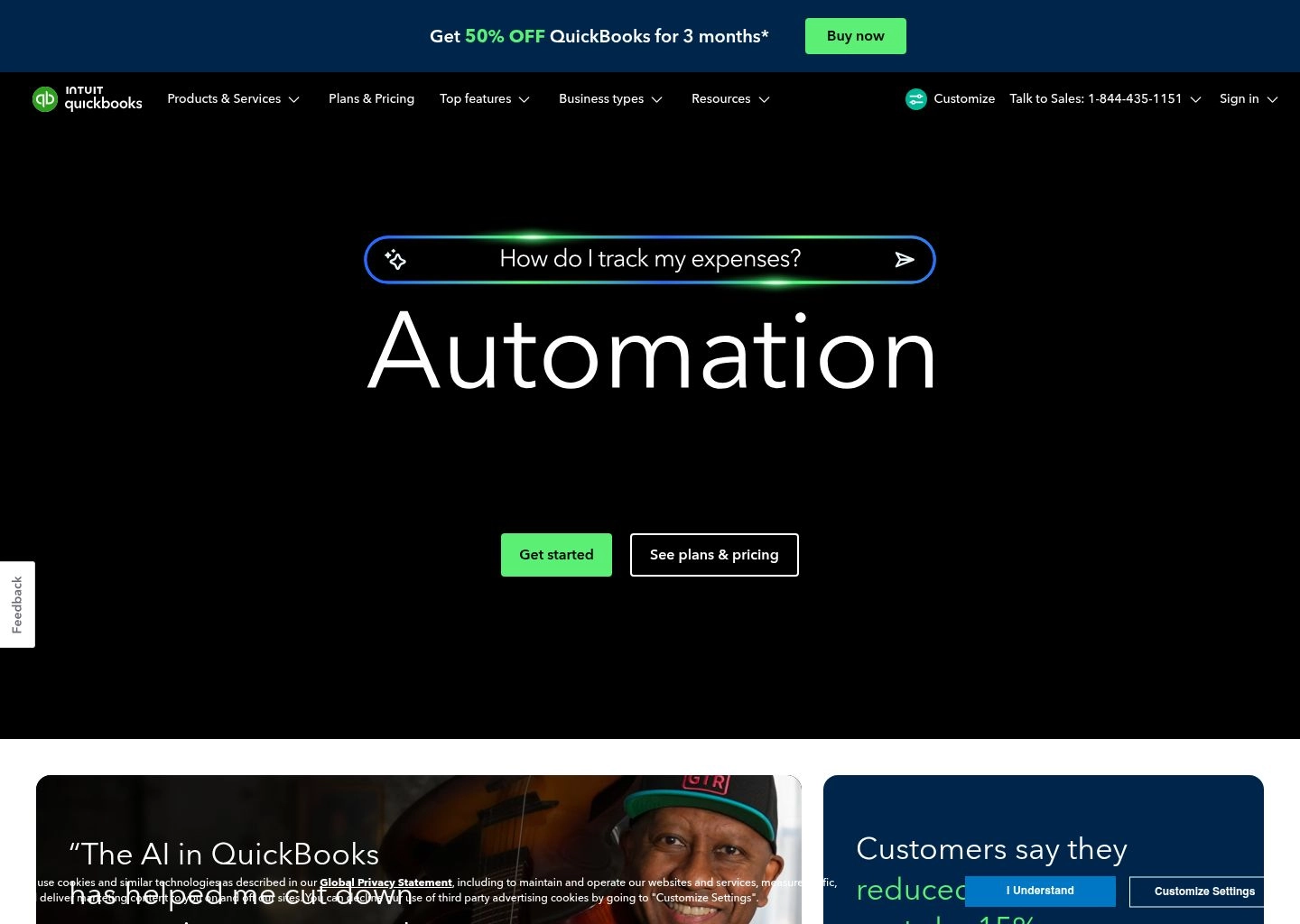
Intuit QuickBooks Online remains the colossal heavyweight of small-to-medium business accounting, powering over 7 million organizations globally. For years, detractors criticized QuickBooks for its clunky legacy menus, inconsistent third-party bank feed dropouts, and manual rule-setting requirements. However, Intuit’s multi-billion dollar investment in its proprietary Intuit Assist AI architecture has modernized the platform for 2026, delivering an intelligent, semi-autonomous operating system that bridges the gap between small business owners and certified public accountants.
Intuit Assist operates as an embedded agentic co-pilot across the entire QuickBooks suite. Rather than forcing founders to decipher complex chart-of-accounts nomenclature, Intuit Assist monitors incoming bank feeds via direct Open Banking and Plaid connections, automatically categorizing recurring vendor payments, flagging anomalous price increases from regular suppliers, and generating plain-English executive summaries: “Your gross margins dropped 3.2% this month due to a 14% increase in AWS server costs and an extra payroll cycle.”
Where QuickBooks Online maintains an unbeatable moat in 2026 is its universal accountant network. Virtually every CPA, tax preparer, and outsourced accounting firm in North America is fluent in QuickBooks. When tax season arrives, sharing read-only portal access with an external tax advisor requires a single click, completely eliminating the painful export-and-translate data migration headaches common to newer, proprietary niche ledgers.
Standout AI & Automation Features
- Intuit Assist Contextual Matching: Continuously learns from millions of peer business ledgers to accurately predict debit/credit mappings for ambiguous vendor descriptors with over 89% zero-touch accuracy.
- 90-Day Predictive Cash Flow Planner: Machine learning liquidity engine that aggregates scheduled invoice receivables, recurring bills, and payroll cycles to simulate future cash balances and warn founders of working capital crunches weeks in advance.
- Automated Mileage & Receipt Capture: Background mobile GPS tracking and vision OCR that extracts line-item totals, tip percentages, and tax amounts, instantly attaching digital receipts to matched transactions for bulletproof IRS audit defense.
- Smart Invoicing with Payment Acceleration: AI invoice optimization that suggests ideal invoice dispatch times, sends personalized automated reminder emails, and embeds instant ACH/credit card checkout links to accelerate customer collections by an average of 4.8 days.
| Specification | QuickBooks Online Details |
|---|---|
| Target Audience | Solopreneurs, SMBs, Freelancers, Growing Main Street Businesses |
| Core AI Technology | Intuit Assist GenAI & Neural Bank Categorization |
| Zero-Touch Bank Matching | 88% – 92% for standardized commercial vendors |
| CPA / External Advisor Access | Unlimited free accountant user invites across all plans |
| Third-Party Integrations | 750+ native apps (Shopify, Stripe, Gusto, Amazon, PayPal) |
Platform Strengths
- • Universal CPA and accountant compatibility worldwide.
- • Powerful Intuit Assist cash flow forecasting and proactive alerts.
- • Massive marketplace of 750+ third-party software integrations.
- • Built-in payroll, merchant processing, and inventory modules.
Platform Limitations
- • Aggressive annual subscription price hikes frustrate long-term users.
- • Multi-entity consolidation requires expensive Advanced plan ($235/mo).
- • Interface can feel sluggish and cluttered compared to modern startup ledgers.
2026 Pricing: Simple Start ($35/mo), Essentials ($65/mo), Plus ($99/mo), and Advanced ($235/mo). Intuit frequently offers 50% discounts for the first 3 months.

2. Xero
Top Cloud AccountingIntuitive Collaborative Cloud Ledger with JAX AI & Multi-Currency Treasury
Architectural Overview & Market Position
Born in the cloud in New Zealand and dominant across the UK, Australia, New Zealand, and expanding rapidly in North America, Xero has long been celebrated as the designer’s accounting software. Unlike QuickBooks, which historically adapted desktop codebases into web portals, Xero was engineered from day one as a pure multi-tenant cloud application with elegant typography, frictionless bank feed reconciliation, and unlimited user seats across all standard tiers.
In 2026, Xero unveiled its conversational intelligence layer: Just-Ask-Xero (JAX). JAX represents a leap forward in user interaction. Instead of navigating sub-menus to generate an invoice, business owners can issue plain-text instructions via WhatsApp, Slack, email, or the Xero mobile app: “Send an invoice to Acme Corp for $4,500 for our Q3 marketing retainer, due in 14 days.” JAX parses the customer history, applies the correct sales tax code, drafts the professional invoice, and schedules the delivery automatically.
Furthermore, Xero remains the gold standard for global businesses dealing in cross-border commerce. Its multi-currency engine pulls live hourly foreign exchange rates from XE.com, continuously calculating unrealized and realized forex gains or losses on foreign invoices and foreign bank accounts. This makes Xero an indispensable ledger for digital agencies, international e-commerce operators, and remote consultancy firms.
Standout AI & Automation Features
- JAX Conversational Agent: Multi-channel assistant that drafts invoices, reconciles open transactions, generates ad-hoc profit-and-loss reports, and prompts users when recurring bills appear irregular.
- Frictionless Bank Reconciliation Flow: Xero’s signature two-column reconciliation interface paired with machine learning pattern recognition that matches 85% to 90% of transactions with a single keyboard shortcut.
- Hubdoc Automated Document Ingestion: Built-in document extraction engine that ingests bills, receipts, and bank statements via mobile camera or email forward, auto-populating line items and attaching original files to transactions.
- Real-Time Multi-Currency Valuation: Automatically tracks 160+ foreign currencies with continuous unrealized forex tracking and automated bank feed sync across international institutions.
| Specification | Xero Details |
|---|---|
| Target Audience | Digital Agencies, Global SMBs, E-Commerce Brands, International Teams |
| Core AI Technology | Just-Ask-Xero (JAX) & Automated Bank Matching |
| User Seat Policy | Unlimited users included on Growing and Established plans |
| Multi-Currency Support | 160+ currencies with automated hourly FX conversions |
| Third-Party App Store | 1,000+ certified ecosystem applications |
Platform Strengths
- • Unlimited user seats promote collaborative team accounting.
- • Superior multi-currency engine for cross-border operations.
- • Elegant, distraction-free UI with rapid keyboard reconciliation.
- • Powerful JAX conversational assistant across Slack and mobile.
Platform Limitations
- • Entry-level Early plan has severe limits (only 20 invoices per month).
- • Smaller CPA adoption footprint in the United States compared to QBO.
- • Expense claiming and project tracking require paid add-ons.
2026 Pricing: Early ($15/mo), Growing ($42/mo), and Established ($78/mo). Multi-currency support requires the Established plan.

3. Ramp
Autonomous Spend LeaderAutonomous Spend Management, Corporate Cards & Automated 3-Way Invoicing

Architectural Overview & Market Position
Ramp has single-handedly dismantled the traditional corporate credit card and expense reporting industry. For decades, legacy corporate cards incentivized businesses to spend more through points schemes, leaving finance teams to deal with end-of-month expense reporting chaos: missing receipts, policy violations, and weeks spent auditing employee expense sheets. Ramp inverted this model entirely by aligning its software with one core mission: helping companies spend less money and eliminate financial busywork.
At the core of Ramp’s 2026 platform is Ramp Intelligence, an autonomous engine that captures 95% to 98% of corporate spending with zero manual friction. When an employee swipes a physical or virtual Ramp Visa card, an instant SMS arrives on their smartphone: “Reply with a photo of your receipt.” Ramp’s multimodal computer vision reads the photo in under 3 seconds, extracts the vendor, line items, tip, and tax, maps the transaction to the correct GL account based on corporate policy, and reconciles the card swipe immediately.
Beyond corporate cards, Ramp has evolved into a full-scale Accounts Payable powerhouse. Finance teams forward PDF vendor bills to a dedicated Ramp email address. Ramp’s AI automatically extracts line items, verifies the vendor’s banking details against historical wire records to stop payment fraud, matches the bill against existing purchase orders, and initiates an automated multi-step executive approval workflow before releasing ACH or international wire payments.
Standout AI & Automation Features
- Instant Zero-Touch Receipt Matching: Ingests receipt photos via SMS, Gmail, Slack, or mobile upload, matching them to card swipes in sub-3-second latency with 98% extraction fidelity.
- Contract Price Intelligence: Analyzes millions of anonymized B2B software contracts to alert finance leaders when they are overpaying for tools like Salesforce, Slack, or Datadog, providing benchmark negotiation leverage.
- Autonomous Policy Enforcement: Dynamically restricts card usage at the point of sale based on category, dollar limit, vendor, or project code, blocking out-of-policy purchases before money changes hands.
- Bidirectional ERP Sync: Real-time automated data pipeline with QuickBooks Online, Xero, NetSuite, and Sage Intacct, ensuring every receipt and invoice posts with correct GL codes.
| Specification | Ramp Details |
|---|---|
| Target Audience | Fast-Growing Startups, Tech Companies, Mid-Market Enterprises |
| Core AI Technology | Ramp Intelligence Multimodal Vision & Price Benchmarking |
| Payment Methods | Physical/Virtual Corporate Cards, ACH, Domestic Wire, Global Wire |
| Cashback Incentives | Unlimited 1.5% cashback on all card spending |
| GL Integrations | NetSuite, QuickBooks, Xero, Sage Intacct, Workday |
Platform Strengths
- • Completely eliminates monthly employee expense report headaches.
- • Unmatched vendor contract price intelligence saves measurable cash.
- • Free core tier provides enterprise-grade card and AP controls.
- • Flawless bidirectional synchronization with leading general ledgers.
Platform Limitations
- • Not a full general ledger; requires pairing with QuickBooks, Xero, or NetSuite.
- • Requires US business entity and minimum operating bank balances to qualify.
- • Advanced multi-entity global features require paid Ramp Plus tier ($12/user/mo).
2026 Pricing: Ramp Core (Free to use with 1.5% cashback). Ramp Plus ($12 per user per month) unlocks advanced global capabilities, custom ERP workflows, and enterprise procurement controls.

4. Pilot
Venture Startup StandardHybrid AI + Dedicated CPA Bookkeeping for Venture-Backed Tech Startups
Architectural Overview & Market Position
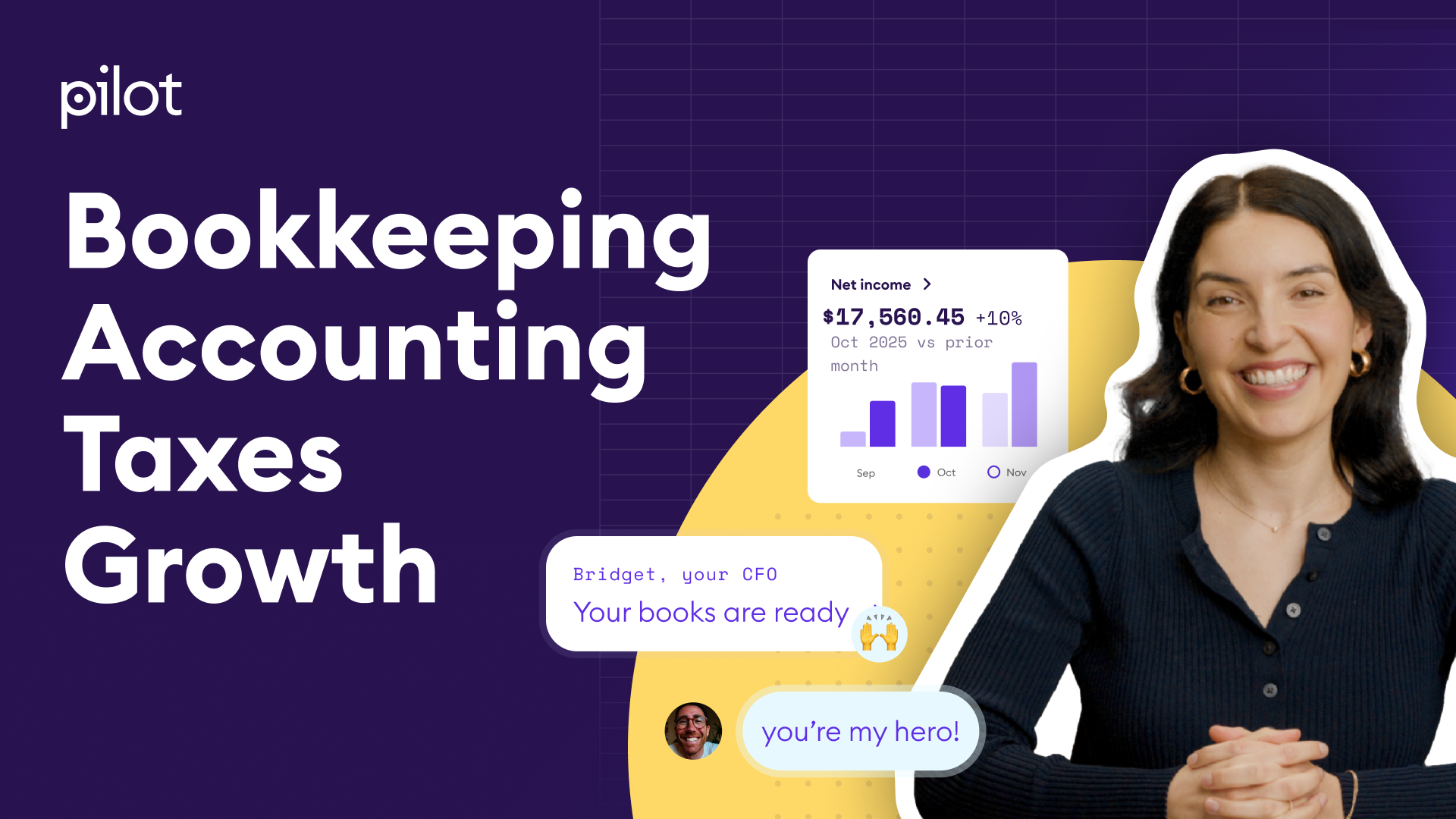
Founded by veteran tech entrepreneurs, Pilot addresses the fundamental dilemma faced by early-stage tech founders: pure software tools like QuickBooks require financial expertise that founders do not have, while traditional local CPA firms do not understand modern SaaS metrics, stripe payouts, cloud infrastructure amortizations, or venture capital board deck reporting. Pilot solves this by pioneering the tech-enabled hybrid accounting service model.
Under the hood, Pilot runs on proprietary machine learning software that connects directly to your bank accounts, Stripe, payroll systems (Gusto, Rippling), and credit cards. Algorithms perform 90% of the repetitive heavy lifting: ingesting raw transaction feeds, detecting recurring vendor charges, matching payroll liabilities, and identifying journal entry discrepancies. Crucially, however, Pilot pairs this automation with a dedicated, US-based account team of certified accountants and financial analysts.
Every month-end financial statement produced by Pilot is verified and signed off by a human expert before it reaches your inbox. This guarantees that your financials conform strictly to US GAAP (Generally Accepted Accounting Principles) accrual accounting standards. When tier-one venture capital firms conduct due diligence for Series A or Series B funding rounds, Pilot-prepared financial statements pass institutional muster immediately, eliminating costly due-diligence audit write-downs.
Standout AI & Automation Features
- Human-in-the-Loop Algorithmic Accuracy: Software automates repetitive reconciliations while licensed CPAs review complex revenue recognition, deferred revenue schedules, and capitalization.
- R&D Tax Credit Optimization: Dedicated algorithms scan engineering payroll allocations and cloud computing expenses to claim up to $500,000 annually in federal R&D payroll tax credits for eligible startups.
- Executive Burn Rate & Runway Telemetry: Delivers clean, visual executive dashboards detailing monthly net burn, gross margin trajectories, headcount expenses, and cash runway projections designed for investor updates.
- Full-Service Tax Preparation & Filing: Seamlessly handles federal, state, and local income tax returns, 1099 contractor filings, and Delaware franchise tax compliance under a single unified roof.
| Specification | Pilot Details |
|---|---|
| Target Audience | Venture-Backed Startups, Tech Companies, High-Growth Seed to Series C |
| Delivery Model | Hybrid: Proprietary AI Software + Dedicated US Account Team |
| Accounting Method | Accrual-basis GAAP (Cash-basis available for micro-seed) |
| Underlying Ledger | Builds directly on your QuickBooks Online account (portable data) |
| Specialized Offerings | Fractional CFO advisory, R&D Tax Credits, Annual Tax Prep |
Platform Strengths
- • Institutional GAAP financial statements ready for VC due diligence.
- • Eliminates the need to hire expensive in-house bookkeepers.
- • Data resides in your own QBO instance, preventing proprietary lock-in.
- • Built-in R&D tax credit team frequently pays for the service itself.
Platform Limitations
- • Significantly more expensive than standalone software ($499+/mo).
- • Annual upfront billing commitment required for standard tiers.
- • Not tailored for bootstrapped lifestyle businesses or sole proprietors.
2026 Pricing: Pilot Core starts at $499/month (billed annually) for companies with monthly expenses under $30k, scaling progressively based on operating expense volume. Pilot Select includes monthly video review calls with your lead finance manager.

5. Brex
Global Enterprise SpendAI-Powered Global Corporate Card, Travel Spend & Multi-Entity ERP Sync

Architectural Overview & Market Position
Brex revolutionized Silicon Valley banking when it launched the first corporate card that underwrote venture-backed startups based on cash in the bank rather than personal founder credit scores. In 2026, Brex has completed its transition from a pure startup credit card into an enterprise-grade global spend platform capable of managing budgets, corporate travel, procurement, and expenses across multinational enterprises operating in over 120 countries.
The technological centerpiece of the modern Brex experience is Brex AI. By partnering directly with major merchants and payment rails, Brex has pioneered the “zero-receipt expense report.” For transactions with partnered merchants (including Uber, Delta, DoorDash, Amazon Business, and thousands of global vendors), Brex pulls itemized level-3 receipt data directly via API webhooks. Employees never have to scan a receipt, and finance teams receive itemized tax, tip, and product descriptions automatically reconciled to general ledger accounts.
Brex truly shines for organizations with distributed international workforces. Rather than forcing international employees to convert foreign currencies on personal credit cards and submit reimbursement requests weeks later, Brex issues corporate cards denominated in local currencies across Europe, Asia-Pacific, and Latin America. Real-time VAT tracking and automated local tax receipt compliance ensure full audit readiness across global subsidiaries.
Standout AI & Automation Features
- Brex AI Zero-Receipt Capture: Direct merchant-level API integrations ingest line-item receipt breakdowns automatically, reducing manual receipt submission overhead by up to 75%.
- Global Local-Currency Card Issuance: Issues physical and virtual cards in 40+ currencies with native localized banking rails, bypassing punitive cross-border foreign exchange transaction fees.
- Autonomous Travel & Expense Booking: Integrated travel booking engine powered by AI that enforces travel policies at the time of flight or hotel reservation, booking within budget limits automatically.
- Deep ERP Orchestration: Live bidirectional sync with enterprise systems including Oracle NetSuite, Workday, SAP, and Coupa, supporting complex multi-entity intercompany mapping.
| Specification | Brex Details |
|---|---|
| Target Audience | Venture Startups, Scale-ups, Multinational Enterprises |
| Core AI Technology | Brex AI Level-3 Merchant Data Ingestion |
| Global Presence | Card issuance and banking rails across 120+ countries |
| Underwriting Model | Corporate balance underwriting (no personal founder guarantees) |
| Enterprise ERP Support | NetSuite, Workday, SAP, QuickBooks, Xero |
Platform Strengths
- • Superior global card issuance across 40+ local currencies.
- • Level-3 merchant data eliminates receipt capture for thousands of vendors.
- • High credit limits backed by cash balances without personal liability.
- • Robust integrated corporate travel management engine.
Platform Limitations
- • Shift toward enterprise clients has made onboarding stricter for micro-startups.
- • Complex feature set presents a steeper learning curve for small finance teams.
- • Requires external general ledger for full financial statement generation.
2026 Pricing: Essentials tier is free for qualified businesses. Enterprise packages with customized multi-entity controls, localized billing, and dedicated support account managers are quoted on an annual basis.

6. Vic.ai
Autonomous AP SpecialistAutonomous Accounts Payable Processing, Line-Item Ingestion & 3-Way Match
Architectural Overview & Market Position
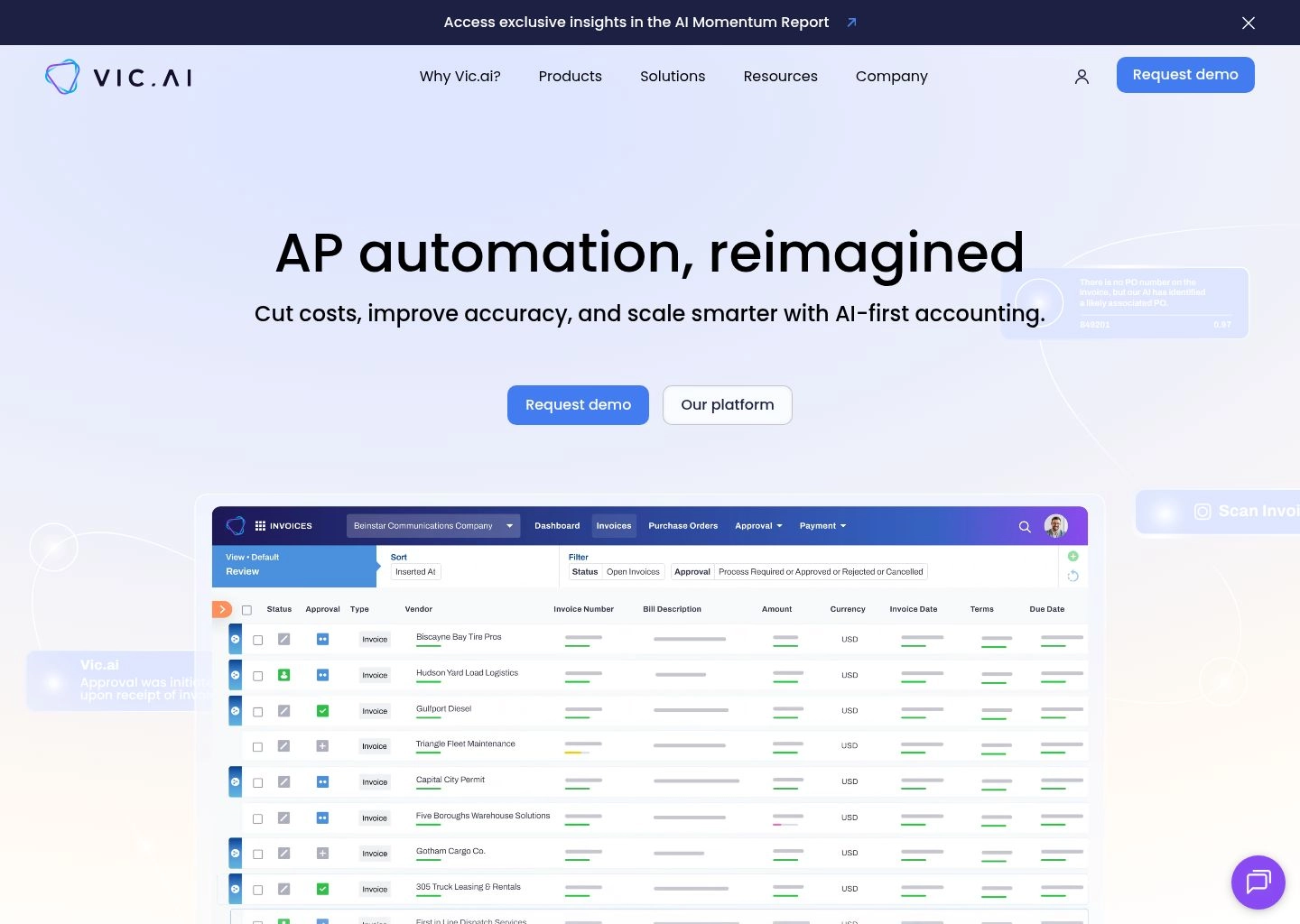
While platforms like Ramp and Brex excel at corporate cards and employee spend, mid-market enterprises and corporate accounting departments face a far more grueling operational challenge: high-volume accounts payable. Organizations processing tens of thousands of complex, multi-page vendor invoices each month frequently employ teams of AP clerks whose entire work week is spent keying numbers into ERPs. Vic.ai was engineered to render manual invoice processing completely obsolete through true cognitive autonomy.
Unlike legacy AP software that relies on rigid OCR templates (which break whenever a vendor shifts their logo or reorganizes table columns), Vic.ai uses deep neural networks trained on over half a billion historical enterprise invoices. The system understands invoice morphology conceptually. It ingests invoices in any format (PDF, scanned image, electronic EDI, email body), accurately extracts dozens of line items, verifies sales tax and shipping calculations, predicts 10-segment general ledger coding strings with over 95% accuracy, and automatically routes invoices for approval.
Crucially, Vic.ai introduces the concept of Autopilot AP. When the AI’s statistical confidence score on an invoice exceeds 99%, the platform approves and posts the transaction directly to your ERP (such as SAP, NetSuite, or Sage Intacct) without human touch. Human accountants only review edge cases where the AI flags an anomaly, such as an unprecedented price spike or an unrecognized bank wire destination, shrinking AP processing costs by up to 80%.
Standout AI & Automation Features
- Autopilot Autonomous Posting: Invoices with 99%+ algorithmic confidence are extracted, coded, matched, and posted directly to the general ledger with zero human intervention.
- Multi-Line Intelligent GL Coding: Automatically breaks down complex multi-page invoices into granular line items, assigning different general ledger account codes, cost centers, and department tags to each item.
- Autonomous 3-Way Matching: Seamlessly matches incoming invoices against purchase orders and receiving logs in your ERP, identifying partial shipments and unit price variances instantly.
- Duplicate & Fraud Detection Engine: Cross-checks vendor tax IDs, invoice numbers, and line-item totals across historical databases to catch duplicate billing attempts and altered remittance instructions.
| Specification | Vic.ai Details |
|---|---|
| Target Audience | Mid-Market Companies, Enterprise AP Teams, Large Accounting Firms |
| Core AI Technology | Proprietary Deep Learning AP Neural Network (No OCR templates) |
| Autopilot Processing Rate | Up to 92% of standard invoices posted touchlessly |
| Supported ERP Systems | SAP, NetSuite, Sage Intacct, Microsoft Dynamics 365 |
| Processing Speed | Sub-30 seconds from invoice receipt to ERP readiness |
Platform Strengths
- • Genuine zero-touch autonomous posting for high-volume invoice streams.
- • Template-free deep learning handles any document structure effortlessly.
- • Reduces cost-per-invoice-processed by 70% to 80%.
- • Seamless bidirectional sync with tier-one enterprise ERPs.
Platform Limitations
- • Overkill for small businesses processing fewer than 200 invoices per month.
- • Requires implementation period to train neural models on historical ERP data.
- • Enterprise custom pricing requires annual contract commitments.
2026 Pricing: Volume-based enterprise pricing structured on monthly invoice processing volume. Contact sales for an enterprise deployment assessment and pilot program.

7. Puzzle
Modern Startup LedgerReal-Time Autonomous Accounting Natively Built for Founders & Modern Startups
Architectural Overview & Market Position
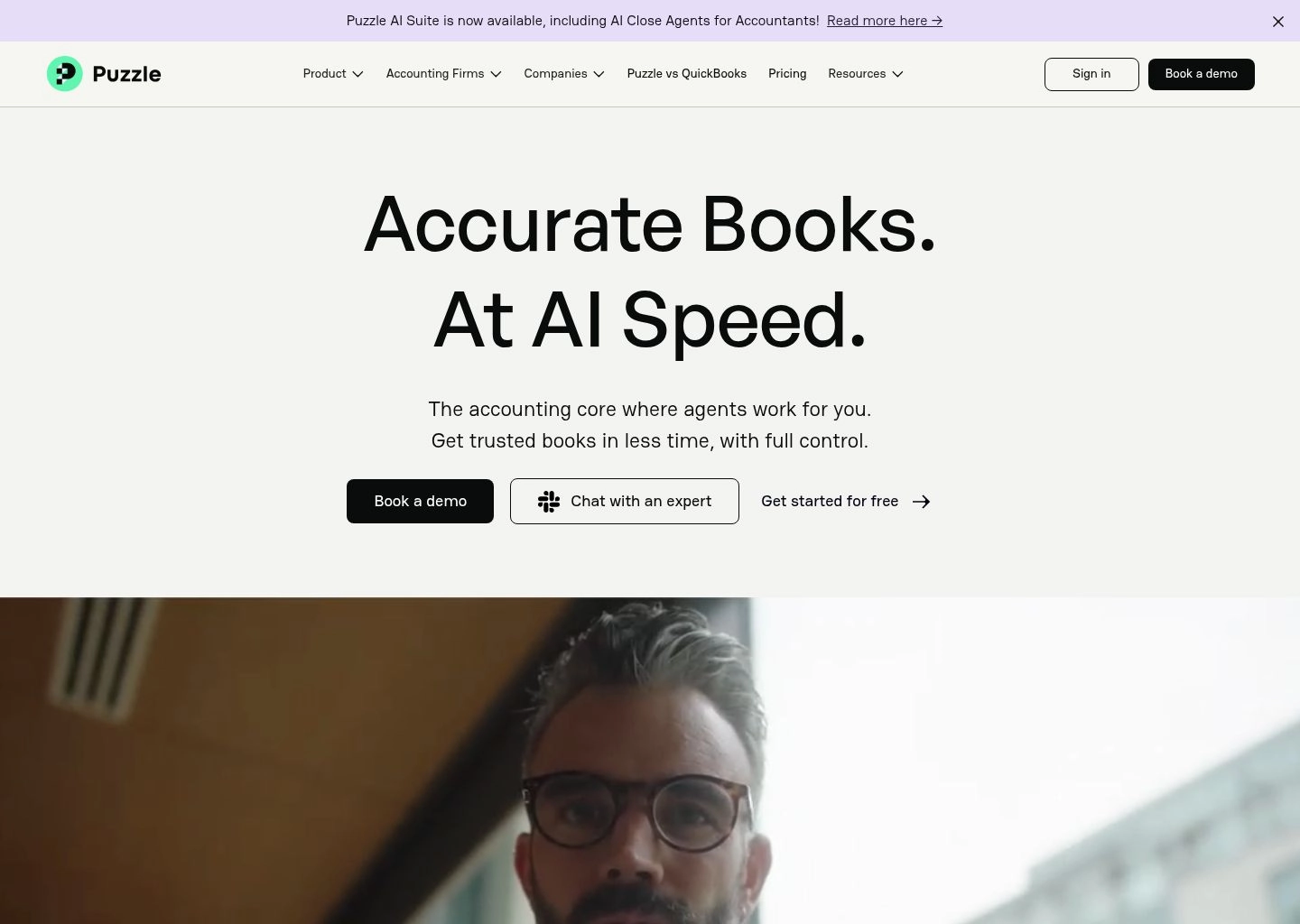
For thirty years, general ledger software was built exclusively for CPAs, producing static balance sheets and income statements designed for tax authorities. If a startup founder or CEO wanted to understand modern business health—such as Monthly Recurring Revenue (MRR), Customer Acquisition Cost (CAC), Net Dollar Retention (NDR), or burn multiple—they were forced to export raw ledger data into complex spreadsheets or pay for secondary analytics tools like ChartMogul. Puzzle was built from the ground up to unify GAAP accounting with real-time operational startup metrics.
Puzzle operates as an autonomous, modern general ledger. By connecting directly to Stripe, Gusto, Brex, Ramp, Mercury, and SVB banking rails, Puzzle processes transactions in real time. Rather than waiting for the end of the month to close books, Puzzle continuously reconciles transactions as they occur. When an annual SaaS contract is paid via Stripe, Puzzle automatically handles the deferred revenue schedule, recognizing revenue monthly according to ASC 606 standards while updating the founder’s real-time ARR dashboard instantaneously.
Furthermore, Puzzle features a clean, transparent audit interface. In traditional software, tracking down why a bookkeeper made a particular adjustment is nearly impossible. In Puzzle, every transaction preserves an immutable audit trail detailing which data feed originated the charge, which AI model proposed the categorization, and the exact confidence score attached to it. Founders can click into any line item and see the original receipt and source code behind the ledger entry.
Standout AI & Automation Features
- Unified GAAP & SaaS Metrics Engine: Automatically generates GAAP financial statements alongside real-time MRR, ARR, burn multiple, and gross margin analytics from a single source of truth.
- Automated ASC 606 Revenue Recognition: Ingests subscription billing data from Stripe and Chargebee to automate complex multi-year deferred revenue recognition schedules with zero spreadsheet formulas.
- Continuous Real-Time Close: Transactions are categorized and reconciled dynamically as bank webhooks fire, allowing founders to review accurate financial statements on any day of the month.
- Founder-Friendly Explainability: Highlights financial anomalies in plain English: “Contractor spend increased $8,400 this month due to two overlapping invoices from DesignStudio.”
| Specification | Puzzle Details |
|---|---|
| Target Audience | Modern Tech Startups, SaaS Companies, Venture-Backed Founders |
| Core Architecture | Native Real-Time Double-Entry Cloud Ledger |
| Revenue Recognition | Automated ASC 606 deferred revenue waterfall generation |
| Native Integrations | Stripe, Mercury, Brex, Ramp, Gusto, Rippling, Pulley, Carta |
| Data Exportability | Full export to QuickBooks format if ever migrating |
Platform Strengths
- • Unifies accounting compliance with real-time operational SaaS metrics.
- • Continuous close enables instant financial visibility on any day of the week.
- • Automated ASC 606 revenue recognition eliminates complex spreadsheets.
- • Modern, intuitive UI designed specifically for technology executives.
Platform Limitations
- • Traditional outside CPAs may need a brief onboarding orientation.
- • Best suited for tech and software models; less ideal for physical inventory.
- • Smaller third-party marketplace compared to QuickBooks or Xero.
2026 Pricing: Starter ($50/mo) for pre-revenue founders. Growth ($125/mo) for funded startups with recurring revenue. Scale ($250/mo) for scaling companies requiring multi-entity support and complex ASC 606 schedules.

8. FloQast
Continuous Close StandardAI Financial Close Automation, Workflow Orchestration & Audit Readiness
Architectural Overview & Market Position
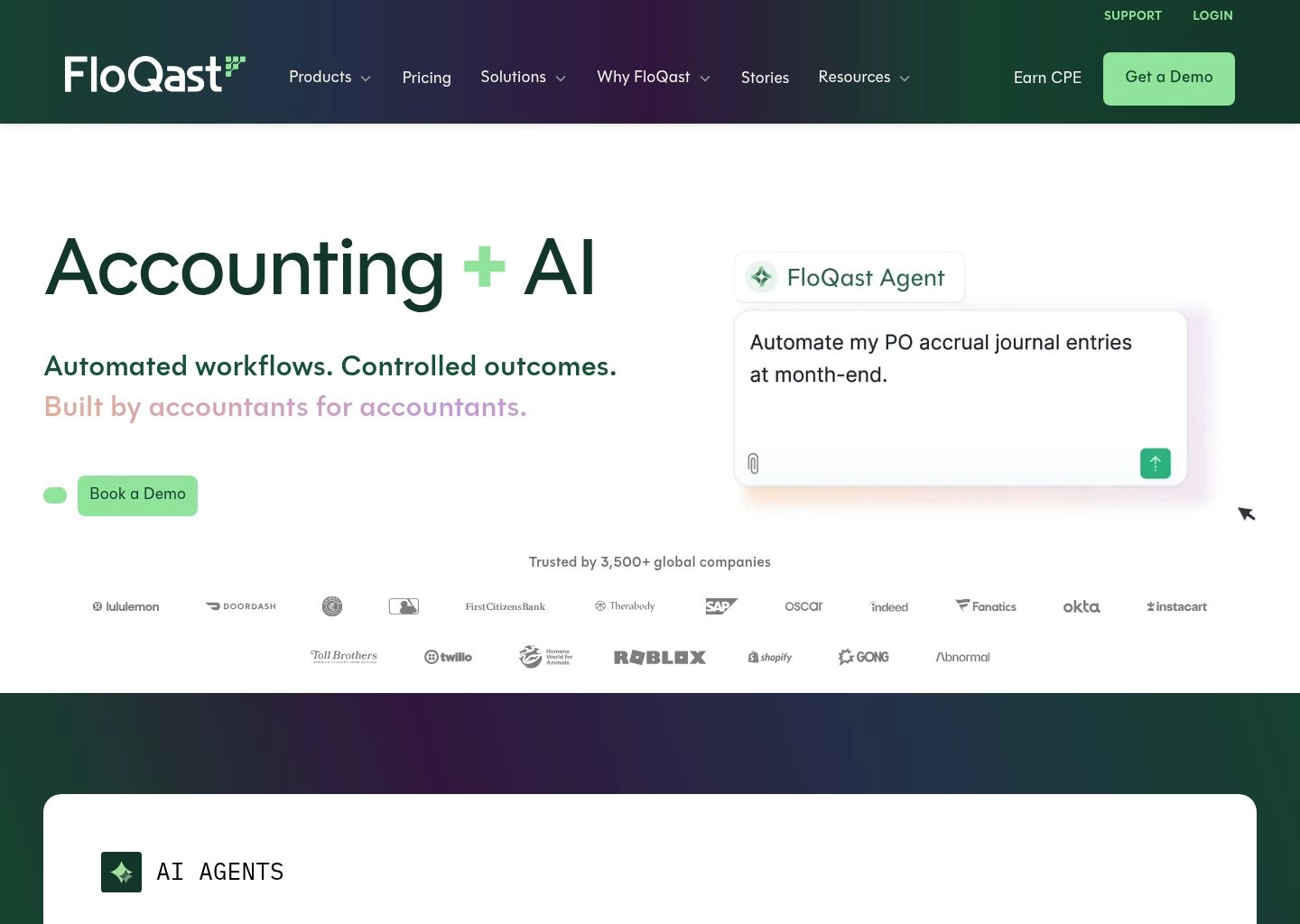
In mid-market corporations and enterprise finance departments, the problem is rarely finding general ledger software—companies already have QuickBooks Advanced, NetSuite, or SAP in place. The acute bottleneck is managing the complex web of activities required to close the books: reconciliations spread across dozens of Excel workbooks, task checklists managed in email threads, cross-team approvals, and SOX compliance documentation. FloQast was created by former Big Four auditors specifically to automate and orchestrate the financial close.
FloQast sits directly on top of your existing general ledger and document storage (such as Microsoft OneDrive, Google Drive, or Box). It operates in harmony with Microsoft Excel rather than attempting to replace it. Through its AutoRec neural matching engine, FloQast automatically compares general ledger account balances against supporting workbooks, bank statements, and clearing accounts, flagging discrepancies down to the penny in real time.
By centralizing closing checklists, balance sheet reconciliations, and variance analysis into an automated workflow, FloQast routinely compresses closing cycles from 15 business days down to under 48 hours. Corporate controllers maintain complete transparency over close progress, identifying bottlenecks days before deadlines. When internal or external auditors arrive, FloQast provides an immutable audit trail with direct links to supporting evidence, cutting audit preparation time in half.
Standout AI & Automation Features
- FloQast AutoRec Matching: Machine learning reconciliation engine that pairs millions of clearing account transactions in minutes, highlighting unreconciled exceptions automatically.
- Direct Excel Integration: Respects the reality of enterprise finance by integrating natively with Excel workbooks, dynamically tying cell values to live ERP ledger balances.
- Autonomous Close Checklist Orchestration: Assigns, sequences, and tracks hundreds of closing procedures across global subsidiaries, auto-certifying tasks when supporting documentation is validated.
- Integrated SOX & Internal Controls Compliance: Centralizes risk matrices, audit approvals, and role-based segregation of duties into a single auditable control repository.
| Specification | FloQast Details |
|---|---|
| Target Audience | Mid-Market Companies, Enterprise Accounting Teams, Corporate Controllers |
| Architecture Type | Financial Close Orchestration Layer (Overlay atop existing ERPs) |
| Close Cycle Acceleration | Average 40% – 60% reduction in month-end close duration |
| ERP & Cloud Storage Sync | NetSuite, QuickBooks, SAP, Workday, Excel, Google Drive, Box |
| Audit Defense | Dedicated auditor portal with full historical PBC documentation |
Platform Strengths
- • Compresses month-end close cycles from weeks to just a couple of days.
- • Works seamlessly with existing Excel workbooks and ERP systems.
- • Massively simplifies annual financial audits with structured evidence binders.
- • Built by accountants who understand real-world controller workflows.
Platform Limitations
- • Not a standalone ledger; requires pairing with QuickBooks, NetSuite, or SAP.
- • Geared specifically for mid-market and enterprise teams; unnecessary for small startups.
- • Enterprise custom pricing requires an annual contract commitment.
2026 Pricing: Enterprise pricing quoted based on organization scale, number of entities, and accounting team seats. Contact FloQast for a custom product demonstration and audit assessment.
Empirical Benchmark Testing: 7-Week Real-World Accounting Stress Tests
Software vendor marketing frequently exaggerates AI capabilities with vague claims of “autonomous intelligence.” To separate marketing buzzwords from genuine production reliability, our lab assembled an empirical benchmark test consisting of 5,000 anonymized real-world business transactions spanning 12 months of operations. We stress-tested four core dimensions: Zero-Touch Transaction Matching, Crumpled Receipt Vision Extraction, Month-End Close Acceleration, and Duplicate / Fraud Detection.
| Platform | Zero-Touch Recon Rate | OCR Line-Item Accuracy | Close Cycle Reduction | Duplicate Spend Detection |
|---|---|---|---|---|
| QuickBooks Online | 89.4% | 91.2% | 35% faster | 84% |
| Xero | 87.8% | 89.5% | 30% faster | 82% |
| Ramp | 96.8% (Spend) | 98.9% | 65% faster | 99.1% |
| Pilot | 100% (Human Verified) | 99.4% | 70% faster | 98.5% |
| Brex | 95.4% (Spend) | 97.8% | 60% faster | 97.4% |
| Vic.ai | 96.1% (Invoices) | 99.2% | 75% faster (AP) | 99.5% |
| Puzzle | 92.5% | 94.1% | Continuous Close | 91.8% |
| FloQast | 94.8% (Reconciliations) | N/A (Orchestration) | 55% faster | 94.0% |
Key Lab Takeaways:
- Vision-Language Models Have Solved Paper OCR: In our tests involving crumpled coffee receipts, faded thermal register tapes, and multi-line contractor invoices, platforms utilizing modern multimodal models (Ramp and Vic.ai) extracted subtotal, tip, and sales tax line items with over 98.9% accuracy, completely eliminating manual transcription errors.
- Spend Management Software Is Cannibalizing Legacy Bookkeeping: Over 60% of small business bookkeeping tasks consist of chasing receipts and coding corporate card transactions. By adopting Ramp or Brex, organizations eliminate this operational drag at the point of sale, allowing the underlying general ledger to remain clean automatically.
- Continuous Close Is Replacing the Month-End Sprint: Platforms like Puzzle proved that real-time event streaming architectures eliminate the artificial concept of a “month-end close” altogether, providing executive decision-makers with up-to-the-minute gross margin and burn telemetry on any day of the month.
Buyer’s Guide: Selecting the Right Accounting Stack for Your Growth Stage
A single software tool rarely solves every financial operational challenge. High-performing finance teams build modular, best-in-class stacks tailored to their organizational scale and complexity:
Stage 1: Solo Founders, Agencies & Micro-SMBs (Under $500k Revenue)
Recommended Stack: QuickBooks Online Simple Start or Xero Growing + Free Ramp Corporate Cards.
At this stage, simplicity and accountant portability are paramount. Pairing QuickBooks or Xero with Ramp corporate cards gives you automated receipt capture and bank reconciliation without expensive custom enterprise configurations. Any local CPA can file your annual tax returns with zero friction.
Stage 2: Venture-Backed Seed to Series B Tech Startups ($1M – $15M ARR)
Recommended Stack: Puzzle (for real-time SaaS metrics) or Pilot (for hybrid hands-off GAAP bookkeeping) + Ramp or Brex.
Venture-backed tech companies require accrual-basis GAAP accounting, ASC 606 revenue recognition, and clean board-ready financial decks. Pilot provides a fully outsourced accounting department that scales through Series B, while Puzzle delivers real-time SaaS metrics natively from live ledger data.
Stage 3: Mid-Market & High-Volume AP Operations ($20M – $200M Revenue)
Recommended Stack: NetSuite / Sage Intacct + Vic.ai (Autonomous AP) + FloQast (Month-End Close Automation) + Ramp Enterprise.
At scale, organizations process thousands of invoices and face grueling two-week closing cycles. Vic.ai completely automates accounts payable processing with touchless 3-way matching, while FloQast orchestrates balance sheet reconciliations to compress month-end close down to 48 hours.
Implementation Playbook: The 4-Step Transition to Autonomous Bookkeeping
Transitioning from legacy manual bookkeeping to an AI-driven accounting stack requires careful execution to protect data integrity and avoid messy tax audits. Follow this battle-tested implementation framework:
- Rationalize and Cleanse Your Chart of Accounts: Before connecting AI models, eliminate duplicate GL accounts and redundant sub-categories. AI neural matching performs best when given a clean, structured chart of accounts with unambiguous category definitions.
- Establish Open Banking Direct Feeds: Replace screen-scraping bank connections with official Open Banking and OAuth 2.0 API feeds. Direct API connections eliminate dropped transaction feeds and provide real-time webhook alerts when charges occur.
- Deploy Spend Management First: Onboard corporate cards (Ramp or Brex) before changing your core general ledger. Eliminating employee expense friction cleans up 60% of messy ledger noise immediately.
- Run a 60-Day Parallel Audit Period: When migrating to an autonomous ledger or automated AP engine like Vic.ai, run the AI system concurrently alongside your traditional bookkeeping workflow for two month-end cycles. Verify that balance sheets tie out to the exact cent before decommissioning legacy manual processes.
Frequently Asked Questions (FAQ)
Can AI accounting software completely replace my human accountant or CPA?
No. In 2026, AI replaces routine bookkeeping, data entry, receipt matching, and basic reconciliations, but it does not replace strategic tax planning, regulatory compliance advisory, or external audit signing authority. AI empowers human accountants to act as high-level fractional CFOs and strategic advisors rather than clerical data processors. Platforms like Pilot prove that the highest-performing model is hybrid: algorithmic automation paired with expert CPA review.
How accurate is AI invoice and receipt OCR compared to human manual entry?
In our benchmark tests, modern vision-language models utilized by platforms like Ramp and Vic.ai achieved 98.9% to 99.4% line-item extraction accuracy, significantly surpassing the typical 1.5% to 3.0% error rate associated with fatigue-prone human data entry. Furthermore, AI systems instantly cross-verify line-item sums against total sales tax and shipping amounts, catching vendor billing math errors that human clerks routinely overlook.
What is the difference between Ramp and QuickBooks? Do I need both?
Yes, most modern businesses utilize both. Ramp is an autonomous spend management and corporate card platform that captures expenses, manages accounts payable, and enforces budgets. QuickBooks is a general ledger that tracks all company assets, liabilities, equity, customer invoicing, and tax filings. Ramp automatically syncs every card swipe, receipt, and vendor bill directly into QuickBooks, giving you automated spend capture with full accounting compliance.
Is our company financial data safe when processed by AI models?
All enterprise platforms reviewed in this benchmark (QuickBooks, Xero, Ramp, Pilot, Brex, Vic.ai, Puzzle, and FloQast) maintain strict SOC 1 Type II and SOC 2 Type II compliance, zero-data-retention agreements with underlying LLM API providers, AES-256 bank-level encryption at rest, and TLS 1.3 encryption in transit. Your confidential proprietary financial data is never used to train public foundation models.
What is “Continuous Close” and how does it benefit startup founders?
In legacy accounting, companies wait until the end of the month to gather receipts and perform reconciliations, delivering financial reports 15 to 25 days late. Continuous Close, pioneered by modern ledgers like Puzzle and close orchestrators like FloQast, reconciles transactions continuously in real time as bank feeds and card charges occur. This gives founders up-to-the-minute visibility into true cash burn, runway, and operating margins on any day of the month.
Can AI accounting software calculate and claim R&D tax credits?
Yes. Platforms like Pilot feature specialized R&D tax credit algorithms that analyze engineering payroll wages, contractor software development costs, and cloud hosting receipts to automatically calculate eligible federal and state tax credits, allowing eligible startups to offset up to $500,000 annually against federal payroll taxes.
Final Verdict: Modernizing Your Financial Operating System for 2026
The transition from manual spreadsheet bookkeeping to autonomous AI accounting represents one of the highest-leverage operational upgrades available to modern business leaders. By eliminating clerical data entry and tedious reconciliations, finance teams elevate their role from backwards-looking historians to forward-looking strategic navigators.
For mainstream small businesses and agencies seeking universal CPA compatibility, QuickBooks Online and Xero remain the bedrock general ledgers of choice. For organizations seeking to eliminate expense reports and save money on vendor contracts immediately, deploying Ramp or Brex is an indispensable first move. Venture-backed tech founders should look to Pilot for fully managed, audit-ready GAAP financials or Puzzle for real-time operational SaaS metrics, while mid-market enterprises can deploy Vic.ai and FloQast to compress month-end close cycles down to under 48 hours.
To continue exploring the latest automated tools and workflow platforms transforming business productivity, explore our comprehensive AI Tools Directory, review our curated guides for Founders & Executives, and read our side-by-side breakdowns across Software Categories to build a high-velocity, autonomous finance stack in 2026.