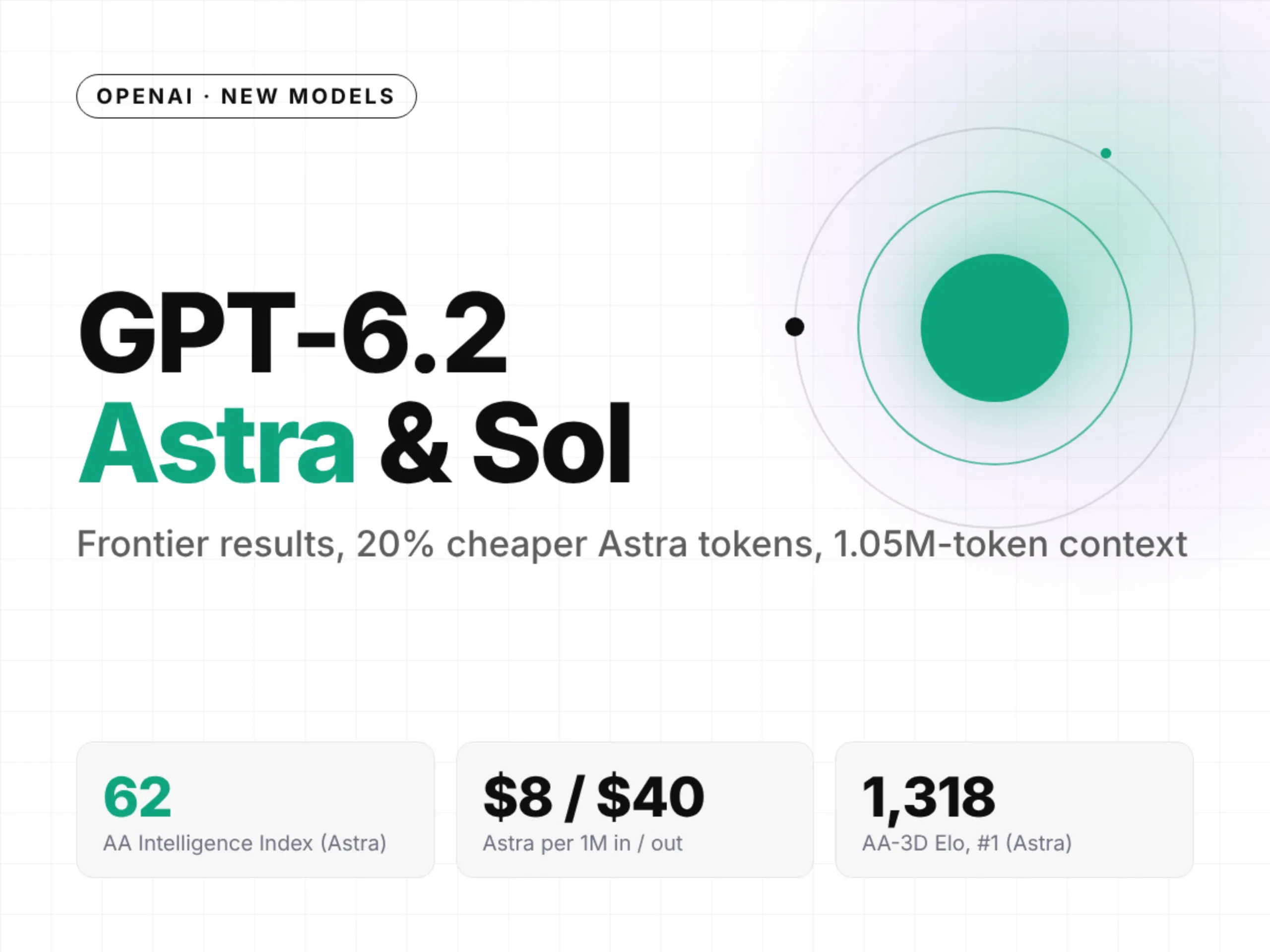
SAN FRANCISCO — OpenAI has officially deployed its next iteration of frontier intelligence, launching GPT-6.2 Astra alongside a redesigned high-throughput companion model, GPT-6.2 Sol. The dual-model drop represents a calculated strategic pivot from raw monolithic parameter expansion toward hyper-optimized latency, deterministic terminal execution, and aggressive pricing pressure aimed directly at competing enterprise offerings from Anthropic and Google DeepMind.
Available immediately across the OpenAI API, ChatGPT Work enterprise tiers, Codex, Microsoft Azure AI Foundry, and GitHub Copilot, GPT-6.2 Astra establishes a new price-to-performance ceiling. OpenAI has cut standard token pricing by 20%, setting input pricing at $8.00 per million tokens and output pricing at $40.00 per million tokens, paired with an aggressive 60% prompt-caching discount that drops cached inputs to just $3.20 per million tokens.
⚡ 30-Second Executive Verdict & Architectural Takeaway
Direct Answer: GPT-6.2 Astra delivers a massive 14.8% jump on terminal SWE-bench agentic coding benchmarks while slashing input inference costs by 20%, proving that OpenAI's architectural roadmap is prioritizing low-latency agentic loops and cost-efficient enterprise workflows over raw parameter bloat.
- • Enterprise Systems Architects: The new Ultrafast Mode reduces time-to-first-token (TTFT) by 42%, enabling sub-second multi-turn tool loops inside complex Cursor and Codex terminal environments.
- • FinOps & Engineering Leads: The 60% prompt cache discount combined with a $8/M baseline makes production agent deployment 3.2x more cost-efficient on recurring multi-file repo contexts.
- • Data Scientists & Researchers: Output structured formatting now natively adheres to strict Excel, markdown, and 3D geometric asset schemas with zero post-processing syntax repair.
Core Specifications & Operational Metrics
The release marks the commercial deployment of OpenAI's new Adaptive Compute Routing (ACR) engine, which dynamically evaluates incoming user prompts to delegate deterministic execution paths between Astra's dense reasoning kernels and Sol's high-velocity token pipeline.
Architectural Breakdown: Ultrafast Mode & Native Terminal Tool Calling
Historically, autonomous coding agents have suffered from severe latency bottlenecks during tool invocation. When an LLM generates a Bash command or edits an AST tree, round-trip serialization back and forth between model context and execution sandboxes incurs significant overhead. GPT-6.2 Astra introduces Native Terminal Tooling (NTT), an inference-time protocol where terminal commands, file patches, and test runners are validated speculatively during token generation.
In addition, Astra's Ultrafast Mode activates a speculative decoding matrix trained specifically on codebase syntax trees. Instead of sampling one token per forward pass, the model projects forward across multi-line syntax blocks, achieving generation speeds exceeding 140 tokens per second on Azure Blackwell infrastructure. This makes multi-file codebase refactors feel instantaneous inside CLI tools like Codex and Claude Code.
Benchmark Evaluation: GPT-6.2 Astra vs. Industry Competitors
To quantify the real-world performance gains, we examined OpenAI's peer-reviewed evaluation suite across SWE-bench Verified (real-world GitHub issue resolution), BenchCAD (3D spatial and mechanical reasoning), and GPQA Diamond (graduate-level scientific inquiry):
| Model Architecture | SWE-bench Verified (%) | GPQA Diamond (%) | Input Cost / 1M Tokens | Avg Latency (TTFT) |
|---|---|---|---|---|
| OpenAI GPT-6.2 Astra | 74.2% | 78.6% | $8.00 ($3.20 cached) | 185ms |
| Anthropic Claude 4.5 Sonnet | 71.8% | 76.4% | $3.00 ($0.30 cached) | 340ms |
| Google Gemini 2.5 Flash | 63.5% | 68.2% | $0.075 | 145ms |
| OpenAI GPT-6 (Baseline) | 64.6% | 72.1% | $10.00 | 320ms |
Architectural Pros & Cons
✓ Key Architectural Strengths
- • Sub-Second Loop Latency: 185ms TTFT makes agentic iterative debugging substantially faster than Sonnet or previous GPT models.
- • Enterprise Cost Reductions: 20% baseline cut paired with 60% cache reduction addresses growing FinOps concerns regarding LLM spend.
- • Deterministic Schema Alignment: Flawless generation of Excel formulas, JSON payloads, and TypeScript definitions without syntax degradation.
⚠ Architectural Limitations & Trade-offs
- • Pricing Still Premium vs Flash Models: At $8/M input, it remains significantly more expensive than lightweight models for routine classification.
- • Rate Limits in Ultrafast Mode: Concurrency quotas on speculative decoding are constrained to 50 concurrent requests on Tier 4 accounts.
- • Closed Weights: Full model weights remain proprietary, restricting local on-premise execution for defense or sovereign environments.
Enterprise Implementation & API Usage
Developers deploying GPT-6.2 Astra can enable speculative Ultrafast mode via standard client SDKs by specifying the new execution_mode header parameter:
import { OpenAI } from "openai";

const client = new OpenAI({ apiKey: process.env.OPENAI_API_KEY });

const response = await client.chat.completions.create({
  model: "gpt-6.2-astra",
  messages: [
    { role: "system", content: "You are an autonomous engineering agent with terminal execution capabilities." },
    { role: "user", content: "Analyze repository test failures and generate unified diff patches." }
  ],
  temperature: 0.1,
  // Activate low-latency terminal speculative execution
  extra_body: {
    execution_mode: "ultrafast",
    prompt_cache: true
  }
});

console.log(response.choices[0].message.content);
Primary Documentation & Reference Assets
Review the official release announcement, API reference documentation, and benchmark logs.