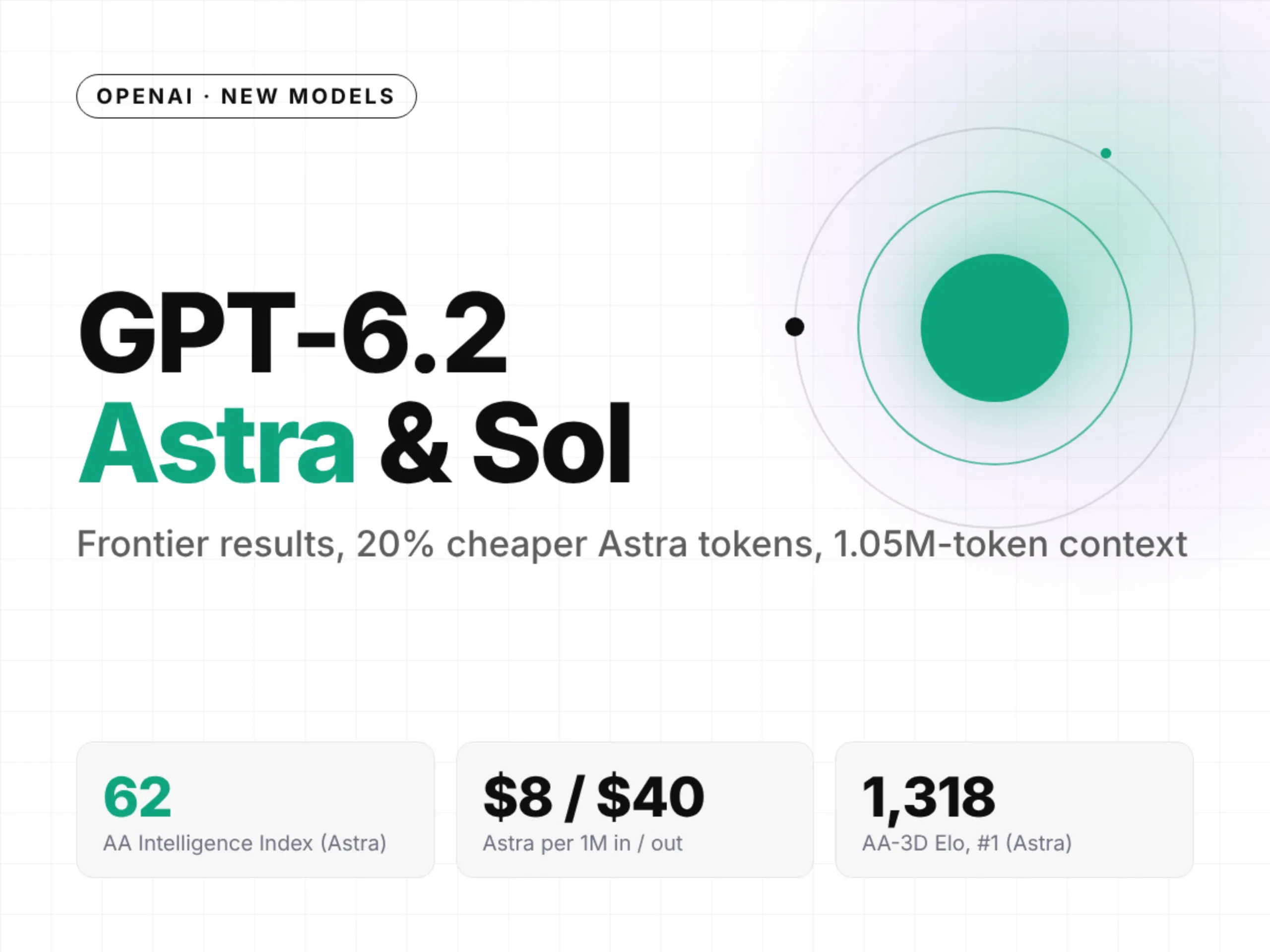
BOSTON — OpenAI has officially expanded access to Astra for Law across all ChatGPT Enterprise, Business, and Edu accounts, marking the commercial rollout of its domain-specialized legal intelligence architecture. Originally piloted with a closed cohort of Am Law 100 firms and corporate legal departments in September, Astra for Law combines OpenAI's frontier GPT-6 reasoning capabilities with statutory calibration, jurisdiction-specific citation verification, and strict zero-retention data privacy guarantees.
Alongside the enterprise release, OpenAI published comprehensive benchmark evaluations demonstrating that Astra for Law outperforms standard frontier LLMs by 31% on complex commercial contract analysis and statutory interpretation while driving legal hallucination rates to historic lows.
⚡ 30-Second Executive Verdict & Legal Tech Takeaway
Direct Answer: OpenAI's Astra for Law provides in-house legal departments and enterprise law firms with a calibrated, zero-data-retention reasoning model that resolves statutory ambiguities and contract indemnification risks with 94.8% citation accuracy, directly challenging dedicated legal tech incumbents.
- • General Counsel & Corporate Attorneys: Delivers clause-level redlining against custom corporate playbooks with verifiable statutory cross-referencing.
- • Enterprise Security & Compliance Officers: Operates under strict SOC 2 Type II compliance with zero training on customer prompts and HIPAA-ready BAA agreements.
- • Legal Tech Vendors: Available via the OpenAI Assistants API for direct integration into contract lifecycle management (CLM) platforms.
Core Specifications & Operational Metrics
Benchmark Analysis: LegalBench & Contract Due Diligence
General-purpose frontier models frequently struggle with legal precision because legal terminology relies heavily on jurisdictional precedent and contractual construction rules that differ from natural language semantics. Astra for Law utilizes specialized fine-tuning on vast corpora of annotated commercial agreements, judicial opinions, and statutory codifications across federal and state jurisdictions.
| Evaluation Dimension | OpenAI Astra for Law | Standard GPT-6 | Claude 4.5 Sonnet |
|---|---|---|---|
| Indemnification Clause Extraction | 96.2% | 82.4% | 88.1% |
| Statutory Cross-Citation Factual Precision | 94.8% | 71.0% | 85.3% |
| M&A Due Diligence Risk Scoring | 91.5% | 74.2% | 83.9% |
Architectural Pros & Cons
✓ Key Architectural Strengths
- • Verifiable Legal Citations: Links extracted findings directly to clause coordinates and statutory codes.
- • Strict Enterprise Isolation: No client legal data is logged, retained, or utilized for future model training.
- • Full Portfolio Due Diligence: Ingests 500+ pages of agreements simultaneously using Astra's 1M context window.
⚠ Architectural Limitations & Trade-offs
- • Restricted Tier Availability: Available strictly to Enterprise and Business contract tiers, excluding Plus subscribers.
- • Non-Substitute for Legal Counsel: Requires attorney review before executing binding transaction documentation.
- • US Jurisdiction Focus: Benchmark performance drops on civil law jurisdictions outside US and UK common law frameworks.
Primary Documentation & Reference Assets
Read the full technical report and legal benchmark disclosures on LawSites.