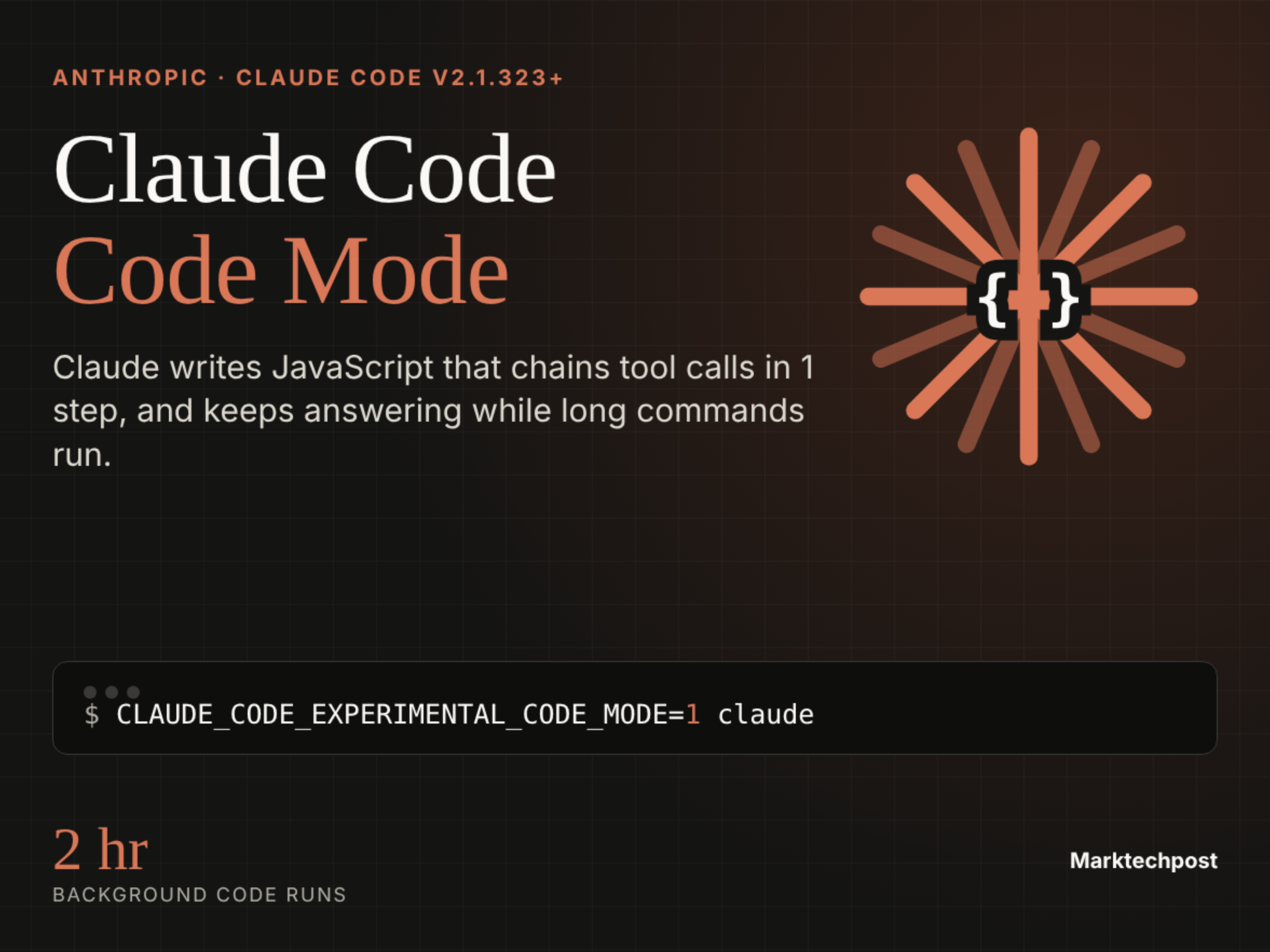
SAN FRANCISCO — In a major architectural leap for autonomous developer tooling, Anthropic has released a breakthrough feature dubbed Code Mode for its flagship terminal assistant, Claude Code. The update fundamentally restructures how the agent interacts with development environments, enabling Claude to chain multiple Model Context Protocol (MCP) tool calls, shell executions, and AST inspections within a single JavaScript execution loop rather than issuing serialized HTTP round-trips for every individual action.
By executing chained actions programmatically inside an in-memory Node.js virtual sandbox, Claude Code eliminates the crushing token and latency overhead that previously plagued multi-file refactoring, large-scale codebase migrations, and automated test suite remediation.
⚡ 30-Second Executive Verdict & Architectural Takeaway
Direct Answer: Anthropic's new Code Mode reduces multi-step agent latency by up to 65% and cuts token consumption by 48% by allowing Claude to write and execute programmatic JavaScript orchestrations that batch filesystem, git, and MCP calls into one atomic turn.
-
•
Software Engineers: Instead of waiting for Claude to run
git status, read 5 files, and run tests across 7 slow round-trips, the agent now executes the entire diagnostic loop in one unified JavaScript execution block. - • Platform & DevSecOps Teams: Execution occurs inside an ephemeral, resource-constrained sandbox that intercepts dangerous system calls and validates permissions before mutating disk assets.
- • Enterprise Integrators: Fully backwards-compatible with all existing Claude Model Context Protocol (MCP) servers with zero configuration changes required.
Core Specifications & Operational Metrics
Technical Deep Dive: Overcoming Serialized Tool Bottlenecks
Traditional agent architectures treat every tool invocation as an explicit dialogue turn: Model → Tool Call JSON → Client Execution → Tool Result → Model. On a task involving searching 20 files, grep filtering, editing 4 modules, and running tests, this back-and-forth pattern can easily generate 30+ separate context calls, consuming tens of thousands of tokens and taking several minutes.
In Code Mode, Claude synthesizes a single JavaScript script that directly imports exposed MCP tool methods as asynchronous native functions:
// Inside Claude Code's Isolated JS Sandbox
import { fs, git, bash, mcp } from "@anthropic/claude-code-runtime";

const modifiedFiles = await git.getModifiedFiles();
const lintFailures = [];

for (const file of modifiedFiles) {
  const content = await fs.readFile(file, "utf8");
  if (content.includes("deprecated_auth_token")) {
    const updated = content.replaceAll("deprecated_auth_token", "secure_vault_token");
    await fs.writeFile(file, updated);
    lintFailures.push(file);
  }
}

// Run unit tests inside the same execution block
const testResult = await bash.exec("npm test -- --bail");
return { patchedFiles: lintFailures, testsPassed: testResult.exitCode === 0 };
Only the final result object is returned to Claude's conversation context, filtering out megabytes of intermediate console stdout and file contents that would otherwise bloat the prompt cache and increase compute costs.
Architectural Pros & Cons
✓ Key Architectural Strengths
- • Dramatic Latency Collapse: Multi-turn tasks execute in seconds rather than minutes by running in-process.
- • Context Window Hygiene: Prevents conversational pollution by dropping intermediate file read outputs from model memory.
- • Complex Control Flow: Claude can use standard loops, conditionals, and error handling natively without prompting the user.
⚠ Architectural Limitations & Trade-offs
- • JavaScript Runtime Dependency: Requires Node.js 20+ installed in the local environment to run the execution sandbox.
- • Sandbox Escape Risks: Requires strict syscall auditing on enterprise networks to prevent accidental filesystem destruction.
- • Debugging Complexity: If a chained JavaScript script fails halfway through, partial disk mutations may require git stash rollbacks.
Primary Documentation & Reference Assets
Explore Anthropic's official Claude Code documentation and MCP specifications.