Direct Answer: Ant Group's inclusionAI team open-sourced LingSante-3.1-flash under a permissive MIT License in November 2026, shipping a 560B-parameter hybrid-linear Mixture-of-Experts clinical model (25B active parameters, 1M context) that beats GPT-6 Astra and Claude Opus 5.5 on HealthBench Professional (65.72) and EHR-Complex (74.40).
- →Architecture & License: MIT-licensed 560B-A25B MoE combining 63 KDA linear attention layers with 9 gated MLA layers (7:1 hybrid ratio) across a 1-million-token context window.
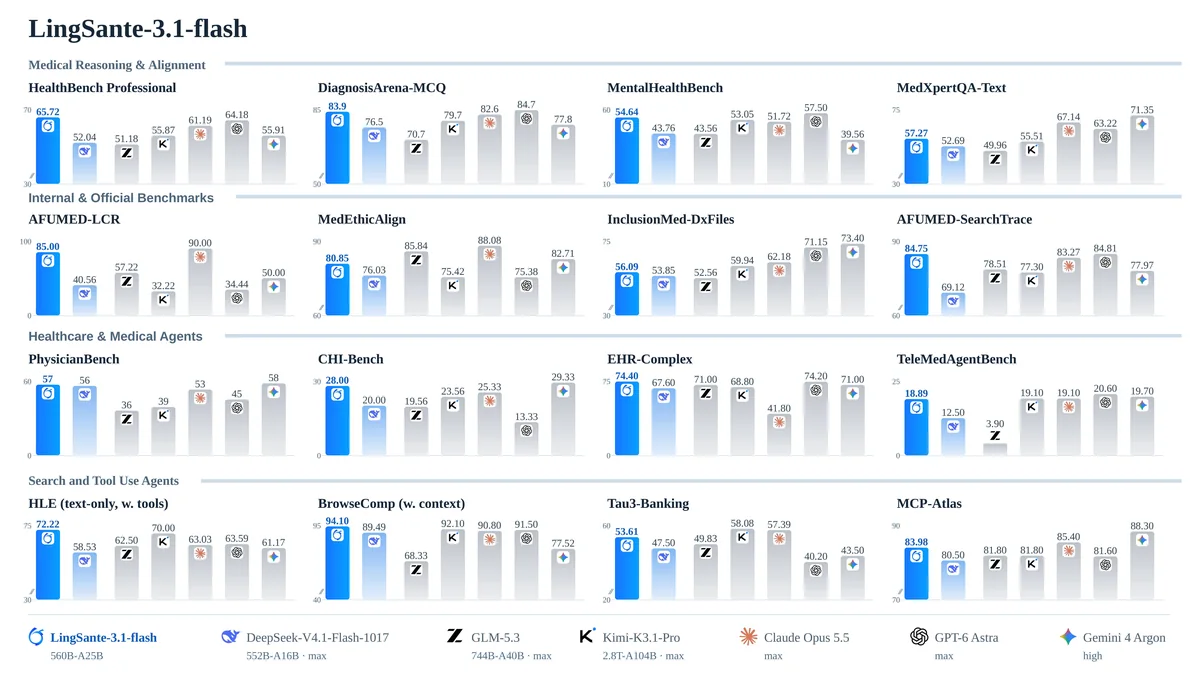
- →Clinical & Agentic Benchmarks: Leads all evaluated frontier models on HealthBench Professional (65.72), EHR-Complex (74.40), BrowseComp with context (94.10), and ranks #1 open-weight on InclusionMed (45.064).
- →Companion Ecosystem: Accompanied by the open MIT 124B-A5.5B multimodal LingSante-3.1-air-VL model plus three proprietary Afu production services (Pulse, MedGuard, Live).
- →Deployment Footprint: Ships on Hugging Face and ModelScope with native support for 8x H200 / 4x GB300 servers via SGLang or an official MXFP4 ~292 GiB quantized build.

Hugging Face
Open-Weight RepositoryOfficial open-weight distribution repository hosting inclusionAI/LingSante-3.1-flash and MIT-licensed weights.
HANGZHOU, China — Ant Group's medical AI research division, inclusionAI, has released the weights of LingSante-3.1-flash under a permissive MIT License on Hugging Face and ModelScope. Built upon operational data patterns from Ant Group's Afu consumer health platform—which reaches 150 million registered users and processes roughly 20 million medical consultations daily—the release brings frontier-level clinical reasoning into an openly auditable 560-billion-parameter model.
Unlike massive dense architectures that struggle under long electronic health record (EHR) workloads, LingSante-3.1-flash activates roughly 25 billion parameters per token through a 512-expert Top-8 routing fabric (plus one shared expert) inside a native 1-million-token context window. Alongside the flagship model, inclusionAI released an open MIT multimodal sibling, LingSante-3.1-air-VL (124B total parameters, 5.5B active, 256K context), while keeping three clinical safety and real-time systems—Pulse, MedGuard, and Live—proprietary inside Afu.
7:1 Hybrid-Linear Attention and Contribution-Aware Joint RL
Long-horizon clinical chart review breaks standard quadratic self-attention quickly because longitudinal inpatient records routinely span hundreds of thousands of tokens of lab panels, imaging summaries, medication histories, and clinical progress notes. To sustain 1M-token patient histories without prohibitive KV-cache bandwidth bottlenecks, LingSante-3.1-flash pairs 63 Kimi Delta Attention (KDA) linear-complexity layers with 9 gated Multi-head Latent Attention (MLA) layers in a 7:1 alternating schedule, supported by a 4,096 hidden dimension, 64 attention heads, and a 157,184-token vocabulary.
Structuring the Mixture-of-Experts bank around 512 fine-grained routed experts plus a single dedicated shared expert under Top-8 token routing keeps compute overhead capped near 25B active parameters while preserving deep clinical capacity across rare sub-specialties. Ant Group's training recipe advances systematically through domain pretraining, long-context mid-training, supervised fine-tuning (SFT), and Contribution-aware Joint RL paired with multi-teacher on-policy distillation. Ant Group researchers report that rewarding diagnostic utility per evidence retrieval step cut agentic search trajectories by more than 20% while reaching 99.62% physician agreement on the reinforcement reward signal across clinical evaluation traces.
| Benchmark | LingSante-3.1-flash (560B-A25B) | GPT-6 Astra | Claude Opus 5.5 | Gemini 4 Argon | DeepSeek-V4.1-Flash |
|---|---|---|---|---|---|
| HealthBench Professional | 65.72 | 64.18 | 61.19 | 55.91 | 52.04 |
| EHR-Complex | 74.40 | 74.20 | 41.80 | 71.00 | 67.60 |
| BrowseComp (w. context) | 94.10 | 91.50 | 90.80 | 77.52 | 89.49 |
| HLE (text+tools) | 72.22 / 74.87* | 63.59 | 63.03 | 61.17 | 58.53 |
| InclusionMed Overall | 45.064 (#1 Open) | 45.1 | 48.9 | 49.1 | — |
| MedQA-USMLE | 94.50 | 97.33 | 97.25 | 97.33 | 95.13 |
| Terminal-Bench 4.0 | 26.5 | 59.1 | 59.6 | 57.1 | 33.8 |
Specialist Strengths vs. General Terminal-Coding Trade-Offs
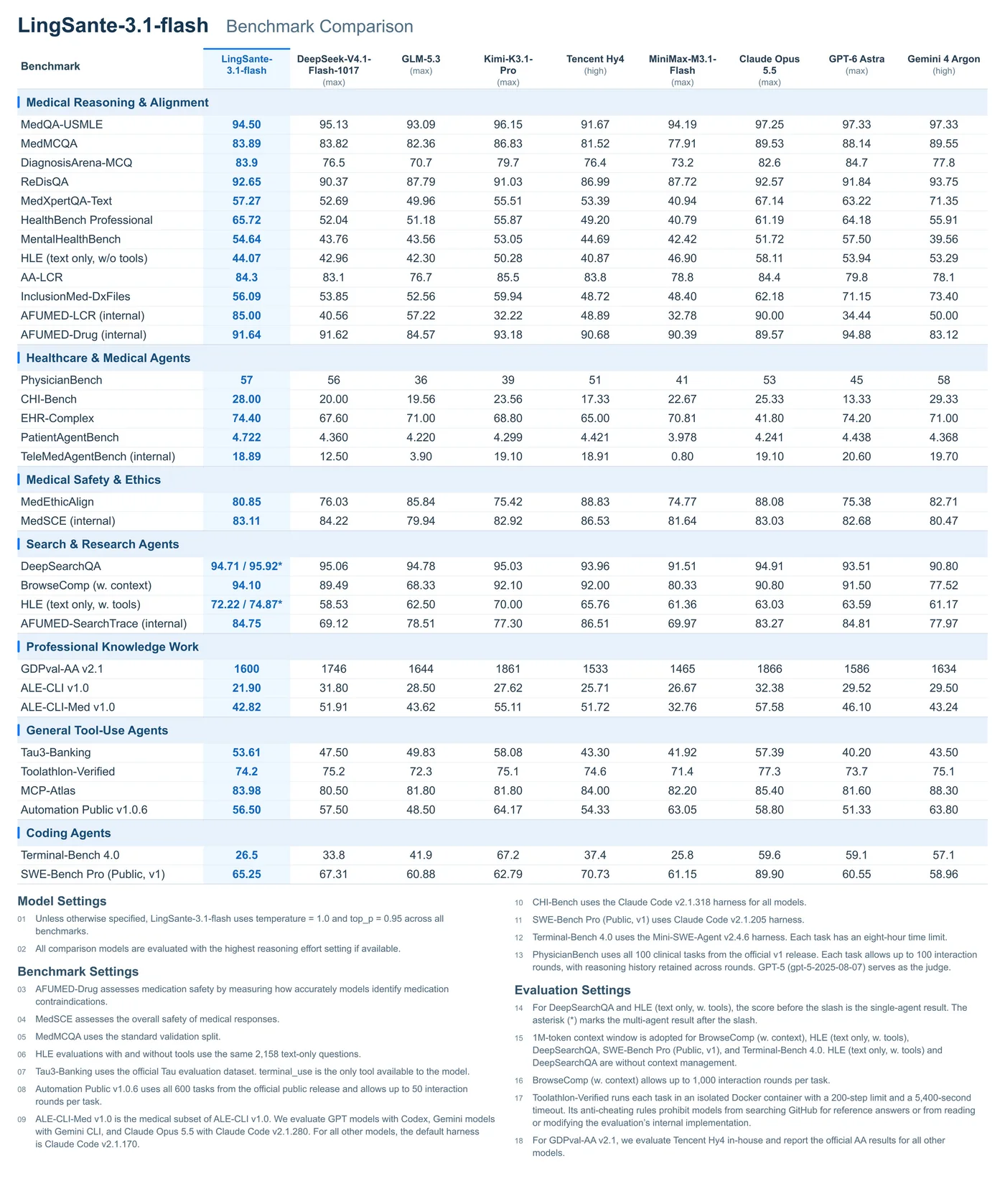
The published evaluation table reveals an unusually sharp domain specialization curve. On HealthBench Professional (65.72), EHR-Complex (74.40), BrowseComp with context (94.10), and tool-augmented Humanity's Last Exam (72.22 single-agent, 74.87 multi-agent), LingSante-3.1-flash leads every proprietary and open-weight competitor tested—outscoring Claude Opus 5.5 by over 32 points on EHR-Complex and surpassing Kimi-K3.1-Pro (92.10) on long-context browsing.
However, on classic multiple-choice board exams such as MedQA-USMLE (94.50 vs. 97.33 for GPT-6 Astra and Gemini 4 Argon) and InclusionMed-DxFiles multimodal diagnosis (56.09), proprietary frontier models retain a clear margin, placing LingSante fifth overall and first among open models on InclusionMed (45.064). Even more notably, specialist clinical distillation coincides with a sharp drop on general CLI engineering: LingSante-3.1-flash scores just 26.5 on Terminal-Bench 4.0, trailing Opus 5.5 (59.6) and Kimi-K3.1-Pro (67.2) by more than 30 points.
# Official SGLang container on 8x NVIDIA H200 or 4x GB300 (TP8 / EP8)
docker run --gpus all --shm-size 64g -p 30000:30000 \
  lmsysorg/sglang:dev-ling-3.1-flash \
  python3 -m sglang.launch_server \
  --model-path inclusionAI/LingSante-3.1-flash \
  --tp 8 --ep 8 --port 30000

# Supported vLLM runtime flags include 3-token MTP + ling3 reasoning parser
# (MXFP4 quantization shrinks GPU memory footprint to ~292 GiB)
Inference Hardware and Clinical Regulatory Boundaries
Enterprises intending to self-host LingSante-3.1-flash face serious compute requirements despite sparse 25B activation. Full-precision weights demand an 8x NVIDIA H200 node or a 4x GB300 system using Tensor Parallelism 8 and Expert Parallelism 8 under SGLang (lmsysorg/sglang:dev-ling-3.1-flash) or vLLM with 3-token Multi-Token Prediction (ling3 parser). Teams constrained on VRAM can deploy an official MXFP4 quantized build reducing static weight memory to approximately 292 GiB.
Just as critical, inclusionAI explicitly restricts the MIT-licensed model card to research, clinical-informatics evaluation, and assistive benchmarking—prohibiting unvalidated autonomous patient diagnosis or direct medical prescribing outside regulated clinical supervision.
Strengths of LingSante-3.1-flash
- +MIT License grants unrestricted commercial research, local auditing, and zero-royalty hospital-sandbox deployment.
- +Ranks #1 across all evaluated models on HealthBench Professional (65.72), EHR-Complex (74.40), and BrowseComp (94.10).
- +7:1 hybrid KDA linear and gated MLA architecture enables 1M-token medical record synthesis at 25B active parameters.
- +Official SGLang container, vLLM 3-token MTP support, and ~292 GiB MXFP4 quantization simplify cluster Bring-Up.
Deployment & Capability Limitations
- −560B total weights still require 8x H200, 4x GB300, or a ~292 GiB quantized multi-GPU footprint.
- −Terminal-Bench 4.0 score (26.5) lags frontier coding models significantly due to medical specialization.
- −Explicitly designated for research and evaluation only, not standalone clinical diagnosis or treatment.
- −Companion safety stack (Pulse, MedGuard, Live) remains closed inside Ant Group's Afu consumer ecosystem.
Inspect official model weights, KDA+MLA architecture parameters, SGLang images, and full clinical safety disclosures on Hugging Face.
Frequently Asked Questions
How many parameters does Ant Group LingSante-3.1-flash have? +
LingSante-3.1-flash contains 560 billion total parameters across 512 routed experts and one shared expert, activating approximately 25 billion parameters per token within a 1-million-token context window.
How does LingSante-3.1-flash compare to GPT-6 Astra and Claude Opus 5.5? +
It outperforms both on HealthBench Professional (65.72 vs. 64.18 and 61.19), EHR-Complex (74.40 vs. 74.20 and 41.80), and HLE with tools (72.22/74.87), while trailing slightly on MedQA-USMLE (94.50 vs. 97.33/97.25) and lagging sharply on Terminal-Bench 4.0 (26.5).
What hardware is needed to host LingSante-3.1-flash locally? +
Ant Group recommends 8x H200 or 4x GB300 GPUs running SGLang with TP8/EP8 parallelism, or using the ~292 GiB MXFP4 quantized checkpoint in supported SGLang/vLLM builds.
Can hospitals use LingSante-3.1-flash for automated medical diagnosis? +
No. Ant Group releases the MIT-licensed model strictly for research and evaluation purposes rather than autonomous clinical diagnosis or unvalidated medical advice.