

modl.ai
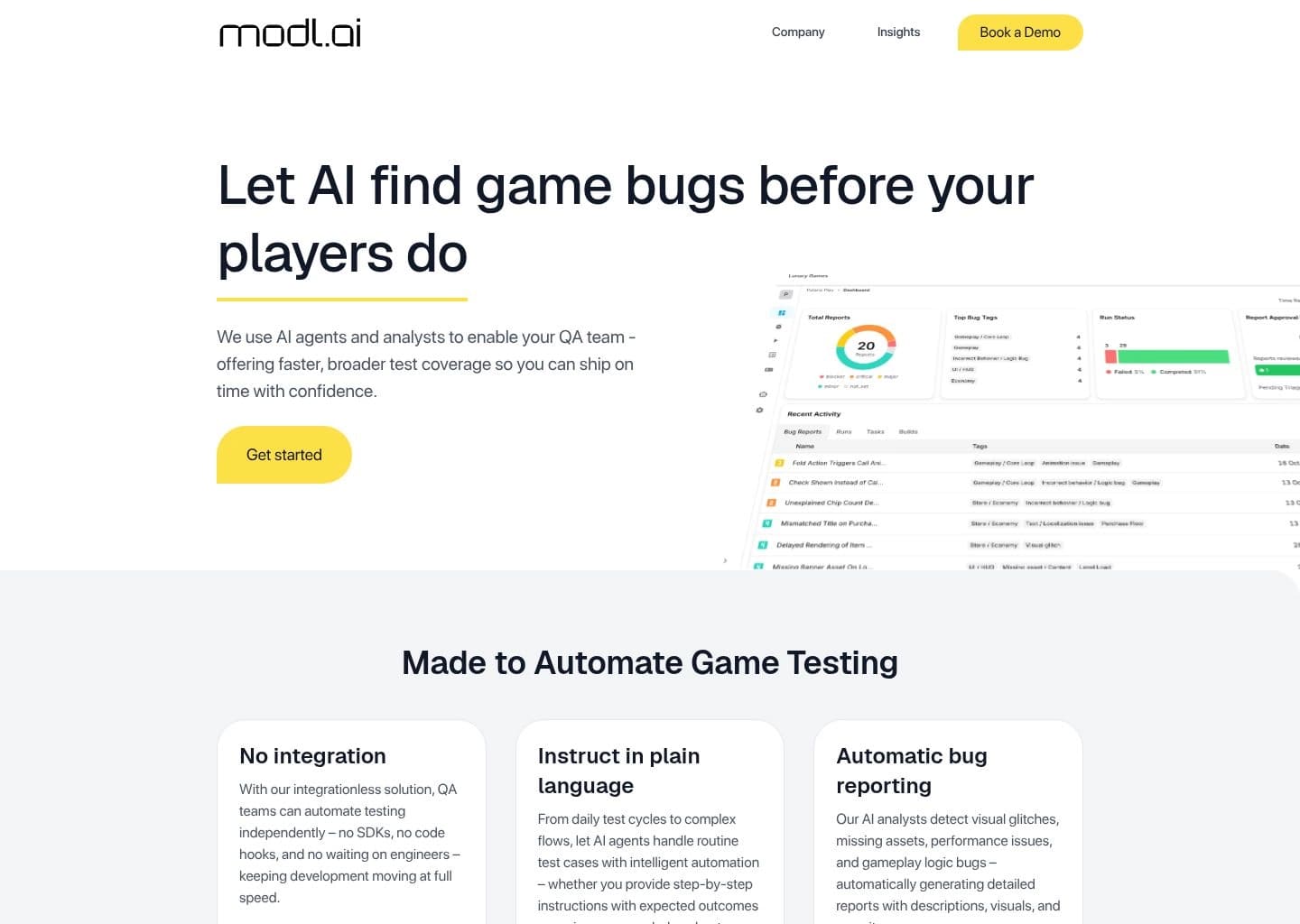
AI agents that find game bugs before your players do
Gallery
7 items



About modl.ai
modl.ai is an AI-powered game testing and quality assurance platform built to help studios find bugs before their players do. The company was founded in 2017 in Copenhagen, Denmark, by Christoffer Holmgård (CEO), Lars Peter Henriksen, and Benedikte Mikkelsen, a team that had collaborated since 2008 in the game AI research community around the IT University of Copenhagen. The founders recognized that by 2016, modern game AI techniques and hardware had matured enough to move game-testing AI out of the research lab and into real production pipelines, and modl.ai was born from that insight. The company has since raised over $10 million, including an €8.5 million Series A in November 2022 led by Griffin Gaming Partners and Microsoft's M12 venture fund, with participation from Rendered.vc, PreSeed Ventures, and Transistormedia.
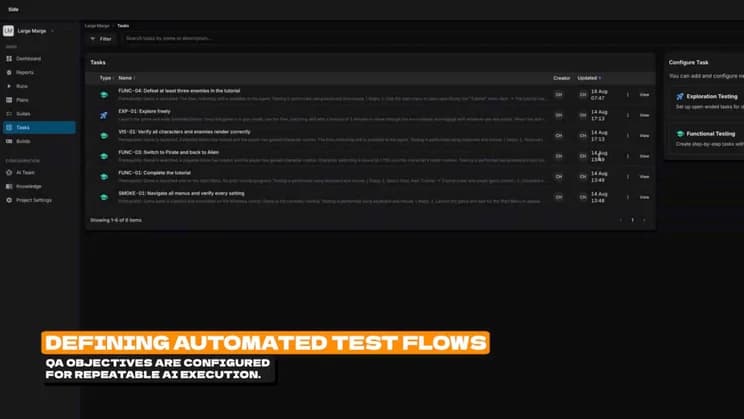
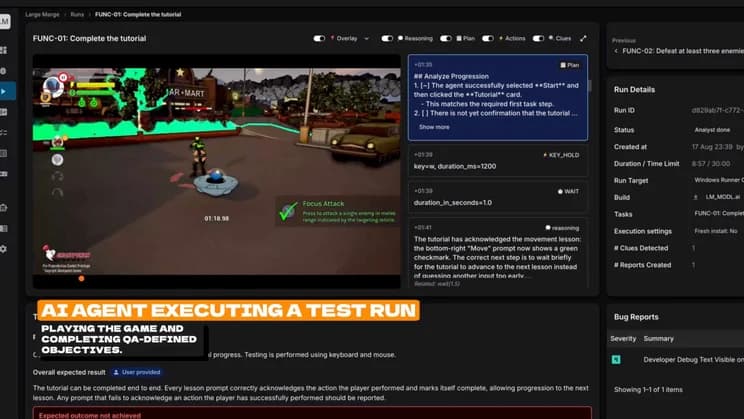
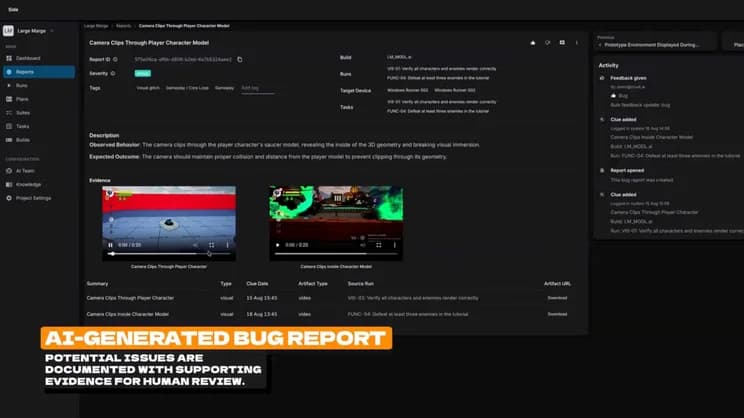
The platform's core differentiator is that it requires no integration at all: rather than embedding an SDK or writing code hooks into a game's engine, modl.ai's AI agents test games externally, analyzing what's on screen and sending simulated player inputs just like a real person would. QA teams upload their latest build, define test tasks in plain language (from a simple goal like "reach level 5" to complex, open-ended exploratory instructions), and the AI agents execute each task autonomously, capturing video, logs, and performance data throughout the run. modl.ai's AI analysts then automatically detect issues like visual glitches, missing or placeholder assets, softlocks, broken menus, crashes, and performance drops, generating detailed bug reports complete with descriptions, visual evidence, and severity scores. Test runs can be triggered manually from the dashboard or automatically as part of a CI/CD pipeline, and the platform works across all major game engines, including Unity and Unreal Engine.
modl.ai serves game studios of varying sizes looking to scale QA coverage without proportionally scaling headcount, with reported partnerships and customers including King, N3twork, and Nitro, and a notable 2026 partnership with Side (a major third-party game services provider) to combine modl.ai's AI-driven testing with Side's human QA expertise. The company positions itself as complementary to, not a replacement for, human testers, using AI to handle the repetitive, exhaustive test coverage that's hardest to scale manually, freeing up human QA teams to focus on nuanced, creative testing. Because pricing depends on factors like game scope and test volume, modl.ai does not publish self-serve rates and requires studios to book a demo directly to get started.
Key Features
- Integrationless AI agents that test games with no SDKs or code hooks required
- Plain-language test task definition, from simple goals to complex exploratory flows
- Automatic bug detection for visual glitches, missing assets, and performance issues
- AI-generated bug reports with descriptions, visuals, and severity scores
- Full session capture including video, logs, and performance data for every test run
- CI/CD pipeline integration for triggering automated test runs on every build
- Compatibility with all major game engines, including Unity and Unreal Engine
- On-demand player bots for multiplayer balancing and simulating real player behavior
Pros
- Genuinely integrationless: no SDKs, plugins, or code changes needed to start testing a build
- Plain-language test definition means QA teams can set up coverage without writing test scripts
- Automatic, severity-scored bug reports with video evidence speed up triage and prioritization
- Works across all major game engines, avoiding engine-specific lock-in for multi-project studios
- Founded by a team with deep, credible game AI research roots dating back to 2008
Cons
- No public self-serve pricing; every engagement requires booking a demo and going through sales
- As a specialized B2B QA tool, it's built specifically for game studios and isn't useful outside that niche
- Small team (11-50 employees) compared to larger QA/testing vendors, which may affect support scale for very large studios
- Vision-based, integrationless testing means it depends on what's visible on screen, which can be a constraint for certain backend or non-visual bugs
Pricing
modl.ai does not publish self-serve pricing on its website. Access requires booking a demo directly with the company's team, after which pricing is determined based on factors specific to a studio's needs, such as game scope, platform coverage, and expected test run volume. There is no free tier or published starting price; interested studios must contact modl.ai through the site's "Book a Demo" or "Get Started" flow to receive a custom quote.
Claim Verified Creator Badge
Are you the founder of modl.ai? Display this listing's verified badge on your website to show your customers that your product has been vetted and listed on AI Central Resources.
<a href="https://www.aicentralresources.com/tool/modlai" target="_blank" rel="noopener">
  <img src="https://www.aicentralresources.com/badges/featured-badge-dark.svg" alt="Featured on AICentralResources" width="200" height="54" style="border: none;" />
</a>
* Place this HTML snippet in your website's footer, landing page, or press section. This creates a search-friendly backlink directly to your verification page.
Connect with modl.ai
Frequently Asked Questions
modl.ai is an AI-powered game testing and QA platform that uses AI agents to autonomously play through video games, detecting bugs, glitches, and performance issues, then automatically generating detailed bug reports so QA teams can ship with more confidence and broader test coverage.
No. modl.ai's AI agents test games externally, analyzing what's on screen and sending simulated inputs just like a human player would, with no SDKs, plugins, or code changes required. Teams simply upload their latest build and the system is ready to start testing.
Yes. Test tasks are defined the way QA teams already think, using instructions like 'complete the tutorial,' 'reach level 5,' or 'open the inventory,' rather than scripted test code. AI agents then execute each task autonomously and report clear pass or fail results.
modl.ai does not publish self-serve pricing. Interested studios need to book a demo directly with the company to get a quote, which is typically based on factors like game scope, test volume, and platform coverage.
After each test run, modl.ai's AI analysts generate detailed bug reports covering crashes, broken menus, missing or placeholder assets, softlocks, visual glitches, and performance drops, complete with descriptions, visual evidence, and severity scores to help teams prioritize fixes.
Similar AI Tools to modl.ai
View all alternatives of modl.ai
Inworld AI
Realtime TTS, STT, and LLM routing infrastructure for consumer-scale voice AI

Ludo.ai
AI-generated production-ready game assets: sprites, 3D models, audio, and video


Scenario
Train custom AI models on your art style and generate on-brand assets across image, video, 3D, and audio

Unity AI Tools
Unity's in-editor agentic assistant, AI gateway, and MCP server for game development (successor to Unity Muse)

Promethean AI
The AI braintrust that helps creative teams build virtual 3D worlds
Compared with modl.ai
Direct head-to-head feature matrices, pricing, and category breakdowns