Direct Answer: Sakana AI CEO David Ha confirmed in Tokyo on November 28, 2026 that training began this month on Sawara, its upcoming sovereign Japanese foundation model family targeting early-2027 on-premises industrial and physical AI deployments alongside national-security contracts under Sakana Defense.
- →Training & Release Cadence: Pretraining on Sawara commenced in November 2026, prioritizing a compact on-premises variant for early 2027 followed by a larger frontier release.
- →Industrial & Physical AI Focus: While Sakana recently launched its Sakana Defense subsidiary, Ha emphasized that manufacturing automation and physical AI anchor Japan's long-term competitiveness.
- →Sovereign Alignment Rationale: Domestic weights aim to eliminate foreign alignment bias and unexpected refusals triggered on localized Japanese legal, political, and cultural prompts.
- →Enterprise Deployment Model: On-premises packaging is engineered specifically for air-gapped defense networks, regulated domestic enterprises, and robotics integrators.

Ollama
On-Premises Runtime 4.6 / 10Widely adopted local inference runtime used by teams deploying compact on-premises sovereign AI weights cleanly.
TOKYO — Sakana AI co-founder and CEO David Ha stated in a November 28, 2026 interview in Tokyo that the company's push into sovereign Japanese foundation models extends far beyond military and intelligence procurement. Confirming that pretraining for its flagship model family, codenamed Sawara, began in November 2026, Ha outlined a two-stage roadmap designed to anchor domestic robotics, factory automation, and regulated enterprise infrastructure across Japan.
The announcement clarifies industry speculation sparked earlier by Sakana AI's launch of a dedicated defense and intelligence subsidiary, Sakana Defense. Rather than pivoting narrowly into a defense contractor, Ha positioned national security and cybersecurity contracts as the initial demand wedge funding foundational domestic AI weights that external cloud providers cannot supply under foreign alignment policies.
Why Domestic Weights Matter Beyond Cloud API Gateways
Ha's argument for Japanese AI sovereignty centers on operational dependency and policy mismatch rather than raw parameter counts alone. Relying exclusively on U.S.-hosted or Chinese-hosted frontier APIs creates three acute points of failure for Japan's industrial base: data-residency compliance in defense and critical infrastructure, cross-border export-control exposure, and upstream content-moderation rules tuned for non-Japanese jurisdictions.
When deployed inside Japanese government ministries, automotive supply chains, or civic planning workflows, imported models frequently exhibit uneven refusals or Western-centric normative skew on nuanced Japanese historical, constitutional, and municipal-policy questions. Training Sawara from the ground up with domestic alignment priorities allows Japanese organizations to govern refusal boundaries, cultural context, and classified fine-tuning pipelines directly without routing sensitive payloads across foreign cloud boundaries.
| Deployment Dimension | Foreign Cloud API Models | Sakana AI 'Sawara' Strategy |
|---|---|---|
| Target Availability | Continuous hosted cloud updates | Compact on-prem early 2027; larger flagship later |
| Hosting Topology | Offshore multi-tenant API gateways | Air-gapped & domestic on-premises enterprise servers |
| Cultural & Policy Alignment | External RLHF policies prone to local refusals | Calibrated specifically for Japanese language and norms |
| Defense & Cyber Readiness | Restricted under sovereign procurement rules | Backed by dedicated Sakana Defense integration arm |
| Long-Term Economic Target | General SaaS & global developer coding | Industrial competitiveness, manufacturing, & physical AI |
On-Premises First: Staging Sawara for Early 2027
In contrast to hyperscalers that debut trillion-parameter multi-cluster flagships before shrinking them down, Sakana AI is staging Sawara in reverse order. A smaller, inference-efficient iteration engineered for on-premises enterprise racks and localized edge deployments is scheduled to ship first in early 2027, followed later by a larger full-scale foundation model.
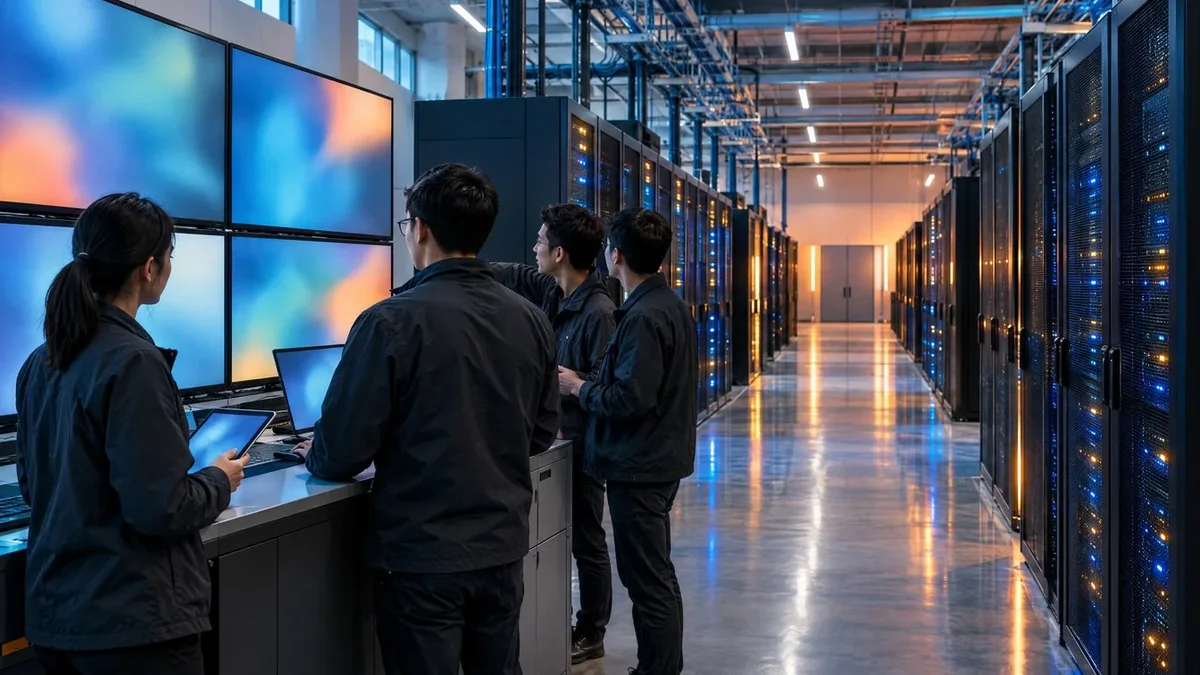
Practically, shipping an on-premises tier first lets Sakana AI validate latency budgets, air-gapped security controls, and Japanese-language reliability inside conservative manufacturing firms, telecom operators, and Sakana Defense environments without waiting for multi-gigawatt cloud buildouts. It also aligns naturally with edge-compute constraints in robotics and industrial control rooms, where unpredictable cloud round-trip delays render remote API calls unusable on the factory floor.
Physical AI and Japan's Industrial Competitiveness
Ha highlighted physical AI and industrial manufacturing as the decisive multi-decade rationale behind Sakana AI's strategy. While Japan faces well-documented demographic aging and factory labor shortages, the country still controls critical shares of global precision robotics, CNC machinery, industrial sensors, and semiconductor materials. Retaining industrial leadership requires reasoning software tailored to physical actuation rather than simply white-collar office chat.
Pairing those mechanical strengths with domestically governed reasoning models could let Japanese manufacturers convert decades of proprietary shop-floor telemetry into closed-loop robotic policies without surrendering factory IP to external model trainers. By keeping national security as one pillar rather than the entire ceiling, Sakana AI is positioning Sawara as shared national digital infrastructure connecting robotics hardware, public-sector security, cyber defense, and private-sector industrial productivity across Japan's regional supply chain.
Strengths of Sakana AI's Sovereign Strategy
- +Addresses concrete sovereign buyer mandates for air-gapped on-premises weights before scaling to larger clusters.
- +Connects frontier foundation-model research directly to Japan's global edge in robotics, machinery, and physical AI.
- +Mitigates external alignment bias and unexpected refusals on localized Japanese political and regulatory workflows.
- +Separates sensitive public-sector procurement cleanly into Sakana Defense while keeping commercial enterprise paths open.
Execution & Competitive Challenges
- −Training flagship models domestically requires substantial capital and GPU cluster scale to rival hyperscale peers.
- −Early-2027 delivery timeline for compact Sawara leaves near-term enterprise deployments reliant on interim stacks.
- −Maintaining benchmark parity across coding, reasoning, and multilingual tasks adds heavy post-training pressure.
- −Balancing defense classification boundaries alongside broad commercial ecosystem adoption demands strict governance.
The Takeaway for Enterprise Architects
Sakana AI's Sawara blueprint reinforces a widening shift across sovereign AI markets in 2026: major industrial economies are no longer satisfied merely subsidizing foreign API wrappers. Rather than treating AI exclusively as a consumer software category, Tokyo policymakers and domestic conglomerates increasingly view sovereign model weights as strategic factory infrastructure comparable to domestic power grids or industrial telecom backbones.
As compact, on-premises foundation models mature into early 2027, enterprises operating in defense, precision manufacturing, robotics, and regulated infrastructure will increasingly demand verifiable local model lineage over opaque cross-border endpoints.
Read the original November 28, 2026 report detailing Sawara's training start, early-2027 on-prem target, and physical AI focus.
Frequently Asked Questions
When did Sakana AI begin training its Sawara foundation model? +
CEO David Ha confirmed on November 28, 2026 that pretraining on Sawara began in November 2026, with a smaller on-premises model slated for early 2027 followed by a larger flagship version.
Is Sakana AI focusing solely on defense and national security? +
No. While Sakana AI recently established Sakana Defense for security and cybersecurity work, Ha emphasized that defense is only one segment and that industrial competitiveness, manufacturing, and physical AI are the central goals.
Why does Japan want domestically trained models instead of foreign APIs? +
Homegrown weights reduce reliance on external cloud vendors, protect sensitive industrial and public-sector data on premises, and eliminate mismatched refusals or foreign cultural bias on Japanese-specific topics.
Will Sawara support on-premises corporate deployments? +
Yes. Sakana AI is prioritizing a smaller on-premises Sawara iteration for early 2027 specifically so regulated enterprises and defense systems can run models locally.