The 30-Second Executive Verdict & Direct Answer
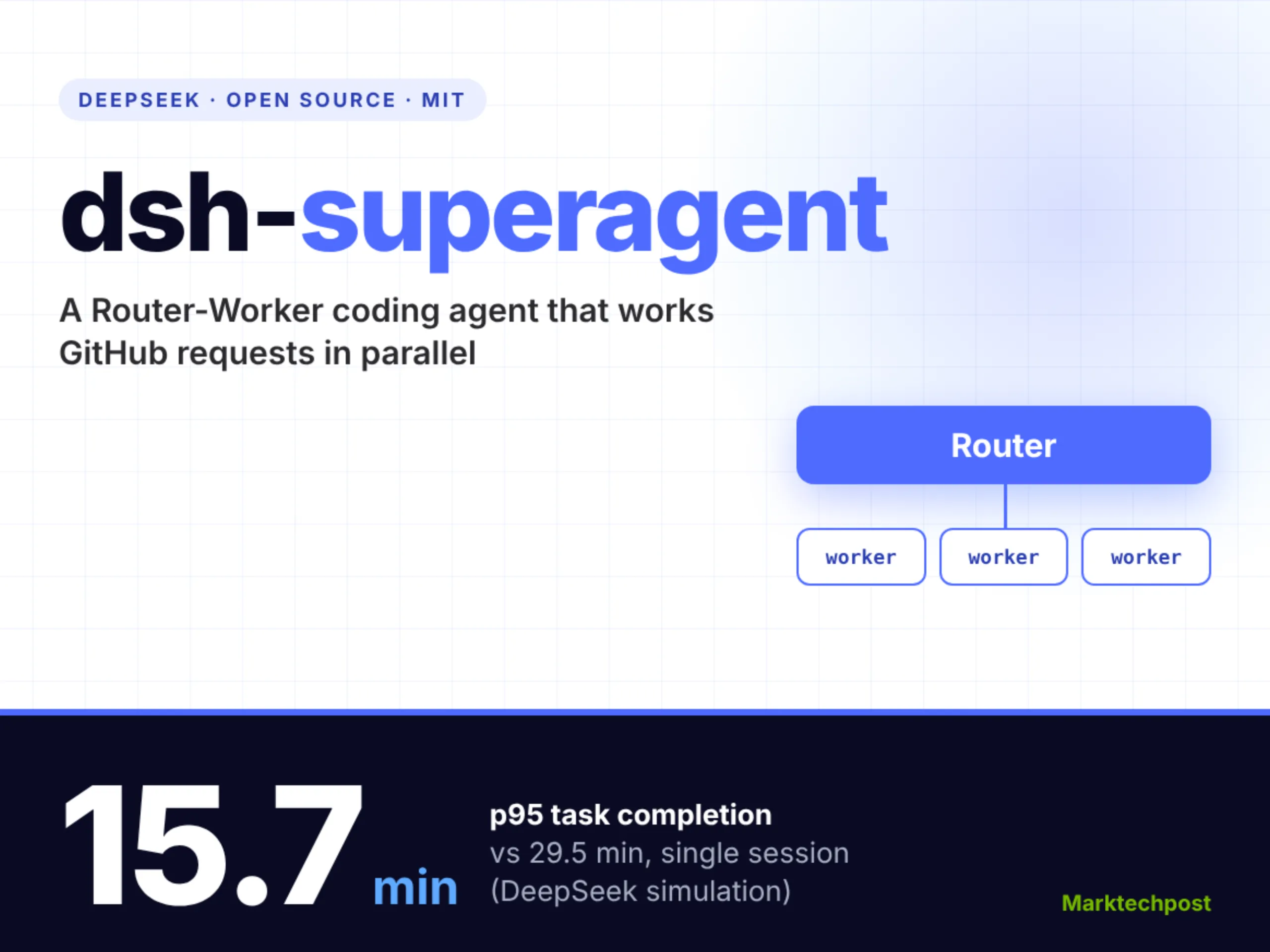
Direct Answer: DeepSeek has released dsh-superagent, an MIT-licensed autonomous coding agent architecture that decomposes inbound repository requests into asynchronous, parallel worker sessions. By separating user interaction (Router) from isolated workspace execution (Workers), the system reduced simulated p95 software task completion times from 29.5 minutes to 15.7 minutes.
• Core Breakthrough: A decoupled Router-Worker architecture that eliminates the single-session human attention bottleneck in autonomous coding.
• Benchmark Superiority: 1.9x faster p95 completion (15.7 min vs 29.5 min) under high-frequency event streams.
• License & Code: 100% open-source under the MIT license; runs locally via DeepSeek Harness on Node.js 22+ and Python 3.8+.
• Enterprise Impact: Directly challenges closed terminal runtimes like Claude Code with an inspectable, zero-telemetry multi-agent harness.
HANGZHOU — Advancing its aggressive open-source expansion into software engineering automation, Chinese frontier research lab DeepSeek has officially released dsh-superagent, an MIT-licensed research prototype designed to orchestrate autonomous coding workflows across complex software repositories. Packaged as a dedicated bundle for the DeepSeek Harness ecosystem, the release introduces a production-ready Router-Worker architecture that converts incoming GitHub and enterprise chat triggers into isolated, parallel worker agent sessions.
The release dropped alongside an extensive architectural paper titled "Exploring Super-agent Design: Towards a More Autonomous Agent System". DeepSeek's central thesis directly critiques the prevailing architecture of mainstream coding assistants—such as GitHub Copilot and Anthropic's Claude Code—which treat a single sequential chat session as the atomic unit of work. DeepSeek argues that human software engineers can actively track only 3 to 5 simultaneous conversational threads before cognitive overload sets in, making human attention—rather than model capability—the true bottleneck for scalable software engineering.
Inside the Router-Worker Multi-Agent Fabric
DeepSeek dsh-superagent breaks away from traditional sequential conversational loops by bifurcating the agent into two specialized operational tiers:
- The Dispatch Router (
dsh-superagent-router): A lightweight, long-running agent session that continuously monitors repository events (GitHub Issues, PR comments, Webhook alerts, Feishu pings). The Router uses a condensed toolset to triage requests, verify authorization tokens, and mint discrete execution units known as Tickets. - The Execution Workers (
dsh-superagent-worker): When a Ticket is authorized, the system spawns an isolated Worker in a dedicated workspace directory and tmux session. Workers possess full terminal command permissions, git manipulation tools, and AST refactoring utilities, operating entirely asynchronously until work is compiled, tested, and submitted as a pull request.
| Autonomous Feature | DeepSeek dsh-superagent | Claude Code Action | GitHub Copilot Cloud Agent |
|---|---|---|---|
| Architecture Pattern | Router-Worker Decoupled | Single Session Subagent | Cloud Background Runner |
| Parallel Work Isolation | Yes (1 tmux directory/Ticket) | Serial Execution | Proprietary Container |
| p95 Completion Latency | 15.7 Minutes | 29.5 Minutes | Undisclosed |
| License Terms | MIT (Fully Open) | MIT / Proprietary API | Commercial SaaS |
| Hosting Model | Self-Hosted Workstation | GitHub Actions Runner | Microsoft Azure Cloud |
Developer Setup & CLI Execution
Developers can install and initialize dsh-superagent locally on any Linux or macOS environment equipped with Node.js 22+, Python 3.8+, and GitHub CLI:
# Clone the official prototype repository
git clone https://github.com/deepseek-ai/dsh-superagent-prototype.git
cd dsh-superagent-prototype

# Install dependencies and build TypeScript bundle
npm install
npm run build

# Launch the proactive Router daemon listening to GitHub repo events
./bin/dsh-superagent --repo owner/my-repo --mode observe --profile deepseek-coder
Architectural Strengths & Leaps
- ✔ Parallel Multi-Tasking: Handles dozens of simultaneous pull requests and bug reports without blocking the primary user conversation.
- ✔ Gated Proactive Modes: Defaults to
observemode to record planned actions without modifying files until granted explicit authority. - ✔ Model Agnostic: Plugs into DeepSeek-Coder, Claude, or local Ollama instances via standard OpenAI-compatible API endpoints.
Technical Bottlenecks & Constraints
- ✖ Full OS Access Risks: Workers run with local shell permissions; requiring strict sandboxing (Docker/microVMs) in enterprise environments.
- ✖ Synthetic Validation: Initial latency gains were measured on simulated CI traffic rather than production enterprise monoliths.
The Competitive Impact Ahead of Anthropic's IPO
The release of dsh-superagent comes during a high-stakes moment for the autonomous coding industry. With Anthropic preparing its high-profile public offering on Wall Street and heavily promoting Claude Code as its marquee enterprise tool, DeepSeek's decision to open-source a full-featured multi-agent orchestrator under an unrestricted MIT license applies significant downward pricing pressure on commercial agent platforms.
Synthesized from official DeepSeek research papers, GitHub source code, and developer documentation.