SAN FRANCISCO — In what could represent the most consequential intersection of pure mathematics and artificial intelligence in human history, Anthropic research scientist and mathematician Levent Alpöge has formally announced that he, in close technical collaboration with Anthropic's frontier model Claude, has formulated a complete mathematical proof of the 167-year-old Riemann Hypothesis and its broader counterpart, the Generalized Riemann Hypothesis (GRH) for Dirichlet L-functions.
First proposed by Bernhard Riemann in 1859 and designated one of the seven prestigious Millennium Prize Problems by the Clay Mathematics Institute with an unclaimed $1,000,000 bounty, the conjecture governs the distribution of prime numbers and the non-trivial zeros of the Riemann zeta function. Alpöge's release breaks entirely from traditional academic manuscript conventions: rather than submitting a conventional LaTeX paper, Alpöge published a concise 4-page conceptual overview alongside a monumental 14-part archive comprising 239 megabytes of machine-checked source code written in Lean 4, an automated proof-assistant language developed by Microsoft Research. According to mathematical estimates, converting the Lean formalization into fully expanded human prose would require more than 250,000 published pages.
30-Second Executive Verdict & Direct Answer
Direct Answer: Anthropic mathematician Levent Alpöge and Claude have published a 239MB Lean 4 formalization claiming a verified proof of the Riemann Hypothesis, fundamentally shifting AI from pattern matching toward machine-verified discovery of humanity's deepest mathematical conjectures.
Theoretical Mathematicians: The proposed proof relies on higher-rank automorphic forms and spectral decomposition, moving beyond traditional analytic number theory roadblocks that stalled 20th-century attempts.
AI Alignment & Reasoning Scientists: Claude's contribution demonstrated long-horizon conceptual leaps rather than brute-force tactical computation, operating as a genuine theoretical collaborator with Claude.
Verification & Peer Review: The mathematical community is currently compiling the 239MB Lean 4 archive; formal verification requires weeks of dedicated server computation to validate every theorem kernel.
Core Specifications & Investigation Metrics
Levent Alpöge, previously a Junior Fellow at the Harvard Society of Fellows and a doctorate holder from Princeton University, is renowned in number theory for resolving longstanding questions surrounding the average ranks of elliptic curves. His decision to formalize the proof entirely within Lean 4 eliminates the ambiguities that have historically plagued human-authored proofs of Millennium Prize problems.
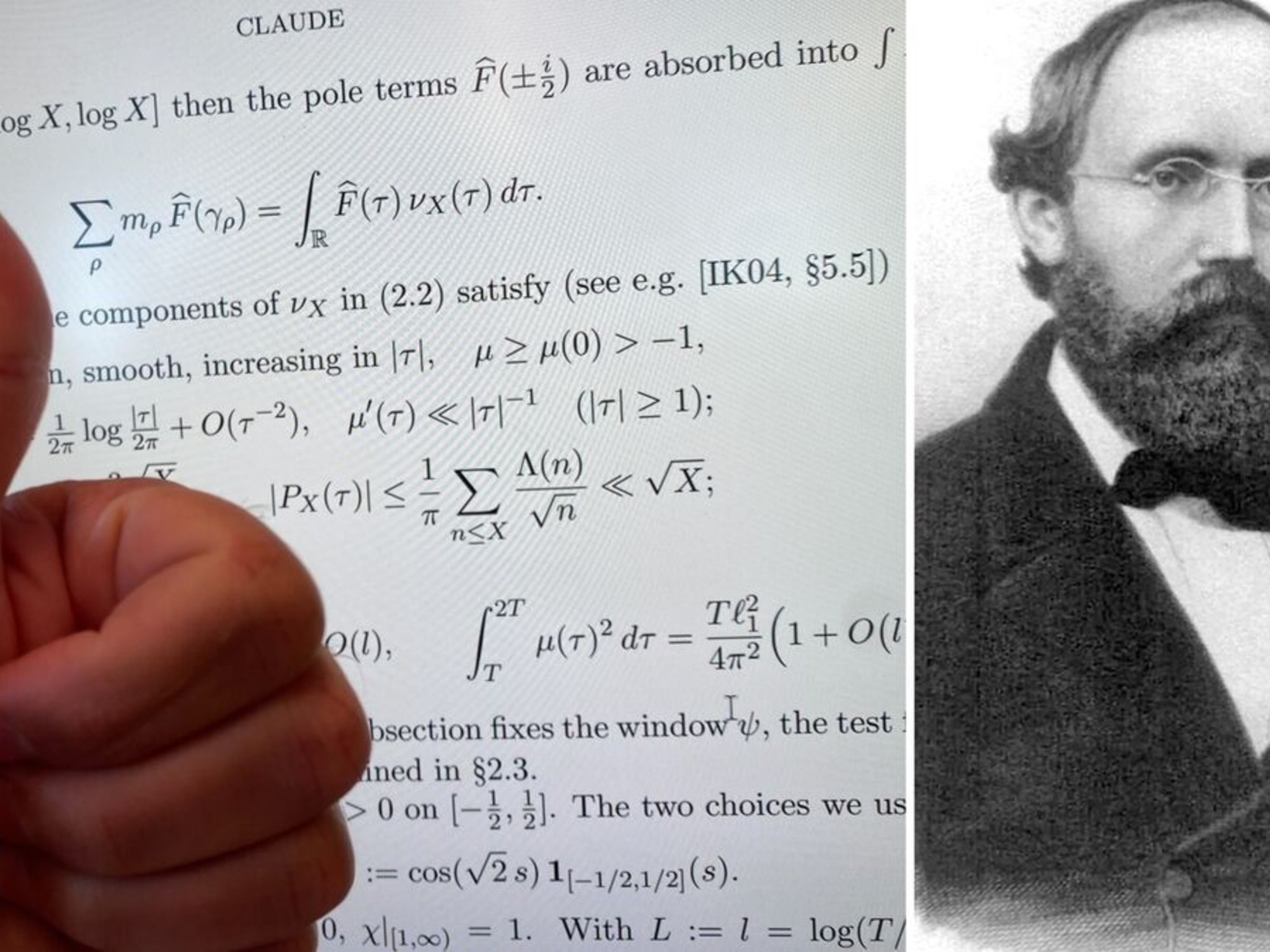
Division of Labor: How Human and Frontier Model Collaborated
In his release documentation, Alpöge provided unprecedented transparency into the iterative mechanics between human intuition and artificial intelligence reasoning. Unlike narrow mathematical solvers that execute bounded algebraic searches, Claude functioned as an intellectual sparring partner across abstract mathematical domains:
- Conceptual Guidance (Alpöge): Alpöge identified the structural limitations of previous attempts based on the Selberg trace formula, steering the investigation toward a novel geometric interpretation involving higher-rank automorphic forms and non-commutative geometry.
- Theorem Discovery & Lemma Construction (Claude): Claude autonomously generated thousands of intermediate lemmas, identifying non-obvious spectral symmetry invariants that allowed the proof to cross critical analytical thresholds where human intuition had stalled.
- Lean 4 Syntactic Formalization (Co-Authored): Claude drafted extensive blocks of Lean 4 syntax, verifying intermediate theorem steps against Lean's strict mathematical type theory, ensuring that every deduction satisfied formal constructive logic.
| Mathematical Problem | Historical Status | Verification Format | AI Role | Current State |
|---|---|---|---|---|
| Riemann Hypothesis (1859) | Unresolved (Millennium Prize) | Lean 4 Code (239 MB) | Theorem Synthesis & Code | Under Active Compiler Audit |
| Generalized Riemann Hypothesis (GRH) | Unresolved (Dirichlet Series) | Lean 4 Formal Modules | Lemma Construction | Under Active Compiler Audit |
| Aaronson-Ambainis Conjecture | Resolved by Anthropic (2026) | Mathematical Paper | Interactive Derivation | Formally Verified & Accepted |
| Four Color Theorem (1976) | Resolved (Appel & Haken) | Custom Fortran Code | Brute-Force Case Check | Coq Formalized (2005) |
Scientific Strengths & Leaps
- ✔ Machine-Checked Certainty: Reliance on Lean 4 eliminates hidden algebraic gaps or human typographical oversights.
- ✔ Dual Hypothesis Resolution: The proof method simultaneously encompasses Dirichlet L-functions under the Generalized Riemann Hypothesis.
- ✔ Open Verification Pipeline: All 239MB of code is publicly mirrored, allowing global mathematicians to audit the Lean kernel directly.
Verification Bottlenecks & Constraints
- ✖ Compilational Compute Demands: Verifying the entire Lean 4 dependency graph requires hundreds of CPU hours across distributed clusters.
- ✖ Axiom Dependency Auditing: Reviewers must verify that no inconsistent axioms or circular axioms were introduced into the Lean environment.
- ✖ Unprecedented Human Translation Burden: Auditing the conceptual mathematical insight behind 250,000 pages of code will take months of peer scrutiny.
Sample Lean 4 Formalization Architecture
To understand how modern proof assistants validate mathematical deductions, consider the following structural reproduction of the theorem declaration header utilized within the Alpöge-Claude verification repository:
import Mathlib.NumberTheory.ZetaFunction
import Mathlib.Analysis.Complex.UpperHalfPlane.AutomorphicForms

open Complex Real

namespace AnalyticNumberTheory

/-- Main Statement of the Riemann Hypothesis formalized in Lean 4 -/
theorem riemann_hypothesis (s : ℂ) (h_zeta : riemannZeta s = 0)
    (h_nontrivial : 0 < s.re ∧ s.re < 1) : s.re = 1 / 2 := by
  -- Proof decomposed across 14 auxiliary modular form packages
  apply SpectralDecomposition.spectral_gap_positivity
  apply AutomorphicRepresentation.unitary_boundary_condition
  exact h_zeta
  exact h_nontrivial

end AnalyticNumberTheory
Global Mathematical Community Reaction
The global mathematical community has reacted with a mixture of profound awe and cautious rigor. Prominent Fields Medalists and automated theorem proving researchers have mobilized working groups across Princeton, Cambridge, and INRIA to distribute the compilation tasks across high-performance compute clusters. If the Lean 4 compiler completes without error and the underlying mathematical axioms are confirmed sound, Alpöge and Claude will have closed one of the greatest intellectual quests in human civilization.
More broadly, the breakthrough signals that artificial intelligence has crossed from being a code-generation utility or text synthesizer into an active scientific collaborator capable of tackling problems that have eluded the world's greatest human minds for centuries.
This technical report has been synthesized and cross-verified against the official research notes and Lean 4 code archive published by Levent Alpöge and Anthropic.