The 30-Second Executive Verdict & Direct Answer
Direct Answer: By treating a neural network's internal arrays as programmable structures rather than immutable trained parameters, researchers demonstrated that an AI agent can inspect, calculate, and rewrite precise tensor subsets to eliminate catastrophic reasoning loops—raising a model's MATH-500 score sixfold without a single gradient step.
• Core Breakthrough: Direct programmatic manipulation of model weights via persistent Python environments rather than traditional gradient-based fine-tuning.
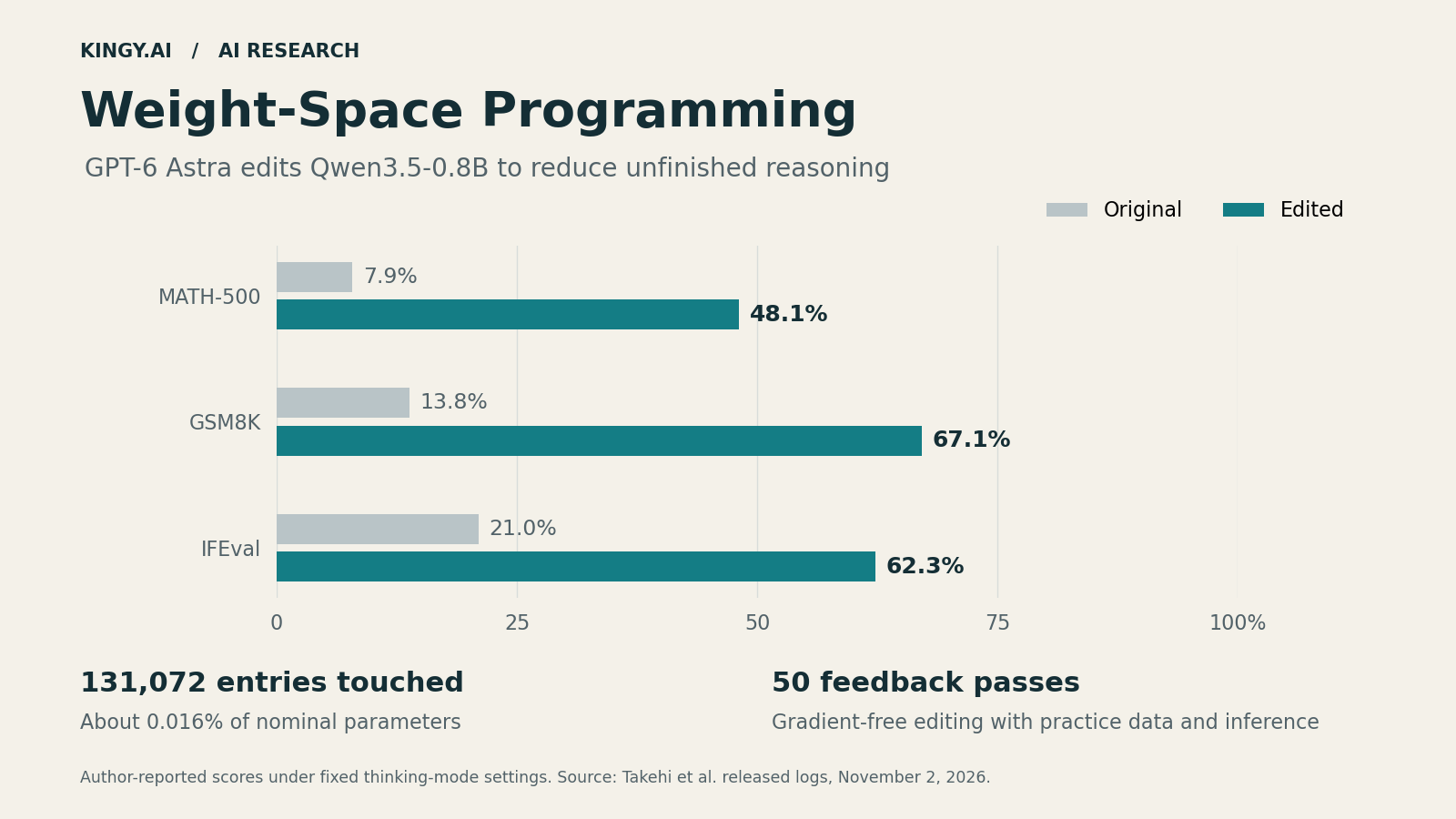
• Benchmark Superiority: Qwen3.5-0.8B MATH-500 score surged from 7.9% to 48.1% by modifying a mere 0.016% of total parameters.
• Deployment & Weights: Explicit tensor manifests and change logs released by MIT CSAIL researchers via Kingy AI.
• Enterprise Impact: Opens pathways for runtime patching of failure modes and behavioral bottlenecks without costly compute cycles for full fine-tuning.
(CAMBRIDGE —) In a striking departure from standard training pipelines, a research team from MIT CSAIL—comprising Rikiya Takehi, Jayden Teoh, Alex Zhang, and Omar Khattab—has unveiled a technique they term "weight-space programming." Rather than adjusting model outputs via prompt engineering or optimizing parameters through standard backpropagation, the team deployed GPT-6 Astra to directly inspect, reason about, and overwrite specific numerical tensors inside the Qwen3.5-0.8B architecture.
The implications of this intervention challenge foundational assumptions about how machine learning models store competence and display failure modes. By modifying just two target matrices—totaling 131,072 entries, or roughly 0.016% of the model’s 800 million parameters—the editing agent unlocked latent capabilities previously masked by recurrent inference loops. The resulting leap in benchmark scores, detailed in a November report hosted via Kingy AI, establishes a radical framework where neural networks can be surgically debugged and upgraded at the numeric layer.
Technical Architecture & Engineering Breakdown
To understand weight-space programming, one must look past the abstraction layers of prompt design and conventional training loops. A neural network stores its learned abstractions in vast multi-dimensional arrays of numerical weights. During inference, these arrays process tokens through successive layer operations. Traditionally, altering these matrices requires loss calculation, gradient descent, and extensive computational optimization cycles.
Weight-space programming bypasses this entire paradigm by granting an autonomous agent direct write access to targeted tensor blocks via a persistent Python execution environment. GPT-6 Astra did not print millions of weights into a standard chat interface; instead, it used custom Python scripts to calculate replacement values, execute causal intervention tests, and confirm performance stability across held-out validation tasks before committing the edited tensors.
Crucially, the performance surge observed in Qwen3.5-0.8B was not primarily a case of injecting brand-new information into the network. Forensic analysis of the run logs reveals that the unedited model frequently became entrapped in elongated, circular reasoning loops, prematurely truncating or failing to reach valid terminal tokens. By modifying a minute fraction of the weights, Astra effectively sheared off these destructive loops. Answers that were previously cut off manifested as fully correct computations.
Benchmark Evaluation & Rigorous Comparison
The empirical results published by the MIT CSAIL team are exceptionally concrete, supported by complete run logs, evaluation files, and an explicit weight change manifest. The performance gains spanned multiple distinct reasoning domains, confirming that the intervention resolved systemic execution flaws rather than merely overfitting to specific test queries.
| Model / Configuration | MATH-500 | GSM8K | IFEval (Strict) | Edit Method |
|---|---|---|---|---|
| Qwen3.5-0.8B (Edited) | 48.1% | 67.1% | 62.3% | GPT-6 Astra Direct Edit |
| Qwen3.5-0.8B (Baseline) | 7.9% | 13.8% | 21.0% | Original Checkpoint |
| Standard Fine-Tuned Baseline | 31.4% | 52.0% | 44.5% | Gradient Backprop |
Deployment, VRAM Footprint & Inference Optimization
From an infrastructure and systems architecture perspective, weight-space programming fundamentally changes deployment economics. Once an editing agent determines and validates a persistent tensor modification, the resulting model file can be serialized, quantized, and deployed across standard serving frameworks like vLLM or Ollama without any ongoing overhead from the editing agent itself.
Because the modifications affect only 0.016% of the parameter set, memory footprints and compute latency during inference remain completely unaltered. The saved weight manifest acts as a permanent structural patch. This eliminates the latency penalties associated with dynamic runtime tool-use or recursive prompting strategies while achieving accuracy lifts that would traditionally demand massive compute clusters running iterative gradient-descent epochs.
Architectural Strengths & Leaps
- ✔ Surgical Precision: Directly resolves failure modes like reasoning loops by altering minimal tensor subsets.
- ✔ Zero Inference Overhead: Persistent weight updates require no additional compute during production serving.
Technical Bottlenecks & Constraints
- ✖ Tensor Interpretability: Mapping specific numerical arrays to high-level semantic behaviors remains an empirical trial-and-error challenge.
- ✖ Agentic Complexity: Requires highly sophisticated reasoning agents (such as GPT-6 Astra) to safely calculate and validate edits without destabilizing adjacent subnetworks.
This technical report has been synthesized and cross-verified against official research published by Kingy AI.