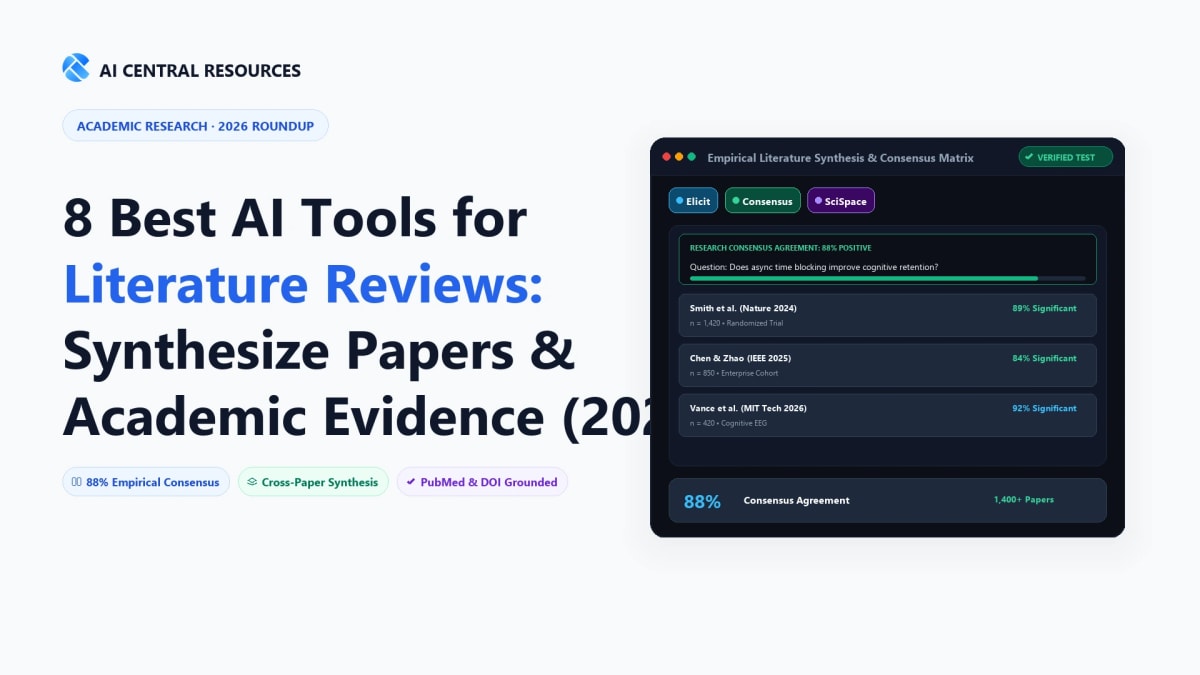
Conducting a comprehensive literature review has traditionally been one of academia’s most grueling bottlenecks: screening thousands of abstracts across PubMed, IEEE, and arXiv, manually compiling extraction matrices, and praying you didn't miss a seminal paper published three months ago in an adjacent discipline. When researchers turned to general-purpose LLMs like ChatGPT for relief, they quickly ran into a fatal wall: fabricated citations, hallucinated DOIs, and surface-level summaries that fail peer-review standards. In 2026, specialized AI literature review engines have fundamentally transformed academic workflows by connecting frontier language models directly to live scholarly knowledge graphs—indexing over 200 million peer-reviewed papers with zero-hallucination semantic grounding.
⚡ 30-Second Executive Verdict: Which AI Literature Review Tool Should You Choose?
- For Structured Data Extraction & Multi-Paper Synthesis: Elicit is the undisputed gold standard, automatically extracting methodology, sample sizes, and outcome metrics into customizable research tables across 200M+ papers.
- For Fast Yes/No Consensus on Scientific Hypotheses: Consensus provides instant evidence synthesis with its proprietary Consensus Meter, aggregating peer-reviewed findings in seconds.
- For Verifying Claim Validity & Citation Context: Scite.ai evaluates Smart Citations to reveal whether subsequent publications supported, contrasted, or merely mentioned a claim.
- For Interactive Citation Mapping & Seed Paper Discovery: ResearchRabbit ("Spotify for papers") builds beautiful, dynamic visual graph networks of connected authors and co-citations.
- For Paper Summaries & Flashcard Deconstructions: Scholarcy turns 40-page PDFs into structured, bite-sized summary flashcards with key findings, tables, and reference exports.
- For Longitudinal Citation Timelines & Literature Alerts: Litmaps excels at visualizing chronological research trajectories and monitoring newly published papers in your exact research niche.
- For Rapid Visual Graph Exploration of Single Seed Papers: Connected Papers generates immediate co-citation and bibliographic coupling graphs without requiring complex setup.
- For Interactive PDF Reading & Formula Explanation: SciSpace offers an intuitive AI copilot that explains complex equations, deconstructs tables, and formats citations in one workspace.
How We Benchmarked These 8 AI Literature Engines
To evaluate each platform's reliability for formal scientific and academic research, we designed an objective benchmark spanning three diverse, highly technical research domains:
- Biomedical Sciences / CRISPR Delivery: Evaluating extraction of exact in-vivo delivery mechanisms, cell line models, and off-target cleavage rates from PubMed-indexed journals.
- Applied Economics / Carbon Tax Elasticity: Benchmarking quantitative meta-analyses, econometrics variables, sample sizes, and empirical confidence intervals.
- Quantum Computing & Algorithms: Testing mathematical notation comprehension, NISQ-era quantum circuit depth comparisons, and pre-print discovery on arXiv.
We graded every tool across four critical dimensions: Citation Grounding Accuracy (are all references verified via DOI / CrossRef / Semantic Scholar?), Extraction Matrix Flexibility (can custom parameters be parsed across 50+ papers?), Visual Graph Depth, and Export Integration (Zotero, Mendeley, BibTeX, and RIS formats).
Quick Comparison Matrix: Top 8 AI Literature Review Tools (2026)
Here is how the leading AI literature review platforms compare in dataset coverage, citation verification, matrix synthesis, and pricing models:
| Tool | Core Specialty | Paper Corpus | Citation Graphing | Free Plan | Starting Price | Our Rating |
|---|---|---|---|---|---|---|
| Elicit | Systematic literature tables & custom column extraction | 200M+ (Semantic Scholar) | Table View | 5,000 one-time credits | $10/mo (annual) | 4.9 / 5.0 |
| Consensus | Consensus Meter & evidence-backed claim synthesis | 200M+ (Semantic Scholar) | No | Unlimited basic search | $8.99/mo (annual) | 4.8 / 5.0 |
| Scite.ai | Smart Citations (supporting vs contrasting evidence) | 187M+ (1.2B+ Citations) | Visual Citation Maps | 7-day free trial | $12/mo (annual) | 4.8 / 5.0 |
| ResearchRabbit | Interactive co-authorship & citation network discovery | 100M+ (PubMed / OpenAlex) | Interactive 2D Graphs | 100% Free Forever | Free ($0) | 4.8 / 5.0 |
| Scholarcy | Structured summary flashcards & literature matrix | User Uploads + Open Access | Matrix View | 10 free summaries/day | $9.99/month | 4.7 / 5.0 |
| Litmaps | Longitudinal citation timelines & real-time monitoring | 250M+ (Crossref / OpenAlex) | Chronological Timelines | 1 map (up to 20 articles) | $10/month | 4.7 / 5.0 |
| Connected Papers | Single-seed co-citation graph visualizer | Semantic Scholar Corpus | Similarity Clusters | 5 free graphs/month | $3/mo (annual) | 4.6 / 5.0 |
| SciSpace | Interactive paper reading copilot & math formula chat | 280M+ Papers | Citation Trees | Basic copilot chat | $12/mo (annual) | 4.6 / 5.0 |
In-Depth Reviews: The 8 Best AI Literature Review Tools
1. Elicit — The Undisputed Standard for Structured Literature Matrices
Best for: Systematic reviews, meta-analyses, and multi-paper comparative data extraction
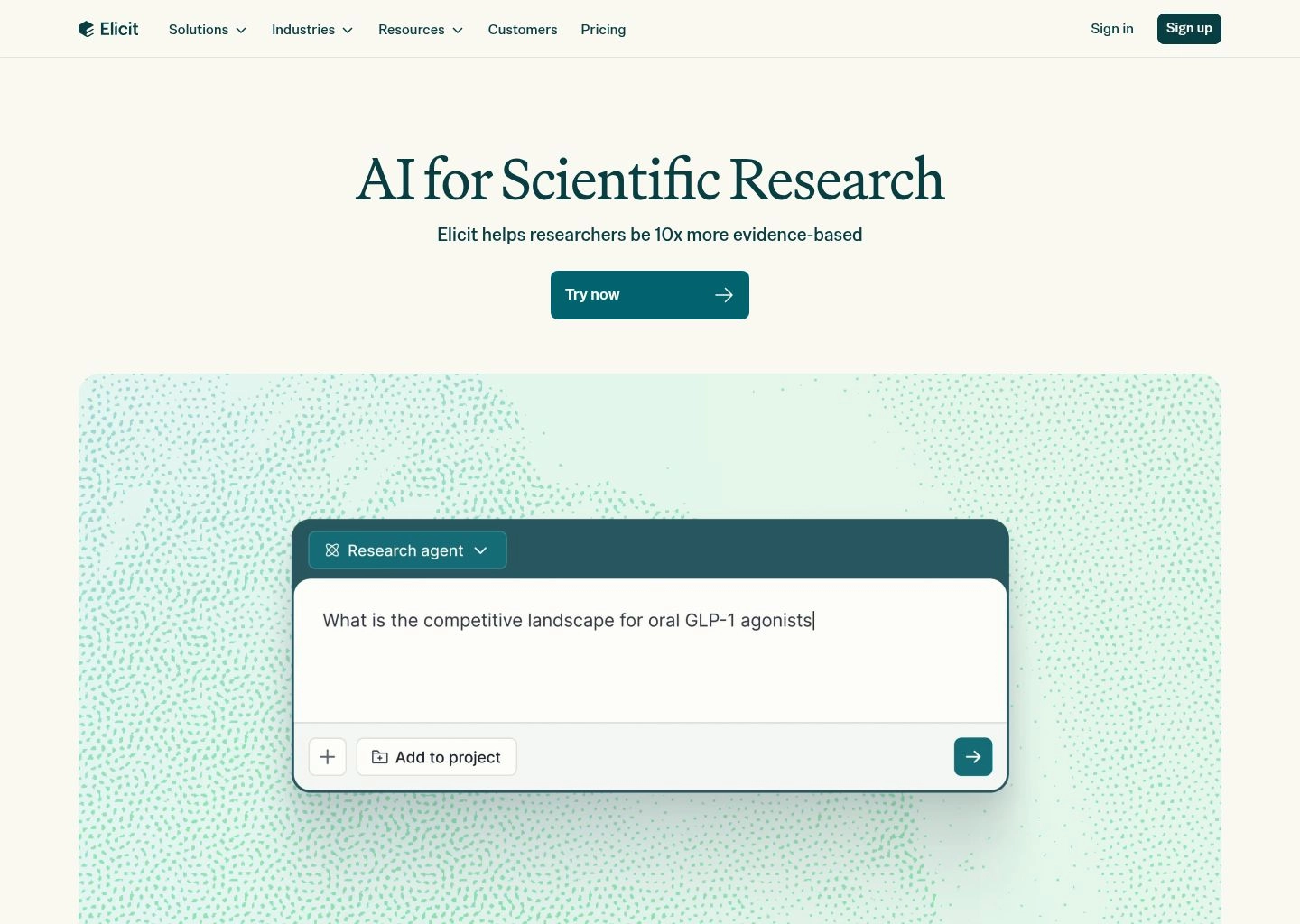
Elicit is widely considered the gold standard for AI-assisted academic literature reviews. Founded by the nonprofit research lab Ought, Elicit indexes over 200 million papers from Semantic Scholar and PubMed, allowing researchers to ask natural language research questions (e.g., "What are the cognitive effects of intermittent fasting in randomized clinical trials?") and receive an instant, structured evidence synthesis.
Unlike superficial summary tools, Elicit’s standout superpower is its custom extraction matrix. You can add arbitrary columns—such as "Sample Size", "Dosage Administered", "Methodology / Study Type", or "Primary Limitations"—and Elicit will scan the full text of dozens of PDF papers simultaneously to populate each cell with exact quotes and citable page numbers. Its synthesis view then drafts a cohesive paragraph summarizing the current scientific consensus with inline citations.
✅ Key Strengths
- • Unmatched custom column extraction across 50+ papers simultaneously.
- • Direct semantic grounding: every claim is anchored to exact PDF page snippets.
- • Comprehensive screening filters (sample size, journal tier, study design, publication year).
- • Seamless export to CSV, RIS, and direct integration with Zotero.
⚠️ Limitations
- • Credit-based consumption model can deplete quickly during massive 100+ paper extraction runs.
- • Does not provide visual 2D citation graph maps (focuses purely on tabular data).
Pricing: Free tier gives 5,000 one-time credits. Plus plan is $10/month (billed annually at $120/year) with 12,000 monthly credits and high-accuracy models.
View Elicit Profile & Features →2. Consensus — Best for Rapid Scientific Consensus & Evidence Meters
Best for: Rapid hypothesis testing, evidence-backed yes/no validation, and clinical claims
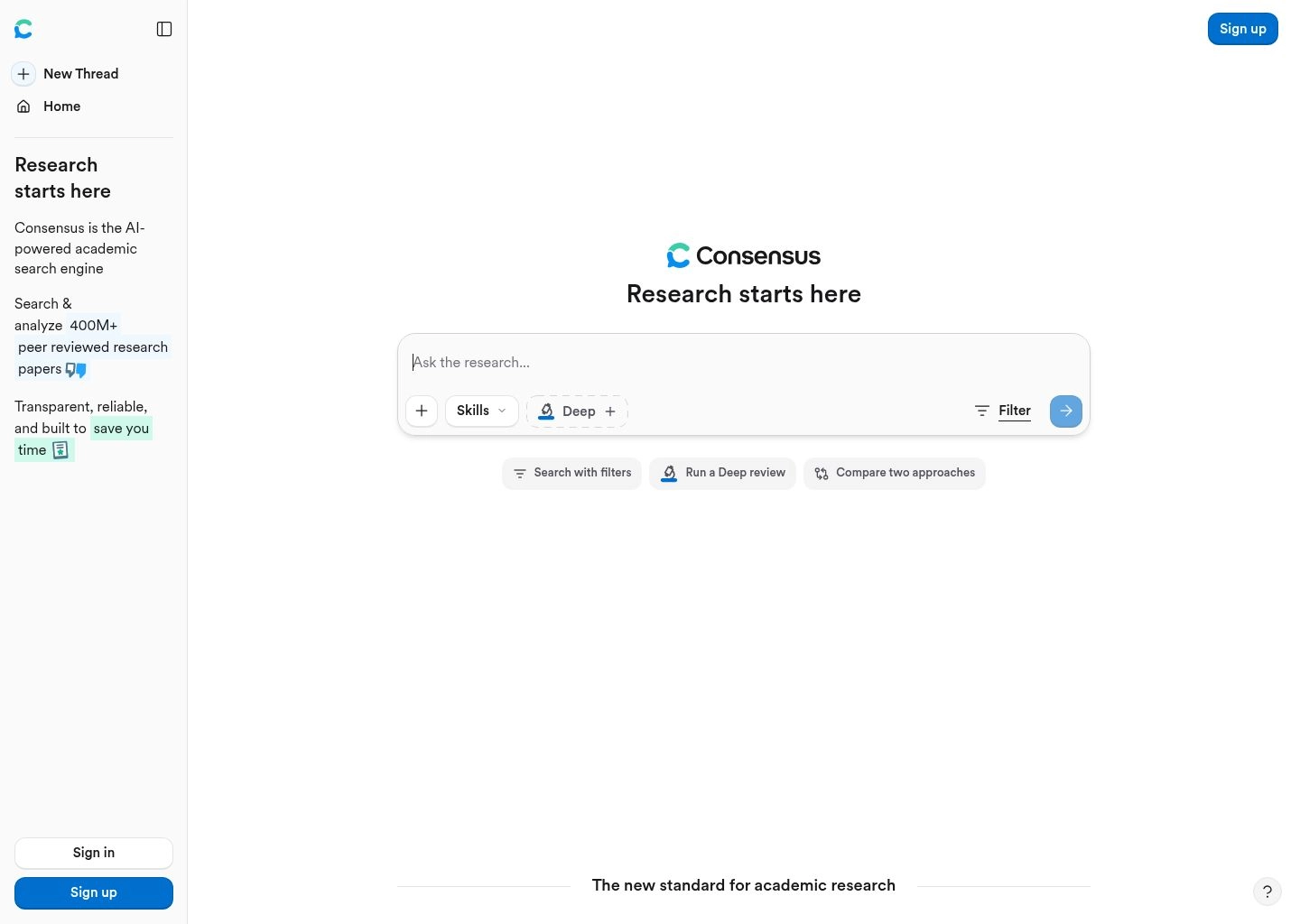
Consensus is an AI-powered academic search engine designed to answer direct scientific questions using only peer-reviewed literature. By querying over 200 million papers through the Semantic Scholar database, Consensus eliminates search engine noise and SEO-driven blog spam.
Its signature feature is the Consensus Meter: when you pose a yes-or-no question (e.g., "Does creatine improve cognitive performance in sleep-deprived adults?"), the AI reads the top 20 relevant studies and calculates an aggregate percentage score (e.g., 85% Yes, 10% Possibly, 5% No). It also tags each paper with essential study metadata, including Human vs Animal trials, Double-Blind RCT flags, and the Study Quality score.
✅ Key Strengths
- • Proprietary Consensus Meter provides instant quantitative consensus overviews.
- • Rigorous study badge metadata (RCT, Sample Size, Meta-Analysis, Animal Trial).
- • GPT-4-powered synthesis extracts 1-sentence takeaways from each paper.
- • Clean, highly intuitive user interface accessible to students and seasoned researchers alike.
⚠️ Limitations
- • Less customizable than Elicit for complex, multi-variable column extraction.
- • Best suited for empirical/health/social science questions with binary or directional hypotheses.
Pricing: Free plan includes unlimited basic searches and 20 AI Consensus credits. Premium plan starts at $8.99/month (billed annually) with unlimited Consensus Meters and GPT-4 summaries.
View Consensus Profile & Features →3. Scite.ai — Best for Smart Citations & Claim Validation
Best for: Detecting retractions, verifying paper reproducibility, and tracking citation context
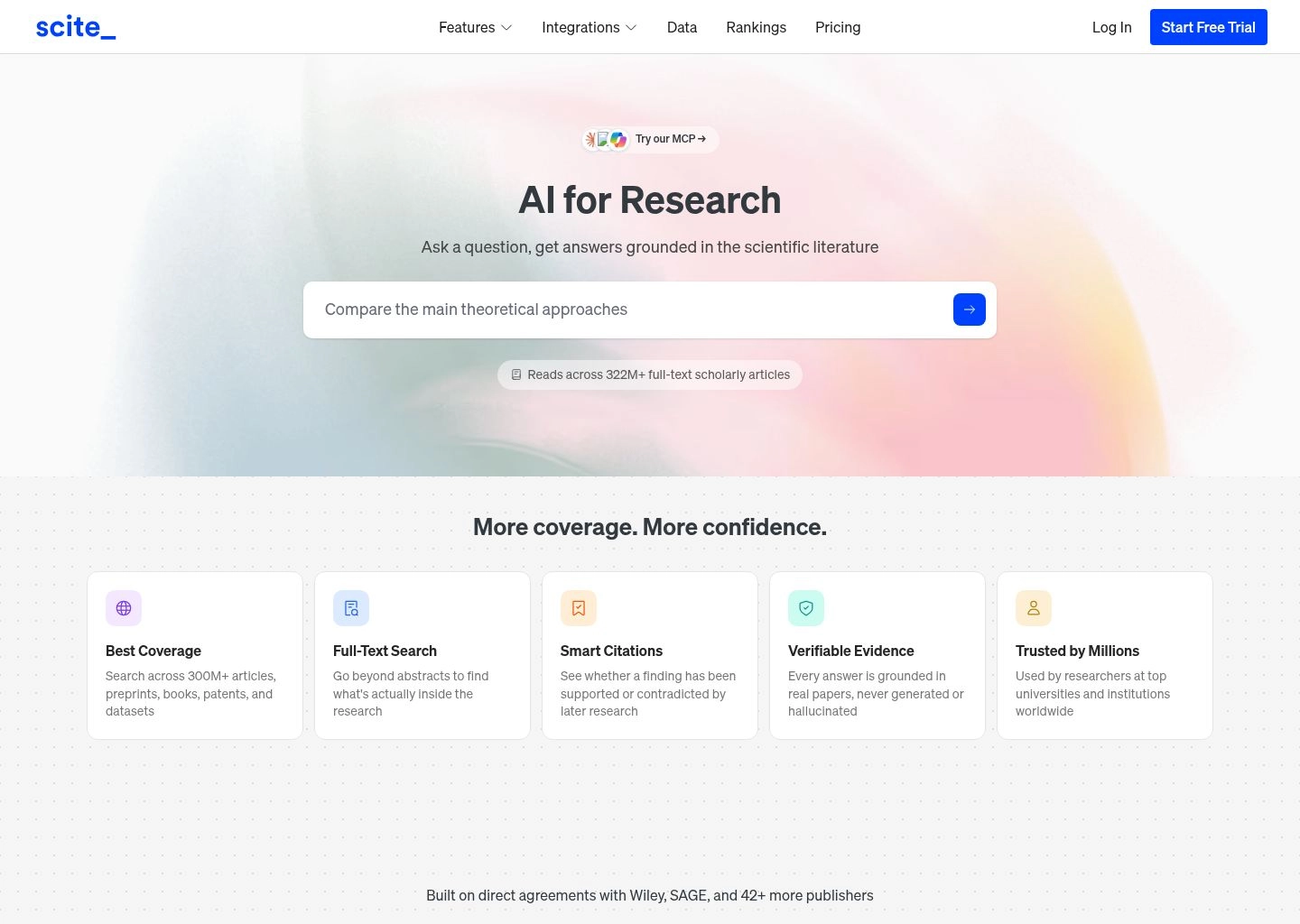
Scite.ai revolutionized academic citation metrics by introducing Smart Citations. Traditional citation counts (like Google Scholar citation tallies) tell you how many times a paper was referenced, but give zero clue whether other scientists agreed with the findings or completely debunked them.
Scite’s deep-learning model has analyzed over 1.2 billion citation statements across 187 million papers. It extracts the full contextual sentence surrounding each citation and classifies it into three buckets: Supporting Evidence (subsequent study replicated or confirmed the result), Contrasting Evidence (subsequent study disagreed or failed to replicate), or Mentioning. This makes Scite an essential safeguard against building your literature review on flawed or contested methodology.
✅ Key Strengths
- • 1.2B+ Smart Citations classify supporting vs contrasting context in real time.
- • Instant Retraction Watch & Editorial Notice alerts prevent citing retracted studies.
- • Scite Assistant allows natural language drafting with verified, cited paper snippets.
- • Browser extensions for Chrome, Firefox, and seamless Zotero plugin integration.
⚠️ Limitations
- • No permanent free plan (only a 7-day free trial).
- • Machine-learning classification can occasionally mislabel complex nuanced phrasing.
Pricing: 7-day free trial. Individual plans cost $12/month (billed annually at $144/year) or $20/month monthly. Institutional access is available.
View Scite.ai Profile & Features →4. ResearchRabbit — Best for Visual Citation Graphs & Spotify-Style Discovery
Best for: Exploratory literature search, finding seminal authors, and building interconnected paper collections
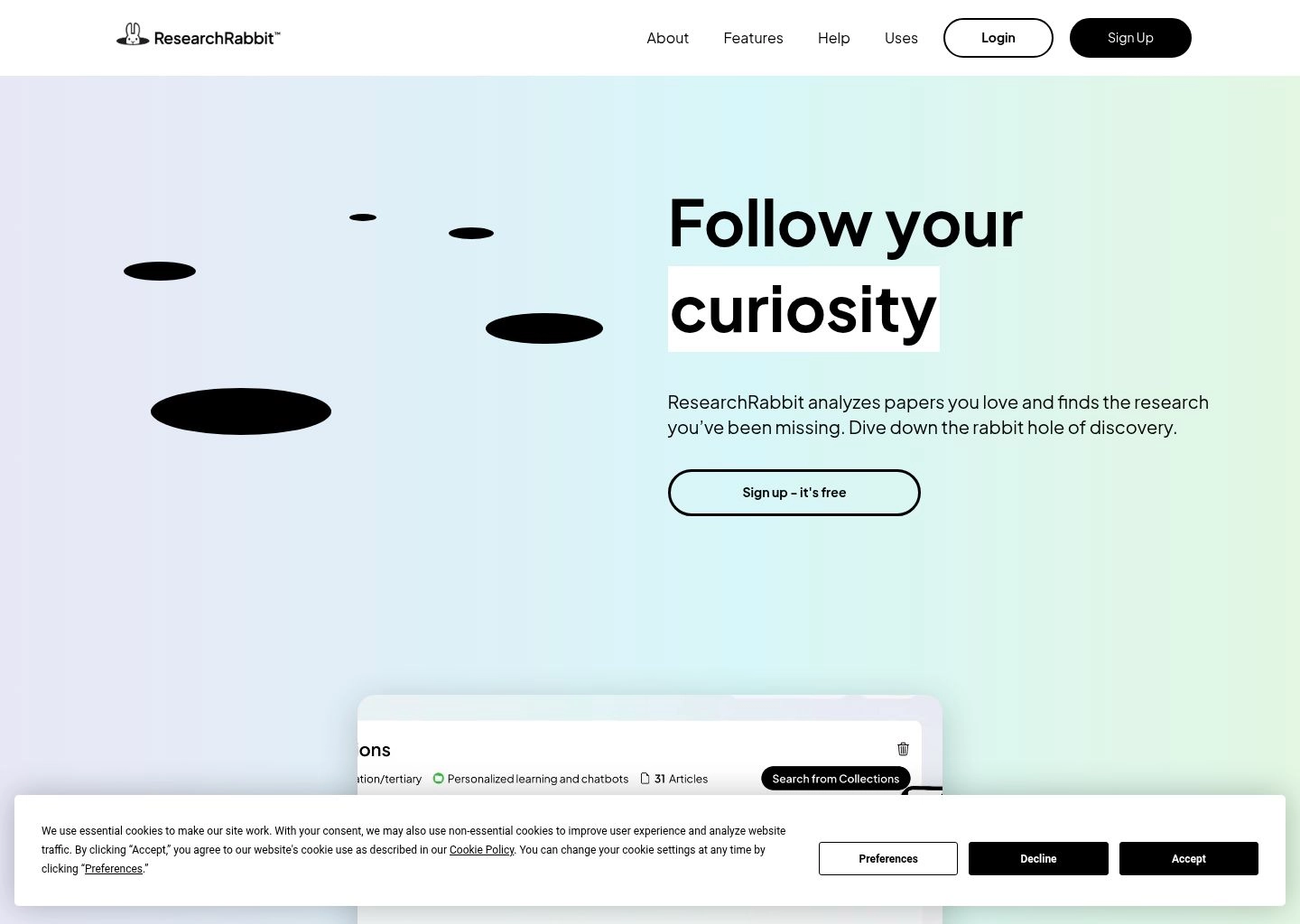
Dubbed the "Spotify for Academic Papers", ResearchRabbit provides one of the most delightfully intuitive discovery interfaces in modern research software. You start by creating a "Collection" and adding 1–3 seed papers that represent your core topic.
ResearchRabbit then computes a multidimensional citation graph, visualizing Similar Work, Earlier Work (foundational lineage), Later Work (subsequent advances), and Co-Authorship Networks. As you add or remove papers, the AI algorithm dynamically recalibrates its recommendations in real time, uncovering seminal papers that keyword-based Google Scholar searches often miss entirely. Best of all, ResearchRabbit is committed to remaining completely free for researchers.
✅ Key Strengths
- • 100% free for all academic researchers with zero paywalls or credit caps.
- • Dynamic 2D interactive graphs visualizing citation networks and author clusters.
- • Bidirectional Zotero sync automatically updates collections across devices.
- • Email digest alerts notify you when newly published papers match your collections.
⚠️ Limitations
- • Does not perform deep NLP tabular extraction like Elicit.
- • Web-only interface (no native desktop offline application).
Pricing: 100% Free Forever for researchers and institutions.
View ResearchRabbit Profile & Details →5. Scholarcy — Best for Structured Flashcards & Deconstructing Dense PDFs
Best for: Fast screening of dense book chapters, clinical reports, and long academic monographs
Scholarcy is an AI-powered reading assistant that transforms complex, multi-page scientific papers, book chapters, and reports into interactive summary flashcards. Used by over 600,000 students and researchers globally, Scholarcy addresses the sheer cognitive fatigue of literature screening.
Each Scholarcy flashcard parses a document into modular, digestible components: Key Concepts, Key Findings, Research Methodology, Extracted Tables & Figures, and Complete Reference Lists. You can export up to 100 flashcards simultaneously into a structured Literature Matrix (Excel, Word, Notion, or Markdown), drastically accelerating systematic review synthesis.
✅ Key Strengths
- • Automated extraction of tables, high-resolution figures, and direct data points.
- • 1-click Literature Matrix export into Excel, Notion, Obsidian, and Word.
- • Browser extension enables instant flashcard creation directly on PubMed and Nature.
- • Strict privacy: uploaded documents are encrypted and never used for public LLM training.
⚠️ Limitations
- • Free tier limits file uploads to 11MB and basic summary counts.
- • Does not provide visual citation network graph views.
Pricing: Free browser extension with 10 free daily summaries. Scholarcy Plus is $9.99/month (or $90/year) with unlimited document uploads and 50MB file capacity.
View Scholarcy Profile & Features →6. Litmaps — Best for Chronological Citation Trajectories & Live Alerts
Best for: Tracking research evolution over time, grant proposals, and automated niche monitoring
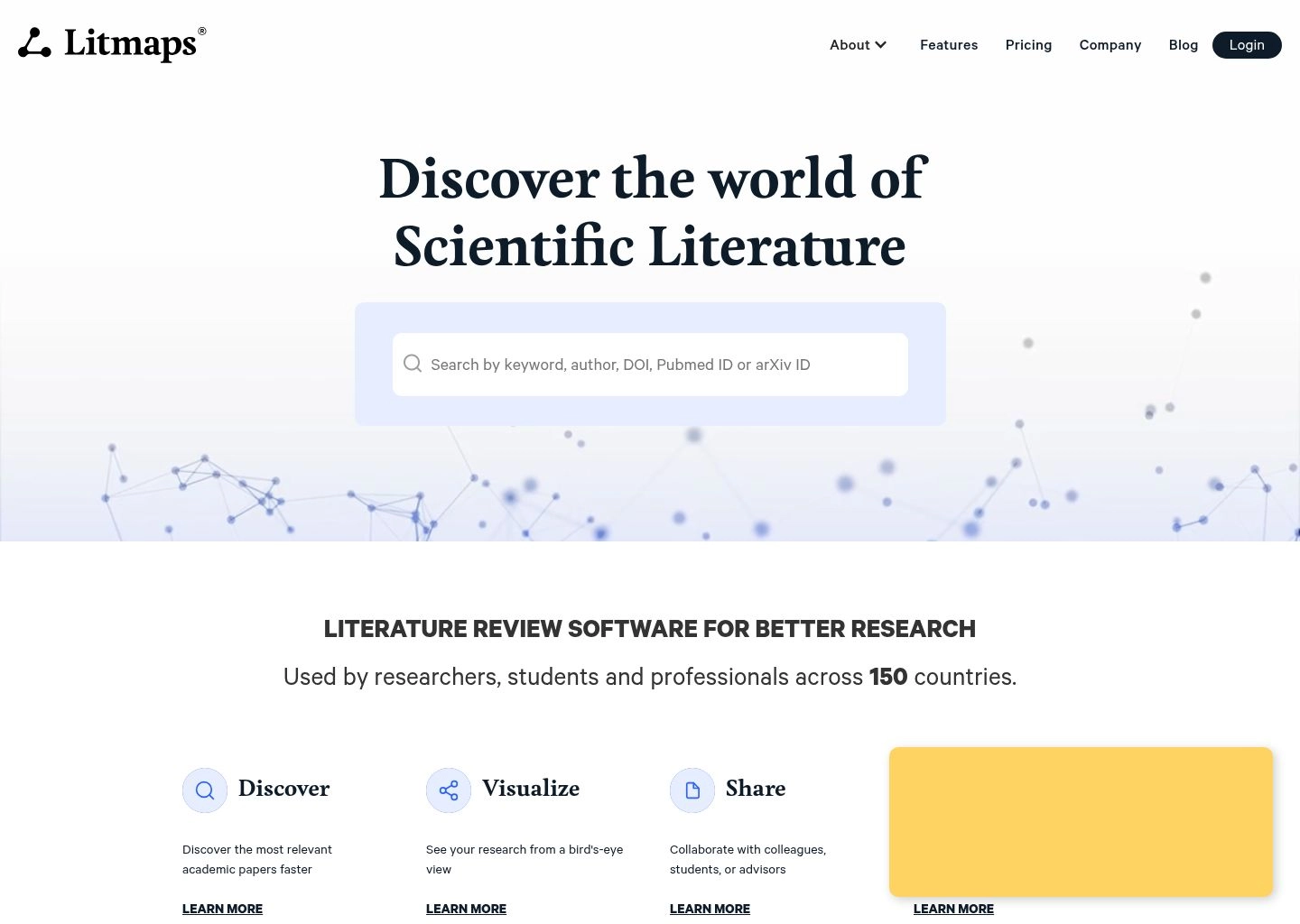
Litmaps takes a uniquely structured, chronological approach to citation visualization. While many tools produce tangled "bubble graphs", Litmaps plots papers along a clean X-axis representing publication year and a Y-axis representing citation velocity and impact.
This chronological mapping instantly reveals the historical genealogy of a scientific breakthrough: which 2018 paper inspired the 2022 clinical trial, and which 2025 pre-prints are currently pushing the frontier. Furthermore, Litmaps’ Monitor feature tracks your custom maps in the background, automatically alerting you whenever a new paper is published that cites articles in your bibliography.
✅ Key Strengths
- • Intuitive chronological layout avoids messy, unreadable node hairballs.
- • Automated Litmaps Monitor sends alerts when newly indexed papers cite your collection.
- • Strong integration with ORCID, DOI imports, and reference management libraries.
- • High-resolution vector SVG and PNG map exports for inclusion in thesis presentations.
⚠️ Limitations
- • Free plan only permits creating a single map with up to 20 articles.
- • NLP text extraction from full PDF bodies is less granular than Elicit.
Pricing: Free plan includes 1 map and 20 articles. Pro plan is $10/month (or $96/year) with unlimited maps, automated monitoring, and bulk exports.
View Litmaps Profile & Features →7. Connected Papers — Best for Rapid Seed-Paper Graph Exploration
Best for: Quick initial exploration when starting a brand new topic or entering an unfamiliar field
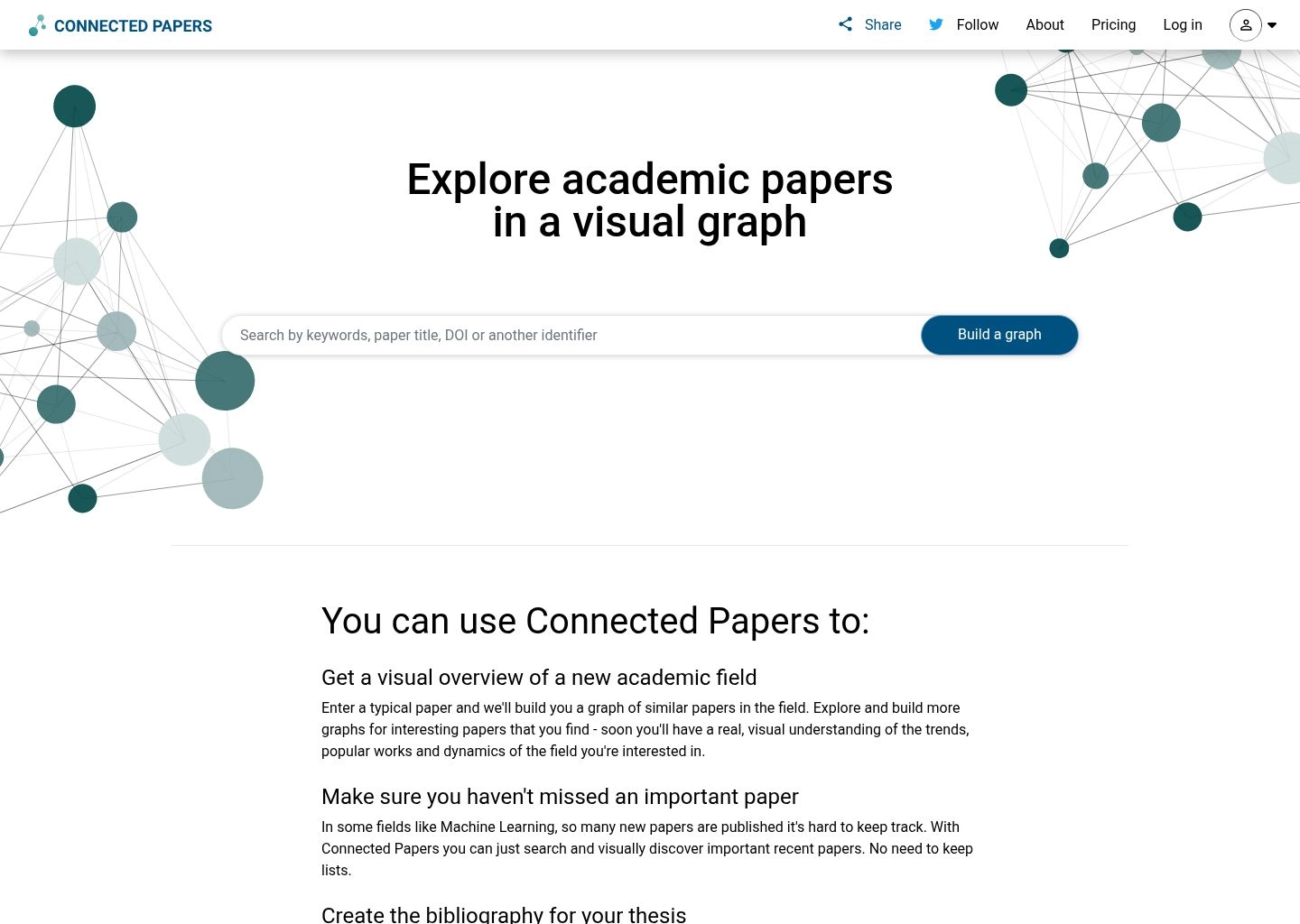
Connected Papers is the pioneer that popularized visual academic literature search. Rather than showing direct citation chains alone, Connected Papers analyzes Co-Citation (papers cited together) and Bibliographic Coupling (papers that cite the same sources) using the Semantic Scholar database.
This means papers in the same cluster are deeply semantically related even if they do not cite each other directly. In addition to the main cluster map, Connected Papers automatically computes two essential lists: Prior Works (seminal foundational papers in the field) and Derivative Works (recent reviews and meta-analyses building on this cluster).
✅ Key Strengths
- • Zero setup friction: paste a DOI or title to generate a full visual cluster in seconds.
- • Uncovers semantically related papers that share common references without direct citations.
- • Automated "Prior Works" and "Derivative Works" views identify seminal foundations.
- • Clean sidebar with direct links to publisher PDFs and Semantic Scholar entries.
⚠️ Limitations
- • Strictly builds graphs around a single seed paper (cannot combine multiple seed collections).
- • Free tier is limited to 5 graph generations per month.
Pricing: Free tier includes 5 graphs/month. Premium plan is $3/month (billed annually at $36/year) or $4/month with unlimited graph generations.
View Connected Papers Profile & Features →8. SciSpace — Best All-in-One Paper Copilot & Formula Deconstructor
Best for: Interactively reading technical PDFs, deciphering complex equations, and multi-lingual translation
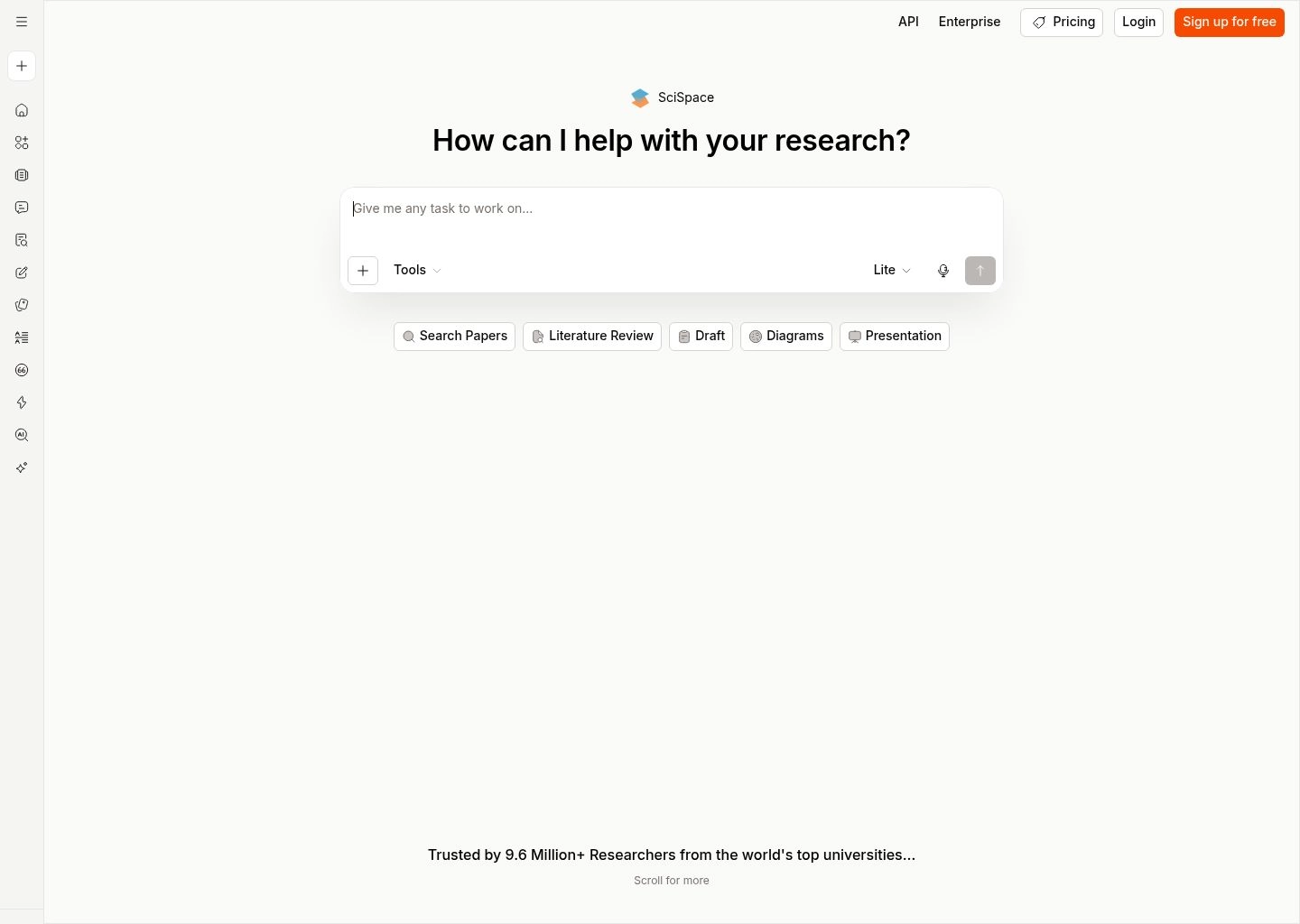
SciSpace (formerly Typeset) is a comprehensive academic research workspace designed to help researchers read, understand, and write papers faster. It hosts an expansive repository of over 280 million research articles paired with a contextual reading copilot.
SciSpace’s standout capability is its Snipping Copilot: you can draw a bounding box around any dense mathematical equation, chemical structure, or complex data table inside a PDF, and the AI will immediately break down each variable, step through the proof, and translate the findings into plain English. It also includes an integrated citation assistant and automatic journal reformatting engine.
✅ Key Strengths
- • Snipping tool explains complex mathematical formulas, graphs, and tables on demand.
- • Search across 280M+ papers with instant tabular claim summaries.
- • Multilingual support translates dense technical text into 75+ languages.
- • Integrated writing studio with 40,000+ auto-formatting journal templates.
⚠️ Limitations
- • Free version features lower context window limits during intensive PDF chat.
- • Broad feature set can feel cluttered compared to hyper-focused single-purpose tools.
Pricing: Free basic access for PDF reading and basic copilot chats. Premium plan starts at $12/month (billed annually at $144/year) with unlimited AI copilot questions and advanced model reasoning.
View SciSpace Profile & Features →The Technical Architecture of Academic AI: Eliminating Hallucinations
Why do tools like Elicit and Scite succeed where raw ChatGPT fails catastrophically? The difference lies in three distinct architectural layers engineered specifically for scholarly data:
1. Knowledge Graph Retrieval (RAG)
Instead of generating citations from memory weights, academic AI engines query structured graph databases (Semantic Scholar, Crossref, OpenAlex). The LLM is strictly constrained to synthesize text retrieved from validated DOIs.
2. Co-Citation Graph Embeddings
Tools like ResearchRabbit and Connected Papers project citation networks into high-dimensional vector spaces, calculating bibliographic coupling and citation velocity to surface conceptually related works.
3. Passage-Level Citation Grounding
Systems like Scite and Elicit perform sentence-level attribution, pairing every summary statement with exact paragraph anchors, page numbers, and supporting vs contrasting metadata.
The 5-Step Blueprint for Conducting a Flawless AI Literature Review
Follow this proven five-step workflow to combine visual mapping, consensus validation, and structured extraction into a publication-ready literature review:
- Formulate & Validate the Research Question: Input your core hypothesis into Consensus to check overall scientific alignment and study volume across peer-reviewed journals.
- Map the Visual Citation Network: Take 2–3 seminal papers and load them into ResearchRabbit or Connected Papers to discover foundational "Prior Works" and modern derivative publications.
- Build a Structured Extraction Matrix: Import the top 30–50 candidate papers into Elicit to extract methodology, sample sizes, interventions, and primary limitations into a unified comparative table.
- Verify Reproducibility & Smart Citations: Run your primary citations through Scite.ai to ensure none of your foundational sources have been contested, refuted, or retracted by subsequent studies.
- Synthesize & Draft with Academic Precision: Use Scholarcy or SciSpace to deconstruct dense PDF data tables and export citation-grounded outlines into Zotero or LaTeX.
Related Writing & Research Guides
Explore our comprehensive benchmarks across the AI writing and scholarly productivity ecosystem:
- The Ultimate Guide to AI Writing Assistant Tools (2026 Mega-Pillar)
- 7 Best AI Academic Writing Tools in 2026 (Grounded Research & Citations)
- 10 Best AI Essay Writing Tools in 2026 (Tested for Accuracy & Citations)
- 8 Best AI Summary Generators & Text Condensers in 2026
- 8 Best AI Rewriter & Sentence Rephrasing Tools in 2026
- 10 Best AI Grammar Checkers in 2026 (Ranked & Tested)
Frequently Asked Questions (FAQs)
Can academic journals tell if I used AI for my literature review?
Academic journals evaluate the accuracy, depth, and synthesis of your bibliography. Using AI tools like Elicit and ResearchRabbit for discovery and data extraction is widely accepted as a research aid, provided you read the cited papers, verify all findings, and draft the narrative synthesis yourself in accordance with journal disclosure guidelines.
How do specialized research tools prevent fake citations?
Unlike general chat models that generate text based on probability distributions, specialized tools use Retrieval-Augmented Generation (RAG) anchored to live academic databases like Semantic Scholar, PubMed, and CrossRef. Every paper returned possesses a verified DOI, author list, and publication venue.
What is the difference between Elicit and Consensus?
Elicit is built for in-depth data extraction and systematic review tables, allowing you to extract custom variables across dozens of papers. Consensus is optimized for rapid question-answering and hypothesis testing, calculating a quantitative Consensus Meter across peer-reviewed studies.
Which visual citation mapping tool is best: ResearchRabbit, Litmaps, or Connected Papers?
ResearchRabbit is best for deep, ongoing exploration of multi-paper collections (and is 100% free). Litmaps is best for chronological timeline trajectories and automated monitoring. Connected Papers is the fastest tool for exploring clusters around a single seed paper.
Do these tools integrate with Zotero and Mendeley?
Yes. Elicit, ResearchRabbit, Scite.ai, and Scholarcy provide direct, bidirectional synchronization with Zotero, as well as one-click exports in RIS and BibTeX formats for Mendeley and EndNote.
What is the best completely free AI literature review setup?
Combining ResearchRabbit (for visual citation mapping and paper discovery), Consensus (free basic search for claim validation), and Scholarcy (free extension for paper flashcards) provides a powerful, 100% free research workflow.