For PhD candidates, postgraduate researchers, medical scientists, and academic faculty, the pressure to produce rigorous, peer-reviewed literature has never been more intense. However, using generic generative AI models like baseline ChatGPT or basic chatbots in academic writing introduces catastrophic risks: fabricated bibliographic citations, hallucinatory statistical claims, stylistic oversimplification, and immediate rejection by journal peer-review boards.
In 2026, specialized AI academic writing tools have evolved to solve these fundamental challenges. Rather than fabricating text out of statistical probabilities, these scholarly AI platforms anchor every assertion to verified citation databases (such as PubMed, Semantic Scholar, Crossref, and Scopus). They assist scholars across the entire scientific workflow—from automated systematic literature reviews and Smart Citation contextual validation to journal-specific stylistic polishing and LaTeX integration.
To identify the most dependable platforms for researchers, we evaluated dozens of tools across literature discovery depth, citation accuracy, grammar and academic register refinement, and journal compliance. Below are the 7 best AI academic writing tools tested and ranked for 2026.
⚡ The 30-Second Executive Summary: Top Academic AI Tools
Best Overall Academic Writing Assistant: Jenni AI leads the market with verified in-text citations (APA, MLA, Harvard, IEEE), autocomplete tailored for scholarly research, and an integrated AskJenni PDF assistant.
Best for Citation Validation & Fact-Checking: Scite.ai evaluates over 1.2 billion Smart Citations to reveal whether cited papers have been supported, disputed, or retracted by subsequent literature.
Best for Journal Pre-Submission Polishing: Paperpal provides real-time academic language editing, journal manuscript readiness checks, and Word/LaTeX add-ins trained on millions of peer-reviewed articles.
Best for Consensus-Driven Literature Evidence: Consensus AI surfaces evidence-based answers extracted directly from 200M+ scientific papers with an automated Consensus Meter.
Best for Systematic Reviews & Meta-Analyses: Elicit automates systematic literature reviews, structuring findings into customizable comparison matrices across methodologies, sample sizes, and outcomes.
2026 Benchmark Scorecard: Top 7 AI Academic Writing Tools
The table below summarizes our comprehensive benchmark of the top 7 academic writing platforms across citation integrity, literature database scale, primary use case, integration ecosystems, and pricing.
| Tool | Primary Academic Focus | Citation Database / Grounding | Citation Styles | Starting Price | Best For |
|---|---|---|---|---|---|
| 1. Jenni AI | AI Co-writing & In-text Citations | Crossref, PubMed & User PDFs | APA, MLA, Harvard, IEEE, Chicago | $12 / mo (annual) | 🏆 #1 Overall Academic Co-writer |
| 2. Scite.ai | Smart Citations & Evidence Vetting | 1.2B+ Extracted Citation Statements | Full Reference Manager Export | $12 / mo (annual) | Citation Reliability & Claim Vetting |
| 3. Paperpal | Journal Submission Readiness & Editing | Trained on 10M+ Peer-Reviewed Papers | Journal-Specific Style Guides | $19 / mo (or $119/yr) | Peer-Review Grammar & Formatting |
| 4. Consensus AI | Scientific Search & Consensus Meter | 200M+ Peer-Reviewed Papers (Semantic Scholar) | Direct DOI & BibTeX Export | Free / $8.99 / mo | Scientific Fact-Checking & Claims |
| 5. Trinka AI | Grammar & Technical Proofreading | STEM & Medical Corpora | AMA, APA, IEEE, Nature Standards | Free / $6.67 / mo | Medical & Technical Language Editing |
| 6. Writefull | Overleaf & LaTeX Academic Editing | Millions of Published Journal Articles | LaTeX Syntax Preservation | Free / $5.42 / mo | LaTeX, Overleaf & STEM Authors |
| 7. Elicit | Automated Systematic Literature Review | 125M+ Papers (Semantic Scholar & OpenAlex) | Structured CSV/RIS/BibTeX Export | Free / $10 / mo | Literature Synthesis & Extraction |
In-Depth Reviews: The 7 Best AI Academic Writing Tools
1. Jenni AI — The Premier Scholarly Co-Writer & Citation Engine
#1 Top Rated 2026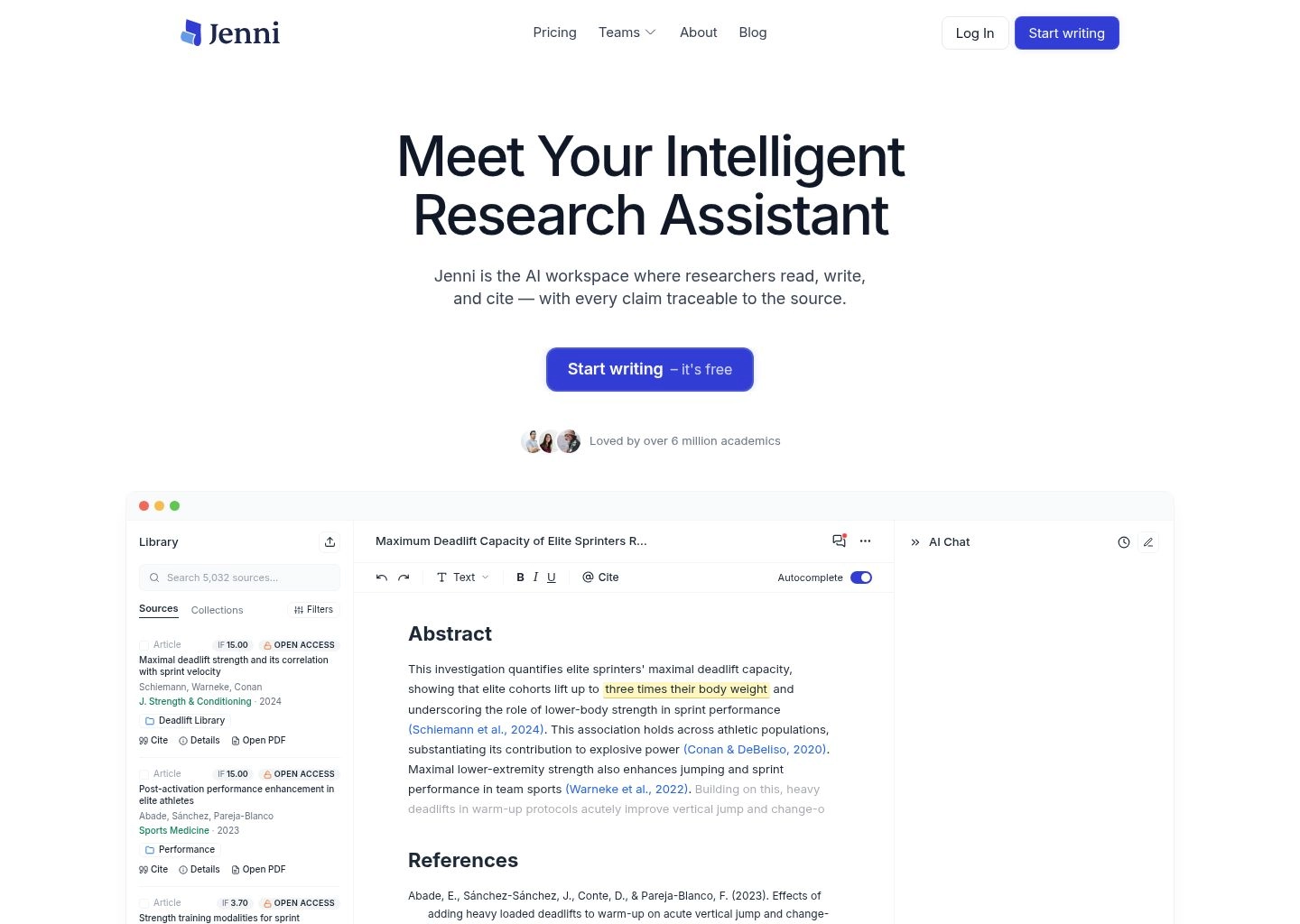
Trusted by over 4 million researchers, graduate students, and faculty members worldwide, Jenni AI has established itself as the leading AI writing assistant purpose-built for academic rigor. Unlike conventional AI tools that generate ungrounded prose, Jenni operates with strict bibliographic verification. Whenever the AI suggests an autocomplete sentence or expands a scientific argument, it actively queries scholarly databases (such as Crossref and PubMed) to append real, verified in-text citations in APA, MLA, Harvard, IEEE, or Chicago formats.
Jenni AI's flagship feature is its interactive AskJenni Research Assistant. Scholars can upload multiple PDF research papers, book chapters, and clinical trial results directly into their workspace. When drafting literature reviews or discussion sections, AskJenni synthesizes data across the uploaded papers, quoting exact page numbers and generating properly formatted bibliography entries without hallucination.
In addition to autocomplete, Jenni features built-in paraphrasing, outline generation, academic tone shifting, and a comprehensive plagiarism checker. It empowers scholars to overcome writer's block while maintaining full intellectual control over their manuscript's arguments.
- Grounded Academic Autocomplete: Suggests context-aware sentences supported by real published academic sources.
- Universal Citation Formats: Generates flawless in-text citations and bibliographies across APA 7, MLA 9, Harvard, IEEE, and Chicago.
- AskJenni PDF Library Assistant: Chat directly with your uploaded PDF research repository to extract evidence and quotes.
- Built-in Academic Plagiarism Checker: Scan drafts against billions of web pages and published scholarly journals.
Smooth, intuitive writing flow; eliminates the risk of fake AI citations; great PDF synthesis.
Free plan is limited to 200 AI words per day; requires manual verification for niche field citations.
Pricing & Verdict: Free tier includes 200 AI words/day and basic citations. Unlimited Plan costs $12/month (billed annually at $144/year) or $20/month billed monthly, unlocking unlimited AI generation, document uploads, and plagiarism checks. The single best all-around academic co-writer available in 2026.
2. Scite.ai — Best for Smart Citations & Evidence Verification
Smart Citations Leader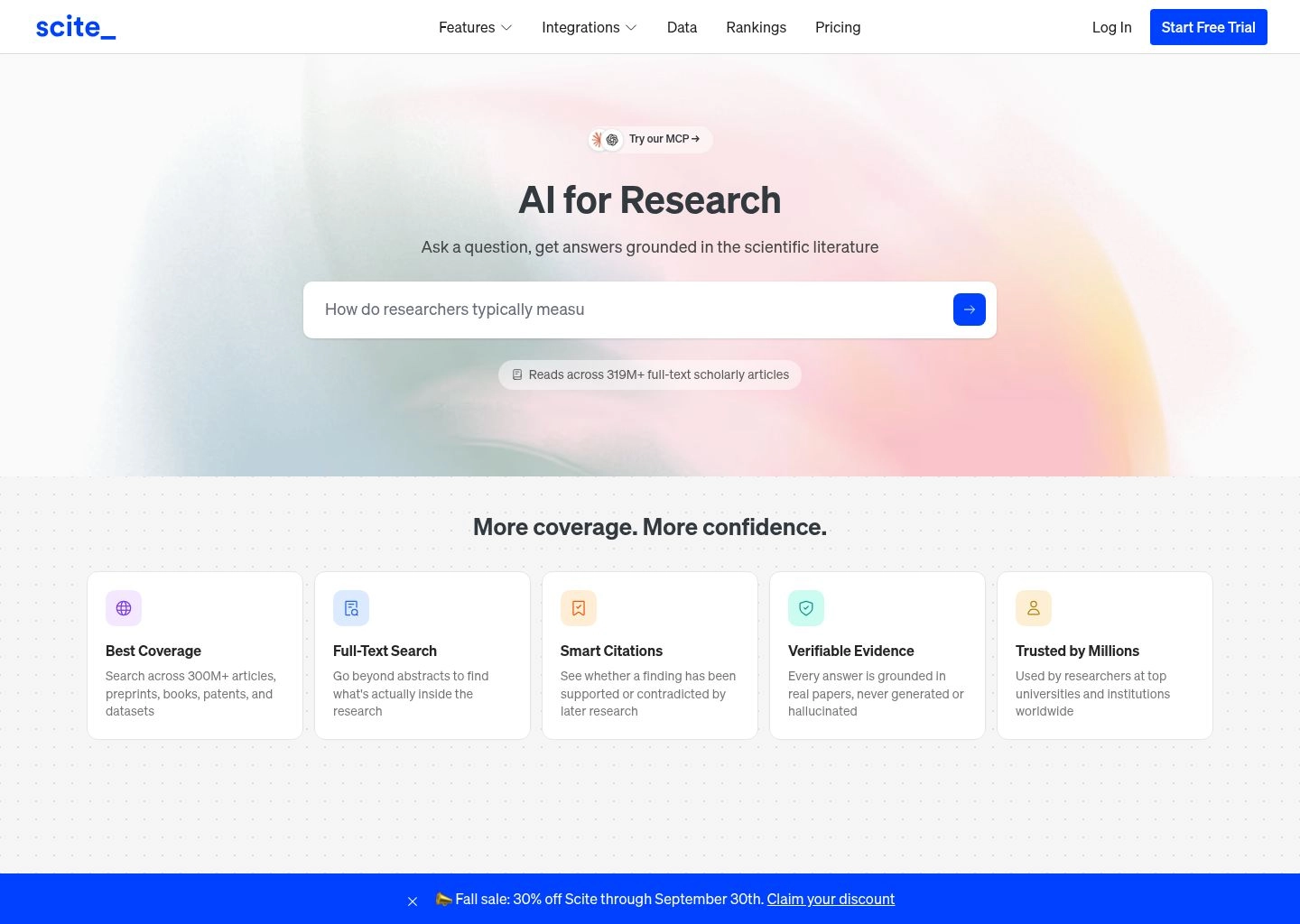
Traditional citation metrics (such as the h-index or simple citation counts) only tell you how often a paper has been cited, but give zero indication of why it was cited. A paper with 500 citations might be heavily cited because its methodology was fundamentally flawed or its clinical findings were successfully debunked. Scite.ai solves this foundational problem through its award-winning Smart Citations technology.
Using deep learning models trained on over 1.2 billion citation statements extracted from 180+ million scholarly articles, Scite categorizes citations into three distinct buckets: Supporting (evidence that replicates or validates findings), Mentioning (contextual reference), or Contrasting (evidence that disputes or fails to replicate findings).
Additionally, Scite's Scite Assistant enables researchers to ask natural language questions (e.g., "What is the efficacy of GLP-1 agonists in non-diabetic fatty liver disease?") and synthesizes answers backed exclusively by peer-reviewed studies, complete with direct snippet quotations and automated retraction alerts.
- 1.2 Billion+ Smart Citation Statements: Instantly check whether any claim in your bibliography has been supported or refuted.
- Automated Retraction & Notice Alerts: Flags cited papers that have been retracted, corrected, or subject to expressions of concern.
- Scite Reference Check: Upload your draft manuscript to instantly scan your bibliography for problematic or ungrounded sources.
- Browser & Reference Manager Plugins: Seamless extensions for Chrome, Zotero, Mendeley, and browser search results.
Crucial defense against citing flawed or retracted research; provides deep contextual citation snippets.
No full standalone co-writing text editor; focused strictly on discovery, verification, and fact-checking.
Pricing & Verdict: 7-day free trial; Individual subscriptions start at $12/month (billed annually at $144/year) or $20/month billed monthly. Institutional site licenses available for universities. An absolute must-have tool for literature vetting and scientific claim validation.
3. Paperpal — Best for Journal Pre-Submission & Manuscript Polishing
Journal Submission Ready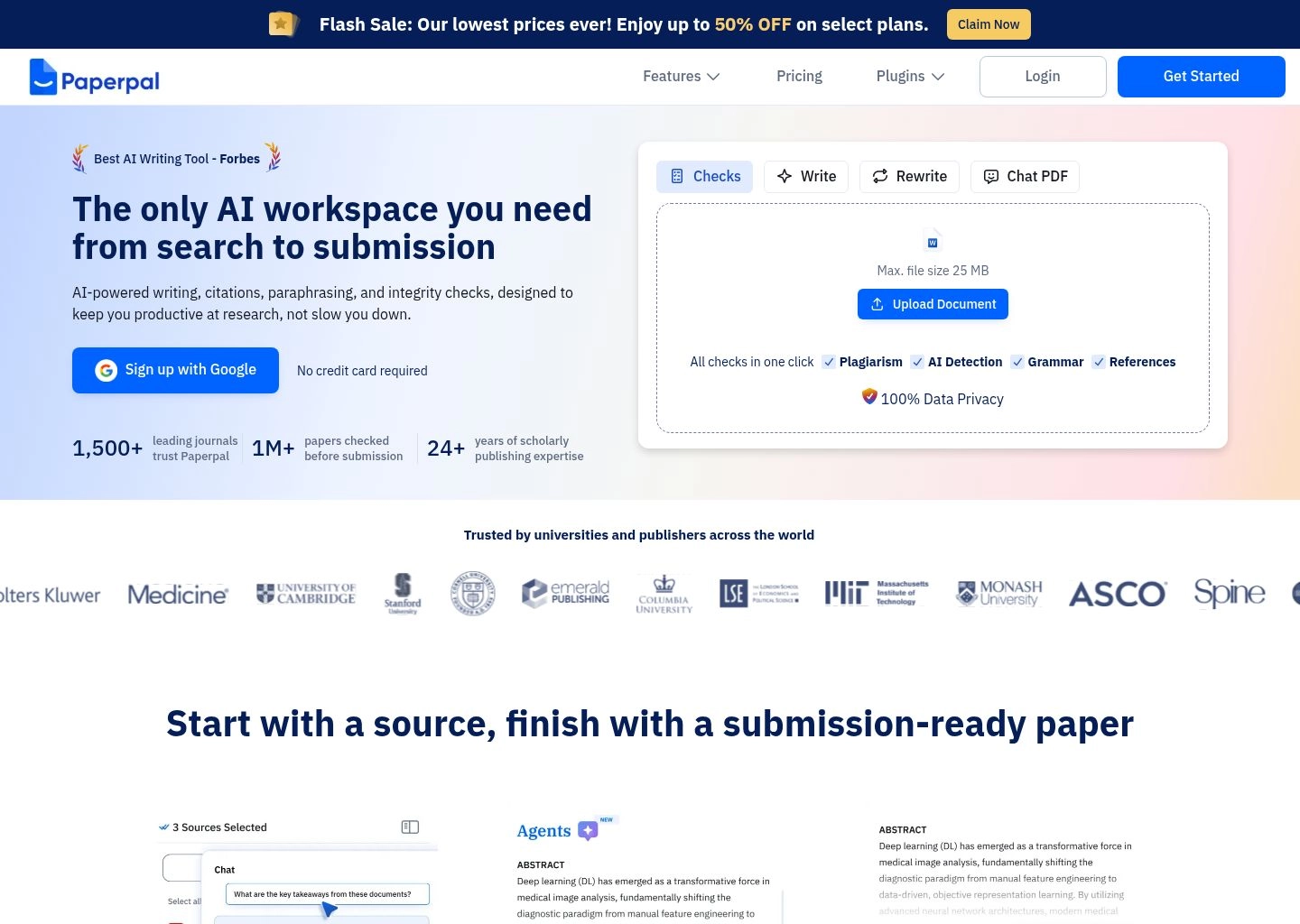
Developed by Cactus Communications (the parent company of Editage, a global leader in academic editing), Paperpal is tailored specifically for researchers preparing manuscripts for publication in leading international journals (such as Elsevier, Springer Nature, Wiley, and IEEE).
While generic grammar checkers often dumb down scholarly terminology or suggest overly simplistic phrasing, Paperpal was trained on millions of published peer-reviewed papers and edited manuscripts. It understands domain-specific conventions across medicine, physics, chemistry, social sciences, and engineering. Paperpal identifies non-standard phrasing commonly produced by ESL (English as a Second Language) authors and rewrites it into publication-quality academic English.
Paperpal's most impressive capability is its Journal Pre-Submission Technical Check. In under two minutes, it analyzes your entire Word or LaTeX manuscript across 30+ technical parameters: language quality, word count limits, reference formatting completeness, ethical declaration disclosures, figure/table citation matching, and author affiliations—providing an actionable readiness score before journal submission.
- Trained on 10M+ Published Manuscripts: Delivers precise academic tone, register, and terminology recommendations.
- Pre-Submission Journal Technical Check: Flags missing ethics declarations, reference mismatches, and journal guideline violations.
- Microsoft Word & Web Add-in: Seamless integration into native Word desktop, Word Online, and Overleaf workflows.
- Generative Academic Rewriting: Summarizes research, generates abstract drafts, and recommends titles suited for target journals.
Exceptional support for ESL researchers; excellent MS Word add-in; robust journal pre-flight validation.
Full journal submission audits consume dedicated check credits on lower-tier plans.
Pricing & Verdict: Free tier includes 200 suggestions/month and basic checks. Paperpal Prime costs $19/month or $119/year (approx. $9.92/month), providing unlimited grammar checks, generative rewrite features, and 30 full pre-submission checks per year. The best tool for international researchers aiming for high-impact journal acceptance.
4. Consensus AI — Best for Scientific Fact-Checking & Consensus Analysis
Consensus Meter AI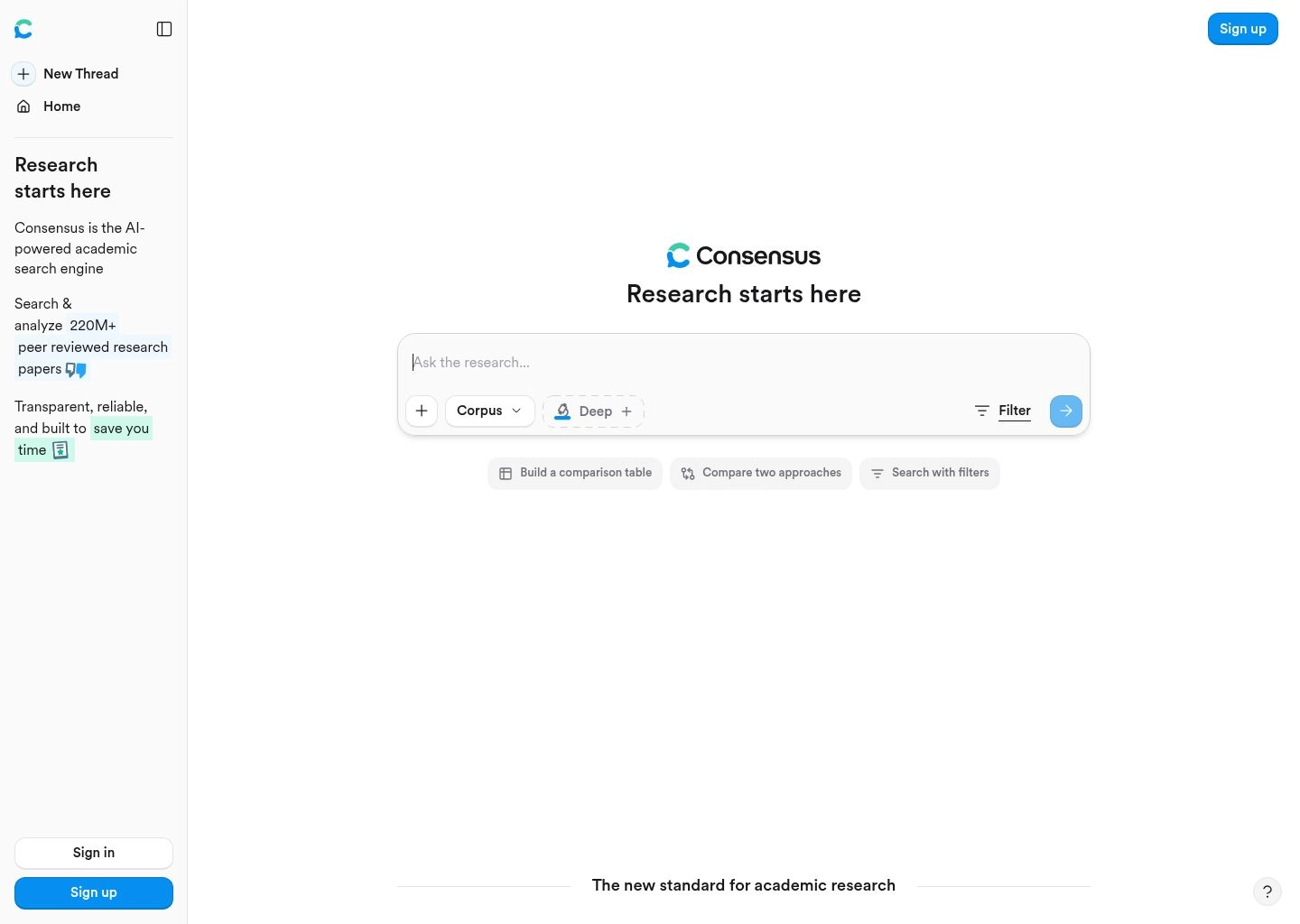
When formulating hypotheses, drafting introductions, or defending research methodologies, scholars need to know: What does the broader scientific literature actually say about this question? Consensus AI is an academic search engine that extracts evidence-based conclusions directly from over 200 million peer-reviewed papers cataloged in Semantic Scholar.
Consensus's hallmark innovation is the Consensus Meter. When you ask a definitive research question (e.g., "Does intermittent fasting improve insulin sensitivity in pre-diabetic adults?"), Consensus analyzes dozens of randomized controlled trials and meta-analyses, generating an aggregated breakdown: for example, 82% Yes, 11% Possibly, 7% No.
Beneath the consensus breakdown, Consensus presents key takeaways extracted verbatim from study abstracts, tagged with methodological rigor indicators (such as Sample Size, Study Type: RCT vs. Observational, Human vs. Animal, and SJR Journal Ranking). Every claim is linked directly to its DOI and full-text source, allowing researchers to copy verified citations straight into Zotero or Word.
- Automated Consensus Meter: Synthesizes research consensus across dozens of clinical trials and papers.
- Study Quality Badges: Instantly displays study type, sample size, methodology, and journal SJR ranking.
- GPT-4 Powered Syntheses: Generates concise literature summaries citing verified DOIs and authors.
- Copilot Search Assistant: Ask complex follow-up questions to drill into subgroup analyses or methodology details.
Saves hours of manual PubMed screening; transparent study methodology tags prevent cherry-picking.
Primarily analyzes abstracts rather than full-text PDF data tables.
Pricing & Verdict: Free plan includes unlimited basic searches and basic Consensus meters. Premium Plan costs $8.99/month (billed annually at $107.88/year) or $11.99/month billed monthly, unlocking unlimited Copilot searches, study snapshot filters, and full export capabilities. The premier tool for fast scientific fact-checking.
5. Trinka AI — Best for Medical, STEM & Technical Language Editing
STEM & Medical Specialist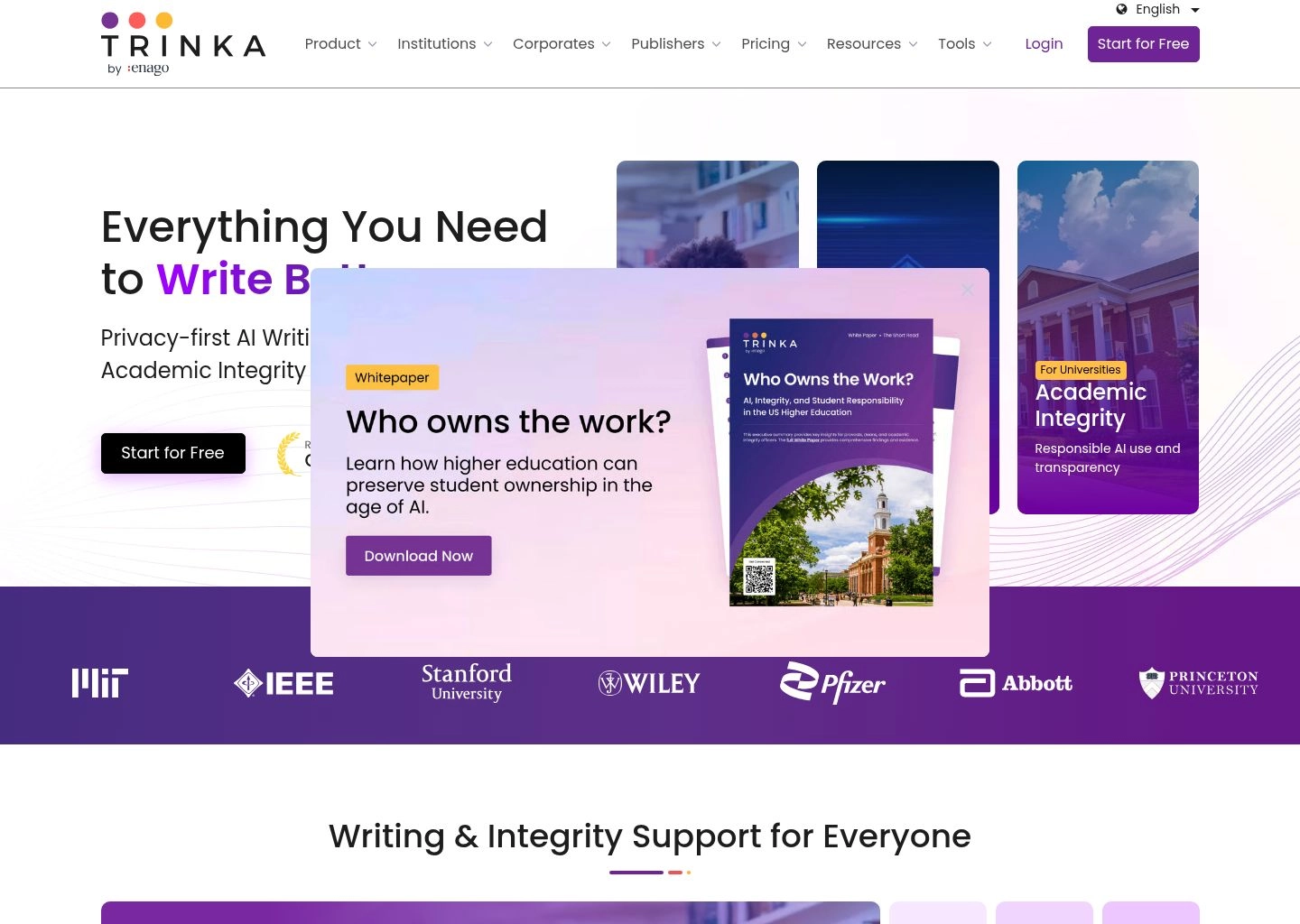
Trinka AI was developed specifically to address the complex syntactic, terminological, and formatting challenges unique to STEM, medical, life sciences, and technical publications. Standard proofreading algorithms often flag complex chemical nomenclature, mathematical notations, gene designations, or pharmaceutical drug names as typos. Trinka, by contrast, possesses deep subject-matter vocabularies spanning over 1,300 technical disciplines.
Trinka corrects over 3,000 complex academic grammar errors that standard software completely overlooks—such as subject-verb agreement in complex scientific clauses, active vs. passive voice balance in methodology sections, ambiguous pronoun references, and discipline-specific vocabulary choice (e.g., advising between "homogeneous" and "homogenous" based on context).
Beyond grammar, Trinka enforces adherence to major international style guides, including AMA (American Medical Association), APA 7th, IEEE, and Nature standards, ensuring consistent capitalization, statistical reporting, unit abbreviations, and citation structures.
- 1,300+ Technical Subject Disciplines: Flawlessly handles medical terminology, chemical compounds, and equations.
- Journal Style Guide Enforcement: Automated compliance checks for AMA, APA 7, IEEE, and Nature standards.
- Automated Publication Readiness Audit: Evaluates manuscript structure, abstract completeness, and ethics statements.
- MS Word & Browser Add-ins: Proofread seamlessly within Microsoft Word desktop and web browsers.
Superior handling of dense biomedical and mathematical phrasing; generous free plan (10,000 words/month).
Web interface can feel cluttered compared to modern minimalist writing apps like Jenni.
Pricing & Verdict: Free Basic plan includes 10,000 words per month and 1 free plagiarism check. Premium Plan starts at $6.67/month (billed annually at $80/year) or $20/month billed monthly, providing unlimited word processing, advanced journal style checks, and monthly plagiarism credits. The top choice for medical and STEM researchers.
6. Writefull — Best for Overleaf, LaTeX & STEM Authors
LaTeX & Overleaf Integration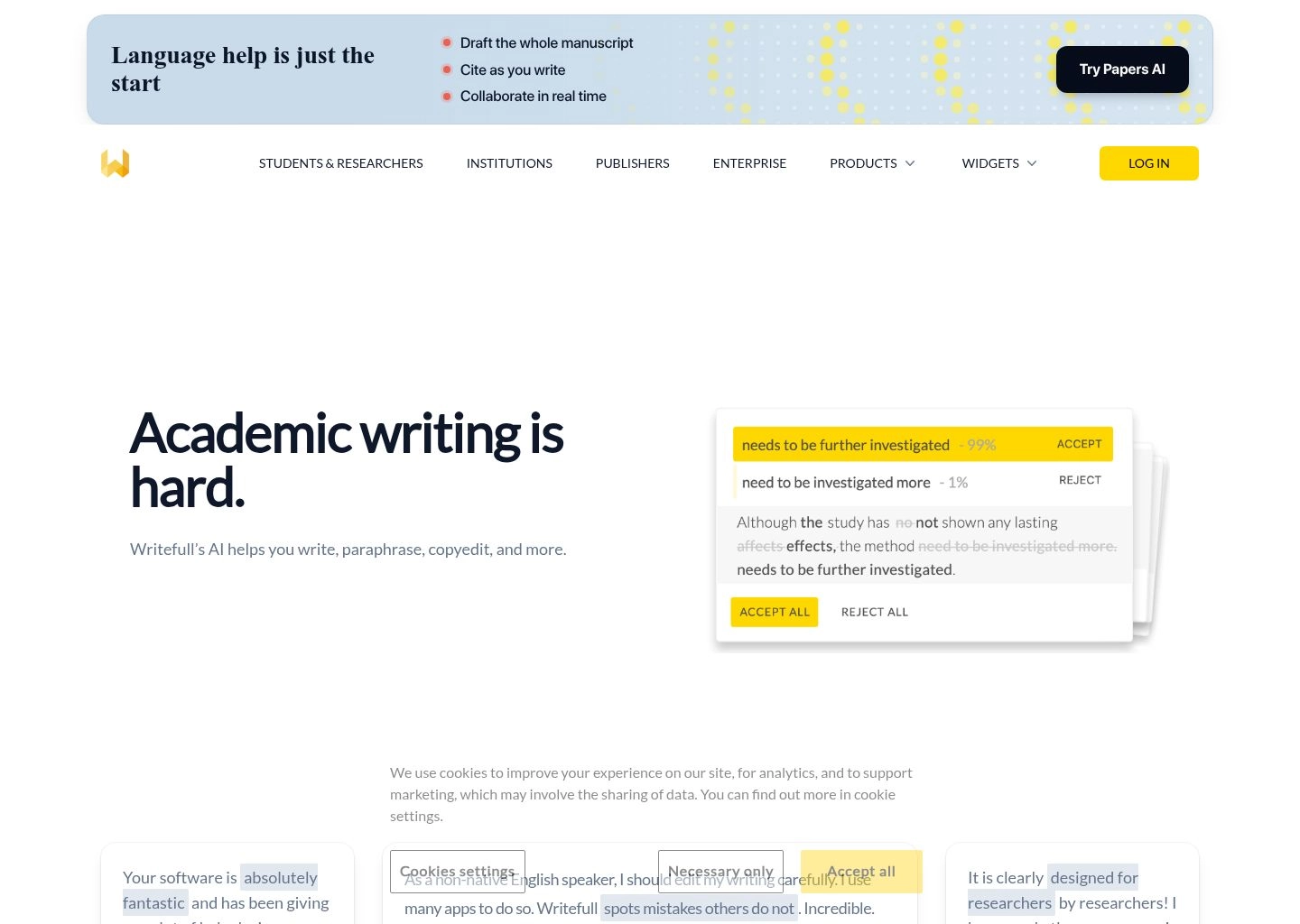
For physicists, mathematicians, computer scientists, and economists who write their research exclusively in LaTeX using Overleaf, standard grammar plugins are notoriously problematic: they constantly break LaTeX tags, scramble math delimiters (`$...$`), and misinterpret code blocks. Writefull was engineered specifically to solve this challenge.
Writefull features a dedicated, native Overleaf Chrome extension that reads your LaTeX source code, providing real-time AI language suggestions and phrasing improvements directly inside the Overleaf editor while safely ignoring all LaTeX markup, mathematical environments, and BibTeX citations.
Trained on millions of published journal articles across leading academic publishers (including Cambridge University Press and Nature), Writefull's language models suggest precise scholarly phrasing, help authors find standard academic sentence formulas (e.g., "In accordance with previous findings..."), and provide automated abstract generation and title recommendations.
- Native Overleaf & LaTeX Extension: Edit LaTeX documents directly without breaking math syntax or markup tags.
- Academic Sentence Palette: Browse thousands of standard scholarly sentence structures extracted from published papers.
- Language Search Widget: Search how frequently specific two-word and three-word technical phrases appear in scientific literature.
- Title & Abstract Generator: Generate concise manuscript titles and structured abstracts from your paper's raw text.
The undisputed champion for Overleaf and LaTeX users; very affordable pricing structure.
Fewer standalone conversational brainstorming features compared to Jenni AI or ChatGPT.
Pricing & Verdict: Free tier available with basic suggestions. Writefull Premium starts at $5.42/month (billed annually at $65/year) or $14.50/month billed monthly. The essential companion for anyone drafting papers in Overleaf, LaTeX, or Word.
7. Elicit — The Automated Systematic Literature Review Assistant
Systematic Reviews AI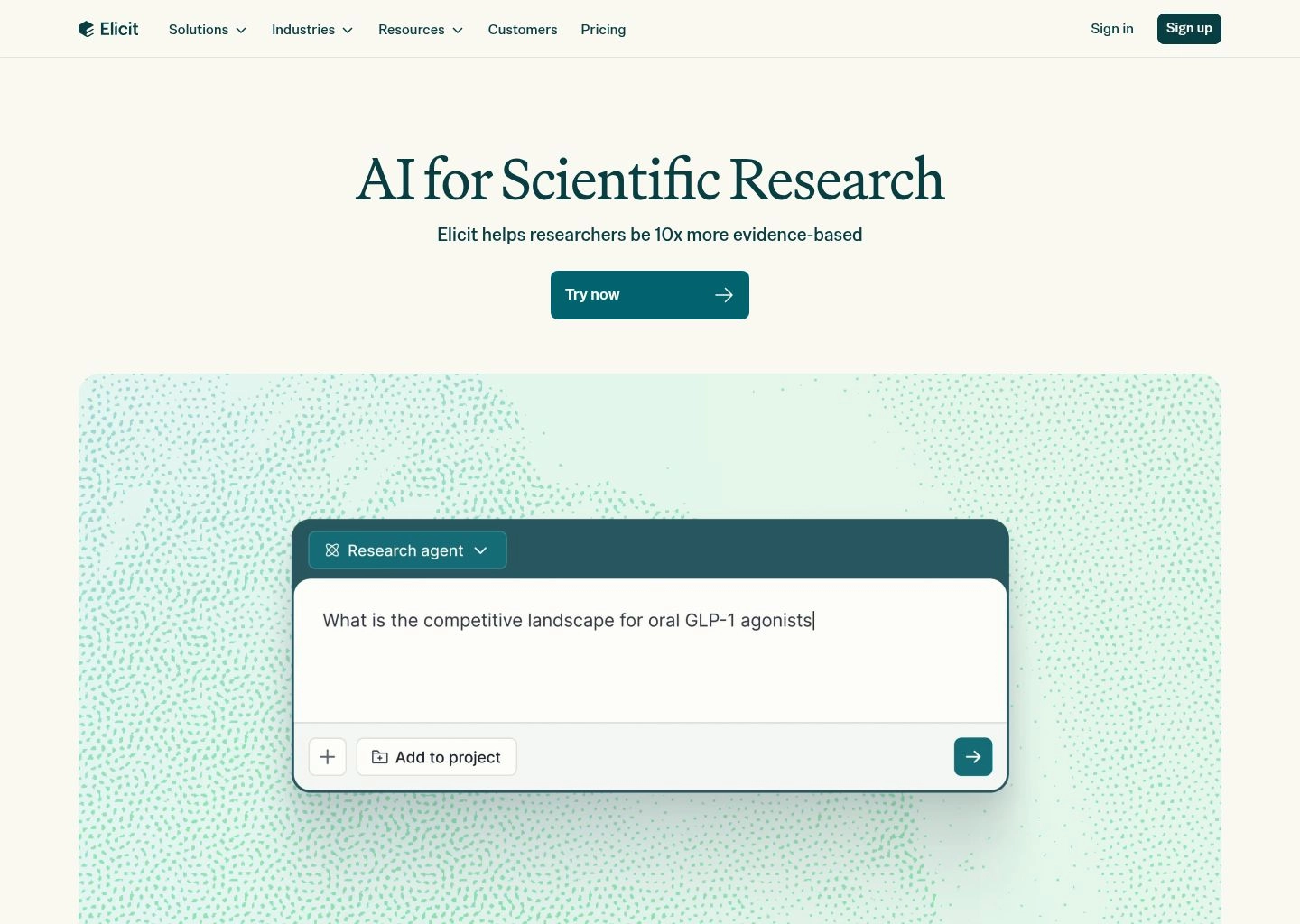
Conducting a rigorous systematic literature review or meta-analysis traditionally requires hundreds of hours of manual paper screening, PDF downloading, and tedious spreadsheet data entry. Elicit was developed by the nonprofit research organization Ought to automate and accelerate this entire workflow using fine-tuned language models.
Indexing over 125 million research papers from Semantic Scholar and OpenAlex, Elicit transforms natural language research questions into an interactive, multi-column scientific matrix. When you query a topic, Elicit reads the full text of relevant studies and automatically extracts key data points into dedicated columns: Intervention / Methodology, Sample Size & Demographics, Primary Outcomes Measured, and Limitations & Risk of Bias.
Researchers can also upload their own private library of PDF papers (up to hundreds of files) and ask Elicit to extract custom data fields—such as "What statistical p-value was reported for the primary endpoint?" or "What dosage of medication was administered?"—exporting the entire validated dataset directly to CSV, RIS, or BibTeX formats.
- Automated Data Extraction Tables: Automatically populate custom columns comparing methodologies, sample sizes, and outcomes.
- 125M+ Paper Scholarly Corpus: Deep semantic search identifying relevant studies even when exact keywords differ.
- Upload & Extract from Private PDFs: Analyze proprietary clinical datasets and unpublished research papers.
- Direct Export to Reference Managers: Export structured findings directly to Zotero, Mendeley, Excel, and BibTeX.
Saves weeks of manual systematic review labor; links every extracted data cell directly to the exact PDF page and paragraph.
Does not serve as an in-line prose writing assistant like Jenni AI.
Pricing & Verdict: Free Basic tier includes 5,000 one-time credits for search and extraction. Plus Plan costs $10/month (billed annually at $120/year) or $12/month billed monthly with 12,000 monthly credits and high-accuracy extraction models. The undisputed king of systematic literature reviews.
How to Use AI Academic Writing Tools Ethically (And Avoid Journal Rejection)
Leading academic publishers (including Nature, Elsevier, Science, and IEEE) have established clear, rigorous editorial policies regarding the use of AI in scientific research. To protect your academic reputation and ensure journal acceptance, adhere strictly to these four ethical principles:
1. AI Cannot Be Listed as an Author or Co-Author
All major journal editorial guidelines explicitly state that AI tools cannot meet authorship criteria because they cannot take legal and scientific responsibility for the integrity of the data or approve the final manuscript.
2. Transparent AI Disclosure in Methodology or Acknowledgments
Always disclose your use of AI tools in your manuscript's Methods or Acknowledgments section. Specify which tool was used (e.g., "Jenni AI was used to assist in literature discovery and grammar polishing") and clarify that all factual assertions were verified by the human authors.
3. Manually Verify Every Primary Source and Citation
Never cite a paper based solely on an AI summary. Open the original PDF, verify that the cited paper actually supports your specific factual claim, and inspect its methodology for sample size and potential bias.
4. Use Scite or Retraction Watch to Screen Your Bibliography
Before submitting your manuscript, run your completed reference list through Scite.ai to ensure that none of your cited sources have been retracted, corrected, or refuted by newer replications.
Frequently Asked Questions (FAQ)
Can academic journals detect if I used an AI writing assistant?
Journals use advanced AI text classifiers (like Turnitin and Crossref Similarity Check). If you use generic tools to generate raw blocks of text, AI detectors will flag your manuscript. However, when using specialized academic tools like Jenni AI or Paperpal to refine human-written arguments and improve grammar, the output adheres to standard scholarly discourse and passes editorial review when properly disclosed.
Why do tools like ChatGPT hallucinate fake academic citations?
General-purpose LLMs predict the most statistically likely sequence of words based on training data. When asked for a citation, they frequently assemble real author names, plausible journal titles, and realistic-looking DOIs into a completely fabricated paper. Specialized tools like Jenni AI, Scite, Consensus, and Elicit query live scholarly databases (Crossref, PubMed, Semantic Scholar) to ensure every citation is a verified, real publication.
What is the best academic AI tool for Overleaf and LaTeX?
Writefull is the undisputed gold standard for Overleaf and LaTeX authors. Its browser extension integrates directly into the Overleaf editor, providing real-time AI suggestions while safely ignoring all LaTeX markup, equations, and BibTeX citations.
How does Scite.ai differ from Google Scholar?
Google Scholar provides raw citation counts and search indexing, but does not analyze the context of citations. Scite.ai evaluates over 1.2 billion Smart Citations to reveal whether subsequent researchers supported, mentioned, or contrasted the cited paper's claims, alerting you if a cited paper has been retracted.
Is it safe to upload confidential, unpublished research to academic AI tools?
Paid enterprise and individual tiers of reputable platforms like Jenni AI, Paperpal, and Scite contractually guarantee that your uploaded manuscripts and datasets remain strictly confidential and are never used to train public AI models. However, you should always verify the privacy policy and avoid using free unauthenticated tools with confidential proprietary data.
Explore our Ultimate Guide to AI Writing Assistants, check our ranked list of the 10 Best AI Grammar Checkers, read our review of the 7 Best AI Translation Tools, or browse the AI Writing Category and Productivity Category for more research software.