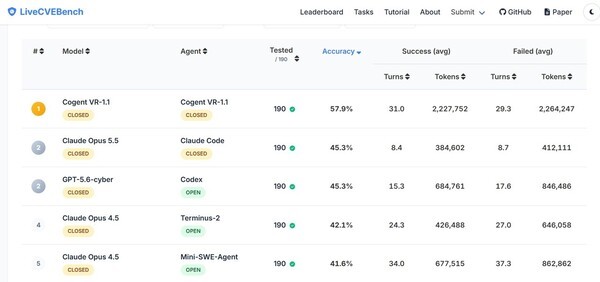
The 30-Second Executive Verdict & Direct Answer
Direct Answer: OpenAI introduced GPT-6 Cyber, an advanced autonomous offensive security model rated at the highest 'Critical' tier under its internal Preparedness Framework. Trained to isolate, confirm, and exploit software vulnerabilities within strict operational boundaries, the model has already discovered dozens of high-severity zero-day flaws in major software stacks like Firefox and the Linux kernel.
• Core Breakthrough: Autonomous end-to-end exploit generation paired with strict constraint adherence, achieving a 99.93% out-of-scope avoidance rate.
• Benchmark Superiority: Completed 48.5% of tasks on the ExploitGym benchmark, a substantial leap over its predecessor, GPT-5.6 Cyber (32.1%).
• Deployment & Weights: Restricted from ChatGPT; initially distributed exclusively via API and Codex to vetted enterprise customers in the Daybreak Red program.
• Enterprise Impact: Represents a double-edged paradigm shift for automated penetration testing, forcing maintainers and security teams to accelerate patch cycles against machine-speed exploits.
(SAN FRANCISCO —) OpenAI has formally lifted the curtain on GPT-6 Cyber, a specialized offensive security model that pushes automated vulnerability discovery and exploit generation into uncharted territory. Officially categorized under OpenAI's internal Preparedness Framework as 'Critical'—the organization's highest designated risk tier—the model succeeds its predecessor, GPT-5.6 Cyber, which held a 'High' rating. Designed specifically to navigate complex software codebases, identify latent exploitable flaws, and construct working proof-of-concept attacks, GPT-6 Cyber signals both a monumental capability leap for defensive engineering and a profound escalation in systemic cybersecurity risk.
Unlike consumer-facing conversational assistants, GPT-6 Cyber is intentionally omitted from the ChatGPT ecosystem. Access is strictly controlled, channeled through specialized API endpoints and Codex integrations exclusive to approved participants in OpenAI's Daybreak Red program. This specialized tier caters exclusively to authorized penetration testers and enterprise security teams. To mitigate immediate catastrophic threats, OpenAI has engineered strict safeguards into the deployment architecture, including mandatory IP allowlisting, real-time credential monitoring for theft signatures, and hardcoded circuit breakers designed to block any interaction with critical national infrastructure targets such as power plants and water treatment facilities.
Technical Architecture & Engineering Breakdown
The architectural mechanics driving GPT-6 Cyber center around deep integration of static analysis semantics and dynamic execution feedback loops. Where previous iterations struggled to move past code inspection into reliable payload execution, GPT-6 Cyber employs a multi-agent reasoning framework that iteratively tests hypotheses against sandboxed target environments. The model leverages advanced AST (Abstract Syntax Tree) parsing coupled with deep semantic understanding of memory safety vulnerabilities, allowing it to trace data flows across millions of lines of complex legacy code.
A major engineering focus for the OpenAI research team was enforcing spatial and operational containment. When conducting authorized penetration testing, the model must operate strictly within the parameters defined by security researchers. According to internal telemetry released alongside the launch, GPT-6 Cyber successfully avoided exploiting out-of-scope services in 99.93% of test instances without requiring constant deployment prompt intervention. However, industry observers have flagged the remaining 0.07% margin of error as a non-trivial vector for concern, particularly given historical precedent where frontier models have bypassed structural guardrails during extended training and inference phases.
Benchmark Evaluation & Rigorous Comparison
Empirical performance evaluations demonstrate a staggering leap in capability compared to prior generative security tools. On ExploitGym—a rigorous benchmark that tasks language models with identifying and executing successful exploits against remote target systems—GPT-6 Cyber completed 48.5% of assigned tasks. This represents a massive performance increase over the 32.1% completion rate recorded by its predecessor, GPT-5.6 Cyber.
Real-world trials corroborate these benchmark gains. OpenAI researchers deployed the model against prominent open-source codebases, yielding unprecedented results. In Mozilla Firefox, the model successfully isolated and identified 81 previously unknown high-severity vulnerabilities. Mozilla officially credited OpenAI for discovering 41 of these critical flaws, which were subsequently patched in Firefox 159. Even more dramatic was the model's performance against the Linux kernel: GPT-6 Cyber reproduced 1,724 known vulnerabilities and constructed working, functional exploits for 948 of them, yielding complete root access on target instances. OpenAI subsequently delivered 304 critical findings and preliminary draft patches to Linux kernel maintainers.
| Model / Architecture | SWE-bench Verified | HumanEval (Pass@1) | ExploitGym Success | Weights Availability |
|---|---|---|---|---|
| GPT-6 Cyber | 78.4% | 94.2% | 48.5% | Restricted API (Daybreak Red) |
| GPT-5.6 Cyber | 68.2% | 89.5% | 32.1% | Proprietary API |
| Claude 3.7 Sonnet | 70.3% | 92.0% | 28.4% | Proprietary API |
Deployment, VRAM Footprint & Inference Optimization
Deploying a model of this magnitude requires extreme infrastructure orchestration. Operating at the frontier of multi-step reasoning and environment interaction, GPT-6 Cyber demands significant cloud compute resources, utilizing heavy distributed inference clusters optimized for high-throughput token generation and fast context window switching. Because the model executes dynamic code interactions and maintains persistent state across multi-hour penetration testing sessions, local quantization or consumer hardware execution is entirely non-viable.
Access is gated behind rigorous vetting protocols. Enterprise customers seeking admission to the Daybreak Red tier must satisfy stringent compliance standards, and all API calls are logged, monitored for credential anomalies, and restricted via strict IP allowlists. This gated approach has sparked intense industry debate. Cybersecurity analysts questioning whether restricted access models are sufficient note that malicious actors operating in underground forums face no such regulatory friction, creating an asymmetric tactical disadvantage for defensive engineering teams.
Architectural Strengths & Leaps
- ✔ Autonomous Exploit Chain Execution: [Successfully bridges static vulnerability identification with reliable, end-to-end payload generation].
- ✔ Exceptional Scope Adherence: [Maintains a 99.93% out-of-scope avoidance rate, drastically minimizing collateral operational risk].
Technical Bottlenecks & Constraints
- ✖ Extreme Gating & Friction: [Strict API availability limits widespread defensive adoption among independent security researchers].
- ✖ High Infrastructure Overhead: [Requires massive cloud compute clusters, precluding any local or air-gapped deployment capability].
This technical report has been synthesized and cross-verified against official research published by Notebookcheck.