
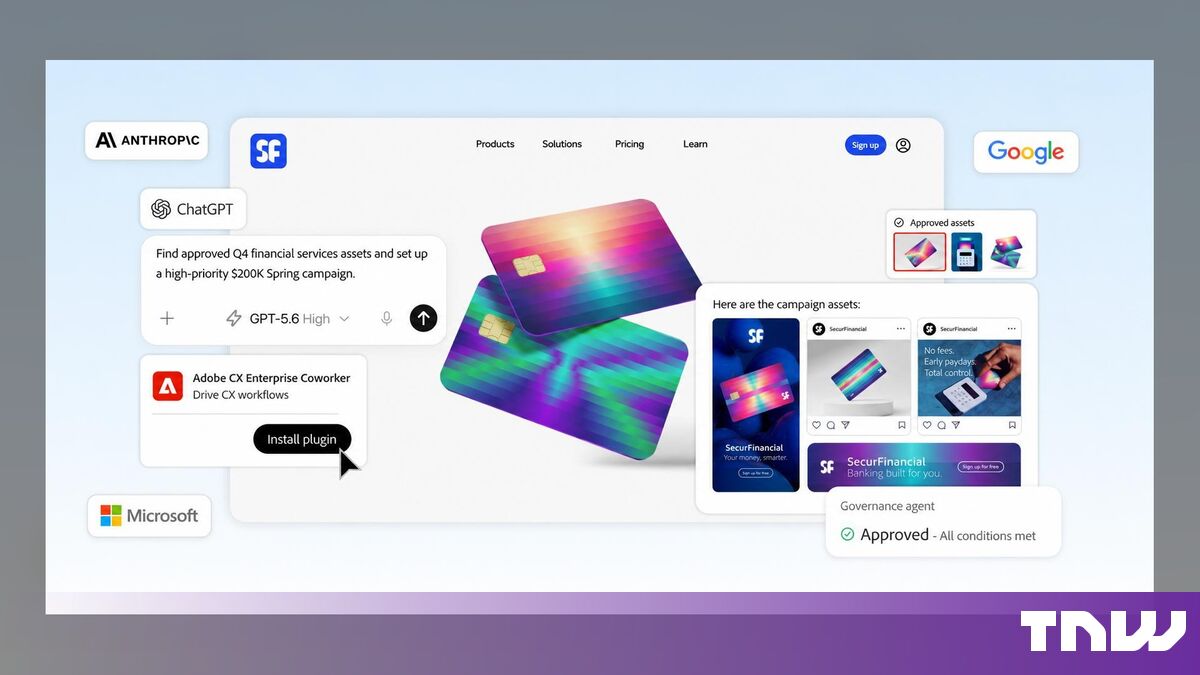
The 30-Second Executive Verdict & Direct Answer
Direct Answer: Adobe has integrated its flagship CX Enterprise Coworker marketing agent directly into frontier chat systems including ChatGPT, Claude, Gemini, Copilot, and Databricks Genie. Powered by the Model Context Protocol (MCP) and Agent2Agent (A2A) standards, the architecture allows marketing teams to orchestrate cross-platform campaigns using natural language while retaining mandatory human oversight.
• Core Breakthrough: Standardization of enterprise marketing toolsets through open MCP connectors, bridging isolated LLM interfaces with live infrastructure like Snowflake, Meta Ads, and Demandbase.
• Benchmark Superiority: Eliminates fragmented context windows by natively executing multi-step campaign planning, audience forecasting, and customer journey iteration in a single request loop.
• Deployment & Weights: Cross-platform plugin architecture deployed via managed cloud APIs, leveraging existing enterprise licenses across over 20,000 global brand deployments.
• Enterprise Impact: Directly replaces siloed software interfaces with an agentic orchestration layer, drastically lowering friction for multinational brands coordinating complex multi-channel media buys.
(SAN FRANCISCO —) Adobe is dismantling the operational silos that have long plagued enterprise marketing organizations by embedding its CX Enterprise Coworker directly into the frontier AI platforms professionals already rely on. Announced this week, the engineering milestone extends Adobe’s marketing agent beyond proprietary software environments, deploying it natively as a plugin within ChatGPT, Claude, Gemini, Microsoft Copilot, and Databricks Genie, with upcoming integrations slated for Amazon Quick, IBM, and Snowflake systems.
Led by engineering head Anjul Bhambhri, the initiative addresses a foundational bottleneck in enterprise artificial intelligence: the execution gap between high-level reasoning models and proprietary domain context. By anchoring the architecture to open standards like the Model Context Protocol (MCP) and Agent2Agent (A2A) specifications, Adobe enables marketing teams to orchestrate complex campaigns, forecast granular audiences, and synchronize disparate data streams without switching between siloed user interfaces or writing brittle custom API integrations.
Technical Architecture & Engineering Breakdown
The structural foundation of the CX Enterprise Coworker relies on decoupled agentic microservices communicating via standardized protocols. Historically, enterprise software vendors have constructed proprietary walled gardens, forcing developers and enterprise architects to build brittle point-to-point connectors for every chat interface or language model. Adobe’s deployment sidesteps this legacy paradigm by adopting the Model Context Protocol (MCP) as its primary integration fabric.
Through ready-made MCP servers, the agent interfaces seamlessly with external data warehouses and ad servers, including Amazon Ads, Demandbase, Microsoft Work IQ, RainFocus, Snowflake, and direct Meta ad campaign management endpoints. When a marketer inputs a prompt into ChatGPT, Claude, or Gemini, the chat interface does not merely hallucinate strategy; it initiates structured tool calls routed through the MCP server layer, fetching live telemetry, evaluating budget constraints, and executing campaign modifications under strict role-based access control policies.
Orchestrating Multi-System Workflows via Agent2Agent (A2A)
Beyond simple data retrieval, the Agent2Agent (A2A) framework allows specialized enterprise agents to negotiate tasks autonomously. For instance, an agency-specific agent built by partners like Accenture, Deloitte Digital, EY, IBM, PwC, dentsu, Havas, Omnicom, Publicis, or WPP can communicate state changes directly to Adobe’s marketing core. If an external system flags a sudden drop in ROAS (Return on Ad Spend) within a Meta campaign logged in Snowflake, the A2A protocol triggers an automated audit trail, reformulates audience parameters, and presents an optimized campaign vector for human sign-off.
Benchmark Evaluation & Rigorous Comparison
Enterprise deployments in digital marketing are evaluated less on synthetic coding benchmarks like HumanEval and more on operational latency, context preservation, and API reliability. Standardizing on open agent protocols radically alters the operational overhead of marketing intelligence platforms.
| Integration Architecture | Protocol Standard | Cross-Platform Reach | Human Oversight Layer | Deployment Status |
|---|---|---|---|---|
| Adobe CX Enterprise Coworker | MCP & Agent2Agent (A2A) | ChatGPT, Claude, Gemini, Copilot | Mandatory Gate | Generally Available |
| Legacy Siloed Enterprise Agents | Custom REST / Proprietary | Single Vendor UI Only | Variable / Often Autonomous | Legacy Phase-Out |
| Open-Source RAG Frameworks | LangChain / LlamaIndex | Custom Developer Stacks | Optional Configuration | Active Engineering |
Deployment, Security, and Governance Implications
Granting external language models access to production marketing budgets and customer telemetry introduces severe security vectors. Adobe’s engineering team has approached this by enforcing strict perimeter controls. The agent acts as an intermediary execution engine rather than an autonomous actor with unchecked write permissions. Every major operational pivot—ranging from audience segmentation adjustments to multi-thousand-dollar ad spend reallocations—requires explicit human authorization.
Furthermore, by leveraging enterprise-grade cloud environments and secure MCP tunnels, sensitive customer data stored in Snowflake or CRM instances remains encrypted in transit and at rest, mitigating data leakage risks commonly associated with consumer-grade chatbot usage.
Architectural Strengths & Leaps
- ✔ Ecosystem Interoperability: Natively connects isolated frontier LLMs to mission-critical marketing data stores via MCP.
- ✔ Reduced Latency: Eliminates manual data export and re-import cycles by querying Snowflake and ad networks in real-time.
Technical Bottlenecks & Constraints
- ✖ Protocol Dependency: Reliability is strictly tied to the uptime and rate limits of third-party MCP endpoints and model providers.
- ✖ Governance Overhead: Requires stringent enterprise auditing to prevent privilege escalation across interconnected A2A networks.
This technical report has been synthesized and cross-verified against official research published by The Next Web.