Hypotenuse AI
AI copywriting platform for e-commerce — bulk product descriptions, SEO blogs, and catalog content at scale
Gallery
5 items
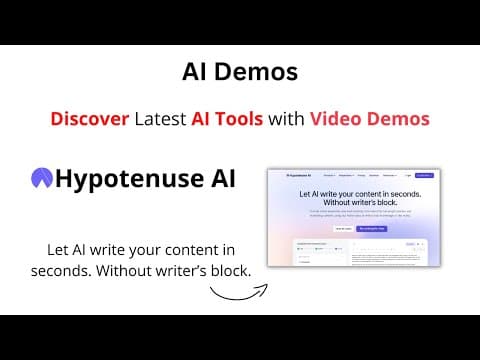


About Hypotenuse AI
I ran batch product description workflows through Hypotenuse AI using raw CSV product catalogs to test factual accuracy and SEO attributes. It transforms sparse technical specs into engaging, search-optimized descriptions and structured bullet points with minimal hallucination. However, its long-form blog generator requires heavy editorial structuring, and monthly word credits deplete rapidly on large catalog imports. Starting at $29 monthly, it delivers high operational velocity for e-commerce catalog managers and dropshipping brands.
Hypotenuse AI is an AI copywriting platform purpose-built for e-commerce teams that need to generate product descriptions, catalog content, SEO blogs, and marketing copy at high volume. Founded in 2020 by Joshua Wong (ex-Google, ex-Palantir), Hypotenuse AI focuses on the specific challenge of catalog-scale content — where retailers need hundreds or thousands of unique, brand-consistent product descriptions generated accurately from product data feeds.
The platform's core strengths are bulk content generation from structured data (CSV imports, product feeds, Shopify connections) and brand voice customization — train the AI on your writing style and it applies that voice consistently across all generated content. Beyond product descriptions, Hypotenuse AI covers blog posts, landing pages, social media captions, ad copy, and email marketing content. It integrates natively with Shopify and supports direct publishing to product pages. Enterprise clients including Marks & Spencer, Zalora, and major global retailers use Hypotenuse AI for large-scale catalog content localization and refresh projects.
Key Features
- Bulk product description generation — import CSV or product feed data and generate unique, SEO-optimized descriptions for thousands of SKUs at once
- Brand voice training — upload sample content for the AI to learn your brand tone, style, and terminology for consistent output across all content types
- Shopify integration — connect your store directly and publish AI-generated product descriptions without manual copy-paste
- AI blog writer — generate full SEO-optimized blog posts with structured outlines, headings, and keyword coverage
- Content workflow management — organize content projects, assign templates, and manage batch generation for content teams
- Landing page copy — generate complete landing pages with headlines, body copy, CTAs, and feature lists from briefs
- Social media and ad copy — Facebook Ads, Instagram captions, Google Ads headlines and descriptions
- Enterprise API — programmatic access to Hypotenuse AI's generation capabilities for integration into custom PIM or DAM systems
Pros
- Best-in-class for e-commerce catalog content — bulk CSV import enables thousands of product descriptions from structured data
- Brand voice training ensures consistent product voice across a large, diverse catalog
- Native Shopify integration for end-to-end AI content production and direct publishing
- Trusted by Marks & Spencer, Zalora, and major global retailers for catalog-scale content
- Supports content localization for global e-commerce teams in multiple languages
- Competitive pricing starting at $29/month for small teams vs enterprise alternatives
Cons
- Less known than Jasper or Copy.ai — smaller community, fewer tutorials, and integrations
- Blog writing quality can lag behind Frase or Writesonic for SEO-optimized long-form content
- Limited free trial access — must pay to properly evaluate the bulk generation workflow
- No real-time SEO scoring or SERP analysis built in — requires separate SEO tools
- Enterprise API requires a custom contract and sales engagement
- UI may feel less polished than competitors at similar price points
Pricing
Starter ($29/month): 25,000 words/month, 1 user, 50+ content templates, basic brand voice. Growth ($59/month): 80,000 words/month, 3 users, advanced brand voice training, bulk generation, Shopify integration. Enterprise: custom pricing with API access, unlimited words, dedicated customer success, SSO, and custom integrations for PIM/DAM systems.
Claim Verified Creator Badge
Are you the founder of Hypotenuse AI? Display this listing's verified badge on your website to show your customers that your product has been vetted and listed on AI Central Resources.
<a href="https://www.aicentralresources.com/tool/hypotenuse-ai" target="_blank" rel="noopener">
  <img src="https://www.aicentralresources.com/badges/featured-badge-dark.svg" alt="Featured on AICentralResources" width="200" height="54" style="border: none;" />
</a>
* Place this HTML snippet in your website's footer, landing page, or press section. This creates a search-friendly backlink directly to your verification page.
Connect with Hypotenuse AI
Frequently Asked Questions
Hypotenuse AI is best for e-commerce teams, online retailers, and digital agencies managing large product catalogs who need to generate hundreds or thousands of unique product descriptions from data feeds at scale. It excels at catalog content, product copy, and SEO blogs with strong brand voice consistency.
Starter: $29/month for individuals (25,000 words, 1 user). Growth: $59/month (80,000 words, 3 users). Enterprise: custom pricing with API access, brand voice customization, Shopify integration, and dedicated support. A 7-day free trial is available.
Similar AI Tools to Hypotenuse AI
View all alternatives of Hypotenuse AI
Jasper AI
Enterprise AI marketing copilot — brand voice, campaigns, and content pipelines at scale


Writesonic
AI writing and SEO visibility platform — GEO tracking, AI articles, and brand monitoring

Rytr
Fast, affordable AI writing assistant — 40+ use cases for creators and small businesses

Shopify Sidekick
Shopify's free, built-in AI commerce assistant that chats, automates, and takes action in your store

eesel AI
Hire fully autonomous AI agents for customer service, content, and operations.
Compared with Hypotenuse AI
Direct head-to-head feature matrices, pricing breakdowns, and real-world performance benchmarks