

Elicit
AI research assistant for systematic literature reviews — screen papers, extract data, and synthesize evidence at scale
Gallery
4 items


About Elicit
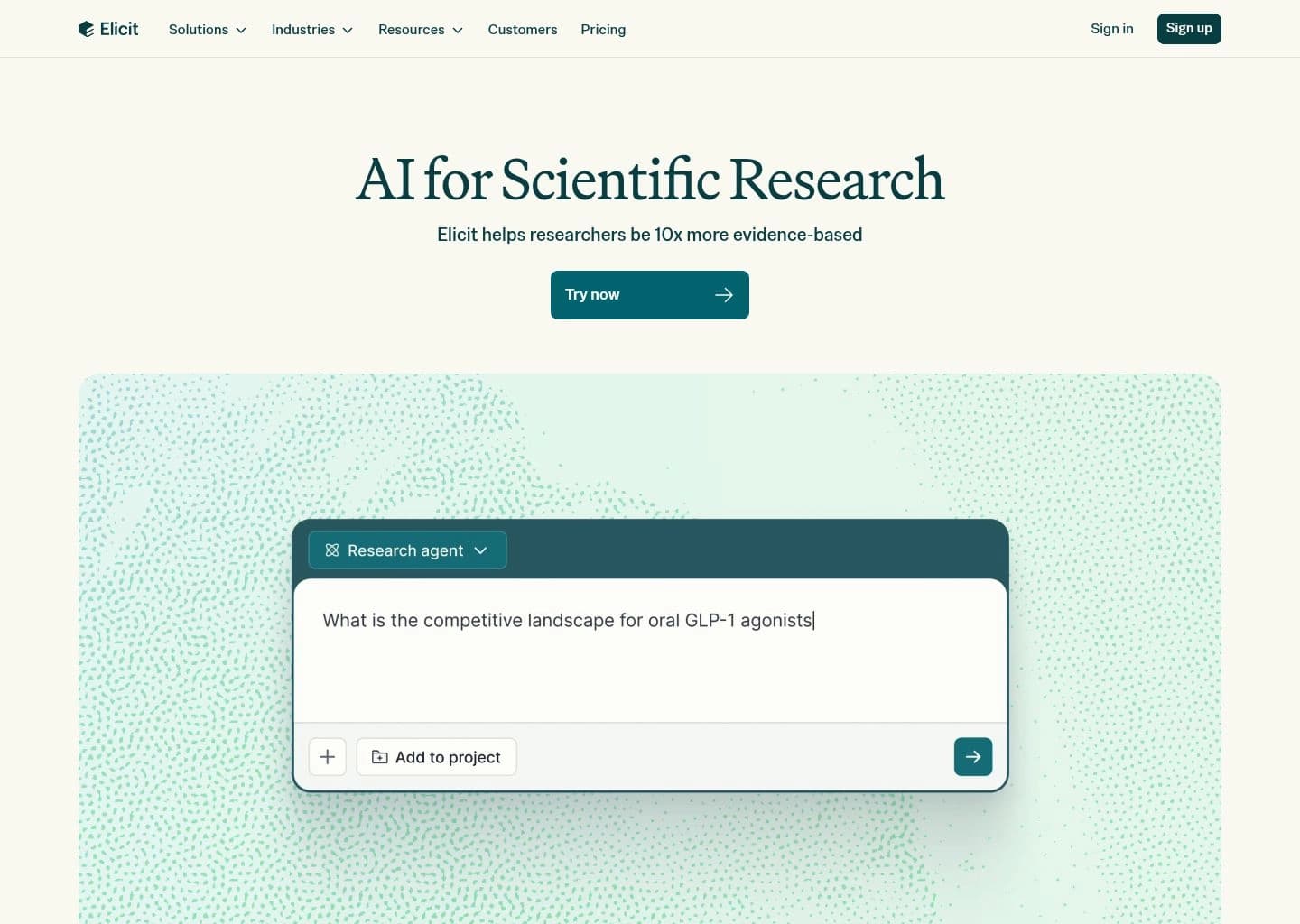
Elicit is an AI research assistant built specifically for systematic literature review and evidence synthesis, trusted by over 2 million researchers across medicine, social sciences, computer science, and policy. Developed by Ought, an AI safety nonprofit, Elicit is purpose-built for the most rigorous type of academic research: systematic reviews that require screening hundreds or thousands of papers, extracting structured data, and synthesizing findings into evidence-based conclusions.
Unlike general AI assistants or even academic search engines, Elicit automates the most time-consuming steps of the systematic review process. Its title and abstract screening tool applies user-defined inclusion and exclusion criteria to large paper sets automatically. Its structured data extraction creates spreadsheet-style comparison tables — sample sizes, methodologies, primary outcomes — with each cell traceable back to the exact sentence in the source PDF. Research Reports generate cited evidence synthesis documents from multiple papers, while the Research Agent autonomously searches, screens, and summarizes literature from a single research question. The full-text chat feature allows researchers to interrogate individual papers in natural language with grounded, sourced answers.
Elicit is the right tool for academic researchers, PhD students, systematic reviewers, healthcare professionals conducting evidence reviews, and policy researchers who need to process large volumes of scientific literature with rigorous source attribution — particularly those running formal systematic reviews or meta-analyses where every extracted data point needs to be traceable to its source.
Key Features
- 138M+ paper database with semantic similarity matching — finds relevant papers without exact keyword matches
- Title and Abstract Screening — automated inclusion/exclusion criteria screening at scale for systematic reviews
- Structured Data Extraction — pull sample sizes, methods, outcomes into organized comparison tables with source citations
- Research Reports — generate cited evidence synthesis reports from multiple papers with full source traceability
- Research Agent — autonomous AI agent that searches, screens, and synthesizes literature from a research question
- Chat with Papers — ask questions of individual papers using full-text access with sourced, grounded answers
- Figure Extraction — extract charts, tables, and figures from PDFs (Plus and Teams plans)
- Zotero integration for importing existing reference libraries into Elicit workflows
- Project-level library with recurring alerts for newly published matching literature
- Free plan with unlimited search, unlimited summaries, and unlimited full-text chat — no credit card required
Pros
- Purpose-built for systematic reviews — automates the most time-consuming steps (screening, extraction, synthesis)
- Structured data extraction with source traceability — every extracted data point links back to its source sentence
- 138M+ paper database with semantic matching — finds relevant papers based on meaning, not just keywords
- Free tier is genuinely useful — unlimited search, summaries, and full-text chat with no credit card required
- Research Agent autonomously searches and synthesizes literature from a single question
- Zotero integration lets researchers bring existing reference libraries into Elicit workflows
- Trusted by 2M+ researchers including at top academic and medical institutions globally
Cons
- Research Agent and Research Reports usage limited on free plan — heavy systematic review users need Plus or Teams
- Database of 138M papers is strong but not as large as Consensus AI (220M) or Google Scholar
- Less suited for discovering very recent preprints or non-indexed grey literature
- No built-in citation manager — relies on Zotero export for reference management
- Teams and Enterprise pricing is per-user and can add up for large research groups
Pricing
Elicit offers a genuinely functional free Basic plan with unlimited paper search, unlimited abstract summaries, and unlimited full-text chat with papers — no credit card required. Research Agent and Research Reports are available with limited usage on the free tier.
Plus at $12/month (individual) expands Research Agent runs, Research Report generation, and adds figure extraction from PDFs — designed for independent researchers running regular systematic reviews.
Teams at $14/user/month adds collaborative workspaces, shared project libraries, and higher usage limits for research groups and labs. An Enterprise tier is available for institutions requiring SSO, audit logs, higher volume limits, and dedicated support. Note: Elicit significantly lowered its top-tier pricing in April 2026 (from $780 to $79/user/month for the highest plan). Verify current rates at elicit.com/pricing.
Claim Verified Creator Badge
Are you the founder of Elicit? Display this listing's verified badge on your website to show your customers that your product has been vetted and listed on AI Central Resources.
<a href="https://www.aicentralresources.com/tool/elicit" target="_blank" rel="noopener">
  <img src="https://www.aicentralresources.com/badges/featured-badge-dark.svg" alt="Featured on AICentralResources" width="200" height="54" style="border: none;" />
</a>
* Place this HTML snippet in your website's footer, landing page, or press section. This creates a search-friendly backlink directly to your verification page.
Connect with Elicit
Frequently Asked Questions
Elicit is built specifically for systematic literature reviews and evidence synthesis — it automates title/abstract screening, structured data extraction, and research report generation from multiple papers. Consensus AI is a search engine that shows scientific agreement on yes/no questions via its Consensus Meter. They complement each other: Consensus for quick evidence checks, Elicit for deep multi-paper systematic analysis.
Elicit searches 138 million+ academic papers from Semantic Scholar and other sources using semantic similarity matching — meaning it finds relevant papers even without exact keyword matches, based on the meaning of your research question.
The free (Basic) plan gives unlimited paper search, unlimited abstract summaries, unlimited full-text chat with papers, and limited usage of Research Agent and Research Reports. Plus at $12/month expands Research Agent runs and Report generation. Teams at $14/user/month adds collaborative workspaces.
Elicit's structured data extraction lets you define custom columns (e.g. sample size, methodology, primary outcomes) and automatically extract that information from multiple papers into a comparison table — with each cell linked back to the exact sentence in the source PDF it came from.
Yes — Elicit connects with Zotero so you can import your existing reference library and work with those papers inside Elicit's workflow. It also supports direct PDF uploads and full-text reading of papers within the platform.
Similar AI Tools to Elicit
View all alternatives of Elicit
Consensus AI
AI-powered academic search engine — find answers from 220M+ peer-reviewed papers with citations

Scite.ai
AI citation intelligence platform — Smart Citations classify 1.2B+ statements as supporting, contrasting, or mentioning

Paperpal
AI academic writing assistant for researchers — grammar, citations, plagiarism checks, and Overleaf support

Jenni AI
AI academic writing assistant for students and researchers — citations, autocomplete, and research in one workspace

Writefull
AI academic writing platform trained on peer-reviewed journals — TeXGPT, Overleaf integration, and zero data storage

Google NotebookLM
AI research tool and thinking partner that analyzes sources, clarifies complexity, and transforms content.
Compared with Elicit
Direct head-to-head feature matrices, pricing, and category breakdowns