
Botpress
Build and deploy LLM-powered AI agents and chatbots with a visual studio and full code control
Gallery
6 items


About Botpress
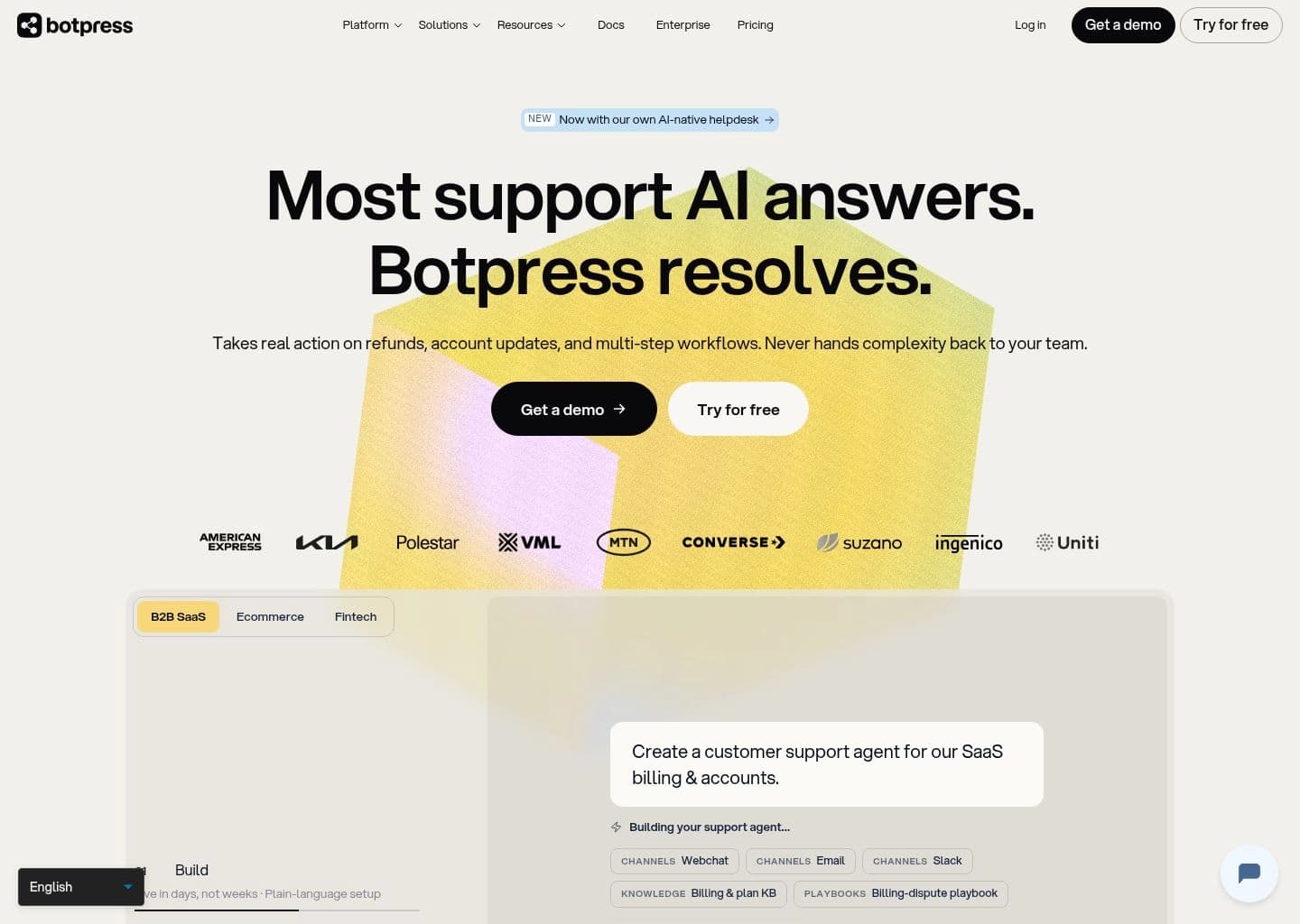
Botpress is a conversational AI platform for building, deploying, and monitoring LLM-powered chatbots and autonomous AI agents across web and messaging channels. It combines a visual Agent Studio with a drag-and-drop flow editor, an Autonomous Engine that lets agents reason through multi-step tasks in natural language, centralized Knowledge Bases for grounding answers in real content, and built-in Tables for storing structured data across sessions. Teams can go from a blank canvas to a working agent without writing code, then drop into custom JavaScript, APIs, and SDKs whenever they need more precise control.
The platform solves the problem of stitching together disconnected chatbot tools, LLM providers, and support infrastructure by handling orchestration, hosting, and scaling in one place. Key features include multi-LLM support so teams can mix models by cost or capability, a large integration hub covering tools like HubSpot, Salesforce, Shopify, Notion, and Slack, native deployment to channels such as WhatsApp, Instagram, Messenger, and Telegram, human handoff with a unified inbox, and Botpress Desk, an AI-native helpdesk for support teams. Versioned, isolated runtimes and built-in analytics give developers observability and confidence when shipping agents to production.
Botpress is built for both non-technical builders and developers. Founders and support leads can launch a working agent in an afternoon using templates from the Botpress Hub, while engineering teams can extend agents with custom code, connect proprietary APIs, and self-host or scale via Botpress Cloud. It is widely used for customer support automation, lead qualification, appointment scheduling, and internal workflow automation, and its open-source roots have made it a long-standing favorite among developers building conversational AI from scratch.
Pricing follows a usage-based model layered on subscription tiers, with a free Pay-as-you-go plan for prototypes, paid Plus and Team plans for growing support operations, and custom Enterprise plans for large organizations that need dedicated support, custom limits, and compliance guarantees like SOC 2 and GDPR.
Key Features
- Drag-and-drop Agent Studio for visual conversation flow design
- Autonomous Engine for LLM-driven, multi-step reasoning and task execution
- Centralized Knowledge Bases that index PDFs, websites, and documents for grounded answers
- Built-in Tables for structured data storage across conversation sessions
- Multi-LLM support to mix models by task, cost, or capability
- Human handoff with a unified inbox and team routing rules
- Botpress Desk, an AI-native helpdesk with a public Help Center for self-service
- Native deployment to WhatsApp, Instagram, Messenger, Slack, Telegram, and web widgets
Pros
- Visual Agent Studio makes it possible to build a working bot without writing code
- Autonomous Engine lets agents reason through multi-step tasks using natural-language instructions instead of rigid flows
- Deep customization available through custom JavaScript, APIs, and SDKs for developer teams
- Large integration hub and native support for channels like WhatsApp, Instagram, Messenger, and Slack
- No markup on AI Spend, so teams pay LLM providers at cost
- Open-source roots and an active developer community with extensive documentation and templates
Cons
- Usage-based AI Spend on top of subscription fees makes total cost harder to predict than flat-rate competitors
- White-labeling and human handoff require at least the Plus plan
- Steeper learning curve for advanced customization compared to simpler no-code chatbot builders
- Team plan pricing is a significant jump for growing support operations
- Enterprise pricing requires contacting sales rather than transparent published rates
Pricing
Botpress offers four main tiers. Pay-as-you-go is free with no base subscription, including one collaborator seat, a monthly AI credit, and usage billed as AI Spend beyond that credit; it's best for prototypes and small tests. Plus starts at $89/month and adds live-agent handoff, white-labeling, and WhatsApp deployment. Team starts at $495/month and adds real-time collaborative editing, role-based access control, and workspace management, with roughly $1,000 worth of add-ons bundled in. Enterprise is custom-priced for large organizations, adding white-glove onboarding, a dedicated support manager, formal uptime SLAs, and custom workspace, message, and storage limits. Pay-as-you-go add-ons are also available a la carte (for example, extra table rows, incoming messages, or bots). As of a May 2026 pricing update, workspaces created after May 14, 2026 get unlimited bots and bundled AI Spend included on every paid plan; existing workspaces keep prior pricing. Additional storage can be added to Plus and Team plans for $40/month.
Claim Verified Creator Badge
Are you the founder of Botpress? Display this listing's verified badge on your website to show your customers that your product has been vetted and listed on AI Central Resources.
<a href="https://www.aicentralresources.com/tool/botpress" target="_blank" rel="noopener">
  <img src="https://www.aicentralresources.com/badges/featured-badge-dark.svg" alt="Featured on AICentralResources" width="200" height="54" style="border: none;" />
</a>
* Place this HTML snippet in your website's footer, landing page, or press section. This creates a search-friendly backlink directly to your verification page.
Connect with Botpress
Frequently Asked Questions
Yes. The Pay-as-you-go plan is free with no base subscription, including one collaborator seat and a monthly AI credit, with usage beyond that billed as AI Spend.
No. The Agent Studio's drag-and-drop editor lets you build a working bot without code, though developers can add custom JavaScript, APIs, and SDK calls for advanced behavior.
Botpress combines a no-code visual builder with an Autonomous Engine that lets agents reason through multi-step tasks using LLMs, plus knowledge bases, structured data tables, and full developer extensibility.
Botpress agents can be deployed to a website widget and messaging channels including WhatsApp, Instagram, Messenger, Slack, Telegram, and Twilio, among others.
No. Botpress passes through LLM provider costs at cost rather than adding a markup on AI Spend, which is billed based on actual token consumption.
Similar AI Tools to Botpress
View all alternatives of Botpress
Voiceflow
Build, launch, and scale chat and voice AI agents for customer support and CX

Chatbase
Build AI agents that resolve customer support, sales, and product questions everywhere

Kore.ai
Enterprise agentic AI platform to build, deploy, and govern AI agents for customer and employee experiences

Ada
Enterprise AI agents that autonomously resolve 80%+ of customer service inquiries

Tidio
AI customer service platform combining live chat, help desk, and the Lyro AI agent

Compared with Botpress
Direct head-to-head feature matrices, pricing, and category breakdowns