
Google Gemini API
Build with Google's multimodal Gemini models via API and AI Studio
Gallery
6 items


About Google Gemini API
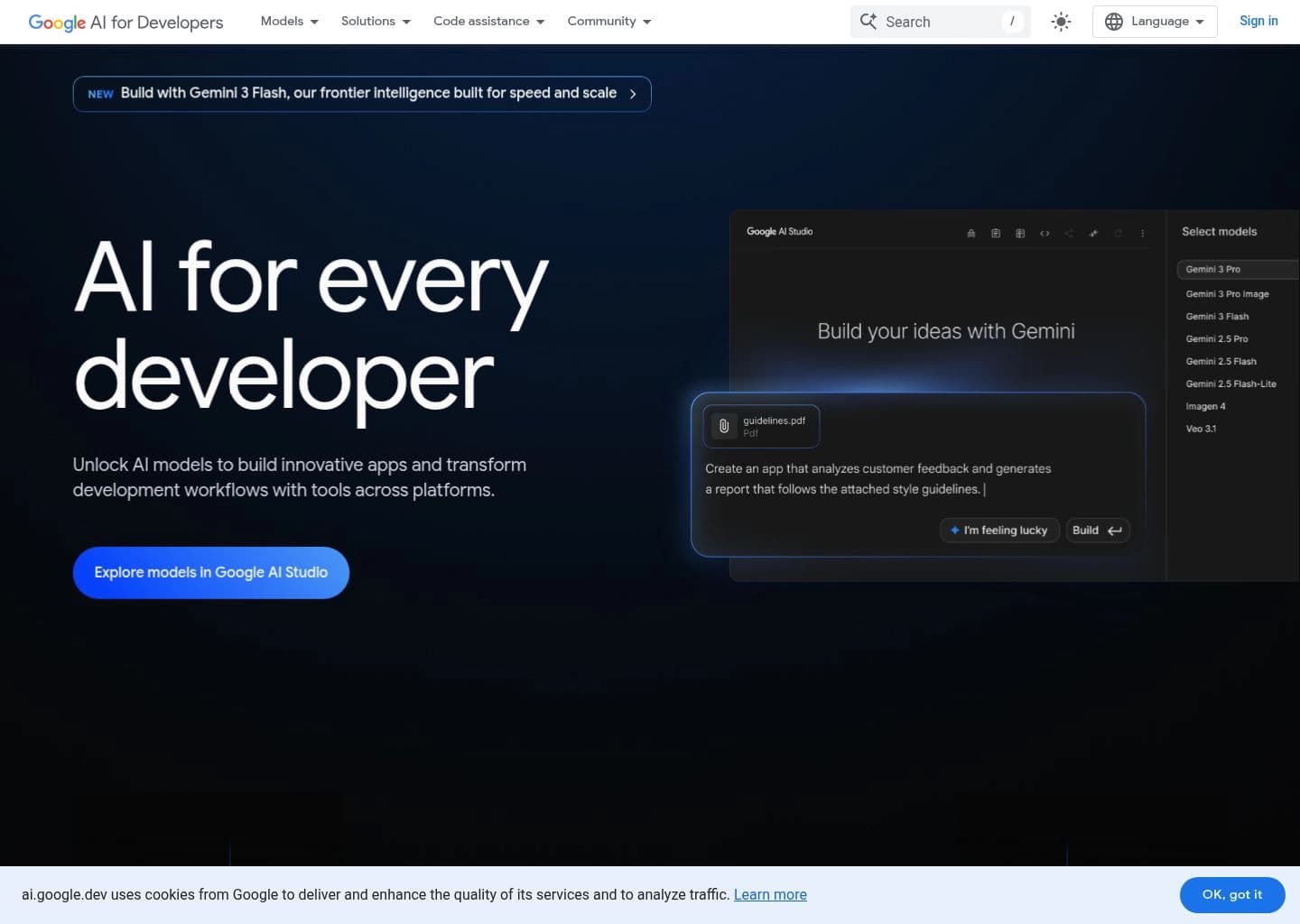
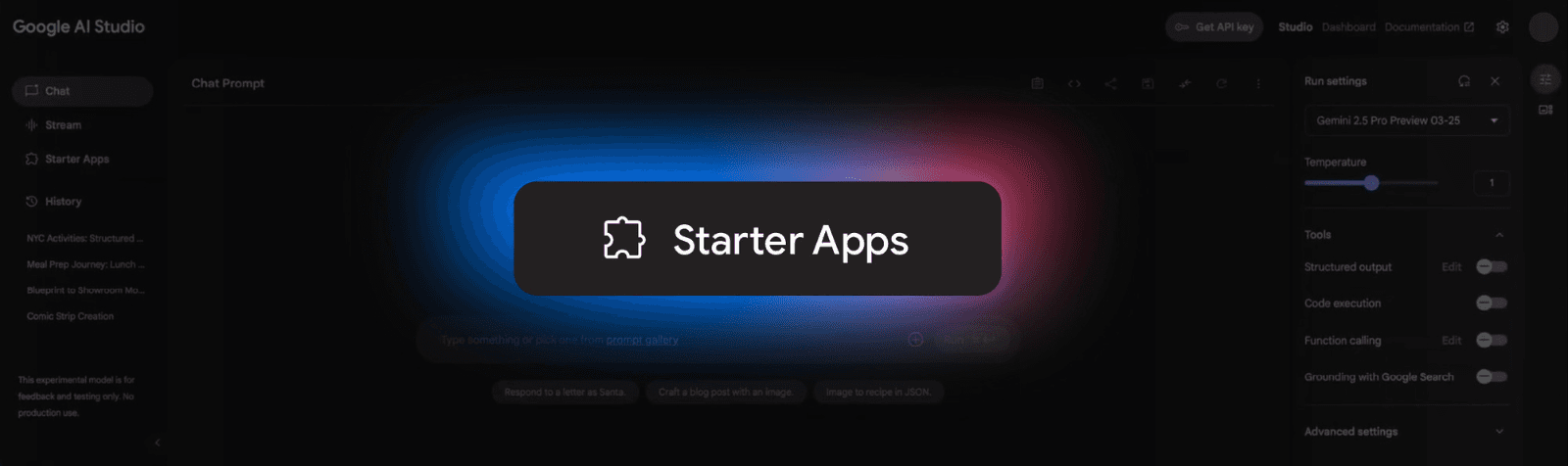
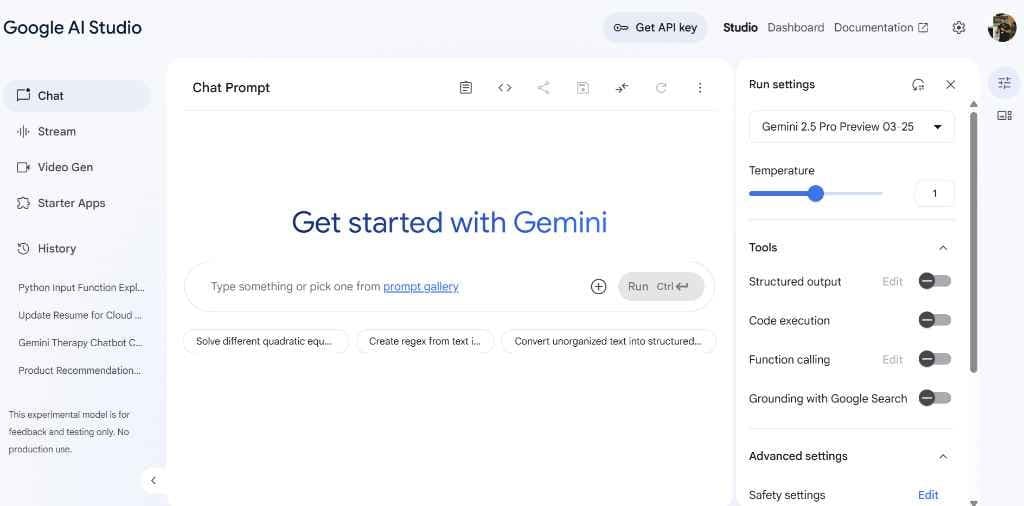
The Gemini API is Google's developer platform for building applications powered by the Gemini family of AI models, covering everything from text generation and reasoning to image, video, and audio creation and understanding. Developers can get started for free through Google AI Studio, a browser-based workspace launched in December 2023 as the successor to Google MakerSuite, where they can select a model, write and tune a prompt, adjust generation parameters, and export working code or grab an API key without configuring a local development environment or adding a billing account.
The platform's core strength is native multimodality: a single Gemini model can process and generate text, images, video (including direct YouTube URLs), audio, and documents, rather than requiring separate specialized APIs stitched together. Beyond the core models, the Gemini API includes dedicated capabilities like Nano Banana Pro (Gemini 3 Pro Image) for image generation and editing, Veo 3.1 for video generation, Lyria 3 for music generation, and a Live API for low-latency, real-time voice conversations supporting 70+ languages. An Agents framework adds managed agents, function calling, code execution, Google Search and Google Maps grounding, and a Computer Use model for building browser automation agents, giving developers the building blocks for more autonomous applications on top of Gemini.
Pricing follows a three-tier structure: a Free tier with generous limits on select models (where content may be used to improve Google's products), a Paid tier with higher rate limits, context caching, a Batch API offering roughly 50% cost savings, and a guarantee that content is not used for training, and an Enterprise tier delivered through the separate Gemini Enterprise Agent Platform (formerly Vertex AI) for large-scale deployments needing fine-tuning, VPC Service Controls, customer-managed encryption keys, and compliance certifications like HIPAA, SOC 2, and FedRAMP. Individual model pricing is billed per million tokens and varies significantly by model tier, from cost-efficient Flash-Lite variants to the flagship Gemini 3.1 Pro.
Built and maintained by Google DeepMind and Google, the Gemini API and AI Studio are the first-party front door to Google's generative AI models, with new capabilities like Live streaming, media generation, and the Batch API typically landing there before anywhere else. Google reported more than 8.5 million monthly developers building on its models as of its I/O 2026 keynote, spanning individual developers, students, and enterprise teams building everything from quick prototypes in AI Studio's Build mode to production-scale applications running on the Gemini Enterprise Agent Platform.
Key Features
- Access to the full Gemini model family, including Gemini 3.1 Pro, 3.6 Flash, and Flash-Lite variants for cost-efficient high-volume tasks
- Google AI Studio: a free, browser-based workspace for prototyping prompts and exporting working code without a billing account
- Native multimodal support for text, image, video, audio, and document understanding and generation
- Image and video generation via Nano Banana Pro (Gemini 3 Pro Image) and Veo 3.1
- Agents framework with managed agents, function calling, code execution, and Computer Use for browser automation
- Google Search and Google Maps grounding to reduce hallucinations with real-time information
- Context caching and Batch API (50% cost reduction) for optimizing high-volume production workloads
- Gemma open-weight models for teams that want to self-host and fully customize on their own data
Pros
- Genuinely native multimodal models covering text, image, video, and audio in one API
- Google AI Studio offers a real, usable free prototyping environment with no billing account required
- Google Search and Google Maps grounding help reduce hallucinations with live information
- Batch API and Flex pricing modes offer substantial cost savings for non-latency-sensitive workloads
- Clear upgrade path from free prototyping to enterprise-grade deployment via the Gemini Enterprise Agent Platform
Cons
- Pricing structure is complex, with per-model, per-mode (Standard/Batch/Flex/Priority) rates that require careful reading to estimate real costs
- Free tier usage is used to improve Google's products, so privacy-sensitive projects need to upgrade to the Paid tier for that guarantee to apply
- Frequent model churn (previews, deprecations, shutdown dates) means integrations need occasional migration work to stay current
- Full enterprise-grade features like fine-tuning, VPC Service Controls, and CMEK live on the separate Gemini Enterprise Agent Platform, not the Developer API itself
- Advanced capabilities like Computer Use and some agent tooling remain in preview with more restrictive rate limits
Pricing
The Gemini API uses a three-tier structure. Free is for developers and small projects, offering limited access to select models with free input and output tokens, Google AI Studio access, and no billing account required, though content is used to improve Google's products. Paid unlocks higher rate limits for production, context caching, the Batch API (roughly 50% cost reduction), access to Google's most advanced models, and a guarantee that content is not used to improve Google's products. Pricing is billed per million tokens and varies by model: for example, Gemini 3.1 Pro Preview costs $2.00 input and $12.00 output per million tokens for prompts under 200K tokens, while cost-efficient options like Gemini 3.5 Flash-Lite start as low as $0.30 input and $2.50 output per million tokens, with additional Flex and Priority billing modes available for different latency and cost tradeoffs. Enterprise is for large-scale deployments through the Gemini Enterprise Agent Platform, adding dedicated support channels, advanced security and compliance certifications (HIPAA, SOC 2, FedRAMP), provisioned throughput, volume-based discounts, and MLOps tooling, available by contacting Google's sales team.
Claim Verified Creator Badge
Are you the founder of Google Gemini API? Display this listing's verified badge on your website to show your customers that your product has been vetted and listed on AI Central Resources.
<a href="https://www.aicentralresources.com/tool/google-gemini-api" target="_blank" rel="noopener">
  <img src="https://www.aicentralresources.com/badges/featured-badge-dark.svg" alt="Featured on AICentralResources" width="200" height="54" style="border: none;" />
</a>
* Place this HTML snippet in your website's footer, landing page, or press section. This creates a search-friendly backlink directly to your verification page.
Connect with Google Gemini API
Frequently Asked Questions
The Gemini API is Google's developer platform for integrating Gemini models into applications, offering text, image, video, and audio generation and understanding through a simple API call, alongside Google AI Studio, a free browser-based tool for prototyping prompts and exporting production-ready code.
The Free tier offers limited access to select models with generous free tokens, but usage may be used to improve Google's products. The Paid tier unlocks higher rate limits, context caching, batch processing (50% cost reduction), and Google's most advanced models, with content not used for training. Enterprise adds dedicated support, provisioned throughput, and compliance features through the Gemini Enterprise Agent Platform.
No, Google AI Studio is completely free to use for prototyping, with no billing account required to start experimenting with Gemini models, generating a working prompt, and exporting an API key.
Yes, the Gemini API natively supports multimodal inputs and outputs, including text, images, video (including direct YouTube URLs), audio, and documents, letting a single model handle tasks that would otherwise require separate specialized APIs.
Yes, the Gemini API includes an Agents framework for building and running managed agents, plus tools like function calling, code execution, Google Search grounding, Google Maps grounding, and Computer Use for browser automation, letting developers build agentic applications directly on top of Gemini models.
Similar AI Tools to Google Gemini API
View all alternatives of Google Gemini API




Fireworks AI
High-performance training and inference platform for open-source AI models

Groq
The fastest inference cloud for open-source LLMs, powered by custom LPU chips
Compared with Google Gemini API
Direct head-to-head feature matrices, pricing, and category breakdowns