
Warp
The open platform for automating development — terminal, agent CLI, and cloud factories
Gallery
6 items
About Warp
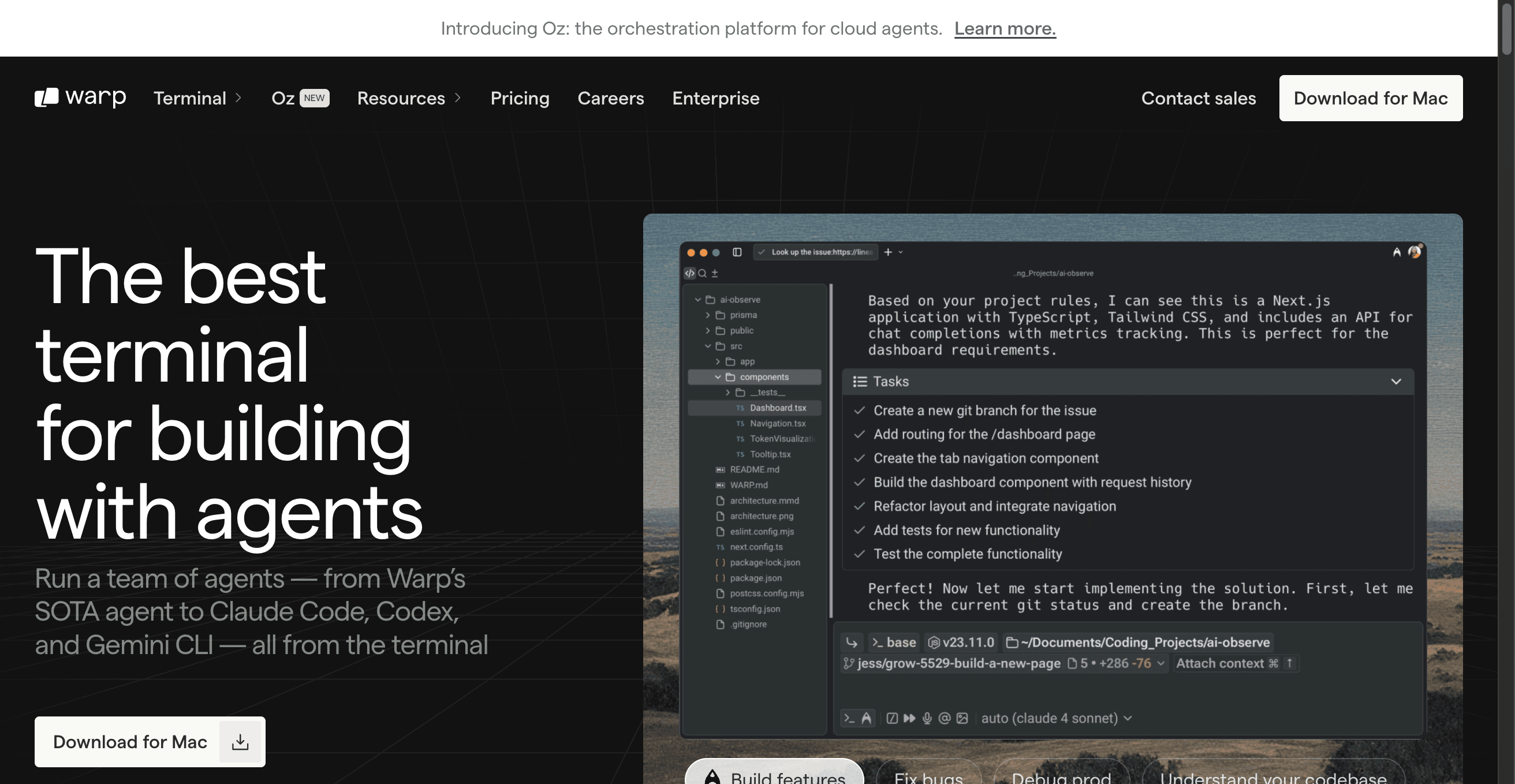
We replaced our default terminal with Warp across daily Git, Docker, and Kubernetes workflows on macOS and Linux. Built in Rust with block-based command execution, intelligent autocompletion, and an integrated AI command assistant, it completely modernizes command-line interactions. The pushback comes from telemetry and login requirements: purists dislike having to log in to an account to use a terminal emulator, and team features require paid tiers. Starting free with optional $20/month agent plans, it is the most enjoyable, modern terminal emulator available for software developers.
Warp is an open agentic development platform built around the terminal, founded in June 2020 by Zach Lloyd (former Principal Engineer on Google Docs and CTO at TIME magazine) in New York City. Starting as a reimagined terminal built natively in Rust for macOS, Warp expanded to Linux (February 2024) and Windows (2025), growing to 718,000+ active developers and adoption across 51% of the Fortune 500 — including Anthropic, OpenAI, Docker, Google, GitHub, Amazon, NVIDIA, Ramp, DoorDash, and Asana. Warp has raised $73M total: a $6M seed (GV/BoxGroup/Neo), a $23M Series A in April 2022 (GV, Dylan Field of Figma, Sam Altman, Marc Benioff, Tobi Lütke), and a $50M Series B in June 2023 led by Sequoia Capital. By early 2026, Warp was reportedly adding ~$1M ARR weekly.
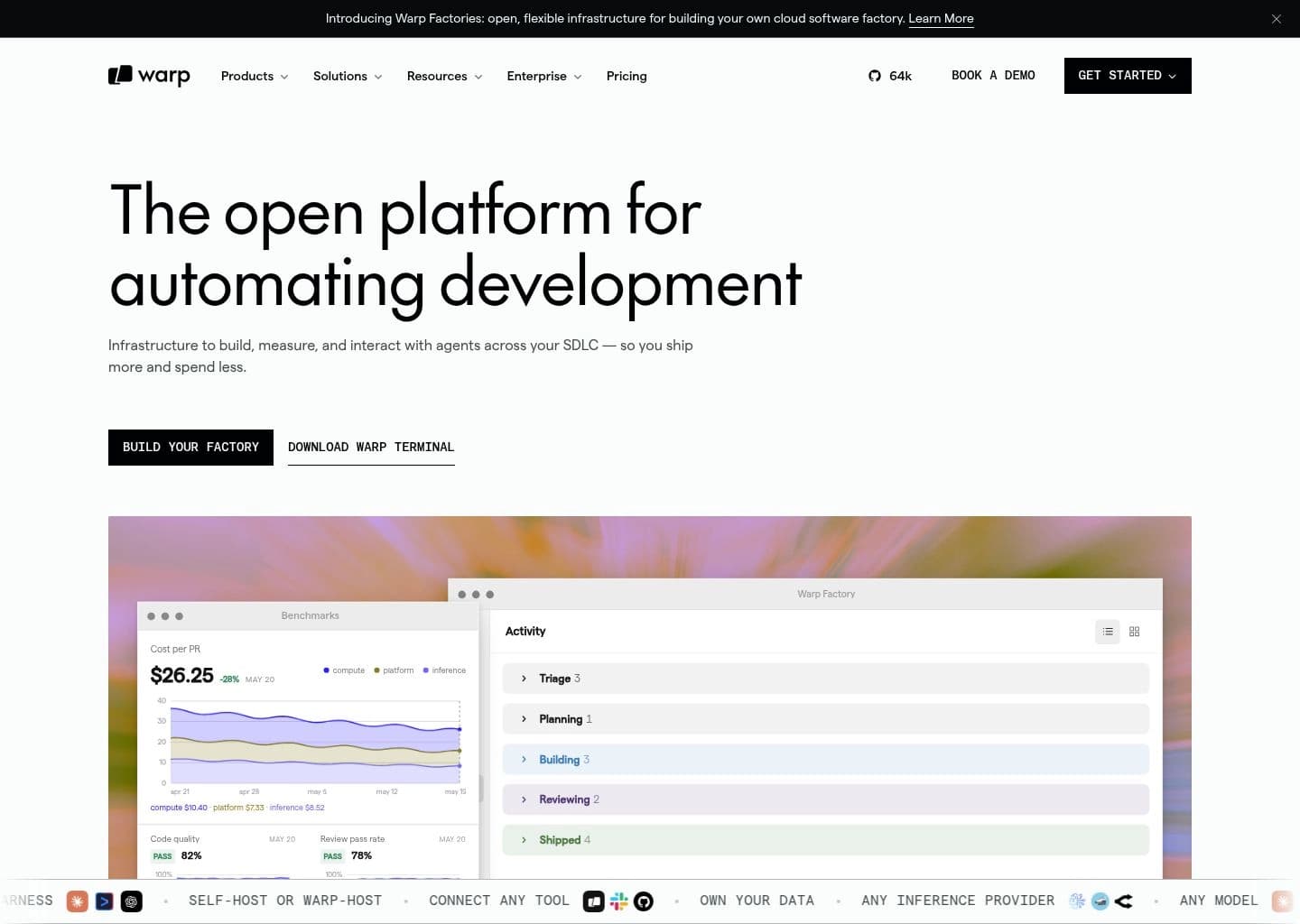
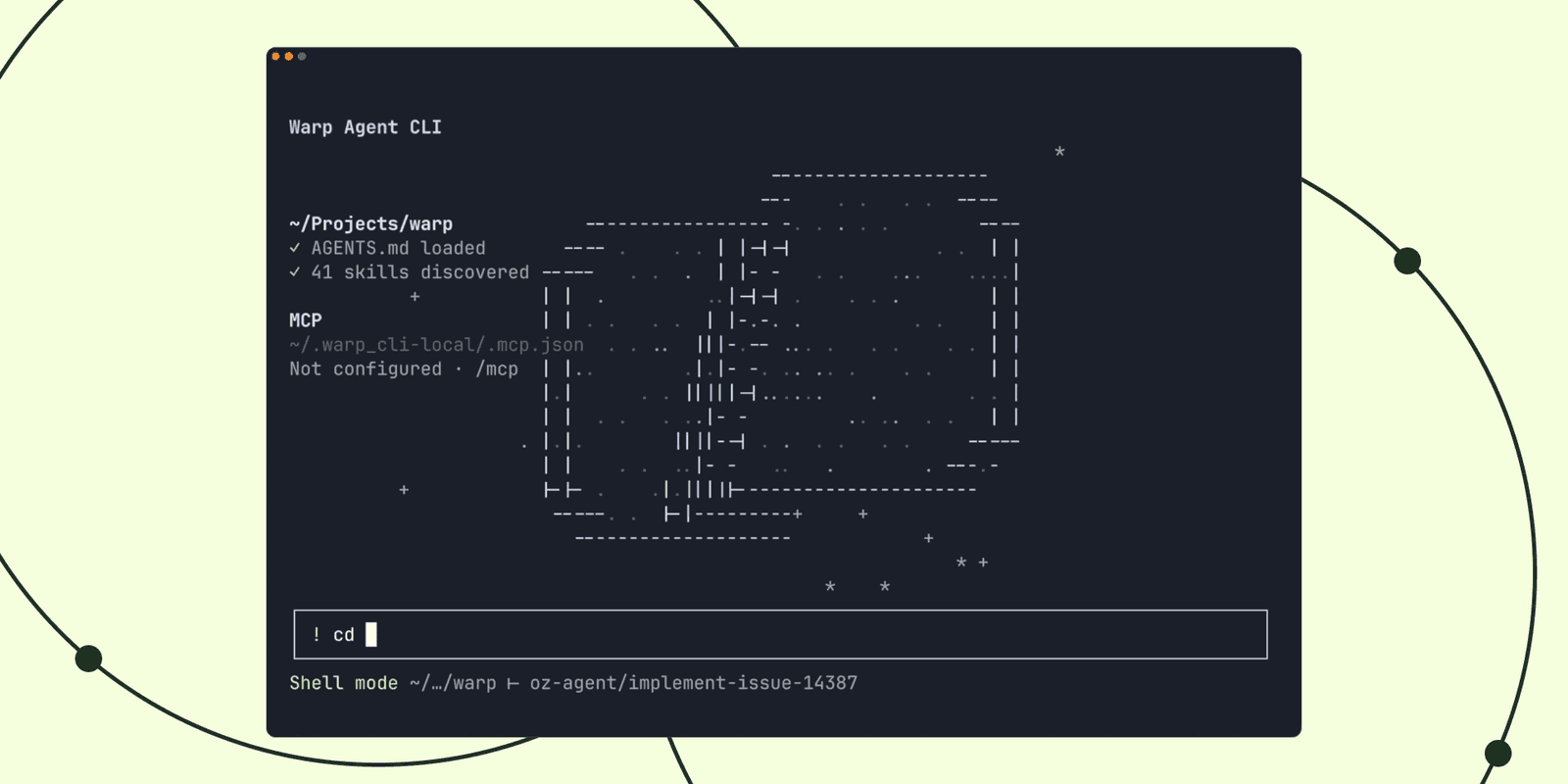
Warp's platform has three layers. The Warp Terminal is a block-based, AI-native terminal that treats each command and its output as a first-class object — groupable, searchable, shareable, and navigable. It supports bash, zsh, fish, and PowerShell, includes an AI sidebar (Warp AI) for asking questions and debugging errors in natural language, and integrates with Warp Drive for cloud-synced team commands, workflows, and environment variables. The Warp Agent CLI (launched 2025) is a standalone coding agent installable via curl in any terminal — it understands your codebase, autonomously executes multi-step tasks, pipes into shell scripts, and runs across macOS, Linux, and Windows without the Warp Terminal IDE. Warp Factories (launched 2026, Early Access) is cloud infrastructure for running fleets of coding agents across the full SDLC — defined as code, running on any model or harness (Claude Code, Codex, Gemini CLI, Warp Agent), with SDLC-wide insights including cost per PR and automation rate.
Warp supports frontier models including Claude Opus 5, GPT-5.6, Gemini 3.1 Pro, Fable 5, GLM 5.2, and Kimi K3 via OpenRouter, LiteLLM, Amazon Bedrock, and BYOLLM. Integrations include Slack (@Warp bot), GitHub, and Linear for triggering agents from chat threads. Warp is SOC 2 certified with Zero Data Retention across all contracted LLM providers.
Key Features
- Warp Terminal — a modern open-source terminal built in Rust with block-based command/output grouping, AI sidebar, natural language search, and support for bash, zsh, fish, and PowerShell
- Warp Agent CLI — a powerful coding agent installable in any terminal via curl, pipeable and scriptable, that understands your codebase and autonomously executes multi-step coding tasks
- Warp Factories — cloud infrastructure for defining and running fleets of coding agents across your entire SDLC (code review, bug investigation, refactors, incident response) as code on any harness
- Multi-harness support — run Claude Code, OpenAI Codex, Gemini CLI, Warp Agent, and any other harness side by side in the same terminal session
- Warp Drive — cloud-synced shared workspace for storing, sharing, and versioning commands, workflows, environment variables, and notebooks across the team
- Slack, Linear, and GitHub integrations — mention @Warp to trigger agents from Slack threads, create PRs, investigate bugs, and get real-time agent session links with shared visibility
- Warp Factories Insights — cost per PR, automation rate, agent usage metrics, and SDLC-wide analytics for engineering leaders
- SOC 2 certified with Zero Data Retention — no customer data retained by LLM providers; individually configurable telemetry and enterprise data governance controls
Pros
- Unique market position — the only platform that combines a modern terminal, standalone agent CLI, and cloud SDLC factory infrastructure in one coherent product
- 718,000+ active developers and 51% Fortune 500 adoption with trust signals from OpenAI, Anthropic, Docker, Google, GitHub, NVIDIA, and Stripe
- Open-source terminal (64K+ GitHub stars) with block-based interface that treats commands as first-class objects — groupable, searchable, shareable, and navigable
- Uniquely supports running multiple third-party agents simultaneously — Claude Code, Codex, Gemini CLI, and Warp Agent all side-by-side
- Adding ~$1M ARR per week as of early 2026 — one of the fastest-growing developer tool companies
- SOC 2 certified with Zero Data Retention across all contracted LLM providers and enterprise BYOLLM for full inference control
Cons
- Warp Factories still in Early Access — full enterprise availability and pricing not yet finalized
- Business plan capped at 25 seats — teams larger than 25 must contact Enterprise sales
- Credit-based pricing can be unpredictable for heavy agentic workloads; complex tasks consume more credits than simple completions
- Terminal purists may dislike the proprietary Rust UI layer vs. a standard PTY — some legacy TUI apps have compatibility quirks
- Not an IDE — pairs best with an editor like VS Code or Cursor rather than replacing one; not a standalone coding environment
Pricing
Warp uses a credit-based Freemium model with five tiers. The Free tier ($0) includes the full Warp Terminal, Warp Agent CLI access, limited cloud agent sessions, pay-as-you-go credit reloads, and the ability to bring your own AI inference keys.
Build ($20/month, $18 annually) includes 1,500 credits ($20 of agent usage at API rates), full model access (Claude Opus 5, GPT-5.6, Gemini, Fable 5, and more), highest codebase indexing limits, unlimited Warp Drive objects, unlimited cloud conversation storage, auto-reload with team-wide spend caps, and private email support. Max ($200/month, $180 annually) provides 18,000 credits — 12x Build's included usage — for high-volume individual developers. Business ($50/user/month, $45 annually) adds per-seat included credits for up to 25 seats, team usage metrics, admin-configurable data controls, BYOK (bring your own API keys), and SAML SSO.
Enterprise is custom-priced and adds unlimited seats, custom shared credit pools, advanced spend controls, enterprise admin and data governance, BYOLLM (route inference through your own cloud at no credit cost), self-hosted cloud agents on customer infrastructure, custom codebase indexing, cross-harness agent memory, Enterprise Analytics API, a dedicated account manager, shared Slack channel, and white-glove onboarding with an implementation engineer. Warp Factories usage is included in Build/Max/Business plans or available pay-as-you-go at API rates + 20%.
Claim Verified Creator Badge
Are you the founder of Warp? Display this listing's verified badge on your website to show your customers that your product has been vetted and listed on AI Central Resources.
<a href="https://www.aicentralresources.com/tool/warp" target="_blank" rel="noopener">
  <img src="https://www.aicentralresources.com/badges/featured-badge-dark.svg" alt="Featured on AICentralResources" width="200" height="54" style="border: none;" />
</a>
* Place this HTML snippet in your website's footer, landing page, or press section. This creates a search-friendly backlink directly to your verification page.
Connect with Warp
Frequently Asked Questions
Warp is an open agentic development platform built around three products: Warp Terminal (a modern AI-native terminal for macOS, Linux, and Windows built in Rust), Warp Agent CLI (a powerful coding agent that runs in any terminal via curl install), and Warp Factories (cloud infrastructure for running fleets of coding agents across your entire SDLC, defined as code). Together they form a full stack for agentic software development from local machine to cloud.
Warp was founded in June 2020 by Zach Lloyd, former Principal Engineer on Google Docs and CTO at TIME magazine. The company is headquartered in New York City and has raised $73M total: a $6M seed (GV, BoxGroup, Neo), a $23M Series A in April 2022 (GV, Dylan Field of Figma, Sam Altman, Marc Benioff, Tobi Lütke), and a $50M Series B in June 2023 led by Sequoia Capital. As of early 2026, Warp was adding roughly $1M ARR per week.
Warp Factories is cloud infrastructure for building and running software factories — fleets of coding agents that automate your SDLC end-to-end: code review on every PR, bug investigation, refactors and migrations, incident response, and custom workflows. Factories are defined as code, run on any model or harness (Claude Code, Codex, Gemini CLI, etc.), support self-hosting on your own infrastructure, and include insights like cost per PR and automation rate.
Free: $0 with limited credits and features. Build: $20/month ($18 annually) with 1,500 credits and full agent access. Max: $200/month ($180 annually) with 18,000 credits. Business: $50/user/month ($45 annually) for up to 25 seats with SAML SSO and admin controls. Enterprise: custom pricing with unlimited seats, BYOLLM, self-hosted workers, and dedicated support.
Warp supports frontier and open-source models including Claude Opus 5, GPT-5.6, Gemini 3.1 Pro, Fable 5 (Warp's own model), GLM 5.2, Kimi K3, DeepSeek, and more via OpenRouter, LiteLLM, and Amazon Bedrock. An Auto mode routes each request to the optimal model. Enterprise customers can also bring their own LLM inference endpoint (BYOLLM) at no credit cost.
Similar AI Tools to Warp
View all alternatives of Warp

GitHub Copilot
AI pair programmer for code completion, chat, and autonomous coding agents



OpenHands
The open platform for cloud coding agents — autonomous, transparent, and in your control
Compared with Warp
Direct head-to-head feature matrices, pricing, and category breakdowns