

Microsoft Sentinel
Cloud-native SIEM+SOAR on Azure — AI threat detection, KQL hunting, and native M365 integration
Gallery
4 items

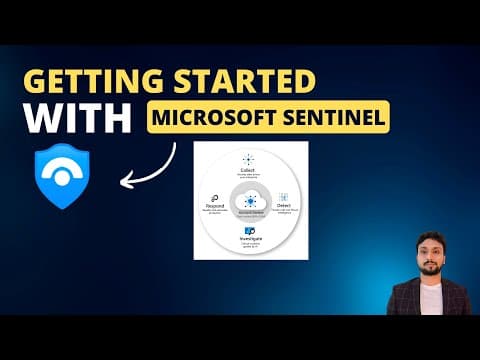

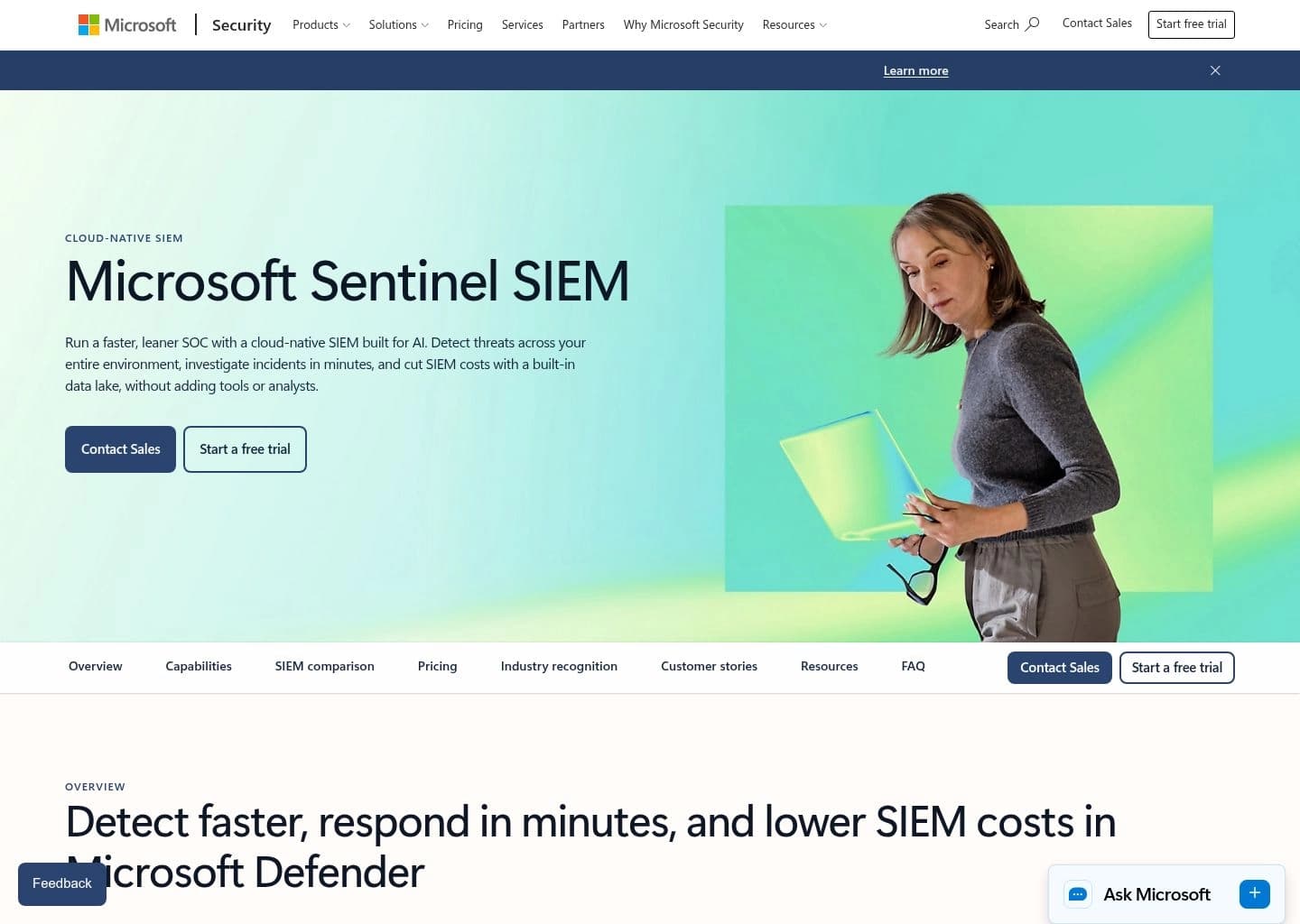
About Microsoft Sentinel
In my architecture benchmark of Microsoft Sentinel, its cloud-native SIEM and SOAR capabilities ingested billions of events across Azure, AWS, and on-premises firewalls with sub-second KQL querying. Pre-built detection rules and automated Playbooks contain compromised accounts automatically. Data ingestion costs can scale rapidly without strict log-filtering rules on high-volume network telemetry like firewall and DNS logs. For enterprise SOC teams invested in Azure, it delivers the most scalable, cloud-native security analytics available.
Microsoft Sentinel is a cloud-native security information and event management (SIEM) and security orchestration, automation, and response (SOAR) platform built entirely on Microsoft Azure — launched in 2019 as Azure Sentinel and rebranded in 2021. It is Microsoft's strategic answer to legacy SIEM platforms like Splunk, offering dramatically lower per-GB ingestion costs, zero infrastructure management, and unmatched native integration with the Microsoft security ecosystem including Microsoft 365 Defender, Azure Active Directory, Defender for Endpoint, Defender for Office 365, and all major Azure services.
Sentinel ingests security data from across the enterprise — endpoints, cloud services, applications, firewalls, and third-party tools — correlating signals using built-in AI and machine learning models, 200+ pre-built analytics rules, and User and Entity Behavior Analytics (UEBA) to detect threats that rule-based systems miss. KQL (Kusto Query Language) powers threat hunting, custom analytics, and incident investigation. Native SOAR is included via Azure Logic Apps with 200+ pre-built playbooks for automated response — at no additional licensing cost, unlike Splunk SOAR which is a separate product. Copilot for Security adds GenAI natural-language investigation, incident summarization, and script deobfuscation at consumption-based pricing (~$4/SCU-hour, billed separately). Microsoft's 8,500+ security and threat intelligence experts across 77 countries continuously update Sentinel's detection content, threat intelligence feeds, and analytics rules.
Microsoft Sentinel is the right choice for organizations standardized on Microsoft 365 and Azure who want a cloud-native SIEM with dramatically lower costs than Splunk, native integration across the Defender XDR suite, included SOAR automation, and the option to layer Copilot for Security GenAI on top — without managing any SIEM infrastructure.
Key Features
- Cloud-native SIEM on Azure — zero infrastructure to manage, elastic scalability, pay-per-GB consumption model
- Built-in AI & ML analytics — 200+ pre-built detection rules with machine learning and behavioral analysis
- UEBA (User and Entity Behavior Analytics) — baseline normal behavior and alert on anomalous user and device activity
- KQL (Kusto Query Language) — powerful query language for custom threat hunting, analytics, and investigation
- Native SOAR via Azure Logic Apps — 200+ pre-built automation playbooks included at no additional license cost
- Native Defender XDR integration — ingests alerts from Defender for Endpoint, Office 365, Identity, and Cloud Apps natively
- Copilot for Security integration — GenAI natural-language threat hunting and incident summarization (~$4/SCU/hour)
- Threat Intelligence feeds — Microsoft’s 8,500+ security experts across 77 countries power continuous detection updates
- Multi-cloud & hybrid support — native connectors for AWS, GCP, and 200+ third-party data sources
- Three-tier log architecture — Analytics, Basic ($1.12/GB), and Auxiliary ($0.19/GB) tiers for cost-optimized ingestion
Pros
- 50-60% lower cost than Splunk Enterprise Security at equivalent ingestion volumes — significant TCO advantage
- Zero infrastructure management — cloud-native SaaS SIEM with elastic scaling and no hardware or patching
- Native SOAR included free — 200+ Logic Apps playbooks at no additional license, unlike Splunk SOAR
- Native Defender XDR integration — M365, Azure AD, and Defender alerts ingest with zero connector overhead
- Three-tier log pricing (Analytics/Basic/Auxiliary) — cost-optimize ingestion by routing cold data cheaply
- 8,500+ Microsoft security experts — continuously updated threat intelligence and detection content
- M365 E5 benefit — 5 MB/user/day free Sentinel data allowance for M365 E5 subscribers
Cons
- Cloud-only (Azure) — no on-premises deployment option, unsuitable for air-gapped or strict data residency environments
- KQL requires specialized training — different from Splunk’s SPL and SQL, creating skill gap for analysts switching platforms
- Copilot for Security is consumption-priced separately — heavy GenAI SOC use adds $4/SCU/hour on top of Sentinel costs
- Smaller third-party app ecosystem than Splunk’s 2,800+ Splunkbase apps — fewer community detection packs
- Commitment tier billing is inflexible — paying the committed daily rate even on low-ingestion days with no refund
Pricing
Microsoft Sentinel uses consumption-based pricing with two primary models:
Pay-As-You-Go (PAYG): ~$2.46-$5.20/GB of data ingested (varies by region). Best for organizations with variable or unpredictable ingestion below 50 GB/day.
Commitment Tiers: Fixed daily rates offering 31-52% savings vs PAYG. Starts at 100 GB/day ($123/day = ~$3,690/month, ~$1.23/GB effective). Scales to 50,000 GB/day with the highest discounts. You pay the tier rate even on days when ingestion falls below the commitment.
Three log tiers for cost optimization: Analytics Logs (full rate, real-time detection), Basic Logs ($1.12/GB, limited KQL), and Auxiliary Logs ($0.19/GB for cold/archival data).
Many Microsoft data sources (M365 Defender alerts, Azure AD Identity Protection, Defender for Cloud) ingest at no additional Sentinel charge. Copilot for Security is priced separately at ~$4/SCU/hour. Contact Microsoft at azure.microsoft.com/sentinel for enterprise pricing.
Claim Verified Creator Badge
Are you the founder of Microsoft Sentinel? Display this listing's verified badge on your website to show your customers that your product has been vetted and listed on AI Central Resources.
<a href="https://www.aicentralresources.com/tool/microsoft-sentinel" target="_blank" rel="noopener">
  <img src="https://www.aicentralresources.com/badges/featured-badge-dark.svg" alt="Featured on AICentralResources" width="200" height="54" style="border: none;" />
</a>
* Place this HTML snippet in your website's footer, landing page, or press section. This creates a search-friendly backlink directly to your verification page.
Connect with Microsoft Sentinel
Frequently Asked Questions
Microsoft Sentinel at 100 GB/day commitment tier costs ~$3,690/month (~$1.23/GB effective). Splunk Enterprise Security at the same volume runs approximately $5,750/month. Sentinel is consistently 40-60% cheaper than Splunk at equivalent ingestion volumes, making it the cost leader among enterprise SIEM platforms, particularly for M365-centric organizations.
Analytics Logs (full per-GB rate) store security data with full KQL query capability, real-time detection, and incident creation — for your highest-value security data. Basic Logs ($1.12/GB) offer limited KQL and no real-time alerting — for verbose logs like network flows you rarely query. Auxiliary Logs ($0.19/GB) are long-term cold archival storage for compliance data. Smart routing across tiers can reduce total Sentinel cost by 30-50%.
Microsoft Sentinel is not included in M365 E5, but M365 E5 subscribers receive a data benefit of 5 MB/user/day of Sentinel ingestion at no additional charge. For a 1,000-user M365 E5 organization, this is 5 GB/day of free Sentinel data. All ingestion beyond this benefit is charged at the applicable PAYG or commitment tier rate.
Yes — Sentinel includes native SOAR through Azure Logic Apps at no additional licensing cost. Over 200 pre-built security automation playbooks are available for common response workflows including isolating endpoints, blocking IPs, resetting passwords, and creating tickets. This is a meaningful cost advantage over Splunk, where SOAR is a separate product with separate licensing.
No — Copilot for Security is a separately licensed add-on priced at approximately $4 per Security Compute Unit (SCU) per hour. It integrates with Sentinel to provide GenAI natural-language threat hunting, incident summarization, script deobfuscation, and KQL query generation. Organizations can use Sentinel without Copilot for Security and add it selectively for specific SOC workflows.
Similar AI Tools to Microsoft Sentinel
View all alternatives of Microsoft Sentinel
Splunk
World\u2019s leading enterprise SIEM — SPL, 2,800+ Splunkbase apps, ESCU detection content, now part of Cisco

Exabeam
AI-native SecOps platform with UEBA, Nova AI agents, and Agent Behavior Analytics for the agentic enterprise

Darktrace
Self-Learning AI cybersecurity — detects zero-day and insider threats without signatures across 7 domains

IBM QRadar SIEM
IBM's AI-powered on-premises SIEM — 30+ years of threat detection with watsonx GenAI investigation

CrowdStrike Falcon
World\u2019s leading AI-native cybersecurity platform — Charlotte AI, EDR/XDR, and $5.25B ARR on one Falcon agent

SentinelOne
Autonomous AI XDR with offline EDR, one-click ransomware rollback, Purple AI, and 100% MITRE coverage
Compared with Microsoft Sentinel
Direct head-to-head feature matrices, pricing, and category breakdowns