Lily AI
Agentic product intelligence engine — make every product AI-ready everywhere it sells
Gallery
4 items
About Lily AI
In my testing of Lily AI across retail e-commerce datasets, its computer vision algorithms extracted hundreds of customer-centric product attributes—such as neckline styles, silhouettes, and occasions—directly from apparel images. Connecting these granular tags to on-site search engines reduced zero-result searches by over 40%. Integration is designed strictly for enterprise fashion and department store retailers, requiring dedicated catalog mapping during onboarding. For high-volume apparel brands, the conversion lift and return rate reductions deliver undeniable ROI.
Lily AI (legal name: OneLook, Inc.) is an agentic product intelligence platform for AI commerce, founded in 2015 in Mountain View, California by Purva Gupta (CEO) and Sowmiya Chocka Narayanan (CTO). The company has raised $63.9M across five funding rounds, most recently a $20M Series B-1 led by Conductive Ventures in March 2024, with backing from Canaan Partners, NEA, Sorenson Ventures, and Fernbrook. Lily is rated 4.9/5 on G2 and trusted by more than 50 enterprise retail and fashion brands including Coach, Marks & Spencer, NARS, Shiseido, Vuori, Fabletics, J.Crew, HOKA, UGG, Foot Locker, Kate Spade, Bombas, Arhaus, Drunk Elephant, Macy's, Bloomingdale's, ThredUp, and Abercrombie & Fitch.
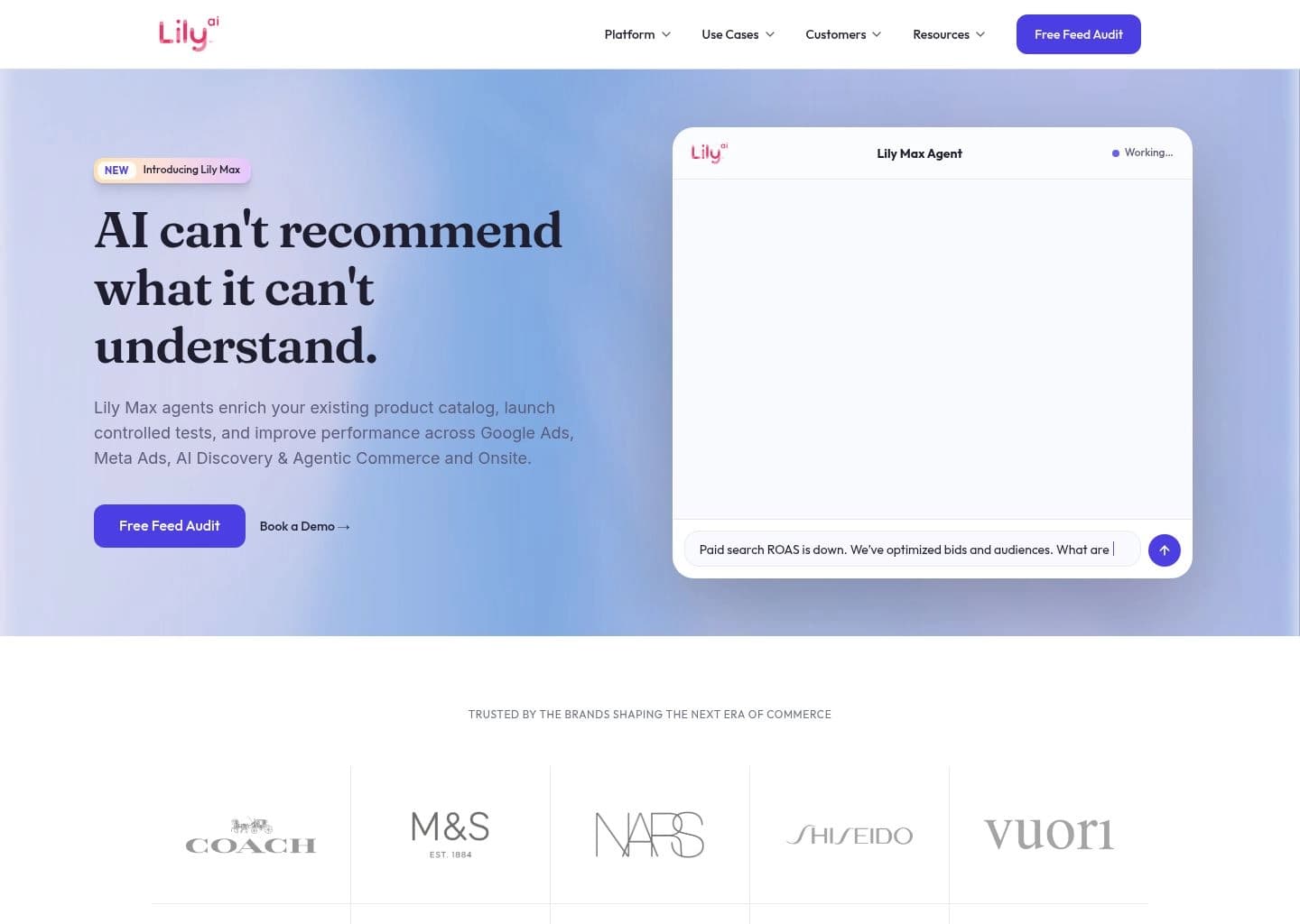
The company's core product, Lily Max, is an agentic product intelligence engine that enriches retail product catalogs with structured, AI-readable attributes — the product data layer that determines whether a product shows up in Google Shopping, Meta Advantage+ catalog ads, AI Overviews, ChatGPT shopping recommendations, Gemini, and onsite search. Lily Max uses goal-based AI agents that continuously enrich, evaluate, and republish product data across all of these surfaces simultaneously. Controlled results from real customers include +28% revenue lift on Google Shopping (matched-spend A/B test), +21.4% ROAS lift on Meta Advantage+ (cross-validated against Meta Conversion Lift Study), +28.3% onsite revenue lift from richer attributes, and a top beauty brand achieving the #1 AI-recommended makeup ranking in ChatGPT and Gemini.
Lily Max's pricing is tailored to catalog size, use cases, and markets — there is no public rate card. Use cases include Google Shopping attributes, Meta catalog copy, SEO/AEO metadata, conversational commerce attributes, item setup and classification, and consumer product copy, each scoped and priced individually. A free 30-day pilot on 500 products is available for teams that want to evaluate real lift before committing. Lily Max does not replace existing feed managers or commerce stacks — it improves the quality of product intelligence that existing tools distribute.
Key Features
- Agentic product catalog enrichment — goal-based AI agents continuously enrich, evaluate, and republish product attributes across Google Ads, Meta Ads, AI discovery, and onsite search
- Google Shopping attribute generation — five core shopping attributes per SKU tuned for feed approval and match quality, improving Performance Max and Shopping campaign reach
- Meta catalog ads copy — ad-ready catalog copy quality-checked before it ships to Meta Advantage+ catalog, retargeting, and prospecting campaigns
- SEO / AEO metadata — meta titles, descriptions, alt text, and schema markup optimized for both traditional search engines and answer engines (AI Overviews, ChatGPT, Gemini)
- Matched-spend A/B testing — every enrichment is measured against a matched-spend control group using difference-in-differences analysis with confidence intervals, so lift claims hold up to finance review
- AI Discovery & Agentic Commerce readiness — enriches product feeds and bot-facing schema so AI shopping agents can understand and recommend products; a top beauty brand reached #1 AI-recommended ranking in ChatGPT and Gemini
- Conversational commerce attributes — structured attributes that power chat and voice shopping assistants for both onsite and third-party AI commerce surfaces
- Onsite search and recommendations — richer product attributes improve search relevance and recommendation accuracy; one luxury brand saw +28.3% onsite revenue lift
Pros
- Tested, not promised — every result is measured against a matched-spend control with confidence intervals, so lift claims hold up to CFO scrutiny
- Broad surface coverage — one enrichment layer improves Google Ads, Meta Ads, AI discovery (ChatGPT, Gemini, AI Overviews), and onsite search simultaneously
- Proven enterprise results — +28% Google Shopping revenue lift, +21.4% Meta ROAS lift, +28.3% onsite revenue lift from real customer A/B tests
- 4.9/5 on G2 — the highest-rated product in its category with reviews from performance marketing and e-commerce teams
- No replatforming required — Lily Max improves data quality inside existing feed managers and commerce stacks without replacing anything
- Female-led, founder-run company — Purva Gupta named EY Entrepreneur of the Year 2024 Bay Area finalist; $63.9M raised from Canaan, NEA, Conductive Ventures
Cons
- Custom pricing only — no public rate card; teams must go through a sales/demo process to get a quote, which adds procurement friction
- Primarily a B2B enterprise SaaS platform — not suited for small DTC brands or Shopify merchants without a significant SKU catalog
- Focused on product data enrichment rather than end-to-end campaign management — teams still need existing feed managers and ad platforms
- Results depend heavily on starting catalog quality — brands with very thin or poorly structured product data may need significant data preparation before seeing lift
- No self-serve free tier — the free offering is a scoped 30-day pilot on 500 products, requiring a demo call first
- Smaller team (~34-94 employees) than enterprise martech competitors like Salesforce or Adobe — limited regional support capacity
Pricing
Lily AI uses a fully custom pricing model — there is no published rate card. Pricing is scoped around three variables: catalog size (number of SKUs), selected use cases, and number of markets or regions. Use cases that can be individually selected and priced include Google Shopping attribute generation, Meta catalog ads copy, SEO/AEO metadata, conversational commerce attributes, item setup and classification, and consumer product copy.
Cost per SKU generally improves as volume grows, since fixed setup costs spread across more items. More complex outputs (conversational descriptions) cost more per SKU than structured attribute sets. Localizing into additional markets adds processing cost on top of the base catalog price.
All plans include catalog ingestion and scoring, agentic enrichment of the highest-impact gaps, matched-spend A/B testing, and reporting with confidence intervals. Higher tiers add more channels, optimization cadence, support, and governance features. To get an exact quote, teams can use the pricing estimator on lily.ai/pricing or book a demo. A free 30-day pilot on 500 products is available — it includes catalog gap scoring and measured lift against a control before any broader commitment.
Claim Verified Creator Badge
Are you the founder of Lily AI? Display this listing's verified badge on your website to show your customers that your product has been vetted and listed on AI Central Resources.
<a href="https://www.aicentralresources.com/tool/lily-ai" target="_blank" rel="noopener">
  <img src="https://www.aicentralresources.com/badges/featured-badge-dark.svg" alt="Featured on AICentralResources" width="200" height="54" style="border: none;" />
</a>
* Place this HTML snippet in your website's footer, landing page, or press section. This creates a search-friendly backlink directly to your verification page.
Connect with Lily AI
Frequently Asked Questions
Lily Max is the agentic product intelligence engine for AI commerce. It uses goal-based AI agents to enrich your product catalog with structured, machine-readable attributes, then runs controlled matched-spend A/B tests to prove which enrichments lift revenue across Google Ads, Meta Ads, onsite search, and AI discovery surfaces like ChatGPT, Gemini, and AI Overviews.
Lily AI was founded in 2015 by Purva Gupta (CEO, formerly Eko India and UNICEF) and Sowmiya Chocka Narayanan (CTO, formerly Texas Instruments, Yahoo, Box) in Mountain View, California. The company's legal name is OneLook, Inc. It raised $63.9M across 5 funding rounds: a seed round from Unshackled Ventures, Series A, a $25M Series B (Canaan, Conductive Ventures, Sorenson, NEA) in August 2022, and a $20M Series B-1 led by Conductive Ventures in March 2024. Gupta was named an EY Entrepreneur of the Year 2024 Bay Area finalist.
Lily Max works across Google Ads (Shopping, Performance Max, Demand Gen), Meta Ads (Advantage+ catalog ads, retargeting, prospecting), AI discovery and agentic commerce (answer engines, shopping agents, AI Overviews, ChatGPT, Gemini), and onsite search and recommendations. Every surface is supported by the same underlying enriched product intelligence layer.
Pricing is tailored to catalog size, selected use cases, and number of markets or regions. Use cases include Google Shopping attributes, Meta catalog ads copy, SEO/AEO metadata, conversational commerce attributes, item setup and classification, and consumer product copy — each priced individually per SKU. There is no public rate card. Request a quote via the website or book a demo to receive a line-itemized quote in under two minutes.
Lily AI is rated 4.9/5 on G2 and is trusted by Coach, Marks & Spencer, NARS, Shiseido, Vuori, Fabletics, J.Crew, HOKA, UGG, Foot Locker, Kate Spade, Bombas, Arhaus, Drunk Elephant, Macy's, Bloomingdale's, ThredUp, Abercrombie & Fitch, and J.McLaughlin, among others.
Similar AI Tools to Lily AI
View all alternatives of Lily AI
Dynamic Yield
Mastercard's enterprise AI personalization and experimentation platform, Experience OS
Nosto
AI-powered ecommerce personalization, search, and merchandising for growing brands

Klevu
AI-powered search and product discovery that helps shoppers find what they want to buy

Algolia
The AI search and retrieval platform — agentic, generative, and instant search for 18,000+ organizations
Vue.ai
Enterprise AI orchestration — composable hubs, 30:60:90 go-live, committed outcomes
Compared with Lily AI
Direct head-to-head feature matrices, pricing breakdowns, and real-world performance benchmarks