

Cohere
Enterprise AI: private, secure, and customizable large language models
Gallery
6 items


About Cohere
Cohere is an enterprise-focused AI platform providing large language models, embedding models, and search re-ranking tools built specifically for organizations that need data privacy, private deployment, and regulatory compliance. Founded in Toronto in 2019 by Aidan Gomez, Nick Frosst, and Ivan Zhang, three researchers with roots in Geoffrey Hinton's Google Brain lab, Cohere was built on unusually strong technical pedigree: Gomez was a co-author of the original 2017 "Attention Is All You Need" paper that introduced the Transformer architecture underpinning virtually all modern large language models. The company has raised over $934 million in venture capital, reached roughly $100 million in annual recurring revenue by mid-2026, and deliberately avoided acquisition offers, with Gomez stating publicly that "acquisition is failure."
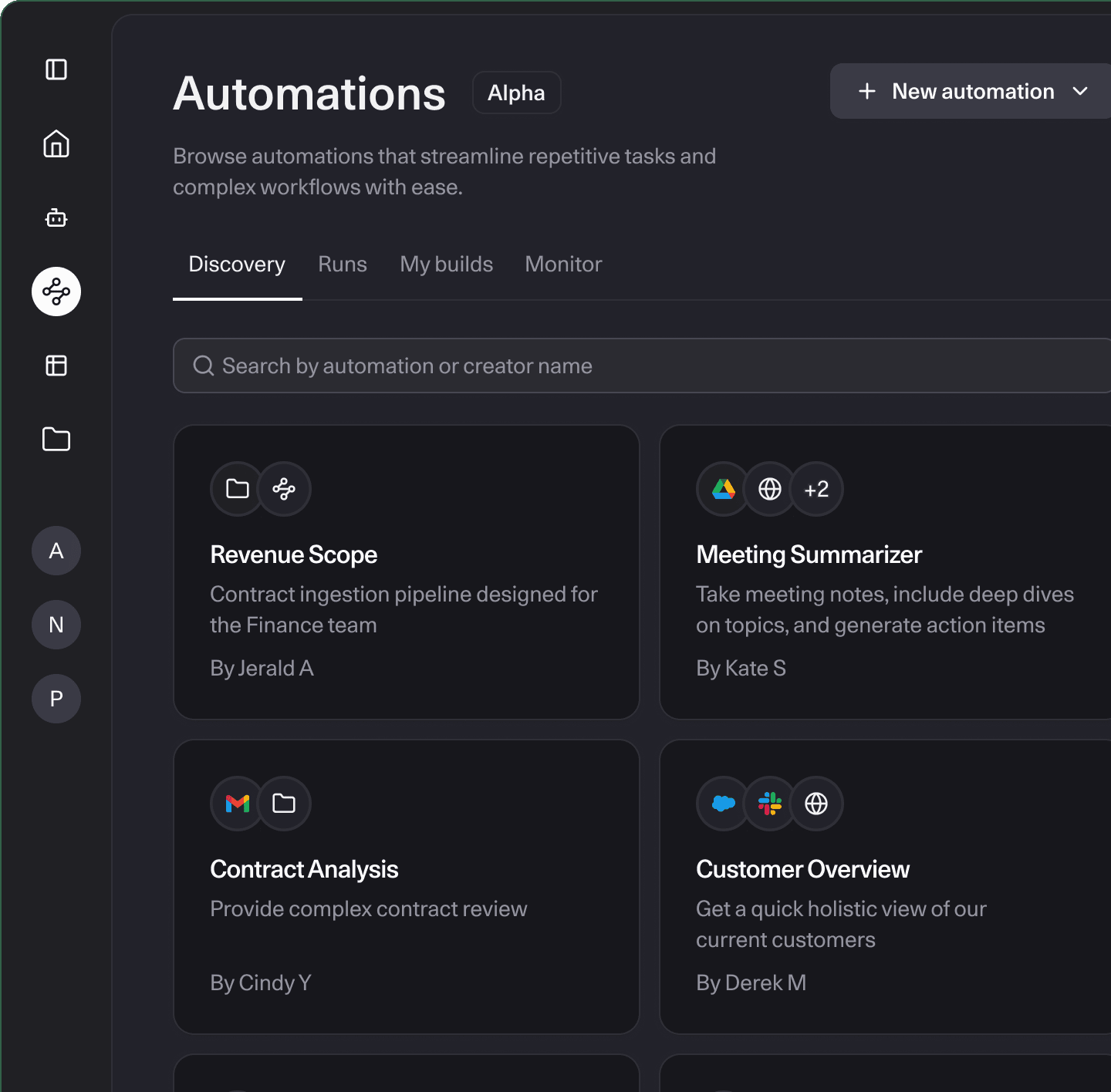
Cohere's product suite centers on three model families: Command, its generative model line built for agentic, multilingual, and tool-use tasks across 49 languages, with the flagship Command A+ released open-weight in May 2026 and marketed for "sovereign critical infrastructure"; Embed, for multimodal semantic search and document retrieval; and Rerank, which boosts search relevance by re-scoring retrieved results against user intent. These three models are designed to work together as a complete retrieval-augmented generation (RAG) pipeline, a workflow Cohere has built its enterprise reputation around since its earliest days. In 2026, Cohere also launched North, a secure enterprise AI workplace platform that connects to a company's internal tools and data to power agent-based automation, positioning Cohere beyond pure API access into a full workplace productivity layer.
What sets Cohere apart from consumer-facing competitors like OpenAI or Anthropic is its singular enterprise focus: no consumer chatbot, no free-for-all app, just infrastructure for regulated industries including financial services, healthcare, energy, manufacturing, telecommunications, and the public sector. Deployment flexibility is central to this pitch, with options spanning public cloud API access, a customer's own VPC on AWS, Azure, or Oracle, fully on-premises hardware, or Cohere's dedicated, Cohere-managed Model Vault. Customers including Oracle, Dell, RBC, Fujitsu, SAP, Salesforce, TD Bank, McKinsey, and Accenture use Cohere's models for use cases where data cannot leave a specific security perimeter.
Pricing is genuinely two-tiered: a transparent, pay-as-you-go public API for the Command R and Command R+ model generation, priced competitively against equivalent OpenAI and Anthropic offerings, alongside custom enterprise agreements for the newest Command A+ family and any private or on-premises deployment, which require contacting sales directly. This makes Cohere best suited for enterprises and regulated organizations that specifically need data sovereignty, private infrastructure, and a RAG-first approach to enterprise search and knowledge retrieval, rather than developers or startups simply looking for the highest-benchmarking general-purpose model at the lowest published price.
Key Features
- Command A+ open-weight flagship model for sovereign, critical infrastructure use cases
- Command family of models supporting 49 languages for agentic, multimodal AI
- Embed models for multimodal semantic search and retrieval
- Rerank models for boosting search relevance and precision
- North: secure enterprise AI workplace platform with agent-based automation
- Transcribe speech-to-text model supporting 14 languages
- Private deployment via VPC, on-premises, or Cohere-managed Model Vault
- Fine-tuning and customization on proprietary enterprise data
Pros
- Built by Transformer-paper co-author Aidan Gomez and team, giving unusually deep technical credibility
- Genuine enterprise-only focus means no consumer product diluting security or compliance priorities
- Flexible deployment across public API, VPC, on-premises, or a dedicated Model Vault
- Command R7B is one of the cheapest production-grade APIs available at $0.0375 per million input tokens
- North extends the platform from raw model access into a full secure AI workplace product
Cons
- Flagship model pricing (Command A+, Reasoning, Translate, Vision) is not publicly listed, requiring a sales call to get real numbers
- AWS Bedrock Provisioned Throughput for Command runs about $49.50/hour per model unit, roughly $29K/month, a steep jump from pay-as-you-go
- Command A ranks outside the top tier for raw intelligence and agentic benchmarks compared to frontier models from OpenAI and Anthropic
- No consumer-facing product means less brand visibility and community momentum than some competitors
- Best value requires committing to the full Embed-Rerank-Command pipeline rather than using Command in isolation
Pricing
Cohere runs a two-track pricing model. Its public, pay-as-you-go API charges per million tokens: Command R+ costs $2.50 (input) / $10.00 (output), Command R is $0.15/$0.60, and the economical Command R7B is $0.0375/$0.15. Embed v3 is priced at $0.10 per million input tokens, and Rerank v3 costs $2.00 per million tokens of search input processed. Command A, the newer general-purpose flagship, is priced at $2.50 input / $10.00 output per million tokens. Newer top-tier models, including Command A+, Command A Reasoning, Command A Translate, and Command A Vision, do not have public per-token pricing and require contacting Cohere sales; trial API keys for these are capped at 20 requests/minute and 1,000 calls/month. Enterprise and private deployment pricing (VPC, on-premises, or Cohere-managed Model Vault) is fully custom. On AWS Bedrock, Command Provisioned Throughput costs approximately $49.50/hour per model unit, or roughly $29,000/month, a meaningfully higher cost tier than the standard pay-as-you-go API.
Claim Verified Creator Badge
Are you the founder of Cohere? Display this listing's verified badge on your website to show your customers that your product has been vetted and listed on AI Central Resources.
<a href="https://www.aicentralresources.com/tool/cohere" target="_blank" rel="noopener">
  <img src="https://www.aicentralresources.com/badges/featured-badge-dark.svg" alt="Featured on AICentralResources" width="200" height="54" style="border: none;" />
</a>
* Place this HTML snippet in your website's footer, landing page, or press section. This creates a search-friendly backlink directly to your verification page.
Connect with Cohere
Frequently Asked Questions
Cohere is an enterprise AI platform offering large language models (Command), embedding models (Embed), and search re-ranking models (Rerank), built specifically for secure, private deployment in regulated industries like finance, healthcare, and the public sector, plus North, its AI workplace agent platform.
Cohere's public API is pay-as-you-go: Command R+ costs $2.50 per million input tokens and $10.00 per million output tokens, Command R is $0.15/$0.60, and Command R7B is $0.0375/$0.15. Embed v3 costs $0.10 per million tokens and Rerank v3 is $2.00 per million tokens. Newer flagship models like Command A+ require contacting sales for pricing.
Cohere was founded in 2019 in Toronto by Aidan Gomez (a co-author of the original Transformer architecture paper), Nick Frosst, and Ivan Zhang, all with ties to Geoffrey Hinton's Google Brain lab in Toronto. The company has raised over $934 million in venture capital.
Unlike OpenAI or Anthropic, Cohere focuses exclusively on enterprise customers rather than consumer products, emphasizing private and on-premises deployment, data sovereignty, and industry-specific solutions for sectors like financial services, healthcare, and government.
North is Cohere's enterprise AI workplace platform that connects to a company's internal tools and data to power AI agents for tasks like search, document analysis, and workflow automation, all deployable within a private, secure environment rather than a public cloud.
Similar AI Tools to Cohere
View all alternatives of Cohere



Google Gemini API
Build with Google's multimodal Gemini models via API and AI Studio

Fireworks AI
High-performance training and inference platform for open-source AI models

Groq
The fastest inference cloud for open-source LLMs, powered by custom LPU chips
Compared with Cohere
Direct head-to-head feature matrices, pricing, and category breakdowns