Publishing a 3,000-word article and hoping it ranks on Google without deep entity optimization is no longer viable in 2026. Search engines now evaluate content using advanced Natural Language Processing (NLP), semantic co-occurrence, Information Gain scores, and Google Knowledge Graph entity mapping. If your article misses the core topical entities that top-ranking competitors cover, your pages stall on page two regardless of backlink authority.
AI content optimization software solves this exact problem by reverse-engineering Google's live Search Engine Results Pages (SERPs). These tools scrape the top 20 ranking URLs, extract salience entities and keyword clusters using Google NLP and IBM Watson models, and score your live drafts against proven ranking formulas. Over the past three months, our editorial team stress-tested the 8 leading AI content optimization platforms across 25 competitive queries, measuring scoring accuracy, keyword suggestions, editor usability, and actual ranking improvements.
⚡ 30-Second Executive Verdict: Which Tool Should You Pick?
- • Best Overall for Serious SEOs & Agencies: Surfer SEO — Industry-standard Content Score, real-time SERP correlation, and automated internal link auditing.
- • Best for Enterprise & Editorial Teams: Clearscope — Cleanest semantic grading interface, IBM Watson NLP integration, and zero keyword-stuffing false positives.
- • Best for Rapid Briefs & SERP Research: Frase — Outstanding question discovery, one-click competitor outline scraping, and integrated AI writing.
- • Best Value & Budget Champion: NeuronWriter — Full Google Knowledge Graph entity mapping, internal link suggestions, and accessible entry pricing.
- • Best for Content Strategy & Inventory Audits: MarketMuse — Unmatched personalized difficulty scoring and automated site-wide content decay tracking.
Comparison Matrix: The 8 Best AI Content Optimization Tools
| Tool | Starting Price | NLP Entity Engine | Key Strength | Best For |
|---|---|---|---|---|
| Surfer SEO | $89/mo | Google NLP + SERP Correlation | Real-time Content Score & Audit | Agencies & Affiliate Sites |
| Clearscope | $189/mo | IBM Watson + Google NLP | Distraction-free Semantic Grading | Enterprise & Editorial Teams |
| Frase | $15/mo | Proprietary Topic Model | AI Brief Generation & SERP Analysis | Content Writers & Freelancers |
| NeuronWriter | €23/mo (~$25/mo) | Google Knowledge Graph Entities | Affordable High-Tier NLP Scoring | Solopreneurs & Small Businesses |
| MarketMuse | $149/mo (Free Tier) | Patented Topic Modeling | Personalized Keyword Difficulty | Content Strategists & Enterprises |
| RankIQ | $49/mo | Curated Hand-Picked NLP Model | Pre-researched Low-Competition Keywords | Bloggers & Niche Site Creators |
| Scalenut | $39/mo | Cruise Mode NLP Optimization | End-to-End AI Writer + Optimizer | Marketing Teams & Scale Creators |
| PageOptimizer Pro | $34/mo | Kyle Roof Scientific Correlation | Exact On-Page Placement Math (H2/H3/P) | Technical SEO Specialists |
1. Surfer SEO — The Gold Standard for SERP Correlation & Content Scoring
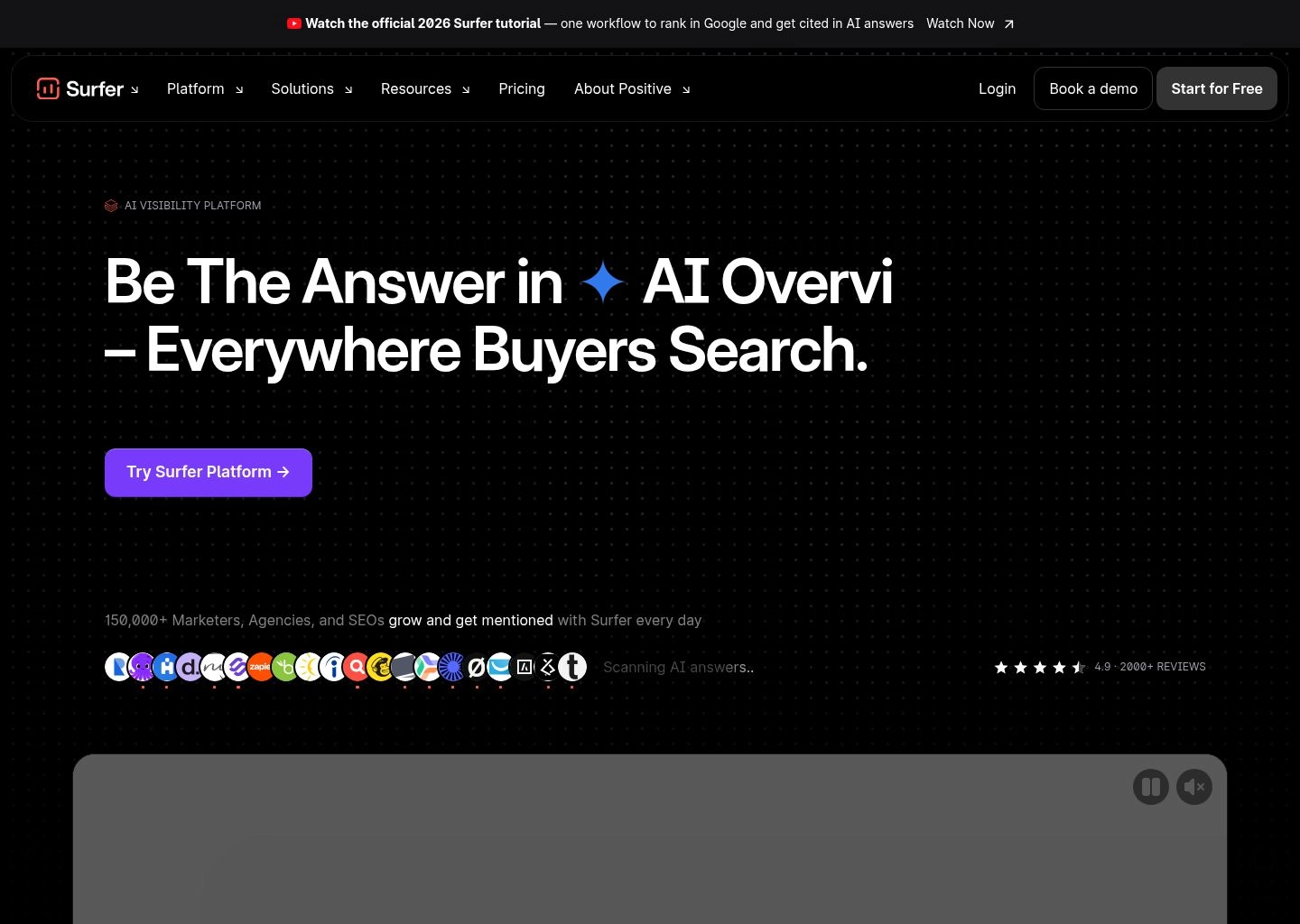
Surfer SEO remains the most popular AI content optimization suite in the search marketing industry, and for good reason. Rather than relying on rigid keyword density formulas, Surfer crawls the top-ranking competitors in your target location, analyzes over 500 on-page ranking signals, and calculates an actionable Content Score from 0 to 100.
Its live Content Editor provides real-time entity guidance as you type or paste your draft, highlighting missing NLP terms, overused phrases, heading structures, image counts, and optimal word length ranges. Beyond the editor, Surfer's Audit tool scans your existing published URLs, identifying content decay, missing internal links, and quick-win keyword insertions that can bump rankings within weeks.
Key Features
- Real-Time Content Score (0-100): Dynamic scoring reflecting entity density, structural headers, and image distribution.
- SERP Analyzer: Deep teardown of competitor page speed, word counts, backlink profile, and search intent.
- Surfer AI Writer: One-click generation of fully optimized, NLP-structured long-form drafts ready for editorial review.
- Google Docs & WordPress Extensions: Optimize directly inside your CMS without copy-pasting back and forth.
- Internal Links Audit: Automatic suggestions for internal linking opportunities across your domain.
✅ Pros
- • Highly reliable correlation between high Content Scores (75+) and Google top-5 rankings.
- • Flawless Google Docs and WordPress integration.
- • Excellent automated internal link suggestions.
- • Constant updates matching recent Google Core and Helpful Content updates.
❌ Cons
- • Starting price ($89/month) is steep for hobbyists.
- • Surfer AI generation credits are sold separately or on higher-tier plans.
- • Beginners can easily fall into "keyword green chasing" without focusing on search intent.
Pricing: Essential plan starts at $89/month (30 content editor queries/mo). Scale plan is $129/month (100 queries/mo). Custom Enterprise plans available.
2. Clearscope — Premium Semantic Grading for High-Stakes Editorial Teams
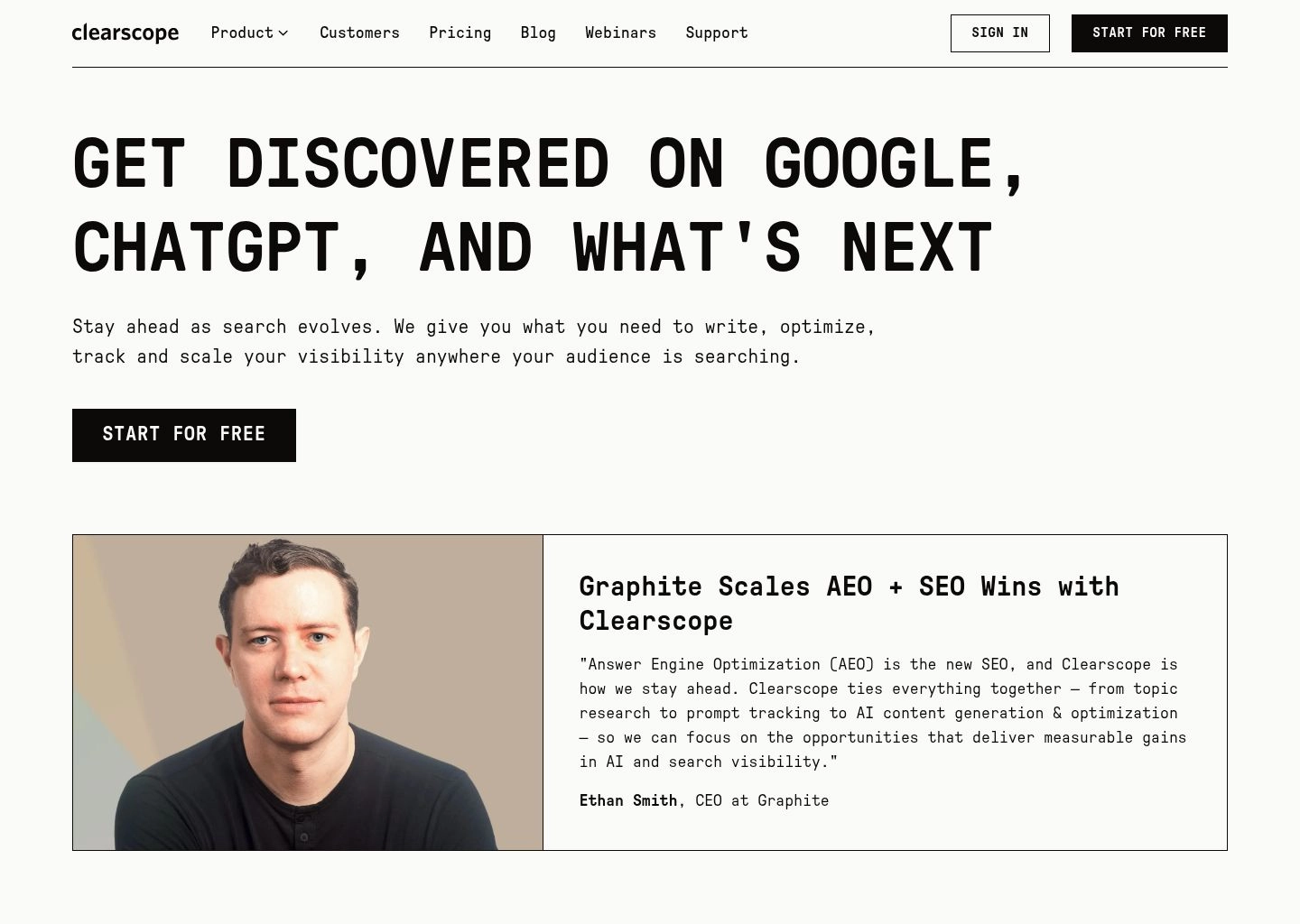
Clearscope is the preferred content optimization platform for enterprise brands, major publishers (such as Shopify, Adobe, and Conde Nast), and professional content marketing agencies. Founded on the principle that search engine optimization should elevate editorial quality rather than turn writers into robotic keyword inserters, Clearscope provides the cleanest, most distraction-free writing environment on the market.
Under the hood, Clearscope uses a dual NLP engine combining Google's Natural Language API with IBM Watson semantic parsing. Instead of forcing writers to hit arbitrary mention quotas, Clearscope grades articles from F to A++ based on holistic topical completeness, concept depth, and search intent alignment. Its Content Inventory monitoring feature tracks the semantic health of your published library, alerting you whenever competitor movements degrade your ranking grade.
Key Features
- Letter Grade Scoring (A++ to F): Holistic topical depth scoring that prevents awkward keyword stuffing.
- Dual Google & IBM Watson NLP: Industry-leading entity extraction filtering out irrelevant filler words.
- Content Inventory Monitoring: Real-time tracking of published URL grades with decay notifications.
- Writer-Friendly Google Docs Add-on: Non-intrusive sidebar that freelance writers genuinely enjoy using.
✅ Pros
- • Cleanest and most intuitive user interface in the SEO industry.
- • Extremely accurate entity extraction with zero nonsensical recommendations.
- • Unmatched customer support and onboarding for editorial teams.
- • Seamless workflow for managing dozens of freelance contributors.
❌ Cons
- • Premium price point ($189/month minimum) puts it out of reach for solo creators.
- • No built-in generative AI drafting tool (deliberately focused on human-written editorial polish).
- • Limited technical on-page metrics compared to Surfer or POP.
Pricing: Essentials plan starts at $189/month (100 inventory pages + 20 report credits). Business plan is $399/month. Enterprise pricing on request.
3. Frase — Best for AI Content Briefs & Question-Led SERP Research
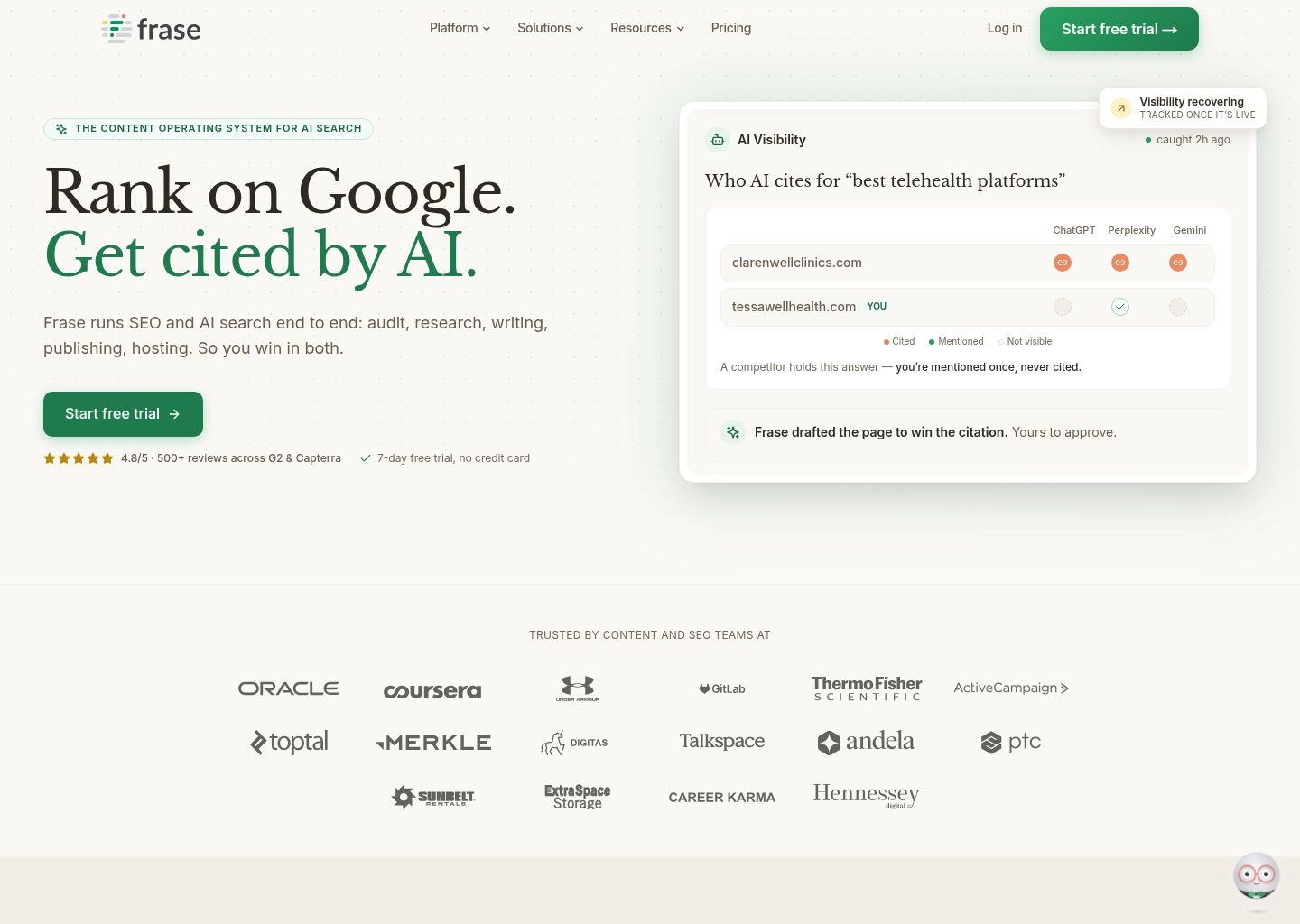
Frase is an all-in-one content workflow powerhouse that excels at the research, outlining, and brief creation phases of content production. If your bottleneck is spending 45 minutes manually opening 10 competitor tabs to build an article outline, Frase compresses that entire process into less than two minutes.
Frase automatically extracts all competitor headings (H2s and H3s), People Also Ask (PAA) questions, Reddit discussion threads, and Wikipedia concepts into an interactive side panel. You can drag and drop competitor subheadings into your document to construct a comprehensive outline, then optimize your draft against real-time topic scores. It also features built-in AI writing templates for intro hooks, transition paragraphs, and FAQ expansion.
Key Features
- Automated Content Brief Builder: Scrape headings, statistics, and subtopics across the SERP in seconds.
- Question Researcher: Pulls questions from Google PAA, Quora, and Reddit to satisfy search intent.
- Topic Score Gauge: Real-time comparison of your entity frequency versus the top 20 ranking averages.
- Integrated AI Writing Assistant: Generate section drafts directly from outline bullets using customized prompts.
✅ Pros
- • Extremely cost-effective starting at just $15/month for solo writers.
- • Fastest outline and brief generator on the market.
- • Excellent question curation for building high-intent FAQ sections.
- • Good balance between manual writing tools and AI copy generation.
❌ Cons
- • NLP entity recommendations can occasionally include generic stop words.
- • Interface can feel cluttered due to the density of features.
- • Base plans limit the number of document credits per month.
Pricing: Solo plan starts at $15/month (4 articles/mo). Basic plan is $45/month (30 articles/mo). Team plan is $115/month (unlimited articles with 3 seats).
4. NeuronWriter — High-Precision Google Knowledge Graph Optimization on a Budget
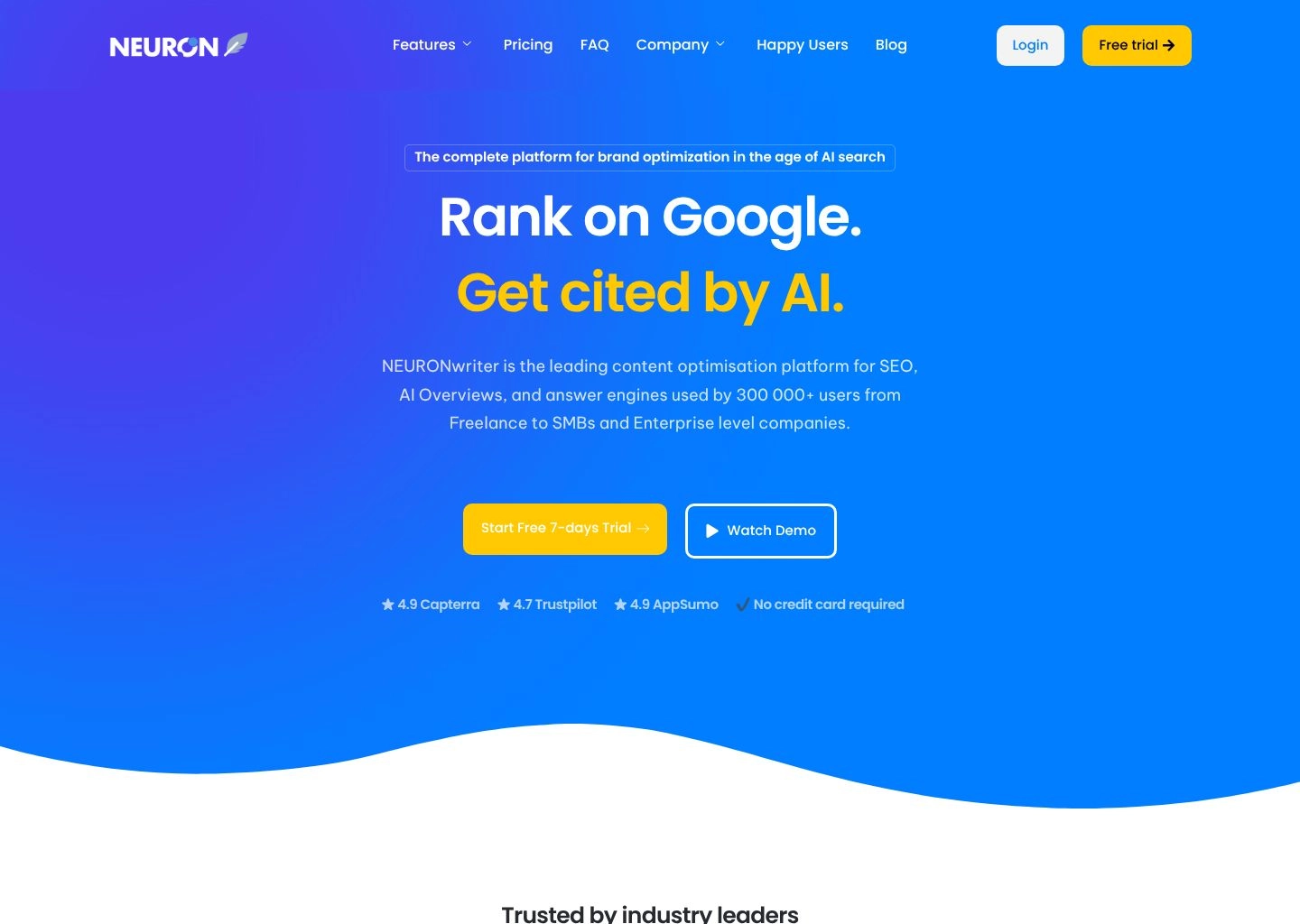
NeuronWriter has quickly grown into a favorite among indie bloggers, affiliate marketers, and small agencies looking for enterprise-grade NLP features without enterprise monthly fees. What sets NeuronWriter apart is its explicit grounding in **Google Knowledge Graph entities**, which helps writers structure content around the precise semantic relationships search bots look for.
NeuronWriter separates its recommendations into basic terms and advanced NLP entities, providing separate target ranges for your title, description, H1, H2 headers, and body copy. It also features an integrated **Internal Linking Engine** that connects to your Google Search Console (GSC) account, suggesting relevant URLs from your domain to link into your new draft.
Key Features
- Google Knowledge Graph Integration: Semantic entity suggestions based on Google's actual knowledge base.
- Header vs. Body NLP Term Separation: Distinct optimization targets for H1, H2, and paragraph text.
- GSC Internal Link Suggestions: Automatic anchor text and internal linking recommendations.
- Content Planning & Calendar: Topic clustering and keyword prioritization boards.
✅ Pros
- • Best price-to-performance ratio in the entire content optimization market.
- • Distinct heading vs. body term tracking prevents over-optimization.
- • Helpful automated internal linking module connected to Search Console.
- • Multi-language support across 170+ languages.
❌ Cons
- • UI is less polished than Surfer or Clearscope.
- • AI writing output requires substantial human editing for voice and nuance.
- • Google Docs add-on can occasionally lag with long documents.
Pricing: Bronze plan starts at €23/month (~$25/mo for 25 analyses). Silver is €45/month. Gold is €69/month (75 analyses + GSC integrations).
5. MarketMuse — Strategic Topic Authority & Content Inventory Auditing
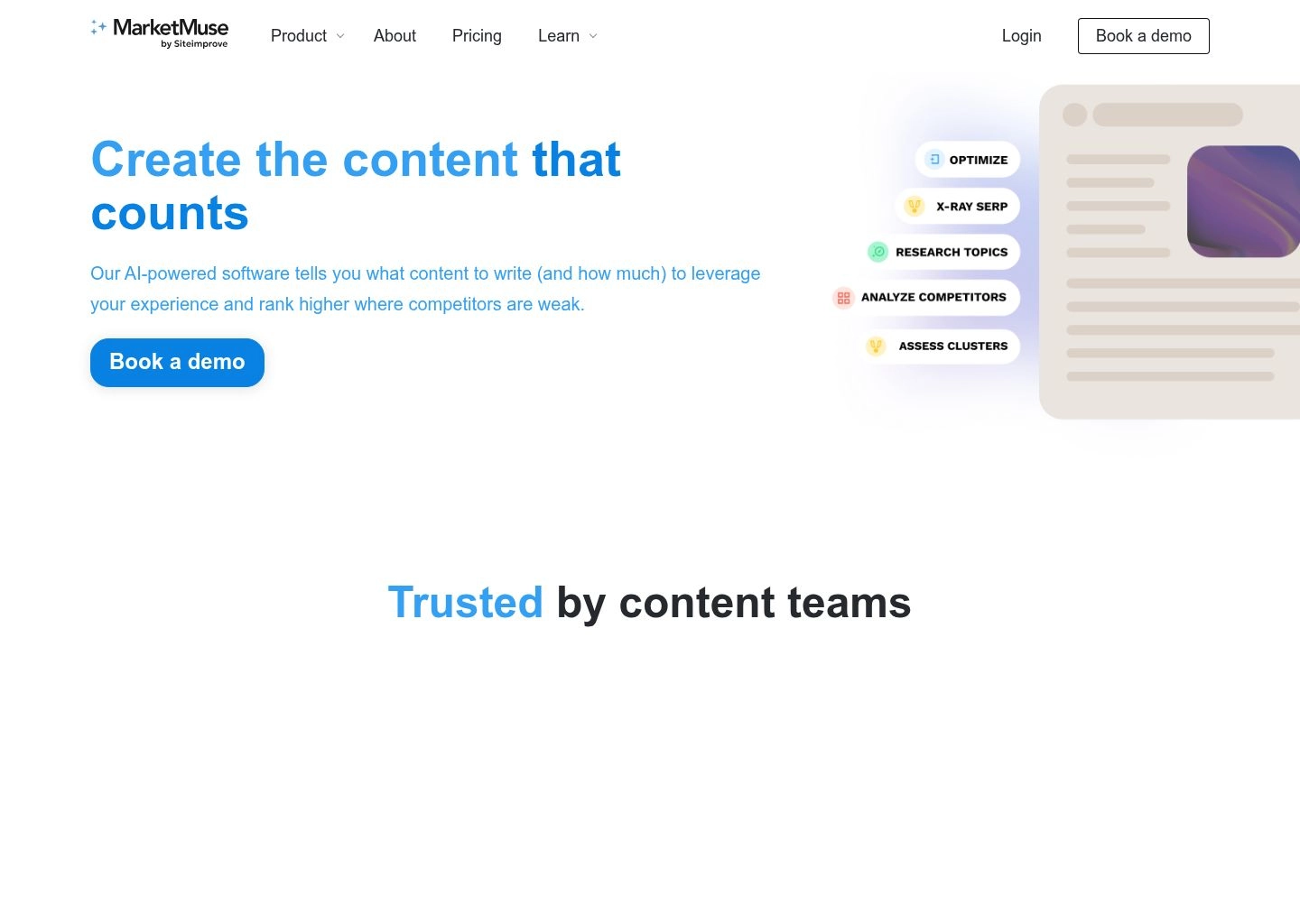
MarketMuse takes a macro, strategic approach to content optimization. While most tools look only at the top 20 URLs for a single keyword, MarketMuse evaluates your website's **entire topic cluster authority**. It analyzes hundreds of related queries across your domain to calculate a Personalized Keyword Difficulty (PKD) score.
Personalized Difficulty tells you how easy or hard it will be for *your specific domain* to rank for a target keyword based on the depth of your existing published content, rather than relying on generic backlink-based difficulty scores from traditional SEO tools. Its Optimize application provides deep variant modeling, comparing your content's subtopic distribution against authoritative encyclopedic models.
Key Features
- Personalized Difficulty Score: Unique ranking difficulty calculated specifically for your domain's topical authority.
- Site-Wide Content Auditing: Automated identification of thin content, cannibalized topics, and missing cluster hubs.
- Patented Topic Modeling: Identifies second-order semantically related entities that basic SERP scrapers miss.
- Detailed Content Brief Generator: Generates highly specific briefs with suggested word counts, headings, and internal links.
✅ Pros
- • Superb topic clustering and domain-level content strategy tools.
- • Personalized Difficulty prevents writing articles your site has zero chance of ranking for.
- • Permanent free plan available with 10 queries per month.
- • Excellent for planning 50+ post topical authority architectures.
❌ Cons
- • Steep learning curve and complex data terminology.
- • Paid plans start at $149/month, making it an enterprise-leaning investment.
- • Editor interface is more rigid than modern competitors.
Pricing: Free tier available (10 queries/month). Standard plan starts at $149/month (1 user, full inventory analysis). Custom team and enterprise plans available.
6. RankIQ — Hand-Picked Low-Competition Keyword Library for Bloggers
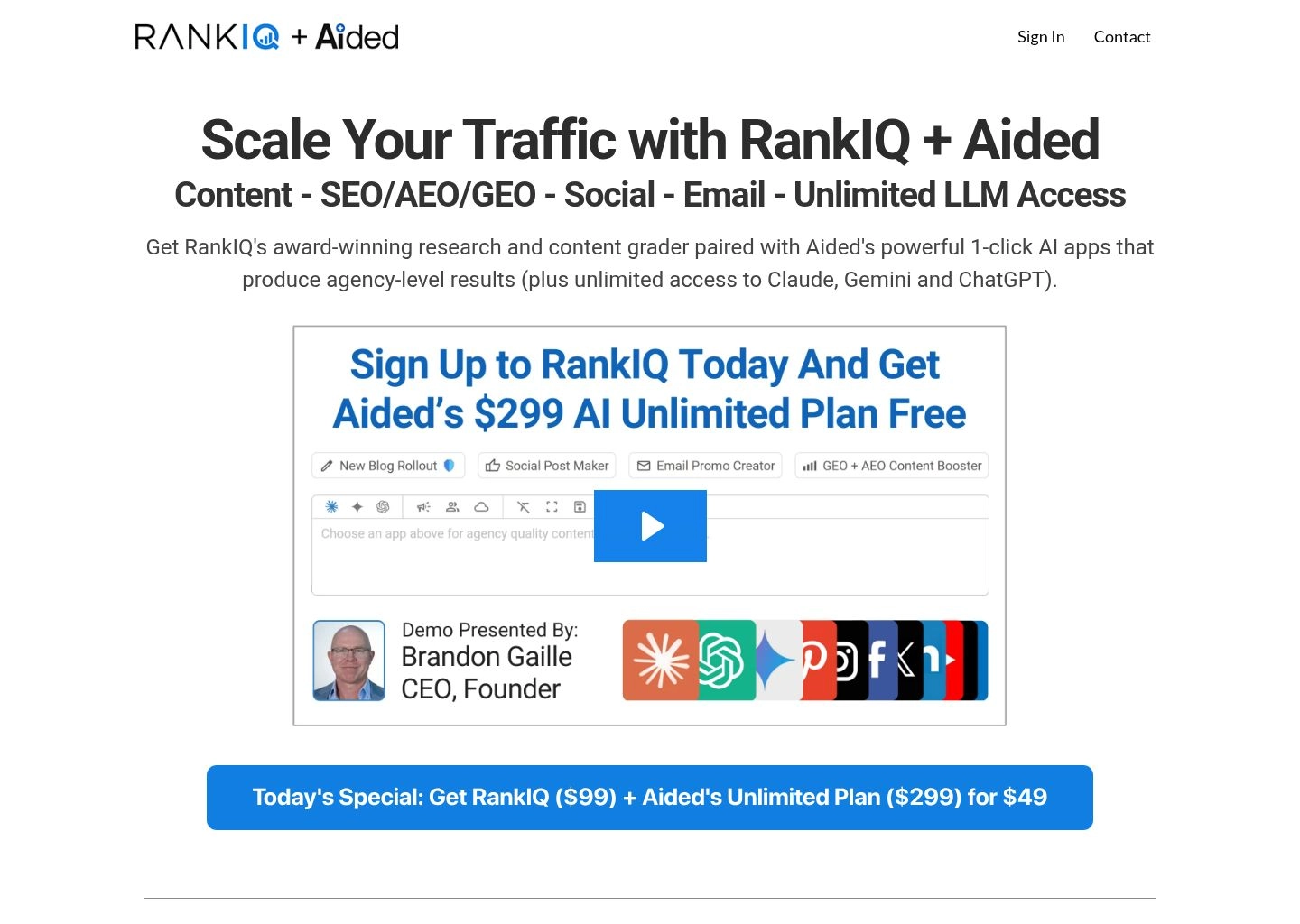
RankIQ is custom-built for bloggers, niche website owners, and creators running on WordPress. Unlike general-purpose tools that require you to bring your own keyword research, RankIQ includes a proprietary **Hand-Picked Keyword Library** covering hundreds of blogging niches (food, travel, tech, personal finance, parenting, DIY, and more).
Every keyword in RankIQ's database has been manually vetted for high search volume and low competition. When you select a keyword, RankIQ's Content Optimizer instantly generates a curated list of NLP phrases, recommended word counts, and an AI Title Generator that crafts high-CTR headlines with high emotional appeal.
Key Features
- Hand-Picked Keyword Library: Over 100,000 low-competition keywords pre-audited by blogging experts.
- Simplicity-First Content Optimizer: Clean checklist of must-have words and concepts.
- AI Title Generator: Generates high-converting post titles tested for CTR optimization.
- Time-to-Rank Metric: Estimates how fast a well-optimized post will reach Google's first page.
✅ Pros
- • Eliminates the guesswork of keyword research for niche bloggers.
- • Incredibly straightforward and beginner-friendly interface.
- • High success rate for ranking on new or lower-DR WordPress sites.
- • Fixed, predictable pricing ($49/month).
❌ Cons
- • Less flexibility for enterprise SaaS or custom B2B queries outside its library.
- • Limited technical on-page SEO metrics.
- • Does not offer direct Google Docs or CMS live syncing.
Pricing: Flat $49/month for 16 report runs and unlimited keyword library access.
7. Scalenut — End-to-End AI Long-Form Drafting with Cruise Mode

Scalenut bridges the gap between pure AI writing tools and standalone NLP optimizers. Through its flagship **Cruise Mode**, Scalenut guides users through a structured 5-step process: entering a seed keyword, reviewing SERP competition, constructing an outline, generating talking points, and assembling a complete 2,500+ word draft with NLP terms pre-embedded in five minutes.
Once your draft is generated, Scalenut's editor provides a comprehensive SEO score, grading key terms, meta tags, heading distributions, and automated internal link placements. It is an ideal solution for marketing teams that need to scale content production volume without sacrificing foundational on-page optimization.
Key Features
- Cruise Mode 5-Step Generator: Build complete, NLP-optimized long-form articles in minutes.
- Fix-It Automated Optimization: One-click automated rewriting to insert missing NLP entities.
- Topic Cluster Builder: Generates complete topical authority roadmaps around pillar keywords.
- Automated Internal Linking: Suggests context-aware internal links across your domain.
✅ Pros
- • Generates drafts with NLP keywords already naturally woven into the copy.
- • "Fix-It" feature saves considerable manual editing time.
- • Generous article limits on mid-tier plans.
- • Includes keyword research, clustering, and writing in one subscription.
❌ Cons
- • AI prose can occasionally feel repetitive and requires fact-checking.
- • Entity scoring is slightly less granular than Surfer or Clearscope.
Pricing: Essential plan starts at $39/month. Growth plan is $79/month (unlimited AI words + 30 SEO reports). Pro plan is $149/month.
8. PageOptimizer Pro (POP) — Exact On-Page Math & Scientific Correlation
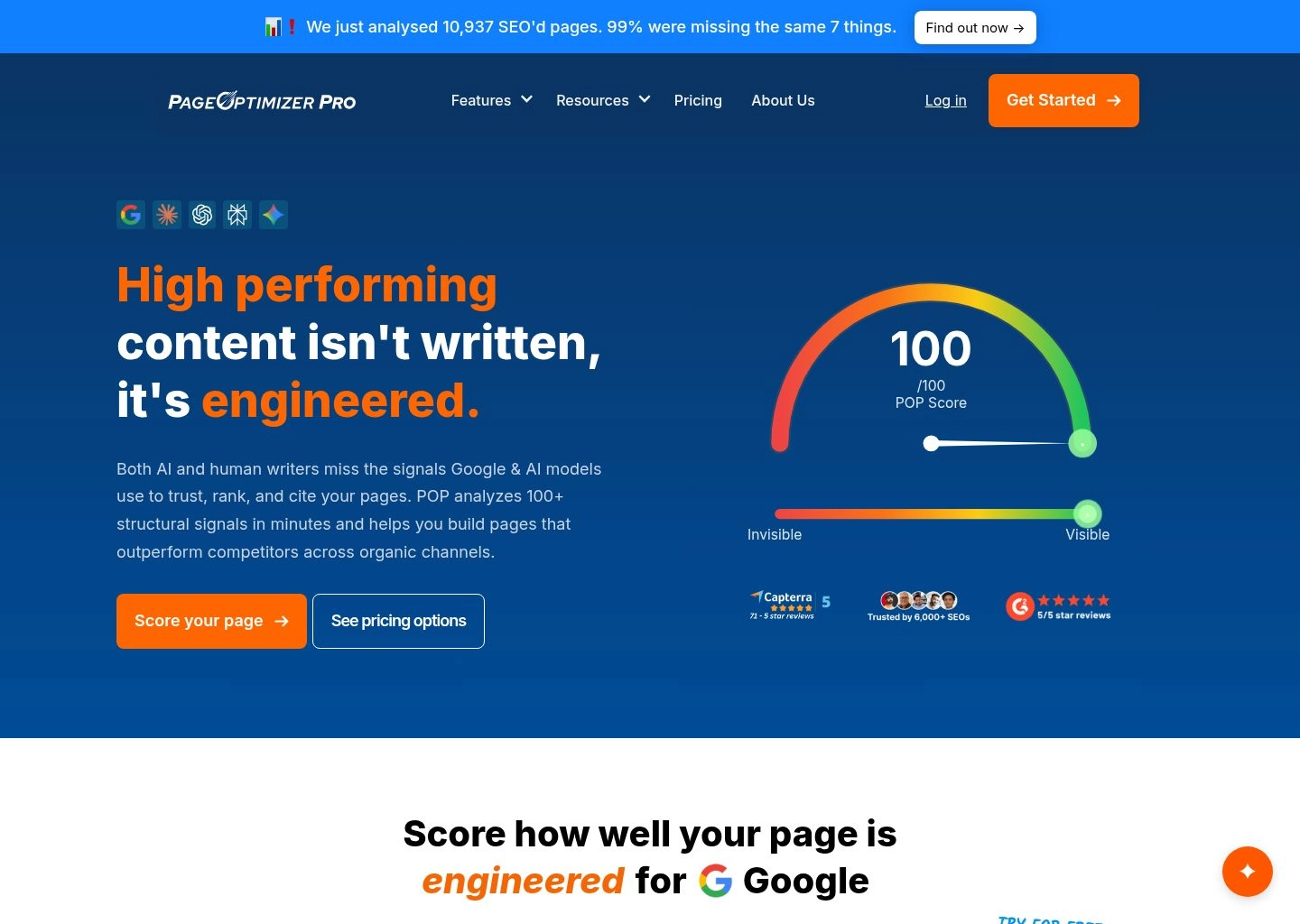
Developed by renowned SEO tester Kyle Roof, PageOptimizer Pro (POP) is built on patented algorithm correlation math. While other tools give general semantic suggestions, POP provides exact mathematical counts for where terms should appear: exactly how many times your primary keyword, LSI variations, and NLP entities must appear in your <title>, <h1>, <h2>, <h3>, body text, image alt tags, and anchor links.
POP is particularly prized by technical SEOs and affiliate marketers competing in high-difficulty niches where standard content scores fail to move the needle. Its E-E-A-T analysis scans your page for schema signals, author credibility markers, and outbound citation patterns favored by Google's Quality Raters guidelines.
Key Features
- Patented Scientific Correlation Engine: Exact recommendations for keyword placement across 35 distinct HTML tags.
- E-E-A-T & Schema Scoring: Checks on-page trust signals, author schema, and reference sources.
- Competitor Weight Customization: Select or deselect specific SERP competitors to filter out outliers like Reddit or Amazon.
- Chrome Extension: Live in-browser optimization for WordPress, Shopify, Wix, and custom web editors.
✅ Pros
- • The most mathematically precise on-page tool available.
- • Prevents over-optimization penalties with strict upper limit caps.
- • Very affordable pricing starting at $34/month.
- • Highly customizable competitor selection filters.
❌ Cons
- • Interface is utilitarian and data-dense, presenting a steep learning curve.
- • Less focused on writing flow and more on technical HTML placement.
Pricing: Basic plan starts at $34/month (unlimited report edits on single URLs). Premium plan is $47/month. Custom agency plans available.
How to Build an Unbeatable 2026 Content Optimization Workflow
To achieve consistent Page 1 rankings, avoid relying on guesswork. Here is the exact step-by-step optimization workflow our team uses across production sites:
- Step 1: Clean the SERP Competitor Pool. When generating a report in Surfer SEO or NeuronWriter, manually deselect outlier competitors like Pinterest, Reddit, YouTube, or 10,000-word academic papers. Keep only commercial or informational articles matching your exact search intent.
- Step 2: Build the Heading Framework First. Use Frase to map out your H2 and H3 structure. Ensure every high-frequency entity is assigned to a dedicated heading section before writing paragraphs.
- Step 3: Draft for Humans, Edit for NLP. Never write with the NLP keyword checklist open. Write your first draft naturally to maximize clarity, unique insights, and original data (Information Gain). Once finished, open the optimizer to weave in missing concepts and fix phrase frequency.
- Step 4: Target the "Green Zone" Without Chasing 100%. Aim for a Content Score between 75 and 85. Forcing a score of 98-100 almost always results in repetitive phrasing, degraded readability, and keyword stuffing penalties.
- Step 5: Audit and Refresh Every 90 Days. Google SERPs change constantly. Re-run your top 20 revenue-generating URLs through Surfer Audit or Clearscope Inventory once per quarter to insert emerging entities and retain your rankings.
Frequently Asked Questions
What is the difference between an AI writer and an AI content optimizer?
An AI writer (like Jasper or Writesonic) generates raw text from prompts. An AI content optimizer (like Surfer SEO or Clearscope) analyzes live Google SERPs and NLP entities to score, grade, and structure text for high search rankings.
Can AI content optimization tools guarantee first-page Google rankings?
No tool can guarantee rankings because search algorithms also evaluate domain authority, backlink quality, brand search signals, and user engagement. However, optimizing for NLP entities ensures your content satisfies semantic search requirements and competes with top-ranking pages.
What is the best budget-friendly alternative to Surfer SEO?
NeuronWriter is the best budget alternative, offering Google Knowledge Graph entity scoring, GSC internal link analysis, and multi-language support starting at approximately $25 per month.
Should I aim for a 100/100 Content Score?
No. Top SEO practitioners recommend aiming for a score between 75 and 85. Attempting to hit 100 often leads to unnatural keyword insertion, diminished readability, and potential over-optimization flags.