

Workday Adaptive Planning
AI-powered enterprise planning that connects to any ERP, HCM, or CRM
Gallery
6 items

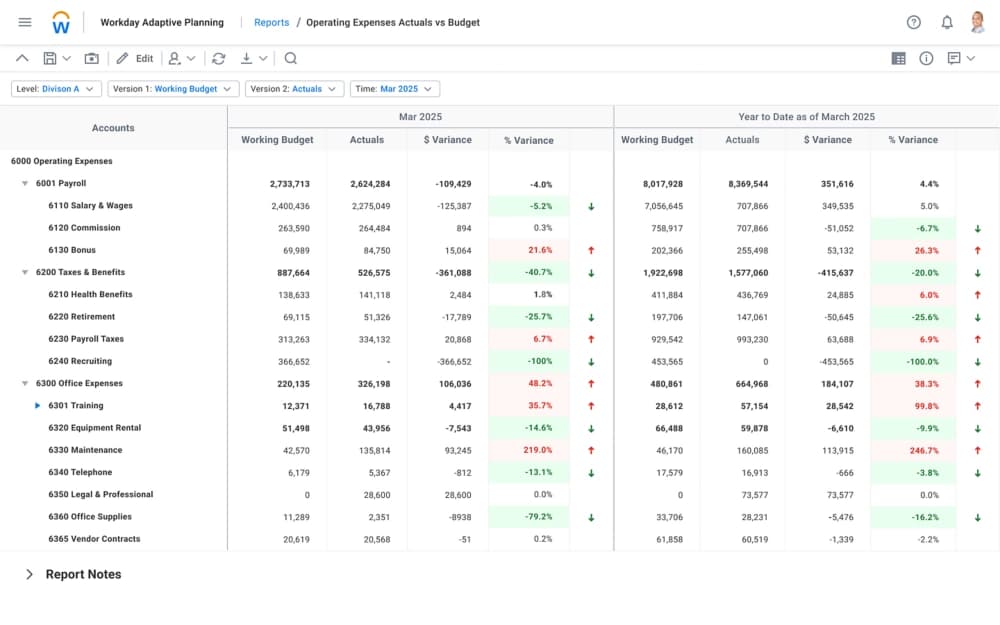
About Workday Adaptive Planning
Workday Adaptive Planning is an enterprise performance management (EPM) platform for financial, workforce, and operational planning, originally founded as Adaptive Planning in 2003 in Palo Alto, California (later renamed Adaptive Insights) before Workday acquired it for approximately $1.55 billion in 2018, just two days ahead of its planned IPO. The platform runs on Elastic Hypercube Technology (EHT), an in-memory modeling engine, and connects to any ERP, HCM, CRM, or data source through a purpose-built integration framework covering 300+ systems, without requiring any other Workday product. More than 7,000 teams at organizations including HubSpot, KeyBank, Southwest Airlines, ExxonMobil, and Mondelez use the platform, and it can be deployed standalone or alongside Workday Financial Management and Human Capital Management.
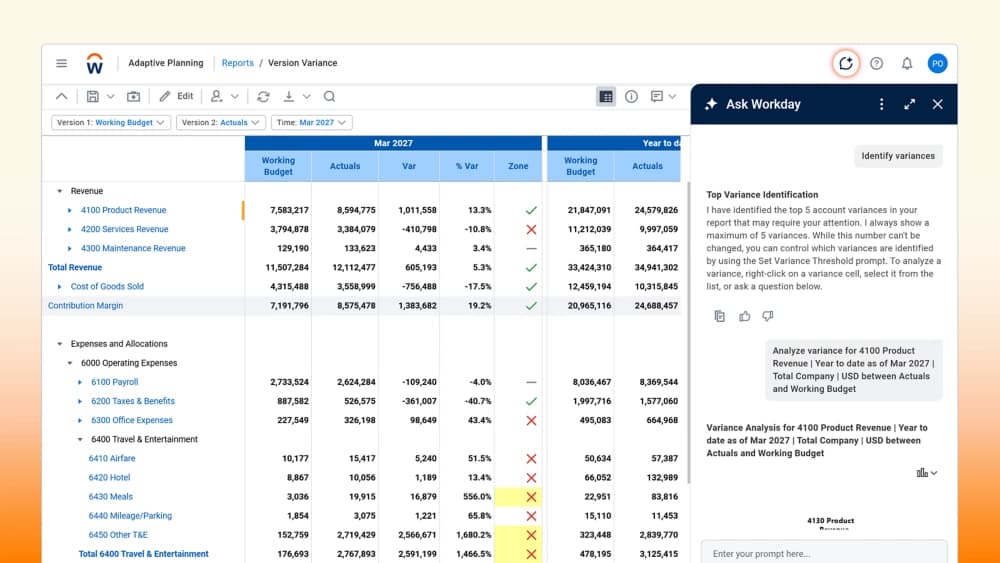
Workday's current AI push centers on the Planning Agent, an embedded conversational assistant with four role-based modes: Analyst (automated variance analysis with plain-language narrative reports and root-cause drill-down), Planner (predictive forecasts and rapid what-if scenario testing), Modeler (no-code model and formula building), and Admin (automated integrations and workflow monitoring). Workday is rolling out new Planning Agent skills throughout 2026 — including Variance Analysis, Data Exploration, Scenario Modeling, Self Service, and Agent-to-Agent interactions via a native MCP Server that lets teams securely connect external LLMs like Claude or ChatGPT directly to governed planning data. A separate Adaptive Decision Intelligence layer lets finance teams model M&A, pricing, and capacity decisions by reshaping dimensions and rewriting assumptions on the fly, then commit the winning scenario back to the core working plan. Workday emphasizes that this AI is embedded natively (no separate copilot or third-party tool to manage) and governed under ISO 42001 alignment with human-in-the-loop controls throughout.
Workday Adaptive Planning does not publish pricing; deployments are custom-quoted based on user counts, entity structure, and modules. Third-party pricing benchmarks report per-planner-user fees of roughly $300-$1,200/year across three commercial tiers (Standard, Professional, Enterprise), plus a separate annual platform fee of $30,000-$120,000 depending on entity count, with Viewer (read-only) licenses priced at around 20% of the Planner rate and a distinct Office Connect license for Excel-based access. Average deployment time is 4.5 months, and Forrester has documented a 249% three-year ROI with payback under six months for a composite $1B-revenue organization. Notably, bundling Adaptive Planning's renewal with an existing Workday HCM or Financials contract can unlock an 8-16% discount versus renewing it standalone, making renewal timing a real cost lever for existing Workday customers.
Key Features
- Planning Agent: conversational AI with role-based modes (Analyst, Planner, Modeler, Admin)
- Automated variance analysis with plain-language narrative summaries and root-cause drill-down
- Predictive Forecasting: AI-generated forecasts with built-in confidence metrics and accuracy tracking
- Adaptive Decision Intelligence for modeling M&A, pricing, and capacity scenarios across connected data sources
- Native MCP server for securely connecting external LLMs like Claude or ChatGPT to governed planning data
- Elastic Hypercube Technology (EHT): in-memory modeling engine for large-scale, complex calculations
- Purpose-built integration framework connecting to 300+ ERP, HCM, CRM, and data systems out of the box
- Financial, workforce, and operational planning unified in one connected model
- Close and consolidation automation to reduce manual, batch-based processes
- ISO 42001-aligned AI governance with human-in-the-loop controls throughout
Pros
- AI (Planning Agent) is natively embedded with no separate copilot or third-party tool to manage or migrate to
- Native MCP server lets teams work with governed planning data directly inside Claude or ChatGPT
- Proven ROI: Forrester documented 249% three-year ROI with payback under six months for a composite enterprise
- Extensive out-of-the-box integration framework (300+ systems) with no third-party connector tools required
- Backed by Workday's scale and 7,000+ enterprise customers, with strong analyst recognition (Gartner Magic Quadrant, TrustRadius Top Rated, G2)
Cons
- No published pricing; per-planner-user fees ($300-$1,200/year) plus a separate $30,000-$120,000/year platform fee make total cost opaque until a custom quote
- Implementation is a significant undertaking, averaging 4.5 months even for experienced deployment partners
- Three distinct paid user types (Planner, Viewer, Office Connect) complicate quoting and license management
- Advanced Planning Agent skills are being rolled out progressively through 2026, so full AI capability isn't uniformly available on day one
- Best value is realized when co-termed with an existing Workday HCM or Financials contract; standalone renewals lose an 8-16% bundling discount
Pricing
Workday Adaptive Planning does not publish pricing; every deployment is custom-quoted through Workday sales. Third-party pricing intelligence sources report three commercial tiers (Standard, Professional, Enterprise), each priced per Planner user per year at roughly $300-$1,200, plus a separate annual platform fee of $30,000-$120,000 that scales with entity count. Three license types are counted separately: Planner (full create/modify rights, highest cost), Viewer (read-only self-service reporting, roughly 20% of the Planner unit price), and Office Connect (Excel-based access, its own license count). A simpler industry estimate for standalone deployments cites roughly $20-40 per employee/year, with implementation costs typically equaling 100-150% of the first-year subscription fee. Co-terming the Adaptive Planning renewal with an existing Workday HCM or Financials contract can unlock an 8-16% discount versus a standalone renewal. Contact Workday sales for a quote specific to your organization's entity count and module needs.
Claim Verified Creator Badge
Are you the founder of Workday Adaptive Planning? Display this listing's verified badge on your website to show your customers that your product has been vetted and listed on AI Central Resources.
<a href="https://www.aicentralresources.com/tool/workday-adaptive-planning" target="_blank" rel="noopener">
  <img src="https://www.aicentralresources.com/badges/featured-badge-dark.svg" alt="Featured on AICentralResources" width="200" height="54" style="border: none;" />
</a>
* Place this HTML snippet in your website's footer, landing page, or press section. This creates a search-friendly backlink directly to your verification page.
Connect with Workday Adaptive Planning
Frequently Asked Questions
Workday Adaptive Planning does not publish pricing. Third-party benchmarking sources report per-planner-user fees of roughly $300-$1,200/year across Standard, Professional, and Enterprise tiers, plus a separate annual platform fee of $30,000-$120,000 depending on entity count, alongside Viewer licenses priced at about 20% of the Planner rate. Some analysts estimate a simpler $20-40 per employee/year figure for standalone deployments. Contact Workday sales for an exact quote.
The Planning Agent is an embedded AI assistant with four role-based modes — Analyst (variance analysis and narrative reports), Planner (predictive forecasts and what-if scenarios), Modeler (no-code model and formula building), and Admin (integration and workflow automation) — all driven by conversational, natural-language prompts.
Yes. Workday Adaptive Planning ships a native MCP server that lets teams securely connect external LLMs like Claude or ChatGPT to their governed planning data, keeping native access rules and data security intact while working from a preferred workspace.
Workday Adaptive Planning was originally founded as Adaptive Planning in 2003 (later renamed Adaptive Insights) and was acquired by Workday for approximately $1.55 billion in 2018, just two days before its planned IPO.
Average deployment time is 4.5 months, even for large enterprises, and the platform can be used standalone without requiring any other Workday product (HCM or Financial Management).
Similar AI Tools to Workday Adaptive Planning
View all alternatives of Workday Adaptive Planning


Mosaic
The strategic finance platform with 150+ SaaS metrics for real-time FP&A and forecasting


Limelight
Modern FP&A software that automates budgeting, forecasting, and reporting

BlackLine
The agentic financial operations platform for a faster, more trustworthy close
Compared with Workday Adaptive Planning
Direct head-to-head feature matrices, pricing, and category breakdowns